Skip to content
DevMeme
4090 of 7435
When the Intern Pushes Directly to Main
VersionControl Post #4461, on Jun 16, 2022 in TG

When the Intern Pushes Directly to Main

Why is this VersionControl meme funny?

Level 1: Promises and Perception

Imagine you’re doing your homework and you shout to your mom, “I’m almost done!” To you, that means you just have the conclusion left to write and a quick check for mistakes. But the moment your mom hears “almost done,” she calls your dad and says, “Our kid’s homework will be finished in 5 minutes, let’s go get ice cream to celebrate!” Now you’re in a panic, because actually finishing everything will take another hour.

This meme is funny for the same reason: a developer says “almost done,” thinking there’s just a bit of work left, and the boss immediately assumes it’ll be completely finished and delivered practically overnight. It’s like telling your friend you’re “right around the corner” when you’re actually still at home – and then your friend instantly orders food for both of you because they expect you at the door any moment. There’s a big disconnect between what one person meant and what the other person understood. And in that gap lies both the comedy and the frustration. We laugh because we’ve all been in that spot where someone took our optimistic “almost there” way too literally, leaving us scrambling to actually make it true.

Level 2: The Hidden To-Do List

At its core, this meme is about miscommunication in software development – particularly around deadlines and what “done” really means. Let’s break down what’s happening in a way a newer developer (or someone outside tech) can understand:

  • “It’s almost done” – the Developer’s perspective: When a developer says “almost done,” they usually mean the main coding work is finished. For example, the feature might be implemented and it works on the developer’s machine for basic cases. However, almost done does not include a bunch of other necessary steps. It’s like saying you’ve built a car engine, but haven’t attached the wheels yet – the engine alone isn’t a drivable car. In software, almost done often leaves out things like thorough testing, reviews, and deployment prep. The developer might be a bit optimistic (or trying to appease the boss) when using this phrase. This is why some teams joke about “90% done” actually meaning “90% done, 90% to go.” It’s not that developers lie, it’s that software projects have a sneaky way of hiding complexity until the end.

  • “It will be in production in 2 days” – the Stakeholder’s perspective: The stakeholder (could be a project manager, a client, or your boss – essentially anyone expecting the software) hears “almost done” and interprets it in the most optimistic way possible. To them, almost done sounds like “just wrapping up, will be finished imminently.” So they respond with, essentially, “Great, we can deliver this to users in two days!” Here, production refers to the production environment – the live system that real customers or users use. Saying something will be “in production” means it will be fully released and running in the real world. When the stakeholder says “2 days,” that’s a deadline – and a very short one! They’re basically scheduling the launch for two days from now. This creates immediate pressure on the development team, because now they’re expected to actually make the software ready and live by that date.

Now, why is that a problem? Because of all the things that “almost done” was silently skipping over. Let’s list out a few important tasks typically left after a developer first says a feature is almost finished:

  • Integration Tests: These are tests where you check that your new code works with other parts of the system. Maybe the feature works by itself, but does it play nicely with the database, or other services? Integration testing might reveal bugs that didn’t show up in isolated development. For example, if you added a new login method, you need to ensure it integrates with the user database and the analytics system correctly. Writing and running these tests takes time. If these aren’t done yet, the software isn’t truly ready.

  • Security Review: This could involve using tools or having a security team review the code to ensure there are no vulnerabilities or compliance issues. In many companies, especially those in regulated industries, you can’t deploy to production without a sign-off from security. Think of it like a safety inspector checking a building before it opens – you don’t want to find out later that there’s a security hole. If the developer hasn’t done this yet, saying “almost done” was premature. Security issues can be subtle: for example, maybe the new feature works, but it inadvertently exposes some user data if misused. A security review would catch that. Fixing any issues it finds could add days or weeks.

  • Infrastructure & Terraform Changes: Terraform is a tool used by developers to manage and configure the infrastructure (like servers, databases, networks) using code. If the meme mentions “an unchanged Terraform plan still targeting staging,” it means that the configurations that set up servers are currently set for the staging environment, not production. Staging is a test environment that mimics production – it’s where you deploy the app to test it in an environment similar to the real world, but without affecting real users. If the Terraform plan is still pointing to staging, then new servers or settings for production haven’t been prepared. In simpler terms: the path to deploy this new feature to real users hasn’t been set up yet. Changing that plan to point to production can involve careful steps – you have to ensure that when you flip those configurations, you don’t break existing stuff. It might involve creating new cloud resources, updating environment variables, or ensuring the production database is ready for this feature. All that is extra work.

These are just a few examples, but they illustrate a pattern: between “almost done” and “in production,” there’s a significant gap. A developer might still need to perform code review (having another developer look at their code for mistakes or improvements), fix any bugs found during testing, write documentation or release notes, and coordinate deployment (sometimes you can’t just deploy anytime; there are change windows, or you need DevOps support).

For a junior developer or someone new, it might be surprising how much happens after the coding seems “complete.” When you’re learning to code, “done” often means “it works on my machine with sample input.” In a professional setting, “done” means “this code is delivered to all users safely and works in all expected scenarios.” The meme is funny (and painful) because it highlights what happens when these two definitions collide. The developer probably meant the former, while the stakeholder assumed the latter.

Let’s consider a common scenario: A team is near the end of a sprint (a 2-week development cycle in Agile/Scrum methodology). In the sprint review meeting, the developer demoed a new feature and said it’s “almost done,” implying just a few minor tasks remain. The product manager or client, hearing that, might say, “Fantastic, so we can release it by the day after tomorrow, right?” Now the developer is in a tough spot – either correct the expectation (and maybe disappoint them) or try to rush all those remaining tasks into two days. UnrealisticDeadlines like “prod in 2 days” often come from this kind of optimistic miscommunication.

Why do developers even say “almost done” if there’s so much left? Sometimes it’s StakeholderPressure – they don’t want to look slow or disappoint the stakeholder, so they highlight the positive (core coding is done) and downplay the rest. Other times, developers themselves might underestimate the remaining work (this is known as the planning fallacy – even experts tend to underestimate how long tasks will take). It’s also a bit of corporate politeness; saying “almost done” sounds better than “we are far from done” in a status meeting.

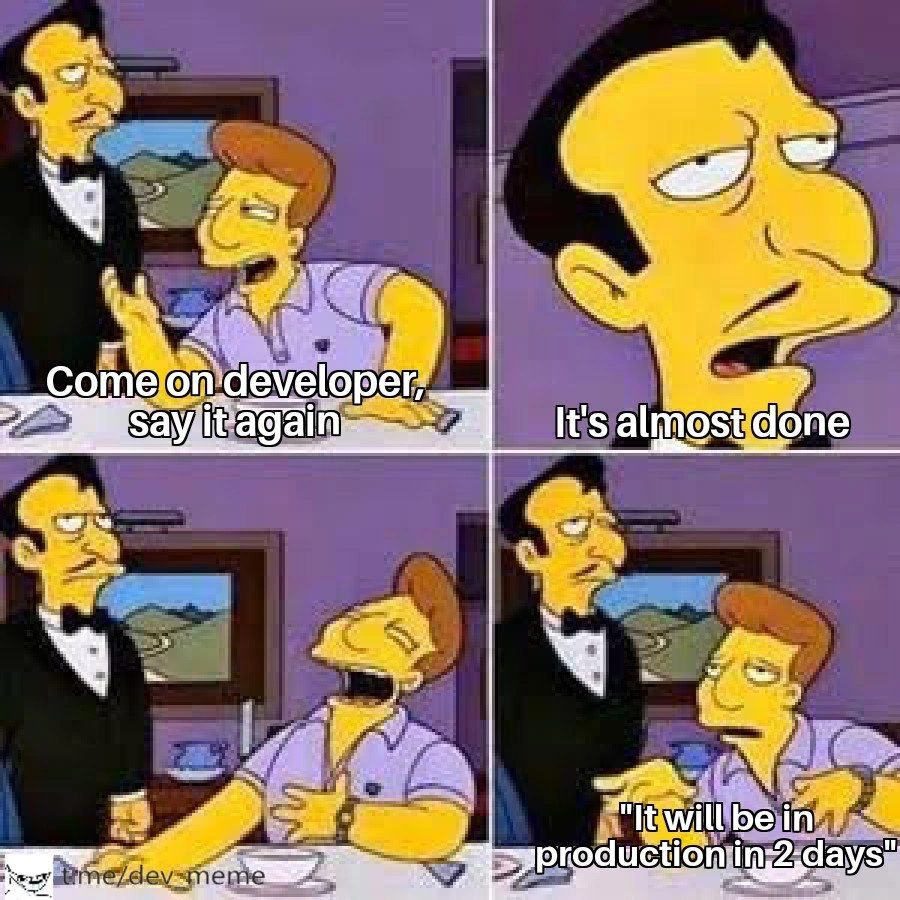
The meme uses the Simpsons characters to amplify the humor:

  • The waiter in a tux prompting “Come on developer, say it again” represents that persistent manager or client who loves to hear good news. It’s like they’re addicted to optimistic updates, even if they know it’s a bit of a ritual or even a lie. This is the stakeholder egging the dev on to repeat the sweet words “almost done.”
  • The close-up of the mob boss with droopy eyelids saying “It’s almost done” represents the developer reluctantly giving the update. The droopy, tired eyes might symbolize the developer’s own lack of enthusiasm or energy – perhaps he’s said this phrase a hundred times before and knows what’s coming. The developer character looks a bit unexcited, almost like he knows this is a farce.
  • The next panel with the man clutching his chest in laughter – that’s the stakeholder (or maybe fellow developers) laughing because “It’s almost done” is such a classic line. They’ve heard it too often to take it seriously. In many workplaces, whenever someone says “almost done,” people who know the game might chuckle or roll their eyes, since they expect delays.
  • The final panel where the man (now serious) says “It will be in production in 2 days” represents the stakeholder turning that optimism into a concrete demand. The sudden transition from laughter to a straight face delivering the deadline is what makes it absurd and funny. It’s like, “Ha ha, I know you always say that… but actually I’m going to act on it this time and hold you to it – prod in 2 days.” It’s both funny and scary for the dev.

In summary, this meme is highlighting a common newbie trap and a frustrating experience for veterans alike: miscommunication about how close to done a project truly is. It’s a lighthearted reminder to:

  • Be cautious when saying “almost done” – consider everything that “done” really involves.
  • Understand that stakeholders might not know all the technical steps remaining; they might take your words at face value.
  • Realize why experienced developers are a bit cynical about optimistic timelines (they’ve been burned by them before).

For someone newer to development: if you ever find yourself saying “it’s almost ready,” make sure you’ve accounted for those last steps (testing, reviews, deployment). And if someone tells you, “Great, then we’ll launch immediately,” don’t be afraid to clarify what’s actually left to do. It’s better than being stuck in a crunch trying to achieve the impossible. The humor of this meme lies in the shared understanding of that scenario – we laugh because we’ve either done it, seen it, or suffered from it!

Level 3: Two-Day Deploy Delusion

The meme lampoons that classic developer vs stakeholder miscommunication: a dev casually says “It’s almost done” and a second later the boss is announcing “It will be in production in 2 days.” Seasoned engineers immediately cringe because we’ve all witnessed this comedic tragedy. In the developer’s mind, “almost done” means the core feature is coded and maybe passes some unit tests, but there’s ahidden iceberg of work remaining (integration tests, security audits, environment configuration – you name it). However, to an eager stakeholder, those magic words sound like “practically shippable, just polish it up”. It’s a textbook example of DeadlinePressure meeting technical reality.

This four-panel Simpsons-style meme nails the CorporateCulture of overly optimistic delivery promises. The top panels show a smug stakeholder egging the developer on: “Come on developer, say it again.” The dev obliges with a sleepy-eyed “It’s almost done.” Cue explosive laughter – because both know that phrase is a running joke. In real life, “almost done” is often developer-speak for “I think I solved the hardest part, but there’s still a backlog of tasks before we’re truly done-done.” Those tasks are the unglamorous grunt work: writing integration tests to verify everything works together, getting a security review (so you don’t deploy a vulnerability-laden app), and updating the Terraform config that’s – whoops – still pointing to the staging environment. None of that is finished, but the dev’s trying to project confidence.

Then comes the punchline (bottom panels): after laughing it off, the stakeholder collects himself and says, “It will be in production in 2 days.” This is where the StakeholderExpectations rocket to absurd heights. Two days?! Every developer’s eyebrow just twitched. We know that deploying to Production isn’t as simple as merging to main and clicking a button. If the Terraform plan hasn’t been changed from staging, deploying in 2 days means you’d have to scramble to provision new infrastructure or update configurations overnight. Integration tests likely haven’t run on a production-like environment – any number of things could fail when you finally connect all the moving parts. And a security review might turn up a show-stopper that absolutely cannot be fixed in 48 hours. In other words, “almost done” was a hopeful status, but suddenly the team is staring down a UnrealisticDeadline.

This humorous exaggeration strikes a nerve because it’s DeveloperFrustration 101. Maybe the project demo is Friday, maybe a client is pressuring for a release – whatever the reason, management hears “almost done” and assumes “we can ship by end of week.” The veteran engineers in the room have that silent headshake: they’ve survived enough ReleasePressure to know that if you push to prod in two days with so many loose ends, you’re courting disaster. It’s the kind of optimistic timeline that leads to last-minute on-call nightmares (ever spent a Friday night fixing a “quick” release that broke everything?). There’s an unwritten shared understanding: never trust “almost done.” In fact, there’s an old joke that the first 90% of the project takes 90% of the time, and the last 10% takes another 90%. Here the boss blithely assumes that last chunk will be trivial – a two-day sprint – but every experienced dev knows that’s a delusion.

Why is this so funny (or painful)? Because it’s true. The meme captures that familiar moment of StakeholderPressure: the dev gives a positive update (maybe to stop the constant “Is it done yet?” questions), and the stakeholder pounces to claim a delivery date. The laughter in the meme is practically schadenfreude. The characters laugh because deep down they recognize the absurdity – they’ve seen this play out. It’s a morbid laugh, because everyone in engineering has learned the hard way that “almost done” != “actually done.” The code might function on a developer’s machine, but “ProductionReadyCode” demands far more rigor.

The inclusion of the Simpsons mob boss character (Fat Tony, if you’re a fan) adds an extra layer of dark humor. He’s often used in memes to represent a cynical authority figure. Here he’s the stakeholder/boss who finds the dev’s optimism hilarious at first – then immediately turns it into a hard commitment (likely to the dev’s horror). It’s a “laugh, then threaten” energy that any developer under a tough manager can recognize. Essentially, the dev’s hopeful almost_done_lie (or let’s say optimistic fudge) magically becomes a concrete two_day_production_promise. The speed of that transition – from casual assurance to immovable deadline – is what elicits the face-palm from any developer viewing this meme. It highlights a scope_vs_time_reality gap: there’s so much left to do, but the calendar doesn’t care.

In agile terms, this is a failure to communicate the Definition of Done. If “done” meant “code complete but not tested or deployed,” the stakeholder should know it’s not ready for release yet. But oftentimes non-technical stakeholders don’t grasp those nuances, or they choose not to – they just want the feature now. Corporate culture can sometimes reward saying “we’re almost there” even when TechnicalDebt and tasks are piling up, because nobody wants to be the bearer of delays. The meme nails that ritualistic optimism and how it backfires. ReleasePressure and StakeholderPressure turn a cautious “almost done” into a definitive “goes live on Friday.” As developers, we laugh (and groan) because we’ve either made that mistake ourselves – giving in to pressure and over-promising – or we’ve been the poor soul coding like mad, late into the night, because someone else did.

In short, this meme resonates on multiple levels: it’s poking fun at management_pressure_meme dynamics and the universal scheduling farce in software projects. It reminds us of the eternal truth: Until it’s actually in prod and working, it ain’t done. And if someone tries to compress that last mile into two days, well... get ready for a deployment rollercoaster. “Almost done” in dev speak is a fragile thing – treat it as a joke, and you might end up the punchline.

// Pseudo-code illustrating the meme's logic (or lack thereof)
function developerStatusUpdate(status) {
  if (status === "almost done") {
    // Manager assumes this means immediate release
    scheduleProductionDeploy(Date.now() + 2 * 24*60*60*1000);  // +2 days
  }
}
developerStatusUpdate("almost done");
// Stakeholder has now magically booked the release for 2 days from now

Above is the kind of tongue-in-cheek pseudocode that sums it up: the moment status is "almost done", some manager’s script auto-schedules the prod release for 2 days later. It’s an exaggeration, but not by much! We’ve all seen how one optimistic report can set unrealistic expectations in stone. The humor is dark because it’s accurate – behind every “It’ll be live in 2 days” promise, there’s a developer internally screaming, “That’s not what I meant!”

Description

This meme features a picture of a nuclear explosion, with the caption: 'When you find out the intern's first commit was a force push to the main branch.' This meme uses hyperbole to humorously express the sheer panic and terror that a senior engineer feels when a junior or intern makes a catastrophic mistake in version control, like force-pushing to the main branch, potentially wiping out the work of the entire team. For senior engineers, it’s a funny, if slightly terrifying, reminder of the importance of branch protection, proper onboarding, and the ever-present danger of a single, ill-advised Git command

Comments

8
Anonymous ★ Top Pick We don't need branch protection; we have a culture of trust. Also, our resume-generating event is scheduled for next Tuesday
  1. Anonymous ★ Top Pick

    We don't need branch protection; we have a culture of trust. Also, our resume-generating event is scheduled for next Tuesday

  2. Anonymous

    Translating “it’s almost done” into ISO-8601 duration yields P∞D - yet product still books the launch webinar

  3. Anonymous

    After 20 years in the industry, I've learned that 'almost done' is actually a logarithmic function approaching completion asymptotically - we get infinitely closer but never quite reach it, especially when the PM is watching

  4. Anonymous

    Every senior engineer knows 'almost done' is the most dangerous phrase in software development - it's the Schrödinger's cat of project status: simultaneously 10% complete and 90% complete until a manager forces you to collapse the wavefunction into a specific date. The real tragedy here isn't the intimidation; it's that after 15+ years, we all know that '2 days' estimate will somehow expand into 2 weeks once you account for the edge cases you forgot, the API that's down, the dependency that needs updating, the code review cycle, the staging environment that's broken, and the inevitable 'one small change' request that arrives 10 minutes before deployment

  5. Anonymous

    “It’ll be in prod in 2 days” usually means the diff is ready; now we just need QA, perf and security gates, data migration, feature‑flag rollout, CAB approval, comms, runbooks, and a rollback - so, two fiscal quarters

  6. Anonymous

    '2 days to prod' - spot-on for prototypes, but add distributed tracing and it becomes the half-life of a feature flag

  7. Anonymous

    Senior translation: “almost done” means the happy path runs locally; “two days to prod” means after code review, perf tests, CAB, security, data migration, and a change window - aka next quarter

  8. @VladislavSmolyanoy 4y

    HAHAHAHA

Use J and K for navigation