Skip to content
DevMeme
4088 of 7435
Mom says I'm useful; I deploy an identity function to prove it
CodeQuality Post #4458, on Jun 15, 2022 in TG

Mom says I'm useful; I deploy an identity function to prove it

Why is this CodeQuality meme funny?

Level 1: Look, I Did Something!

Imagine your mom tells you, “You’re not useless; you can be helpful.” To prove her right, you take something she just handed you and then immediately hand it right back to her without changing anything. Then you grin and say, “See, I helped!” 😇 It sounds silly, doesn’t it? You technically did take an action, but you didn’t actually improve or change anything. This meme is joking about that exact kind of situation, but with computer code. The developer’s mom says he isn’t useless, so the developer writes a super simple piece of code that gives back whatever you put into it — basically doing nothing new — and presents it as evidence of being useful. It’s like a child proudly showing a parent an empty drawing and saying “Look what I made!” The humor comes from that playful, ironic twist: the mom is trying to be supportive, and the kid (in this case a grown-up programmer) responds in a way that actually proves the opposite point in a joking manner. Even if you don’t know coding, you can understand the feeling. It’s funny because we all know handing something back unchanged isn’t real help, just like a function that changes nothing isn’t doing much. The meme makes us laugh by capturing that childlike attempt to appear helpful while actually doing almost nothing at all.

Level 2: Echo Service Vibes

Let’s break down what’s happening in simpler terms. The meme’s code snippet is written in Python, and it defines what’s called an identity function. That means the function simply gives you back exactly what you give it. In the image, we see:

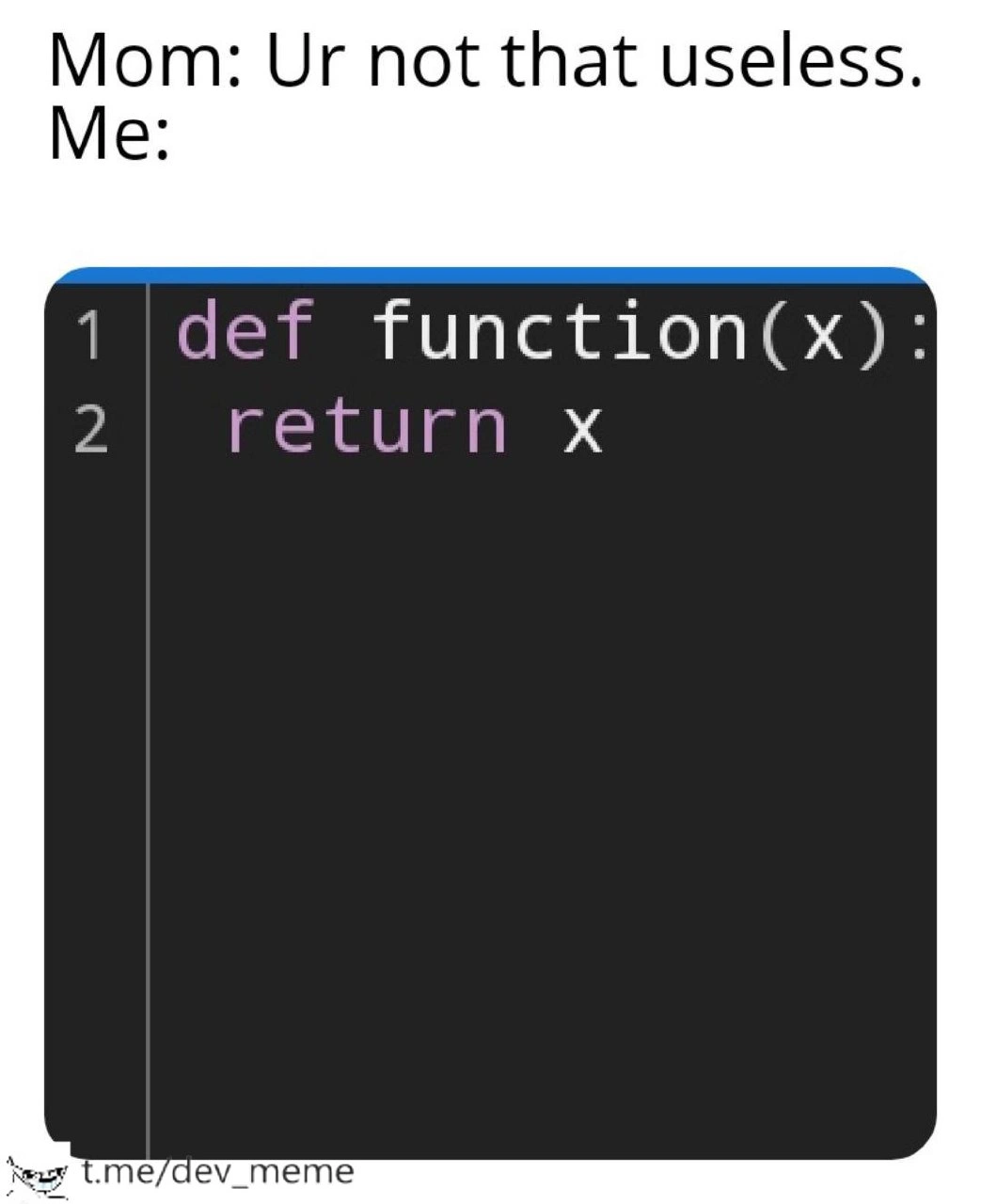
def function(x):
    return x

Here, def starts a function definition named function that takes one parameter x. Inside the function, the line return x sends the input value x right back out as the result. So if you called function(5), it would return 5. If you called function("hello"), it would give you "hello" straight back. The function doesn’t alter x at all – no calculations, no changes, nothing. It’s like a copy machine that just hands you back the original without making any copies. In programmer lingo, this is often jokingly referred to as a “no-op” (short for “no operation”), because it effectively performs no operation on the input. It’s also comparable to an echo – think of shouting into a canyon and hearing your own voice come back. An echo service in computing is a server that simply returns whatever message you send it, and that’s exactly the vibe here: whatever data goes in comes out the same way, echoed back.

Now, why is this funny in a developer meme? The text at the top says, “Mom: You’re not that useless.” and then “Me:” followed by this trivial code. The humor is that the developer is “proving” they aren’t useless by showing off a function that by all practical measures is useless code. It’s a form of self-deprecating humor – the coder is making fun of themselves. Most programmers learn early on that good CodeQuality means writing functions that actually do something: solve a problem, transform data, produce a result. A function that simply returns the input is so simple that usually you wouldn’t bother writing it at all, unless you had a very specific reason (for example, sometimes as a placeholder or default behavior in more complex systems). In fact, if a colleague wrote this and submitted it in a real code review, the reviewer might ask, “Do we actually need this function? Can we not just use the value x directly?” It adds no new value, and maintaining code that doesn’t do anything can be confusing to others.

For a new developer or someone learning Python, writing def function(x): return x might be a quick exercise to understand how functions work. It’s often one of the first examples of a function: give it something, and it gives it back – not very useful, but it shows the syntax. However, in a production codebase, you typically expect functions to implement some logic. That’s why this meme is funny to insiders: the relatable developer experience here is feeling like you coded all day or built something, but in the end it’s as if you achieved nothing. A lot of developers have had days where a bug fix turned out to be a one-liner or an entire task was basically writing a trivial function. It can make you wonder, “Did I really do anything worthwhile?” This meme puts that feeling into a joke format. The mom in the meme represents someone giving encouragement (“you’re not useless”), and the me (the developer) responds with a cheeky example that ironically doesn’t exactly scream “useful.”

Let’s also clarify the context: the image looks like a screenshot of a code editor (likely Visual Studio Code from the styling). The black background, line numbers on the side, and colored text are typical of a programmer’s workspace. It reinforces that this is code written by the meme’s author. The function is even generically named function, which is humorous in itself because it’s so non-descriptive – it’s like naming a pet cat “Cat”. Everything about this code snippet says, “this is as minimal and generic as it gets.” And that’s the joke. The developer is effectively saying: “See, I contribute at work – I wrote a function!” while slyly acknowledging that the function doesn’t actually do anything. It’s a bit like a student proudly turning in an assignment that just re-states the question as the answer.

In summary, at this level we understand that the meme is a programmer joking about feeling useless by showcasing a piece of trivial code. It resonates with people who write code, especially in Python, because it’s poking fun at ourselves. We find it funny and relatable because many of us have had moments of doubt about the value of our work. But instead of getting upset, the meme turns it into a lighthearted joke: “I may feel useless, but hey, I can still write an identity function like a pro!” It’s a bit of programmer inside humor mixing coding with everyday feelings of usefulness.

Level 3: No-Op as a Service

At first glance, this meme shows a programmer’s ultimate no-op deployment. The top text sets up the scene: Mom encourages, “You’re not that useless,” and the developer (Me) responds by literally deploying an identity function. In the code editor screenshot (it looks like VS Code with line numbers), we see:

def function(x):
    return x

This two-line snippet is an identity function in Python – it returns whatever input it receives, unchanged. In other words, it does nothing to the data. The humor here comes from the stark contrast: Mom offers reassurance, and the dev “proves” their usefulness by shipping code that accomplishes absolutely nothing new. It’s classic self-deprecating humor in a programming context. Seasoned developers recognize this as the tongue-in-cheek glorification of useless code. We’ve all had moments where a feature or fix we delivered was so trivial we joked it might as well be a no-op. This meme captures that feeling: deploying a function that’s essentially a digital echo, just to say “Look, it’s in production – I did something!”.

On a deeper level, the meme riffs on CodeQuality and the absurdity of minimal-impact changes. An identity function like return x is the simplest correct function – it’s logically flawless (it’ll always return exactly what you give it, so there are no bugs there), but it’s also providing zero business value. In software terms, this is the epitome of useless_code in a codebase: a function that doesn’t transform, calculate, or decide anything. It’s like a data pipeline stage that just passes data through untouched. Experienced engineers have seen this pattern in the wild, sometimes jokingly called a “pass-through” or an “echo service.” In distributed systems or microservice architectures, you might actually encounter an entire service that does nothing except forward requests elsewhere with no changes – pure echo_service_vibes. The meme nails the absurdity of those situations: all the ceremony of defining, naming, and deploying a piece of software that, in the end, might as well not exist. It’s poking fun at those over-engineered solutions where a lot of code and infrastructure end up accomplishing a trivial_function outcome.

Why do such functions even exist outside of jokes? In real projects, an identity function can appear as a placeholder or a required interface implementation. For example, you might need a function to plug into a system, and at first you have no real logic to put there, so you just return x to satisfy the structure. It’s a temporary no-op until real logic is added. But the meme’s humor suggests a more cynical scenario: sometimes developers (especially those feeling imposter syndrome) joke that their day’s work was so inconsequential that it felt like writing an identity function. It’s a shared RelatableDeveloperExperience – the notion that after a long day of programming, the net effect of your code could be zero. The text “Mom: ur not that useless” followed by the identity function is basically a nerdy way of saying “See Mom, I have a purpose in life: I can write code that returns a value… the same value you gave me.” It’s absurd and sarcastic in exactly the way seasoned devs appreciate.

From a CodeQuality perspective, this snippet is amusing because any strict code reviewer would raise an eyebrow: why introduce a function that doesn’t do anything? Generally, good coding practice avoids unnecessary indirection. If a function just returns its argument, you could typically remove it and use the value directly. But here the developer is intentionally showing off this pointless function as if it’s an accomplishment – that irony is the joke. It also slyly mocks corporate culture: imagine a developer deploying this to production just to check a task off the list or to have something to demo at the sprint review. The phrase “No-Op as a Service” fits perfectly – like launching a cloud service that offers, well, nothing (except maybe return_x on demand). It’s a playful jab at sometimes bloated tech efforts where a lot of work results in no real effect. Veteran programmers might chuckle (or cringe) remembering a time they built a fancy framework or pipeline that ultimately didn’t change outcomes at all. And of course, there’s relief in the dark humor too: an identity function is one piece of code that will never break production at 3 AM, because doing nothing means nothing can go wrong (if only all our code were so wonderfully inert!).

Underneath the comedy is a tiny nod to computer science fundamentals. The identity function is a real concept — in mathematics and functional programming, it’s often denoted as id(x) = x. It’s the function that leaves things unchanged, essentially the neutral element of function composition. So in a weird way, this useless little piece of code is a fundamental building block in theory (every value has an identity transformation that does nothing). But in practice, bragging about writing def function(x): return x is like bragging about inventing the mirror. The meme plays with that disparity: theoretically important but practically, well, useless for any new functionality. And that’s exactly the self-own that the developer is making for a laugh. They’re facetiously proving their usefulness by demonstrating a minimal snippet that technically is correct and works – yet it couldn’t be less ambitious. It’s the programmer equivalent of showing your mom you tied your shoelaces as proof you’re succeeding at life. The mix of technical accuracy (yes, it’s valid code) and comedic inadequacy (it does nothing novel) is what makes this meme resonate among developers. We’ve all been there, chuckling and groaning at how sometimes our grand coding efforts boil down to something as thrilling as return x.

Description

The meme is split into two parts. At the top, plain black text on white background reads: "Mom: Ur not that useless. Me:". Below that is a dark-theme editor window with a blue tab bar, grey line numbers "1" and "2", and pastel-purple syntax highlighting for a two-line Python snippet: "def function(x):" followed by an indented "return x". The snippet is literally an identity function, conveying that the author’s contribution does nothing beyond echoing its input. Visually it mimics VS Code’s layout with wide black padding, reinforcing developer context. Technically, the joke riffs on shipping no-op logic, poking fun at code quality, minimal business value, and the self-deprecating feeling many seasoned engineers get when their work seems like a glorified passthrough
Comments

31
Anonymous ★ Top Pick Basically a stateless microservice: 99.999% uptime, 0% business logic - perfect KPI alignment
  1. Anonymous ★ Top Pick

    Basically a stateless microservice: 99.999% uptime, 0% business logic - perfect KPI alignment

  2. Anonymous

    After 20 years in the industry, I've finally achieved peak architectural elegance: a microservice that's so micro it's literally just middleware that forgot to do anything. At least it's stateless, has 100% test coverage, and scales horizontally

  3. Anonymous

    Ah yes, the identity function - the software engineering equivalent of that meeting that could have been an email. Technically correct, functionally pointless in isolation, yet somehow essential when you're building monads or need a default callback. It's the 'return x' that launched a thousand functional programming tutorials and made every CS professor explain why f(x) = x is actually profound. At least it's O(1) and has 100% test coverage by default

  4. Anonymous

    I’ve shipped identity functions with five microservices, two feature flags, and a full SLO - because even a no-op needs observability and procurement approval

  5. Anonymous

    The facade pattern perfected: abstracts away zero functionality for maximum indirection

  6. Anonymous

    Rebranded as the Enterprise Normalization Gateway - a twelve‑factor microservice that forwards x to x, complete with tracing and a VP’s OKR

  7. @sylfn 4y

    this takes time

  8. @RiedleroD 4y

    sometimes needed for callbacks

  9. @abstract_factory 4y

    const foo = () => { bar() }

    1. @saidov 4y

      You forgot =>

      1. @abstract_factory 4y

        Forgot it is not dart 👀

        1. @saidov 4y

          What is dart

          1. @abstract_factory 4y

            Baby don't hurt me

            1. @varavchik 4y

              What is daaart? Baby don’t hurt me don’t hurt me no more

              1. dev_meme 4y

                Stop posting sound via text, you are mad!

                1. @NiKryukov 4y

                  still better than a voice message

                  1. dev_meme 4y

                    Ngl you’re right

  10. @unknown24907 4y

    id in haskell is useful

    1. @deadgnom32 4y

      id in mathematics is useful.

      1. @unknown24907 4y

        haskell is math

        1. dev_meme 4y

          yeah, but therefore its useful, like, everywhere. ppl just don't know about such abstractions, where it comes in handy.

          1. @unknown24907 4y

            omg linus torvalds

  11. @dsmagikswsa 4y

    We need IE retire meme

  12. @abel1502 4y

    It's (arguably) the most useful one in maths

  13. @sylfn 4y

    [Igor Markelov] > Voice messages > Are the reason > To be killed in this chat

  14. @feskow 4y

    You get killed for voice messages in this chat.

  15. Deleted Account 4y

    It's useful, called identity

  16. @HellAbyss 4y

    That's not useless, that's encapsulation

    1. @RiedleroD 4y

      encapsulation is useless (usually)

      1. @HellAbyss 4y

        Let's go further. OOP is useless

        1. @RiedleroD 4y

          no, but much of the mindless 'good practice' that is usually taught alongside OOP is useless

Use J and K for navigation