Skip to content
DevMeme
3460 of 7435
Senior Dev Grandeur vs. Junior Dev Victories
Juniors Post #3794, on Oct 10, 2021 in TG

Senior Dev Grandeur vs. Junior Dev Victories

Why is this Juniors meme funny?

Level 1: Small Steps, Big Castle

Imagine you’re learning to do something new, like building with LEGO blocks. You’re super happy because you managed to stack two LEGO bricks into a little tower. It might be simple, but it’s the first time you’ve done it, so it feels like a huge win! 😃 Now, right next to you, there’s an expert builder who has been doing it for years. They’ve created a giant Lego castle, with hundreds of pieces carefully stacked into towers and walls. Seeing their big castle, you might think, “Wow, that’s amazing – how can they do that so easily?” That’s exactly what this meme is showing with funny cartoon pictures: the beginner (like me with my tiny LEGO tower, or SpongeBob with one burger) is proud and excited about a small success, while the expert (like the person who built the huge castle, or the experienced coder with a pyramid of burgers) can do something incredibly complex without breaking a sweat. It’s funny and cute because it reminds us everyone starts small. Even the castle-builder once celebrated making a single little stack of bricks. The big lesson: every master was once a beginner, and those small victories are how we all get to the big stuff. So keep stacking your little blocks (or coding your first API calls) – one day you’ll build pyramids too!

Level 2: One Patty at a Time

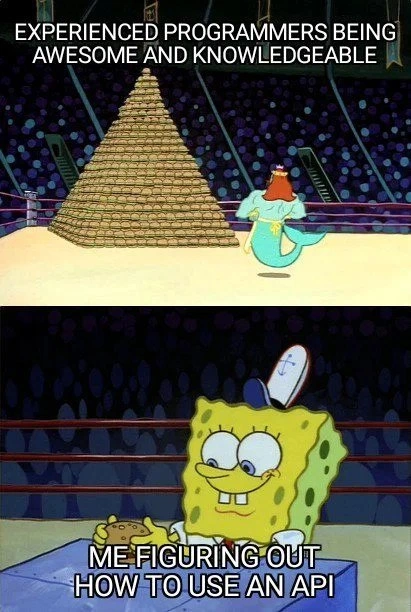
Let’s break down what’s happening in this meme in more straightforward terms. SpongeBob SquarePants is used here to represent developers at different experience levels. In the top image, a character (King Neptune) has built a gigantic Krabby Patty pyramid – literally hundreds of burger patties stacked into a huge structure. This represents an experienced programmer doing something huge and complex with ease. Think of that pyramid as a big software project or system made of many small pieces. It’s like saying the senior dev can build an entire application or manage a whole bunch of services working together. The caption calls them “awesome and knowledgeable” because, to a newcomer, senior devs often seem to know everything and can do amazing things in code without breaking a sweat.

Now look at the bottom image: SpongeBob sits at a little table under the same spotlight, happily putting together just one Krabby Patty (just one burger). The caption says “me figuring out how to use an API.” This is the beginner or junior developer perspective. An API, or Application Programming Interface, in this context usually means a web API – basically, a service you can call over the internet to get some data or perform an action. For example, an API might let you ask “Hey, what’s the weather in New York?” and it will answer with the weather data. “Using an API” involves writing code to make a request to that service and then handling the response it gives you (often some data in formats like JSON).

When you’re new to APIs, even doing a simple RESTful request (REST is a common design style for web APIs) can feel like a big achievement. You have to figure out a lot of things step by step:

  • Reading API documentation: You find the instructions for the web service. For instance, the docs might say “to get weather info, call GET https://api.weather.com/v1/current?location=XYZ”. This can be overwhelming with new terms and endpoints.
  • Getting credentials: Many APIs require an API key or token (like a password) to use them. You might have to sign up and find a long string of characters that serves as your key.
  • Making the HTTP request: You write a bit of code or use a tool (like Postman or curl) to actually call the API. For a beginner, this means learning your programming language’s HTTP library (for example, using Python’s requests or JavaScript’s fetch). You need to put the URL, maybe some parameters, and that key you got into the right place.
  • Handling the response: The API will return data, often in JSON format (which looks like a bunch of nested key-value pairs, kind of like a dictionary). You then have to parse that and use it in your program. The first time, even just printing it out to see “Did it work?” is exciting!

Here’s a tiny example in Python of what that first API call code might look like:

import requests

url = "https://api.example.com/data"
params = {"api_key": "MY_SECRET_API_KEY"}  # replace with your real API key
response = requests.get(url, params=params)  # making a GET request to the API

if response.status_code == 200:  # 200 means OK, success
    data = response.json()      # parse the JSON response into a Python dictionary
    print("Success! Got data:", data)
else:
    print("API call failed with code:", response.status_code)

In this snippet, a beginner is using the requests library to call an API. They provide the URL and an API key (notice the params with an API key – many services expect your key either as a parameter like this or in an authentication header). If the call is successful (HTTP status code 200), they print out the data. If not, they print the error code. Writing and running a script like this the first time feels great: you’re communicating with another service over the internet and getting real data back! 🎉

The meme’s humor is that seasoned developers do far more complex things routinely. For instance, an experienced developer might be comfortable integrating multiple APIs into a single project, handling authentication via OAuth tokens (which involves redirecting to login pages, getting tokens, refreshing them – pretty confusing at first), dealing with error handling, rate limiting, and so on. They might construct an entire workflow, like “take data from API A, process it, then send it to API B and C, store results in a database, and show it on a web dashboard,” which is analogous to stacking lots of patties into a big structure. Because they’ve done it before, they know the best practices: how to structure the code, how to secure the secrets, how to handle when one service is slow or down, etc. The skill gap visualized here is huge, and as a newcomer it’s easy to feel like “Wow, will I ever reach that level?”

But remember, the experienced vs novice contrast is exaggerated for fun. In reality, every senior developer once sat at their desk, heart pounding, as they tested out their first API call and saw a successful response. They also struggled with things like “What’s an Auth header? Did I format the URL right? Why am I getting a 403 Forbidden error?” The term LearningCurve is often used because initially a lot of these concepts (HTTP methods, status codes, JSON parsing, etc.) come at you fast and it’s steep going. Over time, though, you become fluent in them. What was once a confusing jumble of headers and endpoints becomes almost second nature. That’s when calling one API isn’t scary anymore, and you start using that knowledge to build bigger things — maybe not a literal pyramid of burgers, but perhaps a full application with many integrated services.

The DeveloperExperience (DX) angle here is that good APIs try to make this learning process easier: clear documentation, example code, sandbox environments to experiment in, and community support (like tutorials or Stack Overflow answers). Despite that, as a junior dev you often feel exactly like SpongeBob: intensely focused and delighted by accomplishing a straightforward task, all while aware that around you in the “arena” are people doing grander feats. And that’s okay! The meme is a lighthearted reminder that senior vs junior developers just have different scales of what’s challenging, and that with time, today’s “hard” task becomes tomorrow’s routine. It’s relatable to anyone who’s been a beginner and then later an expert at something. In short: experienced programmers may be stacking impressive pyramids of code now, but they all started by grilling that first patty (making that first API call) and being just as thrilled about it as you are.

Level 3: Towering Tech Stacks

In the top panel of this SpongeBob meme, King Neptune triumphantly presents a towering pyramid of Krabby Patties — a comically over-the-top achievement representing the feats of experienced programmers. In tech terms, that pyramid could symbolize a massive, elegant software architecture built from countless components (just like stacking hundreds of burger patties). Seasoned engineers often juggle multiple API integrations, complex frameworks, and layered services all at once. To them, crafting a robust system that connects dozens of web services or microservices might feel as routine as flipping burgers. The meme humorously contrasts this with the bottom panel: SpongeBob (the novice developer) is grinning ear-to-ear while assembling a single patty, much like a beginner proudly making their very first API call. The absurd size difference between the pyramid and the lone patty nails the joke: what’s monumental for a junior dev is merely a building block for a senior.

This extreme visual exaggeration hits home for many developers. We’ve all seen those star programmers in the “arena” (perhaps on GitHub or at hackathons) seemingly conjure entire applications or tech stacks overnight. They deploy scalable backends, design intricate database schemas, and implement slick UIs in one go. It feels almost magical — akin to King Neptune magically summoning hundreds of patties. Meanwhile, when you’re new, getting one thing to work (like successfully fetching data from a REST API without errors) can feel like winning a wrestling match. The humor comes from that collective RelatablePain and relief: every expert once struggled with “Hello World” too. The meme acknowledges the steep learning curve in programming. Consuming a web API — dealing with endpoints, query parameters, and authentication tokens — can be genuinely confusing for newcomers. And yet, experienced devs handle these things as second nature, stacking one successful integration on top of another until they’ve built something spectacular.

From a senior engineer’s perspective, the scene also pokes fun at how knowledge accumulates. Each Krabby Patty in the pyramid could represent a piece of hard-earned know-how: a mastered programming language here, a familiar design pattern there, dozens of APIs learned over the years. Stack enough of those “patties” and you appear to have superhuman coding abilities. The seasoned devs aren’t literally smarter mermen; they’ve just been stacking patties (learning and building) for a long time. What was once a struggle — perhaps their first time handling an OAuth 2.0 token or parsing a JSON response — is now just another step in a routine. They might even have abstracted it away: for example, writing a wrapper library or using high-level frameworks so they no longer need to sweat the small stuff like raw HTTP requests. This is classic DeveloperHumor about perspective: the SeniorVsJuniorDevelopers gap. It’s funny because both sides recognize it. Seniors chuckle remembering that “arena” feeling when even one API call was daunting, and juniors laugh (and cringe) because they’re living it.

Importantly, the meme isn’t mocking the beginner — it’s cheering them on in a tongue-in-cheek way. The SpongeBob character’s excited face and the single patty he’s holding up are depicted with the same triumphant energy as the grand pyramid. In real developer life, that first successful API call is awesome and worth celebrating. Experienced programmers know that behind their polished pyramids are many failed builds, bug hunts at 3 AM, and yes, memories of being that person googling “how to use an API”. The meme resonates across the stack: novices feel seen in their small victory, and veterans nod knowingly because they’ve stacked those patties one by one themselves. It encapsulates a bit of DeveloperExperience_DX wisdom: everyone starts with the basics, and with practice, those basics stack up into something amazing. Just as a pyramid is built brick by brick (or patty by patty), coding skills and confidence are built API call by API call. Today’s RelatableHumor about struggling with a single request is tomorrow’s anecdote about “that time I thought calling GET /pets was hard” while you’re effortlessly orchestrating distributed services. So laugh along — one day, you’ll be stacking tech pyramids of your own, and that first patty will be part of the foundation!

Description

A two-panel meme using scenes from 'SpongeBob SquarePants' to contrast different stages of a programming career. The top panel, captioned 'EXPERIENCED PROGRAMMERS BEING AWESOME AND KNOWLEDGEABLE,' shows the god-like King Neptune having effortlessly created a massive, perfect pyramid of hundreds of Krabby Patty burgers in a large stadium. This represents the complex, large-scale work senior developers seem to handle with ease. The bottom panel, captioned 'ME FIGURING OUT HOW TO USE AN API,' shows SpongeBob sitting proudly at a table, holding up a single, simple Krabby Patty with a look of genuine accomplishment. The humor lies in the vast difference in scale, highlighting the perspective of a junior developer. For them, a seemingly small task like successfully integrating with an API is a monumental achievement, even if it feels insignificant compared to the architectural marvels built by their senior counterparts. It's a wholesome and relatable take on the learning curve and the importance of celebrating small wins

Comments

18
Anonymous ★ Top Pick Don't worry, that senior's pyramid of burgers is actually a monolith with a thousand undocumented dependencies, and removing one burger from the bottom will cause a cascading failure across the entire application
  1. Anonymous ★ Top Pick

    Don't worry, that senior's pyramid of burgers is actually a monolith with a thousand undocumented dependencies, and removing one burger from the bottom will cause a cascading failure across the entire application

  2. Anonymous

    Senior dev reality: the towering burger pyramid is just 300 microservices politely retrying the same flaky REST endpoint - SpongeBob’s lone patty is the only piece with a clean contract

  3. Anonymous

    The real pyramid scheme in tech is how we stack our knowledge of undocumented APIs on top of deprecated Stack Overflow answers from 2012, while the actual documentation was last updated when the lead architect still had hope in their eyes

  4. Anonymous

    The pyramid represents the 15 years of accumulated knowledge, but somehow every new API still feels like deciphering hieroglyphics written by a developer who rage-quit before writing the authentication section. Bonus points if the only example in the docs is a curl command that returns 401, and the Slack channel for support has been archived for three years

  5. Anonymous

    API integration is 10% code and 90% discovering the docs, the OpenAPI spec, and production are three separate microservices with eventual consistency

  6. Anonymous

    Seniors stack endpoints like that burger ziggurat; I'm still tracing why auth middleware ghosts my JWTs

  7. Anonymous

    Nothing humbles a principal engineer faster than a vendor “REST” API with OAuth + HMAC, cursor vs. offset pagination, and 200‑OK error payloads - suddenly I’m an archaeologist in Postman, hoping the next header unlocks the tomb

  8. @kerridwen 4y

    * how to print hello world in python)

    1. @mxkrsv 4y

      os.system("echo hello world")

      1. @RiedleroD 4y

        from subprocess import Popen with Popen(["echo","Hello World"]) as p: p.wait()

  9. @tokimonatakanimekat 4y

    *undocumented ancient api

  10. @loves_frogjs 4y

    That's the attitude, one step at a time.

  11. @qtsmolcat 4y

    {"success":"false","error:":{"code":"400","message":"bad request"}}

    1. @feskow 4y

      HTTP Code: 200

      1. @qtsmolcat 4y

        I return proper status codes tyvm

        1. @feskow 4y

          God bless you

      2. @freeapp2014 4y

        Who needs http codes anyway

        1. @feskow 4y

          To not parse body of the document and more quickly react to the error

Use J and K for navigation