Skip to content
DevMeme
3461 of 7435
The Programmer-Mathematician Stereotype Debunked
DevCommunities Post #3795, on Oct 10, 2021 in TG

The Programmer-Mathematician Stereotype Debunked

Why is this DevCommunities meme funny?

Level 1: Not a Math Wizard

Imagine you have a friend who’s really good at building with LEGO blocks. They can create awesome castles and robots out of LEGO. Now someone comes up to them and asks, “Wow, you’re so good at LEGO – you must be super good at math, right?”😃 Your friend would probably laugh and shake their head, “No, not really!” Building cool LEGO structures and solving math problems are different skills. That’s exactly the point of this joke. People assume that if someone is great with computers or coding, they must also be amazing at math – but that’s like thinking a chef who cooks great meals must also be a farmer who grows the vegetables. It doesn’t quite match up. The meme is funny because the programmer is basically saying, “Nope, that’s not how it works!” in a very direct and witty way. It’s showing that writing code is a special skill on its own, and you don’t automatically turn into a math magician just because you can program a computer. So the big laugh comes from hearing the programmer flat-out say they’re not a math wizard, and that surprise “But no” makes everyone realize the assumption was silly in the first place.

Level 2: It’s Not All Math

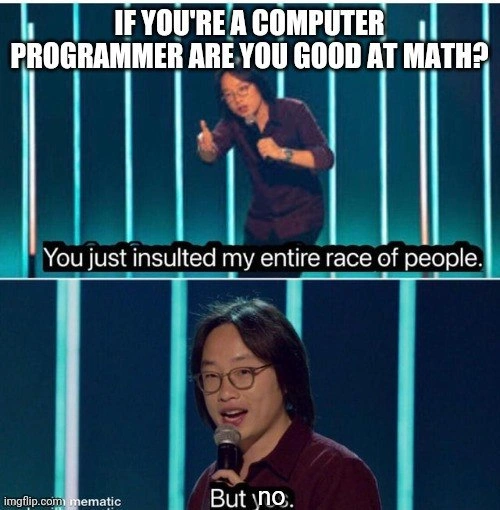
The meme uses a stand-up comedy scene to illustrate a common misconception in tech: the belief that every programmer is automatically a math genius. In the first panel, the comedian on stage repeats a question often heard in real life: “If you’re a computer programmer, are you good at math?” This sets up the stereotype in plain words. In the second panel, his answer comes as a comedic surprise: “You just insulted my entire race of people... But no.” Essentially, he’s saying in a funny way that programmers as a group are not defined by super math abilities. The format is the classic assumption vs. reality joke. The assumption (questioner thinks coding is all about math) versus reality (coder humorously admits lack of math prowess). This works in a stand-up comedy format because comedians often take a common belief and turn it on its head for laughs. The blue-lit stage and subtitles make it feel like you’re watching a Netflix comedy special, which adds to the humor and relatability. Even if you’re a junior developer or just learning to code, you likely find this funny because you’ve either encountered this stereotype already, or it relieves some pressure you might feel about needing godlike math skills.

Let’s break down a few terms and ideas here. A computer programmer is someone who writes instructions (code) to make a computer perform tasks. Being “good at math” usually means being able to solve mathematical problems easily, like equations or complex calculations. Now, programming does involve some math concepts, but often it’s arithmetic and logic rather than advanced mathematics. For instance, one of the first things you learn in coding is using variables and basic operators (like + for addition or - for subtraction) to do simple calculations. You might also learn about binary (the way computers count with 0s and 1s), which is a mathematical concept, or use logic operators (AND, OR, NOT) which come from Boolean algebra. These are part of the CS fundamentals that every developer learns. However, there’s a big difference between understanding these basics versus, say, solving a complex calculus integral or a difficult geometry problem by hand.

Think about algorithms – a word that sounds very mathematical. An algorithm is just a step-by-step way to solve a problem or accomplish a task. It could be something like “find the largest number in this list” or “sort these names alphabetically.” You can explain an algorithm without heavy math; it’s more about logical steps. Yes, in computer science classes you might analyze an algorithm’s efficiency with some math (like counting how many steps it needs, which is part of what we call algorithm complexity), but when you’re actually programming as a beginner, you’re usually taking those algorithms and just implementing them in code. The heavy lifting (like the math behind why one sorting method is faster than another) has often already been figured out by smart people and put into libraries or tutorials. As a new programmer, you often use existing libraries or built-in functions that handle complex operations for you. For example, if you need to find a square root, many languages have a sqrt function in a Math library. You don’t need to recall the manual method to compute square roots or any calculus – you just call the function and move on.

It’s also worth understanding the idea of a stereotype. A stereotype is a general belief about a group of people that might not be true for everyone. Here the stereotype is “all programmers are math whizzes.” In reality, programmers are a diverse bunch. Some love math, sure, but plenty have average math skills and that’s fine. This meme draws humor from that false stereotype. In tech, there are quite a few misconceptions like this. Another example: some people assume all “computer people” can fix any electronic device (from your laptop to your Wi-Fi router) by sheer instinct. You, as a budding developer, might have already been asked to fix a relative’s computer or phone just because you’re known to be good with technology! It’s similar with math – people hear you work with computers and imagine you’re constantly doing equations in your head.

In reality, what do programmers do most of the time? It’s a lot of reading and writing code, testing that code, and debugging (which means finding and fixing errors). Those tasks rely on logical thinking, attention to detail, and creativity in problem-solving. For example, a very relatable developer experience for a newbie is writing a piece of code and getting an error, then methodically checking each part to find the mistake. That process doesn’t require calculus or advanced math; it requires patience and a logical approach. You might use simple math when programming, like adding up totals, converting units (e.g., from centimeters to inches), or maybe using a bit of geometry if you’re making a simple game. But these are usually straightforward calculations. Anything truly complicated mathematically (say you need to do 3D graphics rotations or implement encryption) usually has well-documented formulas or existing code available. In fact, early in your career, if someone asked you to implement something very math-heavy from scratch, you’d probably look for a formula or library on Google or Stack Overflow rather than derive it yourself.

To put it plainly: programming isn’t an endless math test. It’s more like constructing something. You use tools, building blocks of logic, and premade components. Yes, understanding the concepts from math or logic can help you think like a programmer. For example, knowing a bit of combinatorics (a math topic) can help in understanding how many loops or iterations might run, or understanding logical truth tables (from Boolean algebra) helps with writing complex conditions. But being a whiz at those subjects is not a prerequisite to being a good coder. Many great developers will tell you they’ve forgotten a lot of the high-level math they learned in school because they rarely need it directly.

Here are a few points that highlight the reality for junior devs:

  • Most coding tasks use basic math at most: You’ll often find yourself doing things like adding a counter, measuring lengths of text, or using percentages for layouts. All of that is grade-school level arithmetic. If you need something like a random number or a complex formula (for example, calculating an interest rate or a statistical measure), you usually have a ready-made function or library.
  • Logic and problem breakdown are key: Writing code is a lot like solving a puzzle or breaking down a big task into smaller steps. That’s a logical process, not a purely mathematical one. For instance, figuring out the steps to search for a name in a list (“first, sort the list, then check each entry…”) is about planning and logic.
  • Resources compensate for advanced math: If you ever do encounter a task that feels very mathematical (say, some physics formula for a game or an encryption algorithm), you won’t be abandoned in the wilderness. You’ll have textbooks, documentation, and the internet to help. There are coding libraries for complex math. Early in your career, it’s more important to know how to find and use those resources than to derive everything yourself.

In summary, the meme’s punchline “But no” is a lighthearted way to tell everyone that coding is not the same as doing math homework all day. It assures newcomers (and reminds experienced devs) that you don’t have to be Gauss or Einstein to write good code. The crucial skills in programming are understanding how to use languages and tools, how to think through a problem systematically, and how to debug issues — none of which require genius-level math aptitude. So if anyone nervously entering software development thinks, “Oh man, do I need to be a math superstar?”, this meme is essentially the community collectively saying, “Relax, you’ll be fine! We’re programmers and we’re not all math geniuses, and look, things still work out.”

Level 3: Algorithm ≠ Algebra

This meme hilariously skewers a classic tech stereotype. The setup is a stand-up comedian on stage responding to the question, “If you’re a computer programmer, are you good at math?” and his punchline: “You just insulted my entire race of people. ...But no.” 😅 In other words, he’s joking that assuming all programmers are math geniuses is so off-base that it’s almost offensive (in a playfully dramatic way). Experienced developers immediately recognize this scenario. It’s an industry stereotype we’ve heard a thousand times at family gatherings or from new acquaintances. Someone finds out you write code and immediately asks if you can do their kids’ algebra homework or crunch big numbers in your head. The humor here comes from that assumption vs. reality gap: insiders (programmers) know that day-to-day coding isn’t the continuous math exam outsiders imagine. The comedian’s exaggerated “insulted my entire race” retort gets tech folks laughing because it’s a tongue-in-cheek way to say, “Buddy, you clearly have no idea what programmers actually do!” and we’ve all been there.

Digging a bit deeper, why do people assume coding = math wizardry? Historically, computer science fundamentals are rooted in mathematics and logic. Early computing pioneers were often mathematicians. The very term “computer” originally referred to humans who performed computations. In academia, computer science students tackle discrete mathematics, algorithms, and complexity theory. They learn to prove things like whether an algorithm runs in time $O(n^2)$ or exponential time. Those are indeed math-heavy topics. So yes, on the theoretical side, programming does have mathematical underpinnings. For example, an algorithm is essentially a step-by-step procedure (like a recipe) often taught with mathy examples, and analyzing an algorithm’s efficiency can involve mathematical reasoning. Early programming languages like FORTRAN (short for “Formula Translation”) were literally created by mathematicians to solve scientific equations on computers. So it’s not totally out of nowhere that people link coding with math skills.

However – and here’s the punchline the meme delivers – being a software developer is usually more about problem-solving and logical thinking than solving calculus problems. Most of us aren’t doing integrals or theoretical proofs at work; we’re Googling documentation for a library, debugging a null pointer error, or figuring out why the UI layout is broken in Safari. 😁 For instance, a back-end web developer might spend her day writing API endpoints and database queries (no advanced math needed there, just careful logic and knowledge of frameworks). A front-end developer might be adjusting button styles with CSS or handling user input validation. None of that requires mastering advanced algebra or calculus, just a good understanding of tools and logical reasoning. Sure, certain specialized fields like graphics programming, data science, or cryptography will tap into heavy math (linear algebra, statistics, number theory, etc.), but those are the exception, not the rule for an average programmer. It’s completely possible (and common!) to be an amazing coder and not be a “math person.” In fact, many programmers joke that they chose software over other sciences specifically to avoid heavy math!

The comedic irony is that outsiders often think we’re all like rocket scientists crunching equations, while in reality we’re more like builders or translators. We take real-world problems and break them into logical steps that a computer can follow. That’s a different skill set than, say, solving a complex equation by hand. For example, consider a simple task like calculating a sum: in code you might just do total = a + b and let the computer handle the addition. If you need something more complex—say a square root or a random number—you call a built-in function like Math.sqrt(144) or Math.random(). You’re leveraging tools that have the advanced math baked in, so you rarely have to do that math yourself. One could even say programmers are great at delegating math to machines! After all, we have computers so that they can crunch numbers at lightning speed, leaving us humans free to focus on design, logic, and creativity. As a result, being a “human calculator” just isn’t a job requirement for writing good software.

This meme resonates in developer communities because it validates a shared experience. It’s practically a rite of passage for a coder to hear “Oh, you program? You must be good at math then.” The collective response (often accompanied by a chuckle) is, “Well… not really!” We laugh because it’s relatable humor: we’ve all felt that slight awkwardness when someone assumes we’re all Einsteins with numbers. The comedian’s line “You just insulted my entire race of people” is obviously humorous hyperbole, but it echoes a tiny bit of real exasperation. It’s like he’s speaking on behalf of coders everywhere: “Folks, not every coder is a math prodigy, and saying that is kind of like saying all chefs are master chemists — it just ain’t true, and it shows you don’t get what we do.” The final deadpan “But no.” lands the punch: it’s a simple truth stated plainly. The brevity makes it even funnier. After a grand build-up (being insulted!), the programmer simply admits no, he’s not a math genius. That comic timing is perfect, and any seasoned programmer reading the meme is likely nodding along and maybe even feeling a bit of relief. It’s a light-hearted acknowledgment that, yes, you can be part of this “race of people” called programmers without being an all-star at math — and that’s totally okay.

Description

A two-panel meme featuring comedian Jimmy O. Yang from one of his stand-up specials. The top panel has a question in large white text: 'IF YOU'RE A COMPUTER PROGRAMMER ARE YOU GOOD AT MATH?'. Below this, an image of Yang on stage is subtitled with his mock-outraged response: 'You just insulted my entire race of people.' The second panel is a closer shot of Yang speaking into the microphone, delivering the punchline: 'But no..'. The humor works on multiple levels. It directly confronts the common public misconception that all programming requires advanced mathematical ability. Yang cleverly frames 'programmers' as his 'race of people,' setting up a classic stereotype joke, only to subvert it by admitting the stereotype isn't true for him. This resonates deeply with the large majority of software engineers, especially in fields like web and application development, where logic and problem-solving skills are far more critical than calculus or linear algebra

Comments

46
Anonymous ★ Top Pick The most complex math I've done this week was calculating the off-by-one error in a loop and figuring out if I have enough story points left in the sprint to justify a 3-hour Yak shave
  1. Anonymous ★ Top Pick

    The most complex math I've done this week was calculating the off-by-one error in a loop and figuring out if I have enough story points left in the sprint to justify a 3-hour Yak shave

  2. Anonymous

    Twenty years of optimizing distributed systems and I can model p99 latency with a heavy-tail distribution, but ask me to factor a quadratic and I’ll respond with exponential backoff

  3. Anonymous

    I've been writing distributed systems for 15 years and the only math I use is calculating how many 9s of availability I'm lying about in the SLA

  4. Anonymous

    The eternal question that haunts every developer at family gatherings: 'You're a programmer? You must be amazing at math!' Meanwhile, we're over here Googling 'how to center a div' for the thousandth time and using Stack Overflow to remember if array indices start at 0 or 1. Sure, we built a distributed microservices architecture that handles millions of requests per second, but ask us to do long division without a calculator and suddenly we're reaching for Math.floor() and praying the floating-point gods are merciful today

  5. Anonymous

    Programmer math: Big‑O hand‑waving, time‑zone modulo, and proving 0.1+0.2≠0.3; everything else is a dependency

  6. Anonymous

    After 20 years, my math stack is p99s, error budgets, and counting nines in the SLA; if you need eigenvectors, page the ML team, not the CRUD squad

  7. Anonymous

    Good at math? We aced Big O, but ask us to predict sprint velocity without heuristics - pure fiction

  8. @sashakity 4y

    thank god im not the only one

  9. @Cairco 4y

    Sorry dude, I'm good at maths

  10. @dontmindmehere 4y

    Admin, delete your meme - Cairco is good at maths

    1. @doodguy1991 4y

      You can't graduate without finishing Calculus, Differentials, Linear Algebra, and Discrete Math College drop outs gtfo

      1. @dontmindmehere 4y

        Don't be so narrow-minded to assume thar only those who graduated from a specific university can enjoy programming. Give me a break.

        1. @doodguy1991 4y

          Specific university? This is the standard across California you twat

          1. @dontmindmehere 4y

            There's literally not a single word in the meme about any university. The more you talk, the more you embarrass yourself. The nonsense you are saying is like to say that you need to graduate from a conservatorium to write music

            1. @doodguy1991 4y

              The more you talk the more you suck dick. Fuck off dumbass. Go try and pass a PE exam without any math classes. Kys

              1. @RiedleroD 4y

                hey, while it's not in the rules, I do not apprechiate this kind of behaviour. Be nice.

                1. @sylfn 4y

                  "Be nice" is in the rules (although it is marked as not mandatory)

                  1. @RiedleroD 4y

                    aye, true. I wrote that part myself as well 🤦‍♂️

              2. @dontmindmehere 4y

                And yet again you embarrassed yourself. There's not a single word about PE exams in the meme. You want to be acknowledged by bragging about some certificates of yours. Go somewhere else. You are pathetic - no wonder why you're looking for attention. It's hard to be you because it's hard to wear clown makeup every day.

                1. @doodguy1991 4y

                  Doesn't matter if it wasn't in the meme. It's implied that computer people aren't good at math and that'd be far from the truth for anyone who's actually good at their job or hobby

  11. @azizhakberdiev 4y

    Miss

  12. @saidov 4y

    Imagine learning about Big O without knowing how to solve quadratic equation

    1. @RiedleroD 4y

      literally me

  13. @Buckyass 4y

    I think knowing math is not necessery all the time. For example Web development or mobile development

    1. @RiedleroD 4y

      web development is mostly design, not programming. At least it's supposed to be, soydevs will use js for anything.

      1. @freeapp2014 4y

        Well that’s not much different from python that people put literally everywhere no matter how much it’s suited for the task

        1. @RiedleroD 4y

          ubuntu be like

        2. @Buckyass 4y

          Agreed

        3. @freeapp2014 4y

          Backend development? Python Scripts? Python Desktop software? Python Big data? Python Artificial intelligence? Python Machine learning? Python In-app scripting system? Very likely python

          1. @RiedleroD 4y

            the last one is usually perl or lua though, it's really hard to do in-app scripting with python if the main program isn't python, and even if it is, it's very hard to do it securely.

            1. Deleted Account 4y

              lua is good for scripting i heard

          2. @RiedleroD 4y

            but yeah, like half of all preinstalled desktop apps in ubuntu 18.04 had python 2 as a hard dependency

            1. @freeapp2014 4y

              Isn’t it just overall Linux

              1. @RiedleroD 4y

                no, ubuntu 20.04 has less of it (but now a shitton of snap), KDE was always a bit better and the rest of the distros are mostly reasonable.

                1. @RiedleroD 4y

                  fun fact: until ubuntu 19.04, they had some javascript code that was responsible for dynamic mouse movement. They then made a blog post about how much faster it got after replacing it. They didn't say what they replaced it with though.

          3. Deleted Account 4y

            backend development - python is unscalable scripts - python is fine desktop software - python is sloooooow and practically impossible to type check big data - fuck off AI - IDC ML - Literally the same thing scripting in apps - not python kthxbye

            1. @RiedleroD 4y

              for AI and ML, python is actually usable because all the hard work is being done in C/C++land, and you just need to feed data into tensorflow or something

              1. Deleted Account 4y

                yeah exactly

            2. @a_desant 4y

              Python is unscalable in web but Instagram was written on python and works somehow.

              1. Deleted Account 4y

                Anything can be scaled if you're rich enough

                1. @a_desant 4y

                  Lol, last week, when I asked our manager about load testing, he answered that we do more aws instances instead. But still, as python dev I would say that it is scalable enough for vast majority of websites. Even fintech, excluding some features that count every ms and written on C/++.

                  1. Deleted Account 4y

                    Ok

                2. @CcxCZ 4y

                  I wouldn't say anything. But for most web stuff the workflow is to transform request into bunch of database queries, execute them and transform the results into whatever you want to send back. This is trivially parallelizable and the critical point for scalability is actually the database in question. So as long as you don't pull Zope/Plone which wrote their own Python-based object-oriented database you should be fine.

            3. @a_desant 4y

              And also what's wrong with big data on python? All popular libs have direct mapping to C Api. So you just make ml stuff with almost same speed as on C but with much more comfort

          4. @mrybs1 4y

            Are you fucked up?

  14. Deleted Account 4y

    lol i studied statistics

Use J and K for navigation