Skip to content
DevMeme
3274 of 7435
Breaking Prod: A Developer's Rite of Passage
OnCall ProductionIssues Post #3598, on Aug 26, 2021 in TG

Breaking Prod: A Developer's Rite of Passage

Why is this OnCall ProductionIssues meme funny?

Level 1: We All Mess Up

Imagine you’re helping bake cookies and you accidentally drop the entire tray, spilling cookies everywhere and making a huge mess. You feel awful and look up expecting everyone to be really mad. But instead, your older brother just chuckles, pats you on the shoulder, and says, “First time baking, huh?” in a friendly way. He’s not actually angry – in fact, he’s reminding you that everyone makes mistakes when they’re learning. He’s probably remembering how he burned a batch of cookies or made a mess in the kitchen when he was younger. His relaxed reaction shows you that messing up is normal and fixable.

That’s exactly what’s happening in this meme. The new developer broke something important (kind of like dropping the cookies) and is super worried. The senior developers are like the older brother who’s been through it before. They respond with a little joke – “First time?” – to let the newcomer know that it’s okay, we’ve all been there. In other words, welcome to the club, everyone messes up sometimes! The joke makes the newbie feel a bit better, because if the experienced people aren’t panicking, it must mean the mistake isn’t the end of the world. The big idea is: learning often involves mistakes, and people who have been around longer understand and will help you clean up the mess rather than make you feel worse.

Level 2: So You Broke Prod

Let’s break down what’s happening for newer developers or those not steeped in DevOpsHumor. In software teams, "production" (prod) refers to the live system that real users or customers are interacting with. It’s the real deal: the website, app, or service running in the wild. When something in production “goes down” or breaks, it’s a serious issue – users might be unable to use the service, and the company can lose money or trust. This is what we call a Production Incident or an outage. For example, if Amazon’s checkout stops working, that’s a production incident. If a small bug causes your app to crash for everyone at 2PM, that’s an outage. In this meme, the rookie developer admits "I broke something in production," meaning they did something (perhaps deployed new code or changed a setting) that unintentionally caused a live system failure. Oops! 😬

Now, most tech teams have a system to respond to these crises, often called On-Call Duty. Being “on-call” means a specific engineer is responsible for quickly reacting if an alert comes in that something’s wrong in production. Think of it like a firefighter on duty: instead of fires, they fight software emergencies – hence the term “production firefighting.” An on-call engineer carries a pager or phone (nowadays usually an app or texting service) that will start beeping at 3AM if the server is melting down. DevOps and SRE (Site Reliability Engineering) practices emphasize that developers should share in this on-call rotation, so everyone who builds the software also helps operate it. If you cause a problem, you might even be the one woken up to fix it!

For a junior developer, the first time you’re involved in a major production issue can be scary. Imagine suddenly seeing users complaining that the site is down right after you made a change. Your heart races, you might think, "Did I just break it? What do I do?!" You alert the team, and senior developers come to help. In a healthy team culture, they won’t berate you; instead, they stay calm and guide the fix. This meme’s dialogue – “First time?” – is the senior dev’s tongue-in-cheek way of saying “We’ve all made big mistakes in production, it’s normal.” Senior engineers have oncallLife experience: they've probably broken things themselves in the past and have been woken up at odd hours to fix production bugs. Because of that, they tend not to panic. They might even crack a joke to lighten the mood, which is exactly what’s shown here.

Gallows humor (joking in a dark situation) is pretty common among on-call engineers. The image literally shows two people with nooses, making a joke despite the dire situation. Of course, in reality nobody’s getting physically harmed when a website goes down – but in the moment, a rookie developer might fear they’re “in big trouble” or metaphorically feel like they’re on the gallows. The senior dev’s calm quip implies “this isn’t the end of the world.” It’s a form of reassurance. They’re effectively saying: “You feel awful now, but trust me, every seasoned dev has done something like this. Learn from it, fix it, and you’ll be okay.”

After the immediate crisis is solved (say, by rolling back to an earlier version of the code, or applying a quick fix), the team usually does a postmortem. A postmortem is a meeting or document where everyone talks about what went wrong and how to prevent it in the future. Importantly, good teams practice blameless postmortems – meaning they focus on what happened, not who to blame. This encourages honesty and learning rather than fear. So if a junior messed up a configuration, the postmortem might say, "A configuration error caused the outage, and we lacked a safeguard," rather than "Alice messed up the config." The idea is to improve systems so the mistake isn’t repeated, because, frankly, production systems are complex and there will always be new mistakes.

For someone new to this environment, here’s a quick glossary of relevant terms:

  • Production (prod): The live environment where the software/app is serving real users. Breaking "prod" means the live site or service is impacted.
  • On-call: A responsibility rotation where an engineer is available 24/7 during their shift to respond to emergencies. If you’re on-call and something breaks at 4AM, you get notified and must react.
  • Incident/Outage: An event where something in the service fails or stops working properly, often requiring urgent fix. Often categorized by severity (e.g. a P1 incident is top priority).
  • DevOps/SRE: Cultural and engineering practices that combine development and operations, often involving automation, monitoring, and reliable system design. SRE in particular focuses on keeping systems up and running reliably.
  • Firefighting (in IT): Slang for dealing with urgent problems (like a firefighter puts out fires). If you’re “firefighting in production,” you’re fixing a sudden critical bug in the live system.
  • Postmortem: A retrospective analysis after an incident. “Postmortem” literally means “after death” – here it means after the system outage is resolved, we examine it. It’s not about blame; it’s about learning how to make systems safer.

So in summary, the meme is funny to developers because it exaggerates a very real situation. A newbie is freaking out about causing an outage (thinking, perhaps, "Am I going to get fired?"). The senior devs respond casually, almost jokingly, because from their perspective this is just another day in the life of software engineering. Every developer, at some point, has that stomach-dropping moment of "Oh no... I broke it." What you eventually learn is that such moments are surprisingly common. Seniors have a mental checklist from past disasters: check the logs, revert that last deployment, double-check the database, etc. They know eventually everything gets fixed. By saying "First time?" with a grin, the experienced folks signal to the newbie that they’re not alone and not a bad engineer – if anything, they’ve just been initiated into the reality of on-call life.

Level 3: Baptism by Outage

This meme nails the on-call culture rite-of-passage: a panicked junior engineer just accidentally nuked a live service, and the battle-hardened senior responds with a smirk and "First time?". The image (from a movie's gallows scene) is literal gallows humor – dark, sarcastic comedy in a dire situation. In tech, nothing says “Welcome to real-world DevOps!” like breaking production for the first time. Seasoned developers have ProductionIncident war stories and wear them like badges of dishonor (or honor, depending on how much coffee they've had). So when a newbie admits "I broke something in production," veteran engineers react with a knowing, almost comforting sarcasm: “Oh, you tripped over the same wire we all have. Welcome to the club.”

For senior devs and SREs (Site Reliability Engineers), this scenario is painfully familiar. They've been on the grim 3 AM merry-go-round of OnCallDuty long enough to know that ProductionIssues are not a matter of if, but when. They've experienced the adrenaline of pagers going off at ungodly hours, the scramble to trace a cascade of failures, the clacking of keys as they deploy a hotfix while half-awake. Over time, this turns incident response from panic into reflex. That calm, almost bored expression on the senior dev (noose around neck, figuratively speaking) says: “Yep, been here many times. This is just another Tuesday night.” It's a portrait of incident fatigue – after so many system crashes and all-nighters, you become desensitized and maybe a tiny bit nihilistic. The humor is a coping mechanism. As the saying goes, "to err is human, to bring down production on a Friday night is a developer." 😅

The DevOps/SRE philosophy encourages a blameless attitude to failure (because complex systems fail in complex ways). This meme pokes fun at that supportive culture by dramatizing it: instead of yelling, the senior dev gives a darkly humorous thumbs up from the gallows. It's a hyperbole of real life "blameless postmortems" – after an outage, the team will analyze root causes without pointing fingers. In practice, everyone knows exactly who wrote the bug or ran the kubectl delete in the wrong cluster, but they also know ProductionIncidents happen to even the best. The veteran’s "First time?" really means “No worries, we’ve all done something like this. Let’s fix it and move on.” This attitude is both reassuring (you’re not alone in screwing up) and a bit terrifying (outages are so routine that seniors are unfazed).

From an insider perspective, the meme is RelatableDevExperience comedy gold because it captures the unspoken truth: breaking prod is almost a developer baptism. The first major ProductionBug you introduce, the first time your deploy triggers a site-wide outage, you feel your stomach drop to the floor. You’re imagining angry bosses, lost revenue, maybe your career imploding. Then you witness the seniors react with a chuckle and a “first time, eh?” It’s equal parts comforting and disorienting. The calmness of others in such a crisis is how you learn that outages are normal events, not career-ending emergencies (most of the time). In fact, many teams have a postmortem tradition of sharing “ outage horror stories” to help newbies realize that even the rockstar developers have unplugged the wrong server or deployed the wrong branch at least once. This shared trauma builds camaraderie.

Consider some classic goofs that veterans have survived:

  • Accidentally dropping a database – e.g. running DROP TABLE users; on the production DB instead of the test DB (yes, it has happened).
  • Deployment misconfiguration – pushing a config file with a typo that crashes half the microservices. Suddenly everything is on fire because of one false instead of true.
  • Infinite loop or memory leak – a tiny code bug that didn’t show up in testing, but under real traffic it spirals and takes down the server. Cue lots of “OOM Killer” log messages.
  • DNS or certificate slip-ups – the It’s always DNS joke exists for a reason. A senior has definitely lived through an outage caused by a single DNS record or an expired TLS certificate no one remembered to renew.
  • Friday deploys – the newbie merges a big change on Friday 5 PM. By 5:30, everything’s offline. The weekend is spent in a ProductionFirefighting marathon. Seniors have a rule: “No deployments on Friday, unless you enjoy OncallNightmares.”

Each of these mistakes teaches the hard way. After fixing it (and yes, writing a long incident report about why it won’t happen again), that junior dev levels up. The next time an alert pops up at 2 AM, they’ll be a bit more steady. The meme’s dry punchline "First time?" perfectly encapsulates how veteran engineers pass down wisdom: not with formal lectures, but with a chuckle, a shrug, and maybe a helping hand to undo the damage. It’s a mix of tough love and genuine empathy. In a darkly funny way, the seniors being so nonchalant is actually their way of saying “Relax. We’ve all been there, and we survived. You will too.”

Description

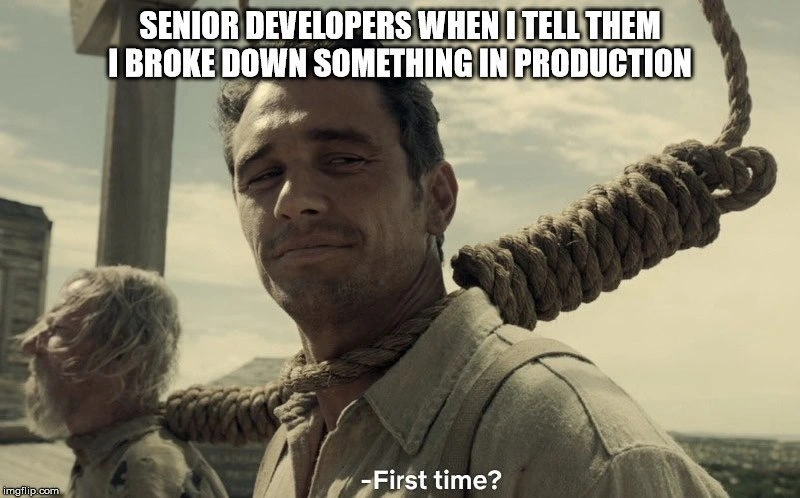
This meme uses the popular 'First time?' format from the film 'The Ballad of Buster Scruggs.' The image shows a man with a noose around his neck, looking calmly at someone off-screen and asking, '-First time?'. The text overlay reads, 'SENIOR DEVELOPERS WHEN I TELL THEM I BROKE DOWN SOMETHING IN PRODUCTION'. The meme humorously captures the vast difference in reaction between a panicked junior developer and a seasoned senior when a critical production issue occurs. For the junior, it feels like a career-ending catastrophe. For the senior, who has seen and caused numerous production outages, it's just another day at the office. The joke resonates with experienced developers who have learned that production failures are an inevitable part of the job and a crucial, albeit stressful, learning experience
Comments

6
Anonymous ★ Top Pick The difference between a junior and a senior is that the junior is afraid of breaking prod, while the senior knows exactly how to break it in a way that makes them look like a hero when they fix it
  1. Anonymous ★ Top Pick

    The difference between a junior and a senior is that the junior is afraid of breaking prod, while the senior knows exactly how to break it in a way that makes them look like a hero when they fix it

  2. Anonymous

    Congratulations, you’ve now earned the senior-engineer starter badge: 1) 3 AM pager serenade, 2) sweaty-palmed kubectl patch on live traffic, 3) the quiet certainty our rollback script hasn’t been run since the Obama administration

  3. Anonymous

    The real senior developer move isn't preventing production incidents - it's having your rollback strategy, incident response playbook, and blameless postmortem template ready before you even merge to main, because after 15 years you know that production is just staging with consequences and a pager

  4. Anonymous

    The real difference between junior and senior engineers isn't the ability to avoid breaking production - it's having broken it enough times that you've already mentally drafted the incident report, calculated the RTO, and know exactly which Slack channels will light up in the next 30 seconds. The senior's calm 'first time?' isn't mockery; it's the thousand-yard stare of someone who's been through enough post-mortems to know that this too shall pass... after the rollback, the hotfix, the all-hands, and the inevitable 'let's add more monitoring' action item that never quite gets prioritized

  5. Anonymous

    Seniors measure outages in MTTR, not shame: your first prod breakage just taught you why roll-forward beats rollback when the migrations aren’t idempotent

  6. Anonymous

    Prod break? 'First time?' - the senior dev's way of saying your incident report just joined their 20-year backlog of war stories

Use J and K for navigation