A Developer's Guide to Self-Deception
Why is this Testing meme funny?
Level 1: Works on My Machine
Imagine a kid cleaning their room by shoving all their toys and clothes under the bed, then proudly yelling, “All clean!” to their parents. 😄 Deep down the kid knows they didn’t really do a good job, but they want to believe it’s fine (and hope no one looks under the bed). This meme is playing with that same kind of situation, but for a programmer. It’s like a programmer saying, “Oh yeah, I definitely checked everything and it’s all perfect!” when in reality they just did a quick pass. We find it funny for the same reason the parent would smirk at the “clean” room: the person is fooling themselves and kind of getting ahead of reality. In both cases, sooner or later the truth comes out – the toys tumble out of the closet, or the software bug shows up – and everyone has a good laugh (and a bit of a groan) about the overly optimistic claim. The humor comes from that little wink of understanding: we know you didn’t really double-check, but nice try pretending!
Level 2: But Did You Test It?
If you’re a newer developer, one of the most common questions you’ll hear after saying “I think I’m done with this feature” is, “But did you test it?” This meme is built around that very question in a joking way. It jokes that every programmer claims “Oh yeah, I tested my changes thoroughly before sharing my code,” even though, in reality, many don’t do as thorough a job as they pretend. The title on the meme’s fake book is essentially a developer boldly saying: “I definitely checked my work!” – and everyone knowing that’s often not true.
Let’s break down the scenario: In normal software development, after you write some code, you’re supposed to test it to make sure it actually does what it’s supposed to do and that it didn’t break anything else in the process. Testing can mean running the program yourself and trying out the new feature (manual testing), and it often also means writing or running automated tests. Automated tests are little chunks of code that automatically verify parts of your program. For example, a unit test might call a function in your code with a sample input and check that the output is what you expect. If the output is wrong, the test will fail, alerting you to a problem. There are also integration tests that check if different pieces of the app work together correctly (imagine testing a full user login flow from the front-end to the back-end as one whole sequence). The idea is that by the time you’re ready to share your code with others, you’ve run these tests (and maybe clicked around the app yourself) to confirm everything is working properly.
Now, what does “commit and push” mean? These are terms from Version Control, specifically Git (which most developers use to manage code changes). When you commit in Git, you’re saving a snapshot of your changes to your local repository, usually with a message describing what you did. For example, you might write git commit -m "Add discount calculation feature" to record that change. When you push, you send those committed changes up to a remote repository (like on GitHub or your company’s Git server) so that others can see them or so that the code can be deployed. Pushing is like saying “Okay team, here’s my code, I think it’s ready.” Often, pushing triggers an automated build or test run on a server, and it certainly makes your changes available to your teammates.
“Testing before you commit and push” therefore means you, the developer, double-check your work before making it official and sharing it. It’s like reviewing an essay one more time for typos before emailing it to your teacher. If you don’t test and just commit & push, you might be sending out code that has problems. The meme is funny to developers because so many times people skip that all-important review/test step. Maybe they were in a rush, maybe they thought the change was so small that “nothing could possibly go wrong,” or maybe they just got a bit lazy and said “Eh, it works on my machine, let’s ship it.” We’ve all been tempted to do this, especially when a deadline looms or we think we’re making a “safe” tweak.
The problem is, when you don’t test properly, things do go wrong. For a junior programmer, it’s an important lesson: even if your code runs once without crashing, there might be scenarios you didn’t consider. For example, imagine you modified how the login process works in a web app. You try logging in with your own account and it seems fine (yay!). You decide that’s good enough and push the code. But unbeknownst to you, you accidentally broke the sign-up form for new users, because your change didn’t account for something in that scenario. Since you didn’t test that part, the first person who tries to register an account after your update is going to hit a error. Uh-oh! If you had taken a bit more time to run through creating a new user, or if you had a unit test simulating a new user sign-up, you would have caught the bug before it went out. This is exactly what the meme is poking fun at: the way developers assure themselves everything is fine without actually checking all the pieces.
There’s a well-known phrase in programming teams: “Works on my machine.” It’s practically the developer’s motto when a bug is found by someone else. It means, “Hey, it ran without issues on my computer, so I assumed it was okay.” The meme’s joke is in the same spirit. Saying “I definitely tested my code thoroughly” when you really only tried one quick thing is like saying “It works on my machine, so I’m sure it’s good everywhere.” Experienced developers and team leads often respond to that with “Well, did you test it on a clean environment or with different inputs?” Usually, the answer is “…not really.” That’s why they ask, “But did you really test it?” as a gentle challenge. It’s a reminder to be more diligent.
In many team environments, there are safeguards for untested code. For instance, when you push your changes, an automated build system might run all the tests on a server. If any test fails (meaning something broke), it will flag your commit and say “❌ Tests Failed.” That’s essentially catching you red-handed for not testing something. It’s a bit embarrassing, and it can hold up the team if your commit is in the main branch because it might stop others from deploying or merging their work (“the build is broken!” is a dreaded phrase). Similarly, some teams have QA (Quality Assurance) engineers or testers whose job is to try out the new code in a staging environment and look for issues. If you skip testing, chances are the QA folks will find the bug and come back to you with something like, “Hey, logging out doesn’t work anymore after your change—did you test this scenario?” It’s not a fun thing to hear, because it was your responsibility to catch that. In short, not testing your code can quickly lead to broken features and extra work for you and your teammates.
So what makes the meme funny is that it’s so true in a tongue-in-cheek way. Every developer says they will be careful and test everything, just like every student might say “I checked my homework twice.” But in reality, people often rush and skip the checks. The cover of the book in the meme basically calls out developers with a friendly jab: “You claim you test before pushing? Haha, sure you do… what a joke!” It’s a form of self-deprecating humor — developers poking fun at their own bad habits. Seeing it presented as the title of a big official-looking book just adds to the irony, because usually books with long titles like that are full of hard truths or serious content, whereas here it’s pure sarcasm. The takeaway for a newcomer is: testing your code is very important, and everyone knows it’s important, but even so, people often fail to do it as well as they should. That shared guilty knowledge is what makes the meme resonate. It’s funny because when you read it, you can almost hear every developer you know laughing and saying, “Yeah… I’ve told myself that joke before.”
Level 3: Commit, Push, Pray
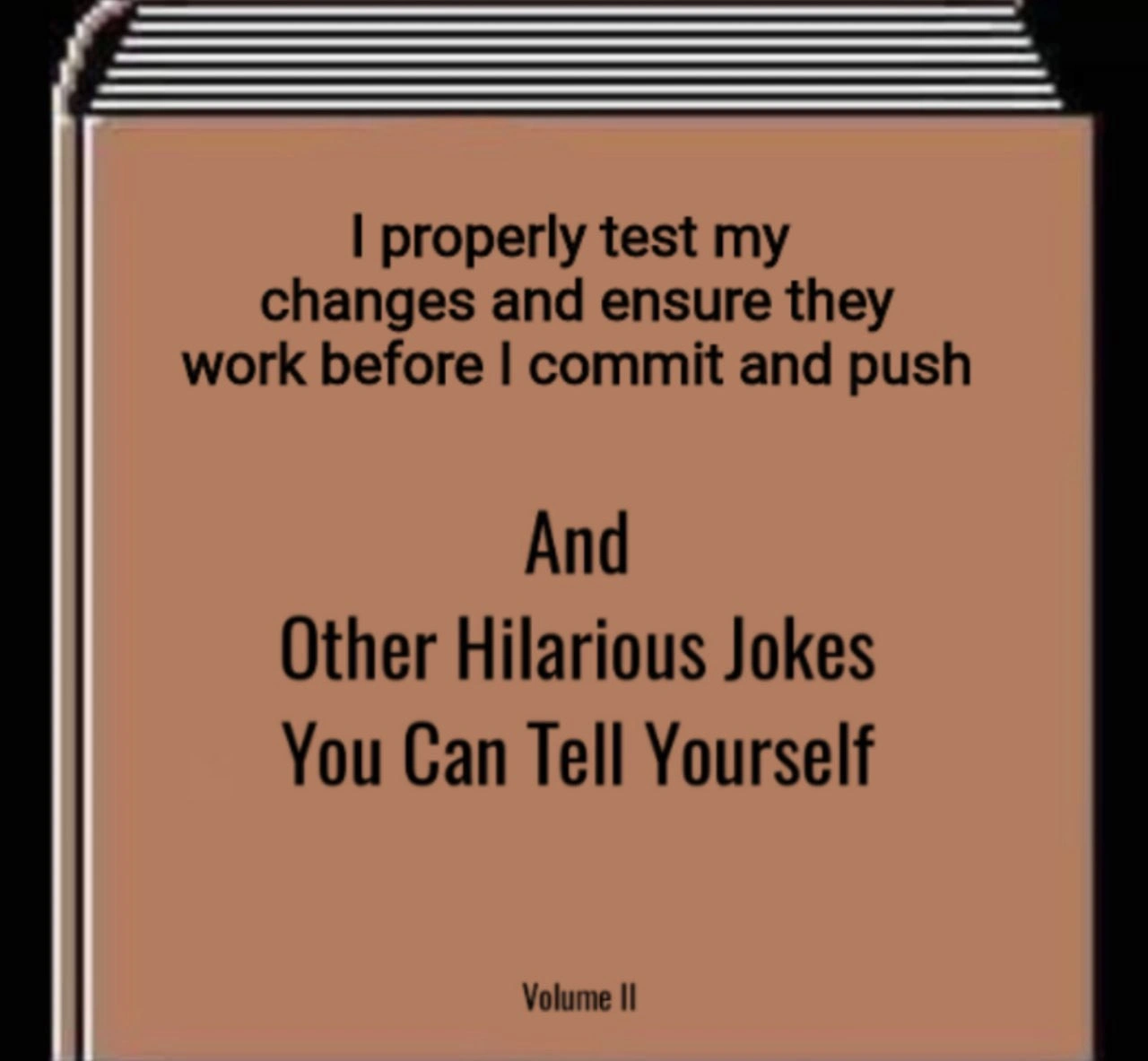
"I properly test my changes and ensure they work before I commit and push"
And Other Hilarious Jokes You Can Tell Yourself (Volume II)
This meme presents a thick book cover emblazoned with a developer’s idealized claim: “I properly test my changes and ensure they work before I commit and push.” The punchline is the subtitle “And Other Hilarious Jokes You Can Tell Yourself,” suggesting this claim belongs in a comedy anthology of programmer myths. The fact it’s labeled Volume II hints there’s an entire series of blatant lies developers tell themselves (Volume I was probably titled “My code has complete documentation” or “I’ll fix that hack next sprint” – equally mythical promises). The humor targets the glaring gap between best practices and actual behavior in real-world software development.
Seasoned engineers immediately smirk at this cover because the grand proclamation on it sounds mythical. In theory, every code change should be thoroughly verified: you write unit tests for new logic, run the full test suite, maybe do some manual clicks, and only then commit your code to version control and push it for integration. That’s CodeQuality 101 in a perfect world. In practice? Let’s just say reality often begs to differ. Under deadline pressure or sheer overconfidence, many of us hit git commit and git push with fingers crossed, skipping some (or all) of the recommended testing. It’s the classic commit_without_testing scenario that the meme mocks. We’ve all seen a colleague merge a change at 4:59 PM on Friday without running the tests – or we were that colleague. This is where the subtitle of our level comes in: Commit, Push, Pray. Instead of “commit, push, verify,” developers end up in a mode of “commit, push, and then pray nothing breaks”. The meme is calling out that unspoken ritual of hope-driven development.
For experienced devs, the joke cuts close to the bone. We know skipping tests is bad, yet it still happens with alarming regularity. The consequences of this habit are the stuff of industry lore: the “small one-line change” that crashes a critical server, the quick hotfix that accidentally introduces a memory leak, or the refactor that breaks the login flow and locks out thousands of users. Each of these disasters often traces back to code that wasn’t properly tested before being pushed. There’s a shared understanding among battle-scarred programmers that whenever someone confidently says “It’s all good, I tested it,” there’s a non-zero chance they missed something. It’s practically a running gag on forums and in DeveloperHumor threads – precisely because it’s so relatable. The meme’s book-title format exaggerates this fib, as if to say: “Sure you do, and I’ve got a bridge to sell you.”
Why do smart developers skip testing? Here are some classic self-justifications we’ve all heard (or used):
- “It’s just a small change, what could break?” – Famous last words. Even a one-line change can have ripple effects that cause spectacular failures elsewhere.
- “I tried it once and it worked on my machine.” – The classic excuse. Works on My Machine™ often means the code only runs in the developer’s special environment and hasn’t been truly vetted. Different settings or data can quickly prove this false.
- “We have QA for that; they’ll catch any bugs.” – Over-relying on a Quality Assurance (QA) team to find obvious issues is a bad look. If a basic bug slips through because the developer didn’t even do a quick check, it’s embarrassing and wastes everyone’s time.
- “I’ll write the tests later, I swear.” – A common lie we tell ourselves. “Later” turns into “never” as new tasks pile on. This procrastination accumulates technical debt – that unpaid “interest” in the form of bugs and brittle code that will bite you back eventually.
Each of these flimsy excuses has led to its share of 3 AM pager alerts and emergency deploys. We laugh at those lines now, but there’s real pain behind them. If you dig through a project’s version history, you might even find evidence of this pattern: a commit that introduces a feature followed shortly by a sheepish “fix bug 🐛 in last commit” because something obviously broke. Version control tools like Git don’t lie – the timeline of commits will expose when a developer was scrambling to patch things they didn’t test. In teams with Continuous Integration (CI) pipelines, it’s common to see a push trigger a flurry of automated tests. A developer who skipped local tests ends up anxiously watching the CI dashboard, hoping for a green build. It’s essentially outsourcing your testing to the CI system and trusting luck. Many of us have been there: the code flies up to GitHub, and then you pray as the test suite runs on the server, half-expecting a failure to come back and smack you. The meme’s joke is exactly that – claiming you were totally careful, when in fact you’re relying on hope and a safety net.
In some cases, developers even circumvent safety nets on purpose. For instance, Git has a --no-verify option that lets you skip any pre-commit or pre-push hooks (these hooks might run automated tests or lint checks). It’s like saying:
git commit -m "Quick fix – skip tests" --no-verify
git push origin main
The --no-verify flag explicitly tells Git “don’t run the tests/linting I’ve set up, I’m sure it’s fine.” 🙄 It’s a power move – or rather, a reckless one – effectively pushing code while whistling past the graveyard. When a teammate sees a commit with --no-verify, they know the author was feeling lucky (or desperate). It’s another entry in the “hilarious jokes” book: “Trust me, I don’t need the safety checks this time.” Spoiler: they usually did.
All of this is why the meme lands so well in programming circles. It’s self-deprecating humor at its finest. We’re essentially admitting, “Yeah, I’ve broken the rule about testing, and it is kind of ridiculous that I still claim to do it properly every time.” The joke book format makes it over-the-top obvious that the statement is a lie, and that’s what gets the laugh. Every developer chuckles because they recognize a bit of themselves in that book title. It’s both cathartic and a tiny bit painful – we joke about it because we know we should do better. In the end, the meme’s message is clear beneath the laughter: no one is perfect at testing their code, and pretending otherwise is a joke we’ve all told ourselves.
Description
The meme shows the brown cover of a book, presented as a classic hardcover. The title reads, 'I properly test my changes and ensure they work before I commit and push', followed by the subtitle, 'And Other Hilarious Jokes You Can Tell Yourself'. Near the bottom, it humorously notes 'Volume II'. The image is a satirical take on a core principle of software development. It humorously suggests that the idea of rigorously testing every change before committing is a fantasy that developers tell themselves, but rarely adhere to in practice. For senior engineers, this is a relatable jab at the pressures of deadlines, the temptation of shortcuts, and the universal guilt of pushing code with a 'works on my machine' seal of approval, knowing full well it might cause issues down the line
Comments
10Comment deleted
Volume I was titled 'I'll write the documentation later.' It's still a work in progress, obviously
Our idea of “shift-left testing” is skipping the suite locally, pushing straight to main, and letting the 40-minute Jenkins pipeline fail - we call it feedback-driven courage
After 20 years in the industry, I've learned that 'Volume II' exists because Volume I ('I'll refactor this later') sold out immediately at every tech conference bookstore, right next to 'The Mythical Man-Month' and 'Clean Code' - books we all own but never quite finish reading
The sequel nobody asked for but everyone relates to - because let's be honest, 'git push --force' is basically our version of 'trust me, it works on my machine.' The real test suite is production users filing tickets at 3 AM
I “test before I push” by shipping behind a feature flag to 1% canary traffic and letting the error budget and the dead-letter queue tell me which unit test was lying
Our pre-commit hook is called '--no-verify'; the actual test suite runs on main and pages whoever believed the book
Senior ritual: Skip tests, commit to main, validate via prod outage symphony
Working on my own Comment deleted
No need to care about branch name and merge requests Comment deleted
*loneness sounds* Comment deleted