Skip to content
DevMeme
4187 of 7435
That mythical moment senior devs finally agree on a tiny detail
Communication Post #4573, on Jun 25, 2022 in TG

That mythical moment senior devs finally agree on a tiny detail

Why is this Communication meme funny?

Level 1: Siblings Share a Toy

Imagine two siblings who always argue about every little thing – like what game to play or who gets the last cookie. Every day, you hear them bickering: “It’s my turn!” “No, I want it this way!” Now picture one afternoon those two siblings suddenly agree on something small, say which TV show to watch or how to build a LEGO set, without any fight. The whole family might pause in disbelief because it’s such a surprise! It’s almost like a magical moment at home. This meme is joking about that kind of feeling. It’s comparing experienced programmers who usually disagree (just like squabbling siblings) to a miracle moment when they finally get along over a tiny issue. It’s funny and sweet in a way – because everyone knows how rare and special it is when people who often argue suddenly say “Yes, let’s do it the same way.” It shows even if they usually fight over silly details, once in a blue moon they might share the same idea, and when they do, it feels as extraordinary as a bit of magic.

Level 2: Tiny Code Battles

For a newer developer or someone outside the coding world, let’s break down what’s going on. This meme highlights a typical scene from a software team’s life: a code review discussion. Code reviews are when developers check each other’s code changes before merging them, to catch mistakes and ensure consistency. It’s a bit like proofreading each other’s work in a shared project. In these reviews, developers can leave comments, suggestions, or ask for changes. Now, a “trivial” issue in code is something very small or low-impact – for example, it could be as minor as adding a missing comma, choosing one word over another in a name, or adjusting code formatting (like spaces and indentations). It’s the kind of detail that doesn’t really change how the program runs; it’s mostly about style or personal/team preference.

Senior devs (senior developers) are the experienced members of the team who have been coding for years. They usually mentor others and make big design decisions. Because of their experience, they often have strong opinions on how things should be done — even on little things. Imagine two senior devs as two old pros who’ve each been through many projects. They’ve seen what can go wrong and what makes code maintainable, so they’ve developed their own set of “best practices.” However, their personal best practices might not always match each other’s. This can lead to clashes over very tiny details.

Think of a small scenario: Alice and Bob are both senior developers. Alice likes to name variables like total_users and Bob prefers user_count. Both names mean the same thing. If Alice is reviewing Bob’s code, she might comment: “Maybe rename user_count to total_users for clarity? That’s what we usually do.” Bob might reply, “I’ve always used user_count. It’s clear enough and shorter.” Now they’re in a debate over two equivalent names! It’s a tiny code battle. The code works fine either way, but each of them feels their choice is a bit better. This kind of disagreement is called a nitpick – focusing on a very small detail (developers often label such comments with “nit:” to show it’s not a big deal, yet here they are discussing it at length).

There’s a funny term for this: “bikeshedding.” The word comes from a story that people spent so much time arguing about what color to paint a bikeshed, while hardly discussing a much more important project (like building a nuclear reactor). In software teams, bikeshedding means everyone enthusiastically debates a minor issue because it’s easy to have an opinion on it, whereas they might stay quiet on the hard, complex problems. In our case, picking a variable name or where to put a curly brace is the “bikeshed” topic – simple, familiar, and unintimidating – so it often gets a lot of attention and discussion, sometimes unnecessarily.

When the meme says “two senior devs agree on something so trivial,” the joke is that this almost never happens without some back-and-forth. Usually, each senior dev will argue their side on a trivial matter for a while. It might start friendly, but it can drag on, sometimes even getting a bit stubborn. For example, one senior might insist on adding a comma at the end of every line in a JSON file for consistency, and another might insist it’s unnecessary – they could go in circles about this insignificant detail. Eventually, either one of them gives in or they find a compromise. When they finally agree, everyone else on the team might jokingly breathe a sigh of relief. It’s like, “Phew, the saga of the comma is over!”

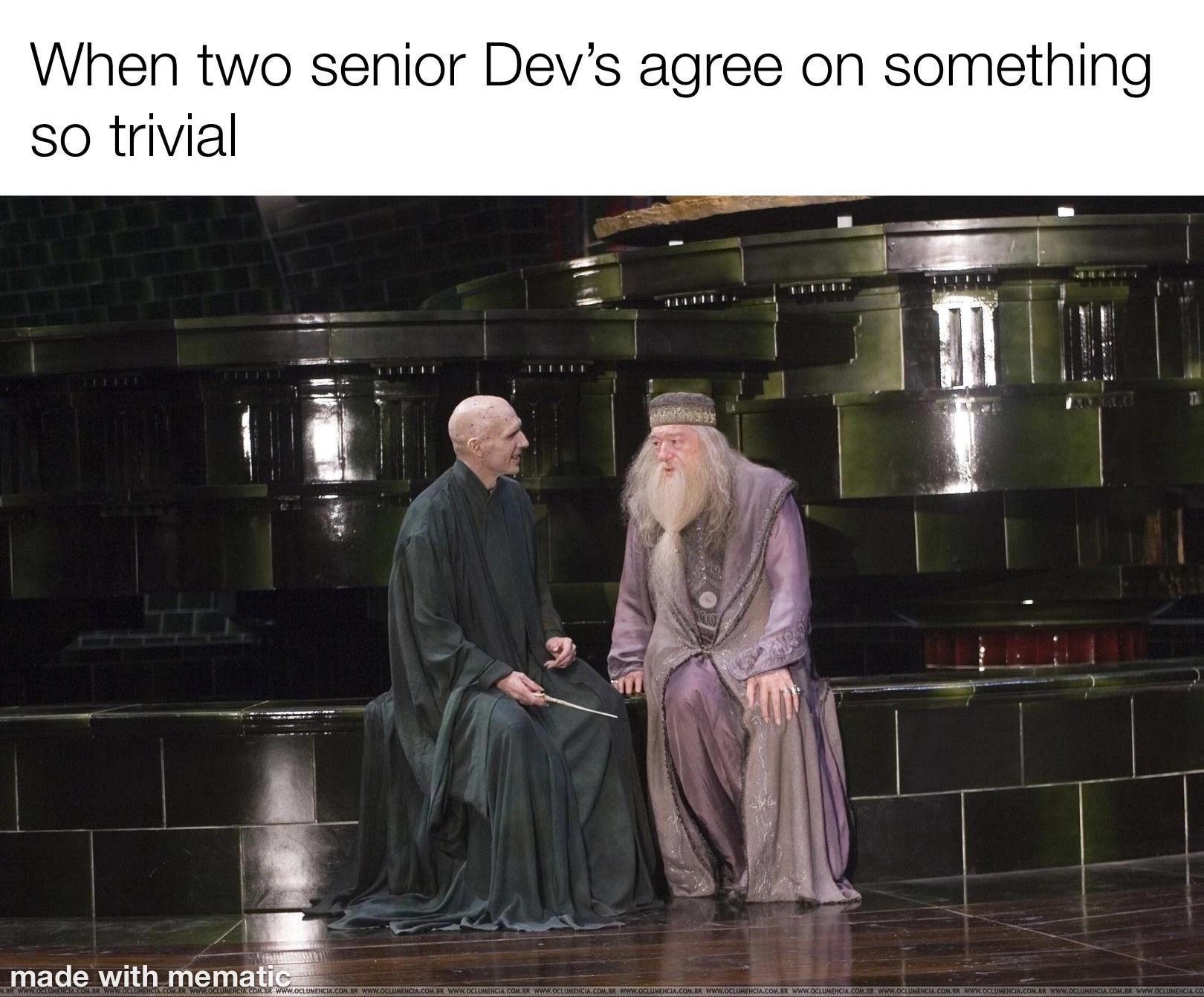
The meme uses a very visual metaphor to illustrate this rare agreement. The image shows two old, powerful wizards (if you’ve seen or heard of Harry Potter, they resemble Dumbledore and Voldemort). In the stories, those two are enemies who almost never see eye-to-eye. They’re usually depicted fighting, not sitting calmly and chatting. But here, in the picture, they look relaxed and amicable, as if they’ve suddenly become friends. This wizard meeting metaphor exaggerates how unusual the situation is: seeing them agree is as astonishing as seeing our two senior devs finally on the same page about a petty code detail. It’s a bit like saying, “When this happened, it felt like fantasy or magic!”

Why is this funny and relatable? In developer culture, it’s well-known that programmers can get into surprisingly intense debates over things that seem very small. If you’re new to coding, you might find it odd – “Why do they care so much about a space or a comma?” – but when you work on code every day, you develop preferences and care about consistency. It’s similar to how an artist might care about a tiny brush stroke; to them it matters for the overall quality, even if others barely notice it. Senior engineers especially have been through many codebases, so they can be very particular about avoiding even minor issues (because sometimes minor issues do snowball into bigger problems, or maybe they just like things neat and their way). These discussions are part of the collaboration challenges in software teams. Everyone is trying to make the code better, but they might disagree on how to do that, even at a micro level. It can be a bit frustrating – hence “pain points” – when a code review for a simple change takes an hour due to such deliberations. At the same time, it’s a shared humor point. Developers joke about it because almost every team has a story of a super long argument over something like code style.

This meme is basically laughing at that common experience. It’s saying: “Look, when these two senior devs actually agreed on a teeny-tiny thing, it was such a rare occasion that it felt as epic as two legendary wizards making peace.” The developer humor here comes from recognizing how absurd it is that we treat these moments like big victories. It’s very relatable humor for software folks: we’ve all rolled our eyes at a trivial debate, or ironically celebrated when a pointless argument finally ended. By using the dramatic wizard imagery and the word “mythical,” the meme lightheartedly mocks the overimportance we sometimes give to trivial decisions. In short, it’s funny because it’s true – even though it probably shouldn’t be that way, it often is. And when the trivial consensus finally happens, it indeed feels like witnessing a unicorn or a magical event in the office. 🦄✨

Level 3: Arcane Bikeshed Truce

In the meme, two wise, wizardly figures (think a benevolent grey-bearded sage and a bald dark sorcerer) are leaning in together as if they’ve finally found common ground. This imagery references a famous duo of arch-enemies from pop culture to dramatize what’s happening: two senior software engineers miraculously agreeing on a trivial detail. In real software teams, that scenario can feel as fantastical as rival wizards forging a peace treaty. The caption sets the stage: “When two senior devs agree on something so trivial.” It’s tongue-in-cheek because senior developers are notorious for heated code-review debates and bikeshedding over the smallest things.

Bikeshedding – formally known as Parkinson’s Law of Triviality – is the phenomenon where groups spend disproportionate time on minor, easy-to-grasp decisions while major complex matters get little attention. In a programming context, this means a code review might gloss over a critical architectural choice in minutes but explode into a 30-minute argument about naming a variable or indentation style. Senior devs, with years of experience and strong opinions, often unwittingly fall into this trap. Each has honed their preferred way to write code (often backed by past lessons or team conventions), so even an insignificant code style issue can ignite a mini holy war. The meme humorously suggests that getting two such seasoned engineers to reach consensus on a nitpick is almost a mythical event. It’s as if Dumbledore and Voldemort (the visual metaphor here) suddenly sat down and said, “Actually, yes – we both like the same solution to this minor issue.” 🧙‍♂️🤝🧙‍♂️

To seasoned developers, the humor cuts close to home. We’ve all seen those pull requests where a single-line change spawns a long discussion thread. Picture a code review on a tiny formatting detail: one senior dev comments “nit: add a space after the comma” and the other fires back “Actually, our style says no space there.” Back-and-forth it goes, like a wizard duel of coding ideals. Meanwhile, the important logic in the change might get a quick “LGTM” (Looks Good To Me) without much fuss. The imbalance is absurd, yet familiar. That’s why this meme is so relatable in developer culture – it exaggerates a real pain point for comedic effect.

Consider some legendary trivial battles that software engineers famously fence over:

  • Tabs vs Spaces – How to indent code. It doesn’t affect execution at all, but debates on this have raged for decades (to the point of making it into TV comedy skits about programmers). Each side insists their choice is cleaner or more standard.
  • Brace Style – Whether to put { on the same line as a statement or on a new line. Entire style guides are written on this, and teams often passionately defend their chosen convention (e.g. K&R style versus Allman style in C/C++/Java).
  • Variable Naming – e.g. naming a counter numItems vs. itemCount. Two seniors might argue which one is clearer or more consistent with the project. It’s a tiny linguistic choice, but it can become a matter of pride in code consistency.
  • String Quotes – In some languages like JavaScript, one dev prefers "double quotes" while another adamantly uses 'single quotes' for strings. There’s no functional difference in output, yet teams enforce one or the other to stay uniform.
  • Trailing Commas – Should the last item in a list or object have a comma after it? One camp likes the convenience in diffs, the other finds it ugly. Cue the debate about a comma that changes nothing in execution.

These are classic examples of developer bikeshedding. They’re essentially stylistic or very low-impact choices, but they can lead to surprisingly heated discussions in code reviews. Senior engineers often carry the scars of past projects where a “simple style issue” might have caused a bug or maintenance hassle, so they come in ready to defend their way. On the flip side, sometimes it’s just personal preference forged into habit. When two strong-willed devs each have their way of doing things, even trivial decisions can turn into prolonged standoffs in meeting rooms or comment threads.

What makes the meme funny is that it captures the sheer rarity of a peaceful resolution in such standoffs. The image of two wizard elders congenially chatting is a perfect exaggeration: it’s referencing Harry Potter icons (a good wizard and an evil wizard normally at odds) finally seeing eye-to-eye. This is satire of developer culture – equating a mundane coding agreement to an epic lore event. It pokes fun at the collaboration challenges and egos in tech teams: we all know code should be about making things work, yet here we are summoning grand debates over a missing semicolon. When those debates finally end in agreement (especially without management stepping in or someone grudgingly saying “fine, whatever”), it feels like magic. The humor has a hint of sarcasm: “Wow, they actually agreed on that tiny thing – break out the champagne, miracles do happen!” It’s a gentle jab at how communication in engineering teams can blow the simplest issue out of proportion.

From a senior dev’s perspective, there’s also a bit of self-irony here. They recognize themselves in this meme. It’s common to chuckle and think, “Yep, guilty as charged – I’ve been in those pointless battles over code style.” The meme resonates because it’s a shared inside joke about Developer Experience (DX): the day-to-day of coding isn’t just solving hard problems; it’s also wrestling with team conventions and enduring the occasional absurdly long debate about nothing. This “mythical moment” of trivial consensus is something many have yearned for during exhausting review sessions. By depicting it as a legendary wizard détente, the meme acknowledges that, yes, we make life harder than it needs to be, and seeing it resolved (even hypothetically) is both funny and oddly satisfying.

Description

The meme has a white header with bold black text that reads, "When two senior Dev’s agree on something so trivial." Below the caption is a stage photo of two wizard-like figures dressed in elaborate robes (one in dark green, the other in lavender with a long grey beard). Both characters sit side-by-side on a glossy, black-tiled dais, leaning toward each other as if sharing a rare, solemn understanding. Their faces are blurred for anonymity, and one casually holds a wand, underscoring the tongue-in-cheek “magical” rarity of the scene. The image humorously compares legendary enemies finding common ground to senior engineers unexpectedly aligning on an insignificant code nit - highlighting how heated code-review debates and endless bikeshedding make even minor consensus feel almost mystical

Comments

6
Anonymous ★ Top Pick The moment both principal wizards LGTM’d that one-character PR, the org-wide mutex called “Architecture Sync” finally released - right up until someone asked what color the next bikeshed should be
  1. Anonymous ★ Top Pick

    The moment both principal wizards LGTM’d that one-character PR, the org-wide mutex called “Architecture Sync” finally released - right up until someone asked what color the next bikeshed should be

  2. Anonymous

    Two architects who've spent three sprints debating event sourcing vs CRUD suddenly achieve enlightenment over tabs being objectively superior to spaces

  3. Anonymous

    The rarest sight in software engineering: two principal engineers who've spent decades in the trenches, each with their own battle-tested opinions on microservices vs monoliths, event-driven vs request-response, and whether Kubernetes is salvation or over-engineering... finally nodding in agreement. The topic? Whether the variable should be named 'userId' or 'user_id'. Meanwhile, the architectural decision that will define the next five years of technical debt sits unresolved in the backlog, because nobody can agree on whether to use REST or GraphQL

  4. Anonymous

    Two staff engineers finally agree on 2‑space indentation - congrats, the human Raft cluster reached quorum for .prettierrc, not the data model

  5. Anonymous

    Two senior devs agree on something trivial - quorum finally reached, but only on the bikeshed; production's still in split-brain

  6. Anonymous

    Rarer than two staff engineers aligning on monorepo boundaries without invoking Conway's Law

Use J and K for navigation