Skip to content
DevMeme
4188 of 7435
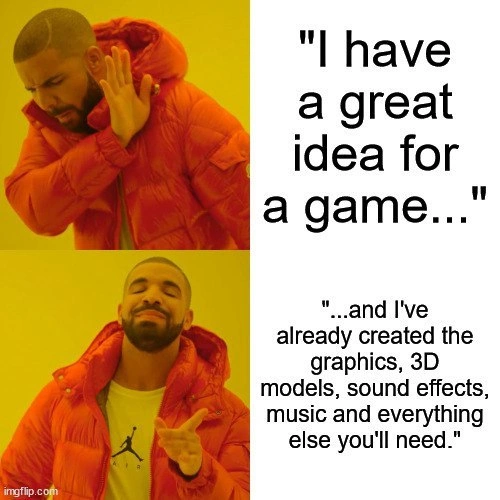
Drake meme: developers embrace game ideas that arrive with complete asset pack
GameDev Post #4575, on Jun 25, 2022 in TG

Drake meme: developers embrace game ideas that arrive with complete asset pack

Why is this GameDev meme funny?

Level 1: Bring Your Own Bricks

Imagine you and your friend want to build a big LEGO castle. The first friend says, “I have a super cool idea for a castle!” but they didn’t bring any LEGO bricks, no drawings, nothing – they just have the idea and want you to do all the building. That wouldn’t be very fair or exciting for you, right? It means you’d have to find all the pieces and figure everything out from scratch. Now, picture a second friend who also says, “I have a super cool idea for a castle,” but this friend comes over with a huge box of LEGO bricks, all sorted by size and color, and even a little blueprint (a drawing) of how the castle should look. They’ve also brought mini figurines, flags, and all the fun details for the castle. You’d probably be really happy to build that castle together because your friend did a lot of the hard work already – they brought all the materials and a plan! All you have to do is put it together with them, which is the fun part.

This is exactly what’s happening in the meme. The developer is like you, and the person with the game idea is like one of those friends. When someone just says “I have a great idea” but has nothing else, the developer feels like they’re being asked to do all the work (just like building a castle with no bricks given). But if someone says “I have an idea, and I’ve already made all the artwork and sounds for it,” that’s like the friend who brings the box of LEGO and a plan. The developer is happy because now they can focus on putting things together and making the game fun, instead of also having to gather or create all the pieces from scratch. In simple terms: it’s always more fun to build something when your friend brings all the pieces, not just the idea!

Level 2: Idea vs Execution

This meme is using the popular Drake meme format, which shows two reactions by the rapper Drake: in the first image he’s rejecting something with a hand up ("Nope"), and in the second image he’s pointing happily at something he likes ("Yes, that!"). Here, the text in the first panel says: "I have a great idea for a game..." and Drake is rejecting that. The text in the second panel continues: "...and I've already created the graphics, 3D models, sound effects, music and everything else you'll need." and Drake is delighted with that statement. Essentially, it’s showing two ways someone can approach a game developer with a project idea, and how the developer feels about each approach:

  • First scenario (Drake says “No”): Someone just says, "I have a great idea for a game!" and nothing more. This is a very common situation. The person has an idea but hasn’t done any of the actual work to make it happen. Developers often get approached by friends, clients, or stakeholders who have a cool concept in mind but expect the developer to do 100% of the execution (all the coding and all the content creation). Drake turning away in the meme represents a developer’s instinct to reject or avoid this kind of proposal. It’s not that developers hate ideas – it’s that they know turning an idea into a real game is a huge job. If someone only brings an idea to the table, it means the developer would have to handle everything else: writing the code, of course, but also possibly making or obtaining all the art, sounds, and other content. That’s like someone saying, “I have an idea for a movie, you go film it and do the effects and music, okay?” It feels one-sided and unrealistic.

  • Second scenario (Drake says “Yes”): The sentence continues with, "...and I've already created the graphics, 3D models, sound effects, music and everything else you'll need." Now this is a very different proposal. Here, the person not only has an idea, they also did a ton of work to support that idea. They made the graphics (2D images or textures), the 3D models (the 3D characters or objects you see in the game), the sound effects (like the noise for footsteps, jumps, or explosions), the music (background soundtrack), and basically everything else the game would require in terms of content. In other words, they are handing the developer a complete package of assets needed for the game. Drake’s happy, approving face in this panel represents a developer who is pleasantly surprised and excited by this situation. It’s like saying, “Wow, you’ve done all that? Yes, I’d love to work on this with you!”

Let’s break down some terms and why the developer’s reaction changes so much between these two scenarios:

  • Assets: This word is used a lot in game development. Assets are all the pieces of content that go into a game. That includes art (like character drawings, environment backgrounds, icons), 3D models (if it’s a 3D game, these are the meshes of characters, buildings, etc.), textures (the images that skin the 3D models with color and detail), animations, sound effects (gunshots, footsteps, jump sounds), and music tracks. Basically, anything that isn’t programming code but is used in the game’s world is an asset. Creating high-quality assets is a big job – typically, artists, animators, and sound designers spend a lot of time on this. If someone tells a developer “I have all the assets ready,” that means a huge chunk of the work is already done. It’s the difference between starting a painting on a blank canvas versus being handed a fully outlined drawing that just needs some coding “paint by numbers” logic filled in.

  • Game development pipeline: The term pipeline here means the workflow or the process that game development follows from start to finish. In a simple view, the game development pipeline includes steps like coming up with the concept/idea, designing the game (rules, story, characters), creating the assets (art, sound, levels), programming the game (writing code to make it all work), testing and fixing bugs, and then releasing the game. When someone only provides an idea, they are essentially leaving all the other steps of the pipeline to the developer. That’s a lot to take on! It’s not just writing a few lines of code – it’s managing an entire project from scratch. But if someone comes with an idea and all the assets already made, they’ve taken care of the design and asset creation parts of that pipeline. The developer can plug those assets into a game engine and focus mainly on the programming and maybe some integration testing. It’s as if half the pipeline is already completed before the developer even starts. That’s why Drake (the developer) looks so happy: the boring and difficult parts like sourcing art and sound are not dumped on him at the last minute. Everything is ready to go (we sometimes say those assets are pipeline-ready, meaning they can smoothly move through the rest of the development process).

  • Stakeholders/Clients: These words refer to people who have a stake in the project or who request the project. A client might be someone who hires a developer to create a game for them, or it could be a boss in a company who wants a certain game or feature made. A stakeholder is anyone who is invested in the project’s outcome (clients, bosses, investors, even end-users can be considered stakeholders). In this meme’s context, the stakeholder/client is the person with the idea for a game. In real life, developers often have to manage stakeholder expectations. Many stakeholders who aren’t familiar with game development might think that coming up with the idea is the hard part, and that building it is just a quick task for the programmer. This meme pokes fun at that misunderstanding. It highlights how a developer’s attitude completely changes when a client actually does their part and provides real supporting materials (like assets) for the project, instead of just demands. Essentially, the meme is saying to stakeholders: If you come with only an idea, don’t be surprised if the developer isn’t thrilled. But if you come with real assets and preparation, the developer will be very interested.

  • Scope creep: This is a term developers learn early in their careers. Scope creep means the scope of the project (the total set of planned features and work) keeps growing over time, often in an uncontrolled way. It usually happens when the initial idea or plan wasn’t clear or complete, so new ideas and changes keep popping up. For example, a client might start with “just a simple game idea,” and once development starts, they keep adding: “Oh, can we also have an online multiplayer mode? And maybe add some mini-bosses in each level? And how about an in-game shop?” Suddenly the project is much bigger than originally thought – that’s scope creep. Now, when someone only gives a developer a vague idea, the risk of scope creep is high because many details probably haven’t been thought through. The developer might start building and then the client will say “Actually, I was thinking it should also do X, Y, Z…” and the work increases endlessly. However, if someone has gone to the trouble of already making graphics, models, and sounds, it implies they’ve concretely decided on a lot of those details. You usually wouldn’t create a bunch of game art without knowing what the game is about. So a person who provides a complete asset pack likely has a pretty fixed vision – meaning less chance for sudden changes. The project’s scope is more defined and less likely to “creep” unexpectedly. That’s another reason a developer would welcome the second scenario: it suggests a well-thought-out project rather than a half-baked idea.

To put it simply, the meme is contrasting idea vs. execution. The first part (just an idea) is all “idea,” no execution. The second part (idea + assets) shows a lot of execution has already been done. Developers value execution very highly. A common phrase you’ll hear is “Execution is key.” Another is “Ideas are easy, implementing them is hard.” The meme humorously teaches this lesson. It tells would-be game creators that if you want a developer to join you or take your project seriously, don’t come empty-handed. Bring something tangible — working prototypes, design documents, or in this extreme (and funny) case, all the art and sound assets ready to go!

Here’s a quick side-by-side comparison of the two approaches depicted in the meme and how a developer is likely to react:

Pitch from the Person Developer’s Reaction (Drake’s stance) Why this Reaction?
"I have a great idea for a game!" (and nothing else) 🙅 No thanks... (Drake rejecting) An idea alone isn’t enough. The developer would have to do all the work — coding and creating/finding all art, sound, etc. It feels one-sided and over-simplified.
"I have a game idea, and all the assets ready!" 👍 Yes, let’s do it! (Drake approving) The person has provided the graphics, models, sounds, music — everything. The hard content work is done, so the developer can focus on coding. It shows the idea is serious and the project is feasible.

(In the table above, 🙅 represents Drake saying “no” with a hand up, and 👍 represents Drake happily giving a thumbs up.)

As you can see, developers get excited when someone has already put effort into the idea. It’s much easier (and more fun) to build a game when the client’s expectations are matched by preparation. On the flip side, when someone just has a big idea and expects “magic” from the developer, it sets off alarm bells. This meme is very relatable in gaming culture and the developer community because it highlights a truth of the game development pipeline: having a great idea is just the beginning, and the real challenge (and value) is in all the work required to bring that idea to life. The second panel essentially shows the ideal client or ideal collaborator – one who understands the process and contributes meaningfully. That’s why Drake (the dev) is all smiles in that bottom image.

For a newcomer to game development, the lesson here is: if you have a game idea and want to work with a developer, try to also bring something concrete to the table. It could be artwork you made, sample levels you sketched out, some music you composed, or even just a detailed design document. Showing that you’ve done more than just think about it – that you’ve started executing – will make developers much more receptive. They know you appreciate how much effort is involved. In short, developers embrace game ideas that come with real assets and preparation, and tend to brush off those that come with nothing but a sentence and a smile. This meme just delivers that message in a fun, exaggerated way with Drake’s help!

Level 3: The Fully Loaded Pitch

Every experienced game developer has encountered the classic pitch from a non-developer: "I have a great idea for a game!" Seasoned devs know to brace themselves at that moment. It usually means someone (a stakeholder or enthusiastic friend) has a grand vision but expects the developer to handle all the actual work. This meme uses the famous Drake Hotline Bling format to capture that scenario perfectly. In the top panel, Drake (standing in for the developer) is recoiling with a hand up, rejecting the statement "I have a great idea for a game..." Why? Because an idea by itself, however exciting, is just the tip of the iceberg in game development. In the bottom panel, Drake is smiling and pointing approvingly when the sentence continues, "...and I've already created the graphics, 3D models, sound effects, music and everything else you'll need." Now Drake (the developer) is thrilled. The meme humorously contrasts the typical idea-only pitch (which developers instinctively dread) with the fully-prepared pitch (which is so rare it's almost mythical). The punchline celebrates that unicorn client who not only has an idea but also provides a complete asset pack up front. It’s essentially saying: developers will eagerly embrace your game idea if you come prepared with all the artwork, audio, and content already done. Talk about a dream scenario!

Why is this so funny (and a bit painful) for game devs? Because in reality, ideas are plentiful and execution is everything. Implementing a game idea involves an enormous amount of work beyond just "having the idea." There’s coding the gameplay, of course, but also designing levels, making 2D/3D art, creating animations, recording or synthesizing sound effects, composing music, writing story text, testing for bugs, and much more. Oftentimes, non-developers vastly underestimate this workload. They might cheerfully say, "You just make it, it's a great idea, it'll be the next Minecraft!" while providing nothing else. In the industry, developers jokingly refer to these folks as “idea guys” – they contribute a grand concept but expect others to do the labor of turning it into a real product. So when Drake turns away from “I have a great idea for a game…”, it reflects that internal eye-roll every coder does upon hearing yet another pitch with no substance behind it. We’ve all been there: a stakeholder or friend enthusiastically describes a game that will surely be a hit, and then waits expectantly for you to magically produce an entire game out of thin air. It’s the classic mismatch of stakeholder expectations versus reality. Developers know an idea alone is the easiest part of the project – the real challenge is everything that comes after. As the saying goes in software (and especially in GameDev): “Ideas are cheap, execution is hard.”

Now look at the second panel of the meme: "…and I've already created the graphics, 3D models, sound effects, music and everything else you'll need." This line is basically a fantasy come true for any developer. Here, the stakeholder is not just tossing the idea over the wall; they’ve actually done all the heavy lifting on the content side. They’re handing over a treasure chest of game-ready assets: character sprites or models, background art, UI elements, sound effects for jumps and explosions, a full musical score – everything. In a real game project, creating or obtaining these assets often takes more time and money than writing the code! Art and audio production involve specialized skills and tools. A team might have multiple artists, modelers, and composers working for months to craft all that content. So if someone comes to a developer with a complete asset library prepared, it demonstrates an incredible amount of work already done. It’s like saying, “I don’t just have an idea – I believed in it enough to do all the artwork and audio. All you need to do is plug it in and code the game logic.” For the developer, that’s a night-and-day difference from the first scenario. Drake’s happy reaction stands for the dev thinking, “This person really understands what a game needs!” It shows commitment and respect for the development process. The idea-provider has essentially met the developer halfway (or more). They’re not just throwing a task at the dev; they’ve been in the trenches creating tangible output. In other words, they’ve moved from being just an “idea person” to being a collaborator who has contributed actual game assets. It’s no wonder Drake is smiling — the project just went from a vague request to a concrete, actionable plan with resources in hand.

From a project management perspective, arriving with all assets indicates a high level of pipeline readiness. In game development, the asset pipeline is the process of taking raw art/audio assets and integrating them into the game engine (like Unity or Unreal) in usable formats. This involves steps like converting files, optimizing textures, rigging models with skeletons, importing audio with correct settings, etc. A lot can go wrong in this pipeline: artists might deliver huge polygon models that the engine struggles with, or audio files might need reformatting. If a client says they’ve created “everything you’ll need,” a senior developer will hope that means these assets are production-ready (optimized and compatible with the target engine). That’s a massive leap forward in the project. It’s akin to skipping one of the hardest levels in the game development process. Instead of the dev spending weeks coordinating with artists or scouring the internet for usable sound effects and placeholder graphics, they can immediately start hooking these assets into code. The game development pipeline usually goes from concept -> design -> asset creation -> integration -> testing. Here, someone showing up with a box full of finished artwork and sound moves you straight into integration and coding. It eliminates one of the biggest sources of delays and headaches in making a game. Anyone who has waited on a critical 3D model or had to cut features because the art wasn’t ready will appreciate how huge this is. By providing assets, the stakeholder also implicitly sets some boundaries on scope – if all assets are done, the game’s content is largely decided and fixed, making it less likely that they’ll suddenly say “Oh, by the way, can we add five more levels and characters?” The scope of the project becomes concrete when assets exist. In contrast, an idea-only project is amorphous; it can expand endlessly (leading to the dreaded scope creep where new features keep creeping in, pushing deadlines forever). So the meme’s bottom panel isn’t just about saving work – it’s about having a clear, stable project definition. The developer can think, “Great, I know exactly what I need to build, and I have the pieces to build it.”

It’s worth noting how rare and refreshing this situation is. The humor carries a bit of an inside-joke truth: virtually every developer has heard “I have an amazing idea, you make it and we’ll be rich!” at some point, and those encounters usually go nowhere. The second scenario in the meme is practically a fairy tale. It’s so uncommon for someone to approach a developer with not only an idea but also a folder full of meticulously crafted art assets, a set of 3D models ready to import, and a library of sound effects and music tailored for the game. In the indie game dev scene, a solo dev often has to either wear many hats (programmer, artist, designer, audio engineer all in one) or collaborate with others to gather those assets. If an indie dev met a person who handed them a complete graphics and audio package for a game idea, they’d likely be ecstatic (after recovering from the shock). In professional studios, usually a client or executive might pitch a game concept, but then the company’s own artists and developers have to flesh it out. Imagine a client who came to a studio and said, “We did all the artwork and sound for you already” – the dev team would probably double-check that it’s not too good to be true! It’s almost like an inversion of the usual stakeholder-developer relationship. Instead of asking for the moon with no provisions, this ideal stakeholder brought the moon rocks neatly boxed and catalogued. The meme’s comedic charm lies in highlighting that contrast. When Drake gives the thumbs-up, it’s every developer effectively saying, “If only all our clients were like this!” It’s a light-hearted reminder in the gaming culture and developer community that ideas vs. execution are wildly different things. The meme rewards execution — the effort to actually create something — with the developer’s love and approval. After all, any developer would be far more excited about a project where the creative content is ready to go (no scope creep, clear requirements, tangible assets) versus a project that’s nothing more than a wishful thought. In summary, the meme humorously educates would-be game idea pitchers: if you want a dev to enthusiastically embrace your idea, don’t just pitch the idea — come with assets and a plan. That’s the real way to a developer’s heart (and to a successful game).

Description

Accessibility: The meme uses the classic two-panel Drake “Hotline Bling” format split vertically. Top left: Drake in an orange puffer jacket turns away with a hand-up rejection gesture against a yellow background; right side text in large black letters on white reads, "I have a great idea for a game..." Bottom left: Drake smiles and points approvingly; right side text continues, "...and I've already created the graphics, 3D models, sound effects, music and everything else you'll need." Visuals feature bold sans-serif typography and high-contrast colors. Technical context: Pokes fun at the common scenario where stakeholders pitch only an idea to game developers; the punchline rewards the rare client who also delivers production-ready art and audio assets, highlighting real game-dev pain points like asset creation, scope creep, and pipeline readiness
Comments

6
Anonymous ★ Top Pick Great game idea? That’s another card in the icebox. Great game idea plus optimized FBX, PBR textures, and a pre-baked Wwise project? Congrats, you just earned write access to main
  1. Anonymous ★ Top Pick

    Great game idea? That’s another card in the icebox. Great game idea plus optimized FBX, PBR textures, and a pre-baked Wwise project? Congrats, you just earned write access to main

  2. Anonymous

    It's like hiring a contractor who shows up with a fully decorated house but no foundation, plumbing, or electrical - and wondering why your game loop throws a NullPointerException when players try to actually play

  3. Anonymous

    Ah yes, the classic 'I've built a cathedral before checking if the foundation can support it' approach. Every senior game dev has seen this: someone shows up with 10GB of meticulously crafted assets, particle effects that would make AAA studios jealous, and a soundtrack that belongs in a Spielberg film... but when you ask about the core game loop, collision detection, or state management, you get blank stares. It's the game dev equivalent of spending six months optimizing your database queries before writing a single line of business logic. Pro tip: if your 'game idea' discussion starts with polygon counts and ends without mentioning a single gameplay mechanic, you're not building a game - you're building a very expensive tech demo that'll sit in your portfolio folder next to that blockchain-based social network you started in 2017

  4. Anonymous

    Nothing upgrades “I’ve got a game idea” to an actionable backlog faster than FBX with sane naming, Wwise banks, and a vertical slice - now we’re debating ECS vs OO instead of offering therapy

  5. Anonymous

    Great, you brought the assets - now we do the part you can’t screenshot: tools, asset pipeline, deterministic netcode, save systems, telemetry, certs, and squeezing 60 FPS into 16ms

  6. Anonymous

    Assets ready? Excellent - now reconcile FBX pivot mismatches, bake lightmaps without artifacts, and debug audio occlusion in a custom ECS

Use J and K for navigation