When your brain schedules burnout before any real work even starts
Why is this MentalHealth meme funny?
Level 1: Tired Before Starting
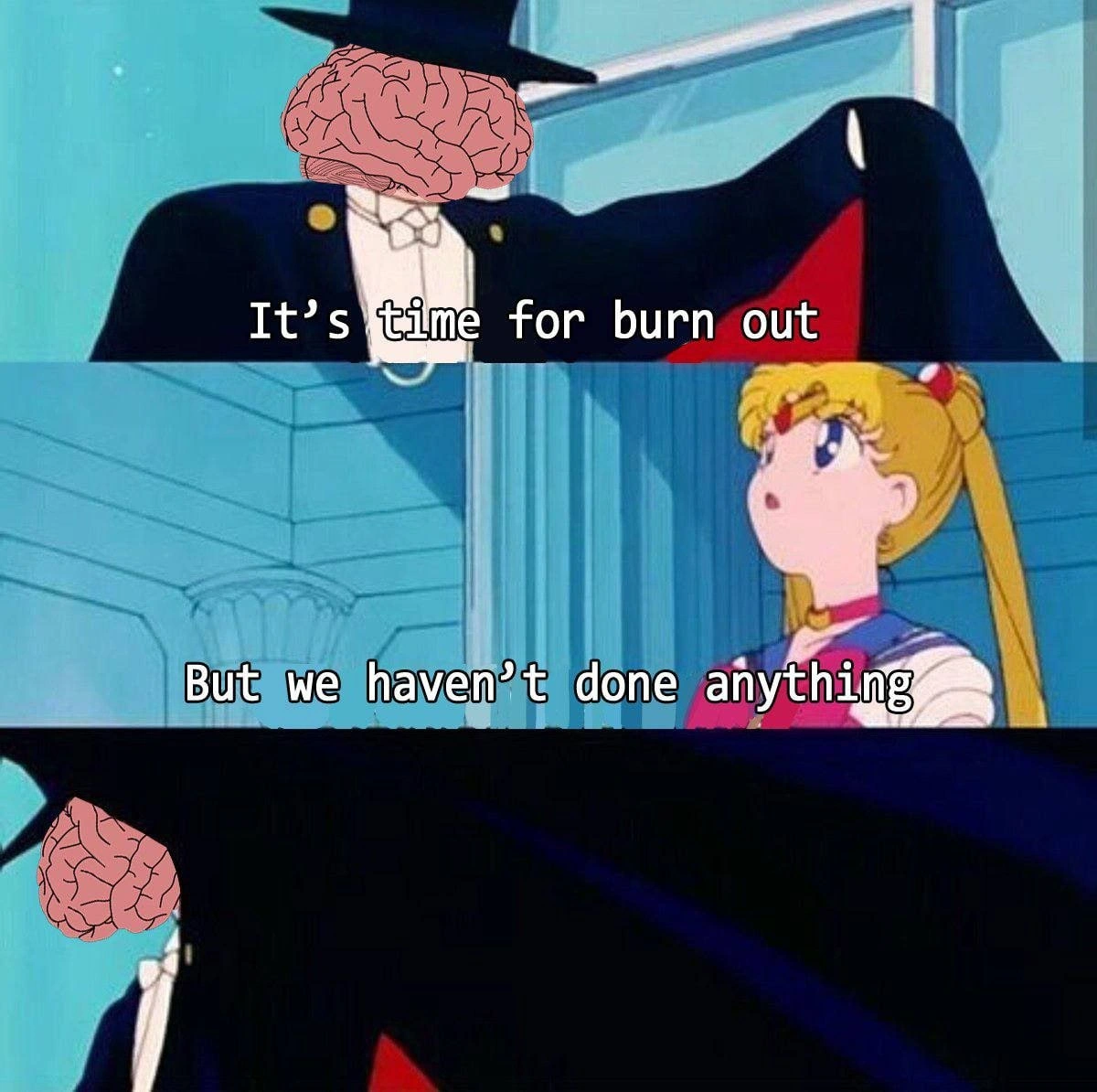
Imagine you have a huge homework assignment or a big chore like cleaning your entire room. You haven’t actually started doing it yet – your room is still messy, the homework page is still blank – but just thinking about it makes you feel really tired. You sit there feeling drained as if you had already run a marathon, even though nothing has been done. This meme is joking about that exact feeling, but for a software developer. It’s saying our brain can sometimes act like a funny character who announces “I’m done, I’m exhausted!” and leaves the building before we even begin the real work. It’s funny in a “so true it hurts” way. We laugh because we recognize that overwhelmed feeling: being super tired and burned out before the job even gets going. It’s like gearing up for a big game or a long trip, and suddenly all your energy is gone just from worrying and preparing in your head. The picture shows a brain dressed as a hero cape figure leaving, and a girl (the developer) left saying, “But we haven’t done anything.” That’s the joke – sometimes you feel out of energy with nothing to show, and it’s strangely comforting to know others feel that way too.
Level 2: Invisible Work Overload
For a junior developer or someone new to the field, let’s break down what’s going on. This meme uses a popular Sailor Moon anime template where a character (Tuxedo Mask) dramatically claims victory and disappears, and Sailor Moon says, "But you didn’t do anything!" In the original meme format, Tuxedo Mask’s exit is ironic because he didn’t actually help. Here, Tuxedo Mask’s head is replaced by a cartoon brain. The brain declares, “It’s time for burnout,” and Sailor Moon (like the developer in us) protests, “But we haven’t done anything.” The brain then vanishes, having triggered burnout out of nowhere.
Burnout in the tech context (and generally) means a state of extreme exhaustion (mental, and sometimes physical) caused by prolonged stress or overwork. It's a serious mental health concern in tech. The twist in this meme is that burnout is happening prematurely – before any real coding or “work” has been completed. How is that possible? The answer lies in all the invisible work and cognitive load that developers deal with.
- Cognitive load: This refers to how much information your brain is processing at once. Developers often juggle many things in their head: understanding new requirements, remembering dozens of little bugs or tasks, switching between coding, code reviews, and meetings. All this thinking uses up mental energy. It’s like having too many browser tabs open in your mind. Even if you haven’t produced a result yet, your brain’s working memory is working hard in the background.
- Context switching: In tech, this means changing focus from one task to another. For example, you’re writing code, then someone asks you to check a bug, then an email pops up, then you go to a meeting. Each time you switch, your brain has to “dump” some context and load new context (like an app swapping out of RAM). This process has a “tax” – it takes extra time and energy to restart each task. New developers often find it surprisingly tiring to not just code, but also handle all the interruptions and role-changes throughout the day.
- Invisible work: Not everything a developer does shows up as a commit or a finished project. Setting up your dev environment, reading documentation, planning out architecture, attending meetings, responding to support tickets – none of these produce visible artifacts in the codebase, but they are essential tasks that use up time and energy. A junior dev might think, “I haven’t built anything today, why am I so tired?” This meme answers that feeling: because your brain has been working non-stop on all that invisible stuff.
In the meme visual, Sailor Moon being confused represents that junior feeling: “We haven’t done anything, why are we tired?” The brain as Tuxedo Mask is a playful way to show your own mind betraying you – it’s scheduling a breakdown as if it were just another meeting on your calendar. It highlights issues of MentalHealthInTech and why stress management in tech is talked about a lot today. Companies emphasize DeveloperProductivity, but it’s now clear that productivity isn’t just about typing code; it’s also about managing mental energy. If that energy gets drained by too many mental tasks or worries, you hit “burnout” even if your commit count is zero for the day. This meme is a form of developer humor that lets people share a serious feeling in a lighthearted way. When you first experience this – being exhausted at 3 PM with nothing checked off the to-do list – it’s a sign that the struggle is real and shared across the industry. Recognizing it is the first step to fixing it (and maybe scheduling fewer back-to-back meetings!).
Level 3: Threadpool Exhaustion
At the senior engineer level, this meme hits like a stack overflow of truth. The brain in the Tuxedo Mask costume is essentially our mental OS scheduling a burnout event before any actual coding threads have even started. It's a darkly funny nod to the high cognitive load and constant context switching in modern development. Our brains are running dozens of background processes (emails, stand-ups, sprint planning, code reviews, on-call dread) that consume resources. By the time we look at our actual task list, the mental thread pool is already exhausted. It's as if the brain's CPU is at 100% just handling interrupts and background jobs, leaving no cycles for real work. This resonates as painfully relatable humor because so many of us in tech have felt developer fatigue creeping in before we write a single line of code in the morning.
- Invisible tasks are piling up: first thing in the morning you check Slack, Jira, and email – instantly your mind is juggling a dozen concerns.
- Context switch chaos: jump from a stand-up meeting to reviewing a PR, then get pinged about a production bug. Each switch costs ~15 minutes of focus. Multiply that by the dozen mini-tasks before 10 AM, and your brain’s cache is thrashing.
- Meeting marathon: back-to-back meetings (a hallmark of certain CorporateCulture environments) mean your brain is active all day with
codingdiscussions and planning, but you end the day with zero tangible output. - Cognitive overload triggers stress: the brain senses the endless to-do list and deadlines (even if you haven't started coding) and preemptively hits the "I'm fried" button. It's a survival response to sustained MentalHealthInTech stressors, almost like a circuit breaker tripping to prevent total meltdown.
- No code, no energy: by lunchtime, you’ve done “nothing” visible, yet feel completely drained. The relatable pain here is that your DeveloperProductivity looks low (no commits, no deliverables), but mentally you’ve been working overtime fighting fires in your head.
The humor has a bitter edge: even Sailor Moon (representing us developers) is confused, saying "But we haven’t done anything." And that’s the punchline – we feel burnt out without having “done” anything, because so much of a developer’s work is invisible and mentally taxing. This meme brilliantly captures a piece of DeveloperHumor born from lived experience: the brain sometimes nopes out early. In a world where burnout-as-a-service feels all too real, our brains are like that caped vigilante vanishing with a flourish after causing chaos, leaving us to wonder what the heck happened to our day.
Description
Three - panel Sailor Moon meme. Panel 1: Tuxedo Mask, but his head is replaced by a cartoon pink brain, declares in white subtitle text, “It’s time for burn out.” Panel 2: Sailor Moon, shown from the waist up, stares upward in confusion; the subtitle below her reads, “But we haven’t done anything.” Panel 3: The caped figure sweeps dramatically off-screen, only the cape and brain head visible, leaving Sailor Moon behind. Visually simple anime art with flat colors and bold outlines reinforces the feeling of abrupt exit. Technically, the meme captures developer cognitive load and chronic stress that trigger burnout even before deliverables, a relatable scenario for engineers juggling context switches, invisible work, and perpetual mental threads

Comments
6Comment deleted
My brain’s Kubernetes scheduler keeps evicting the ‘focus’ pod and auto-scaling the ‘burnout’ deployment before the feature flag even flips
It's like your brain running a predictive burnout algorithm with 99% accuracy - it knows exactly how many Jira tickets, architectural debates, and 'quick sync' meetings are coming, so it preemptively enters power-saving mode to conserve what little dopamine remains after the last production incident
The most relatable part of senior engineering isn't the architectural decisions or the code reviews - it's explaining to your brain why you're exhausted after a day of 'just meetings' where you made zero commits but somehow depleted your entire mental stack. Your IDE stayed closed, your PR count is zero, but your cognitive load balancer hit 100% capacity by 11 AM because you context-switched between fifteen different problems, each requiring you to load an entirely different mental model into RAM. Burnout doesn't check your git contributions before it strikes
Day 1 of the sprint: nothing delivered, yet burnout triggered - my brain’s scheduler misread “burndown” and precomputed exhaustion to amortize the meetings
Classic context-switching induced thermal throttling: brain at 100% CPU before the first commit
My brain is a misconfigured autoscaler - pegged at 100% with 0 RPS because the error budget was burned on meetings, context switches, and on-call aftershocks