Skip to content
DevMeme
4621 of 7435
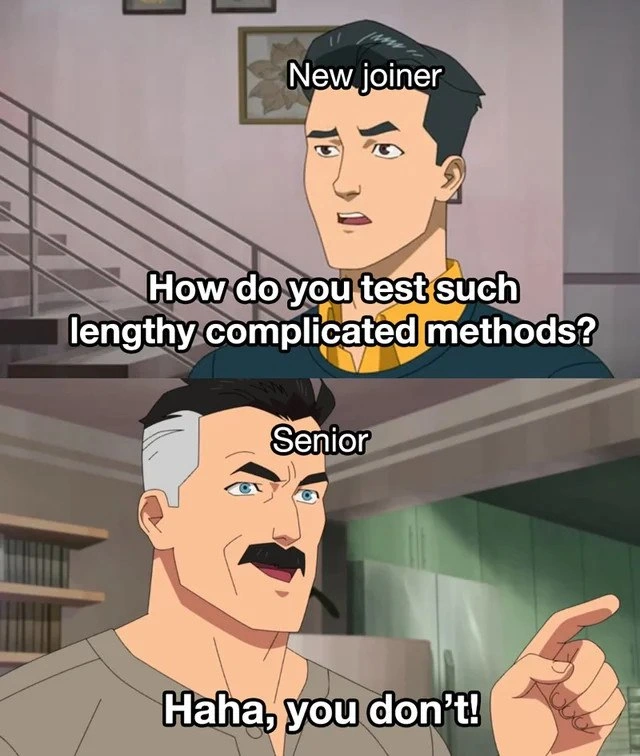
Senior explains the real unit test strategy for giant methods
Testing Post #5069, on Dec 7, 2022 in TG

Senior explains the real unit test strategy for giant methods

Why is this Testing meme funny?

Level 1: A Giant Mess

Imagine you walk into a room that’s extremely messy – toys all over the floor, clothes piled high, maybe even some pizza boxes in the corner. It’s utter chaos. Now you, being new and helpful, ask the person who lives there, “Hey, shouldn’t we clean this up and sort everything out so it’s nice and neat?” And that person just sits among the mess, gives a little laugh, and says, “Haha, we don’t do that here.”

😮 You’d probably be a bit surprised, right? Because normally, when you see a mess, you expect people to try to clean it. But this room is so messy and complicated that the person has basically given up on cleaning – it would be too much work to even know where to start. They’ve been living in the mess so long that it feels impossible to fix, so they just leave it as is. It’s both funny and a little sad. Funny, because it’s a bit absurd to just not clean at all, and sad, because the mess is actually a problem.

This meme is showing that exact idea, but with computer code instead of a room. The “new joiner” is like the newcomer saying, “Shouldn’t we clean this up or check it?” and the “senior” is like the person used to the mess saying, “Haha, no, we don’t even try to fix that now.” It makes us laugh because the situation is so far from what you’d normally expect. It’s basically joking that sometimes things (whether a messy room or a messy chunk of code) get so overcomplicated that people stop trying to handle them the right way. The newbie is shocked that there’s no plan to tidy or test things, and the old-timer just laughs it off. We find it humorous because we recognize that “oh no!” feeling – when something is such a giant mess that even the person in charge has thrown their hands up and said, “Nope, not gonna even attempt it.” It’s a way to laugh at a frustrating situation.

Level 2: Too Big to Test

Let’s break down what’s going on in simpler terms. We have a new joiner (a junior developer) who’s just starting on a team, and a senior developer who’s been around that codebase for ages. The junior sees a single function in the code – one method – that is extremely long and complicated. For example, imagine a function that’s hundreds of lines long, doing many different things one after another. In software slang, that’s often called a “god method” (because it tries to control everything, like it’s all-powerful) or just a big ball of mud. It’s considered a bad practice and a glaring code smell. (A “code smell” means a clear sign that something is wrong with the code’s design, even if it might still work.) Good CodeQuality usually means writing smaller, focused functions, but this one violates that principle in every way.

Now, unit tests are small programs or checks that developers write to automatically test their code. A unit test typically targets one “unit” of code – often a single function – to make sure it does what it’s supposed to do. If you have a simple function (say one that adds two numbers), writing a unit test for it is straightforward: give it some numbers and check if the result is correct. But if you have a lengthy, complicated method that does 10 different things (call a database, calculate something, write to a file, send an email, etc.), how do you even begin to test it? You’d have to set up a fake database, prepare a bunch of data, configure settings... basically recreate a whole environment just to run that one method in a test. That’s extremely hard and time-consuming.

This is where technical debt comes in. Technical debt is a metaphor: it’s like when you take a shortcut or a quick and dirty solution in coding, you “borrow” time, but you “owe” cleanup later. Over time, if you don’t pay off this debt by refactoring (improving the code structure), the “interest” accumulates – meaning it becomes harder and harder to work with the code. A giant untested method is a classic example of technical debt. At some point, someone kept lumping more logic into one place (maybe to meet a deadline or because it was the easiest quick fix), and now that method has turned into a scary, tangled mess. Legacy code (old code that has been around and patched for years) often has these kinds of methods.

So the junior developer’s question, “How do you test such lengthy complicated methods?”, is totally valid. They’ve learned that every piece of code should ideally have tests. They’re probably thinking of strategies like writing multiple unit tests to cover different parts of the method’s behavior. But the senior developer knows the ugly truth from experience: writing unit tests for this untestable code would be a nightmare. In fact, there may be no unit tests at all for that method, and everyone has been too afraid or too busy to add some. So the senior chuckles and says, “Haha, you don’t!” - meaning you don’t test it (with the subtext, we gave up on that long ago). It’s a very sarcastic, world-weary answer. The senior isn’t literally giving good advice, they’re pointing out how bad things have become.

For a junior (or anyone new to the project), this is both shocking and funny in a dark way. Shocking because it goes against everything they’ve been taught: no tests? big bloat of a function? How is this allowed? And funny (in a facepalm kind of way) because the senior’s response is so blunt and defeatist. The meme is basically a TestingHumor in-joke: everybody talks about doing proper UnitTesting, but here we’re admitting that sometimes in real projects, due to TechDebt and time crunches, a piece of code grows so unwieldy that nobody wrote tests for it. The only “strategy” left is to not touch it unless absolutely necessary.

This is also highlighting a typical Junior vs Senior moment in a software team. The junior is full of new knowledge and eager to improve things (“Let’s add tests, let’s clean this up!”). The senior has the context and perhaps some battle scars (“We’ve tried… it’s not that simple… this part of the system is held together by duct tape and luck”). It’s a bit of a reality check. The senior’s half-joking answer points out that yes, ideally we should test it, but realistically we haven’t, and now it’s a tough task. Often, teams in this situation rely on other means like higher-level integration tests or manual testing, or they just have a rule “if it’s working, don’t mess with it.” None of those are ideal from a quality standpoint, but they’re pragmatic short-term solutions.

In summary, the meme uses the dramatic Invincible cartoon scene to illustrate a very relatable software engineering problem: a new developer finds a huge messy function and asks how to properly test it, and the experienced developer basically laughs and says, “We don’t/can’t.” It’s calling out the gap between theory (write tests for everything!) and practice (some things are so badly designed you skip testing them). The humor lands because anyone who’s worked on a mature, messy codebase has likely heard or given an answer like that, at least in jest. It’s both a joke and a little cautionary tale: don’t let your code grow into an untestable monster, or you’ll end up like this senior – cynical and relying on hope instead of tests.

Level 3: Where Unit Tests Fear to Tread

No seasoned developer is shocked by this meme – it’s a grimly familiar scenario in many legacy codebases. Best practices say every method should be small, focused, and covered by unit tests. But then reality throws you a 1000-line monstrosity lovingly known as a “god method.” This is a single function that does everything but wash your car: processing input, making database calls, fiddling with global variables, sending emails – you name it. It’s the embodiment of TechDebt and poor CodeQuality, grown over years of quick fixes and feature requests. The humor here comes from the stark contrast between the ideal and the reality. The New joiner (bright-eyed junior developer) earnestly asks, “How do you test such lengthy complicated methods?” – a perfectly reasonable, by-the-book question. The battered Senior dev, channeling Omni-Man from Invincible, just laughs bitterly: “Haha, you don’t!”

Why is that funny? Because it’s too real. We’ve all encountered that function or class in a project that everyone is afraid to touch. Maybe it’s called ProcessAllTheThings() or initializeEverything() – a huge spaghetti code routine that has somehow been working (through sheer luck or dark magic). It’s full of code smells: no clear structure, side effects all over the place, and zero unit tests. A new dev, fresh from reading Clean Code and armed with UnitTesting frameworks, is understandably horrified: “Why aren’t we testing this properly?” The senior developer’s cynical reply basically translates to: “We’ve given up on that one, kid.” It’s developer humor at its finest (or darkest): pointing out how far reality can drift from the ideals.

Let’s paint the picture of this god_method that scares away tests. It might look something like this:

def processEverything(order):
    # Start with some setup
    if order.needs_special_handling:
        apply_special_discount(order)   # modifies order state
    else:
        prepare_order(order)
    # Now do various operations
    db.connect()                        # external dependency
    order.total = compute_total(order)  # complex calculation
    if GLOBAL_PROMO_ENABLED:           
        order.apply_promo()            # uses a global flag
    # Loop with internal logic
    for item in order.items:
        process_item(item)
        if item.error:
            handle_error(item)
    # More side effects
    log_order(order)                   # writes to file or console
    send_confirmation_email(order.customer_email)  # external system
    return order.status

This pseudo-code is an exaggerated glimpse, but you get the idea: the function reaches out to a database, relies on global config, iterates with custom logic, logs things, sends emails – it’s a whole mini-application in one method. Unit tests thrive on small, isolated units of logic. But here, to “unit test” processEverything, you’d have to set up a fake database, global flags, a bunch of sample order data, and expected outcomes for every scenario (special handling vs normal, promo on vs off, error vs no error…). That’s more like an integration test or a QA checklist than a simple unit test. No wonder the senior effectively says there is no unit test strategy. The strategy is don’t even try, or at best, “test it in production” with real usage and hope for the best (a phrase that sends shivers down any dev’s spine, usually said with a half-joking despair).

Underneath the laugh, there’s genuine pain. This meme jabs at the reality of Technical Debt: at some point, deadlines and pressure led the team to cram more and more into this method without refactoring. Now it’s such a fragile, critical piece that nobody dares to change it just to add tests. It might be running in production, and as long as it kind of works, management might say, “Don’t touch it!” Writing tests for it now might require refactoring the code (breaking it into smaller functions, introducing dependency injection, etc.), which carries the risk of breaking something. It’s the classic catch-22 of legacy systems: you can’t safely change it because there are no tests, and you can’t add tests because the code wasn’t built to be testable. Michael Feathers famously defined legacy code as “code without tests.” By that definition, this giant untested method is the ultimate legacy code – and the senior has probably been living with its quirks for years.

The Invincible meme format amplifies the joke. In the original scene, a father (Omni-Man) admonishes his son (Mark) to “Think!” amidst a brutal reality check. Here the senior (depicted as bloodied Omni-Man) is essentially giving the junior a brutal reality check about the codebase: “Think! If we could test it, we would have already!” The senior’s pointing finger and exasperated face say it all – they’re practically accusing the junior of naiveté: You still believe every piece of code is neatly testable? How cute. It’s a tongue-in-cheek way to vent the frustration that DeveloperHumor often highlights: we know what we should do (write tests, maintain high CodeQuality), but sometimes things deteriorate to the point where even asking for a proper process gets a laugh.

In short, this level exposes the shared understanding among experienced devs that some parts of a codebase turn into untouchable monsters. The discrepancy between what a newcomer expects (a rational testing approach) and what the old-timer delivers (cynical laughter and resignation) is what makes the meme funny. It’s the laugh of “been there, seen that disaster.” JuniorVsSenior culture clash distilled into two lines of dialogue. The senior isn’t literally proud of not testing; they’re sarcastically highlighting how bad the situation is. And every developer who’s had to work with legacy spaghetti code chuckles (or groans) in recognition. This is a coping humor for the fact that, yeah, sometimes the only “unit test strategy” for a god-awful giant function is pray and don’t touch it.

Level 4: Cyclomatic Catastrophe

At the far end of software theory, this scenario highlights the intractable complexity of an overgrown function. A giant method with sprawling logic can have a cyclomatic complexity off the charts – meaning the number of independent execution paths through the code becomes astronomically high. In plain terms, every additional if condition, loop, or branch in a function can multiply the possible ways it can execute. If a function has n binary decisions, you might face on the order of 2^n possible paths (a combinatorial explosion!). Thoroughly unit testing such a beast would require covering each significant path, which quickly becomes a near-impossible task. This is essentially the path explosion problem known from academic research: as code complexity grows, the effort to test all paths grows exponentially.

To put it in perspective, imagine a 500-line function with dozens of if/else branches and loops inside loops – it’s like a labyrinth. Ensuring correct behavior for every twist and turn in that labyrinth demands exhaustive testing that’s computationally and mentally prohibitive. In theoretical computer science, one could liken it to a mini state-space explosion, akin to verifying a complex state machine or solving an NP-hard puzzle. This is why advanced techniques like symbolic execution or formal verification exist: they try to explore many paths or mathematically prove correctness without literally writing a test for each case. But even those techniques struggle here – a monolithic method with tangled logic can defeat automated analysis tools by blowing up the number of states or producing an avalanche of possible symbolic paths. It’s not quite the Halting Problem, but it lives in the same haunted mansion down the street: beyond a certain complexity, determining all the behavior of code becomes undecidably hard in practice.

The senior developer’s dark joke – “Haha, you don’t!” – carries a grain of truth from a theoretical lens. When faced with a cyclomatic catastrophe, writing comprehensive unit tests is so laborious that it borders on futile. It would be like trying to individually test every possible permutation of a large system – you’d run out of time, memory, and patience. In essence, the code’s design has broken the fundamental assumption that unit tests rely on: that the unit under test is of manageable complexity. By shoving an entire program’s worth of logic into one method, you’ve created a black hole of untestable code – not because testing is conceptually wrong, but because the effort required approaches the realm of theoretical impossibility. The sad irony is that the very practices meant to ensure correctness (like modular design and unit testing) were abandoned, leading to a situation where even a supercomputer (or a PhD in formal methods) would struggle to systematically verify the function’s correctness. In short, this is the Code Quality nightmare scenario computer science textbooks warn about – where in theory you could test everything, but the combinatorial complexity has the last laugh.

Description

Two - panel animated meme using the Invincible "Think, Mark!" scene with faces blurred. Top panel: the standing son character is captioned "New joiner" and asks in bold white letters, "How do you test such lengthy complicated methods?" Bottom panel: the wounded father character, captioned "senior", points accusingly and answers, "Haha, you don’t!" Both captions are centered in white with black outline. The humor exposes the dilemma of enormous "god" methods that are effectively un-testable, illustrating how technical debt, poor decomposition, and lack of unit tests frustrate newcomers while veterans respond with weary cynicism

Comments

11
Anonymous ★ Top Pick Our “unit test” for the 2,000-line runEverything() method is whether the pager stays silent - production is the only test harness that can instantiate that class anyway
  1. Anonymous ★ Top Pick

    Our “unit test” for the 2,000-line runEverything() method is whether the pager stays silent - production is the only test harness that can instantiate that class anyway

  2. Anonymous

    After 20 years in the industry, you learn that the real unit test for a 2000-line method with 47 nested if-statements is whether the senior who wrote it still remembers what it does when production breaks at 3 AM

  3. Anonymous

    The senior's response perfectly encapsulates the uncomfortable truth about enterprise codebases: that 3000-line method with 47 nested conditionals, 12 database calls, and side effects scattered like Easter eggs? It's been running in production for 8 years untouched because the original author left, the business logic is undocumented tribal knowledge, and the last person who tried to refactor it caused a P0 incident. Sometimes 'you don't test it' isn't cynicism - it's survival instinct honed by watching ambitious juniors learn why we have a 'if it ain't broke, don't fix it' policy on the legacy monolith

  4. Anonymous

    If a function needs mocks for five repositories and three feature flags, the only passing test is the ADR scheduling its strangler refactor next quarter

  5. Anonymous

    How do you test a 700-line method? You don’t; you add seams and run a strangler pattern until the test pyramid stops looking like a Jenga tower

  6. Anonymous

    Senior strategy: If it's too complex to test, extract to one 800-line behemoth and let prod's chaos sort the survivors

  7. @bezuhten 3y

    that's how to know if you're a senior dev ^)

  8. @LionElJonson 3y

    Haha, you dont WRITE THEM

  9. @lord_nani 3y

    Easy, you just set this as “technical debt”

  10. @Similacrest 3y

    That's the neat part*

    1. @executor2077 3y

      Yup, just wanted to ask what happened with the neat part

Use J and K for navigation