Skip to content
DevMeme
4622 of 7435
Enterprise behemoths recoil as shiny new tech pokes at their legacy core
Enterprise Post #5070, on Dec 8, 2022 in TG

Enterprise behemoths recoil as shiny new tech pokes at their legacy core

Why is this Enterprise meme funny?

Level 1: Elephant and Mouse

Imagine a big old elephant that’s been standing in the same place for years, doing its job. Along comes a tiny mouse – a little new thing scurrying around near the elephant’s feet. You’d think the huge elephant wouldn’t even notice such a small creature, but instead the elephant jumps and trembles. In cartoons and stories, it’s funny to see the mighty elephant being afraid of the little mouse. That’s essentially what this meme is showing. The giant, powerful creature (the big company) gets scared when a small newcomer (a new technology) comes close. We find it humorous and a bit silly because it’s a role reversal – usually the small one fears the big one, but here the giant is afraid of change brought by the tiny thing. The core idea is that even really big, strong figures can get nervous about something new and unfamiliar, which is both funny and kind of true in real life.

Level 2: Giants Fear Change

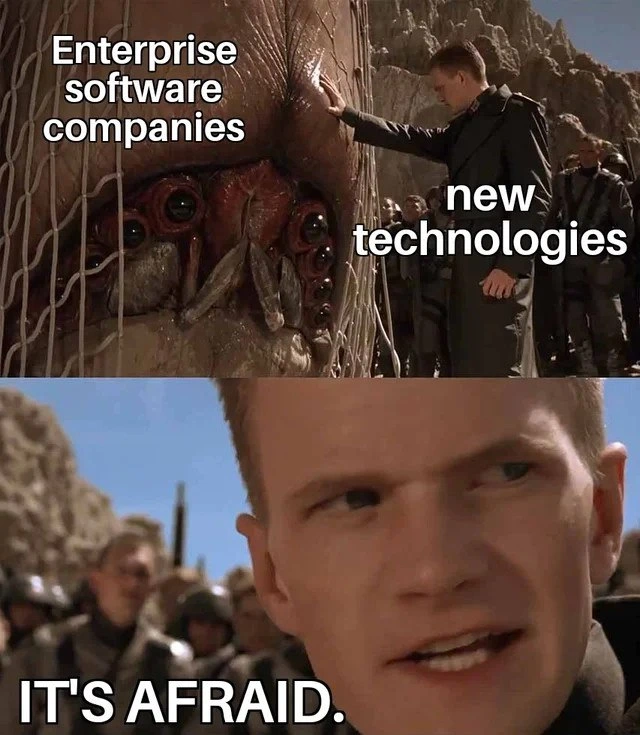
Let’s break down the meme in simpler terms. We have a two-panel image from a sci-fi movie (Starship Troopers). In the top panel, a soldier is cautiously reaching out to touch a huge, slimy alien monster that’s been captured. The meme’s creator added text labels: “Enterprise software companies” over the alien, and “new technologies” over the soldier. In the bottom panel, the same soldier turns toward others and shouts, “IT’S AFRAID.” So, what does this all mean in a tech context?

The enterprise software companies in this meme represent big, established organizations that rely on older technology – also known as legacy systems. Legacy just means anything inherited from the past. In tech, a legacy system is an old software or hardware platform that a company has used for years. It might be a core banking system running on a mainframe from the 1980s, or a customer database built with an outdated language. These systems are usually critical (they run the business daily), but they’re also fragile in that everyone is afraid to change them. They’re like a giant beast that’s been around forever, doing its job in a rocky canyon (to borrow the meme’s backdrop), and nobody wants to disturb it too much.

The new technologies label on the soldier stands for any fresh, modern tech ideas that come along – think of things like cloud computing, a new programming framework, or a trendy tool. For example, a few years back containerization (using tools like Docker and Kubernetes) was the hot new tech. Or switching from a monolithic application (one big program) to microservices (many small, independent services) was the new paradigm. These new technologies promise better, faster, or more efficient ways of doing things. They’re “shiny” because they’re new and often hyped in the industry as the next great solution. In the meme, the soldier (new tech) is touching the alien carefully – this suggests new tech is often introduced carefully into a big company, maybe in a pilot program or an experiment, to see how the old system reacts.

Now, the punchline: the soldier yells “IT’S AFRAID.” In the movie, that line means the big scary alien is actually scared of the humans. In the meme, it means those large companies – despite all their money, power, and huge systems – are afraid of new technologies. This is a humorous way to say that enterprises are risk-averse. Risk-averse means they really avoid taking risks. Adopting a brand new tool or framework feels risky to them, because what if it fails? What if it disrupts their operations? They fear the unknown. There’s a popular saying in corporate IT: “Nobody ever got fired for choosing IBM.” That saying implies that big companies prefer to stick with old, well-known tech (like IBM products) rather than try something new and unproven. It’s safer for a career to go with the old thing that everyone knows, even if it’s not the latest or best.

So the meme is poking fun at that mentality. The huge alien’s many crimson eyes in the image can be seen as the many watchful eyes of management, compliance officers, and legacy system owners in a company, all very nervous about change. When a new technology comes in (that could be a young enthusiastic developer suggesting “hey let’s use this new JavaScript framework for our UI” or moving some servers to AWS cloud), all those eyes turn red with alarm. The enterprise reacts as if it’s under attack. Adoption_resistance is a term that describes how companies put up barriers to adopting (accepting and implementing) new solutions. They might form committees, demand extensive proofs-of-concept, or delay decisions for months. This cautious approach often leads to modernization_hesitation – basically the company hesitates so long to modernize its tech that it barely changes at all. In extreme cases, the fear of change leads to transformation_paralysis, where the organization talks a lot about “digital transformation” (upgrading their tech and processes) but struggles to actually do anything. They are literally paralyzed by the fear of what could go wrong.

We can use an example to make it concrete. Imagine a big bank (an enterprise company) that’s been using a core banking software on mainframes for 30 years. Now, a cloud technology comes along that could let them do the same work on newer servers in data centers run by Amazon or Microsoft. A lot of startups and newer companies are adopting cloud services because it’s cheaper and more scalable. But the big bank might act like that Brain Bug alien: they’re huge and have tons of data, but the idea of moving to the cloud scares them. They worry about security (Is our data safe out there on the internet?), they worry about reliability (What if the cloud goes down? We’ve seen headlines of cloud outages), and they worry about migrating (Can we even move decades of code without breaking everything?). So when a consultant or a bold new CTO touches that legacy system with a “let’s try cloud” proposal, the reaction might as well be someone shouting “It’s afraid!” – the enterprise shows fear or at least extreme caution.

Another example: suppose a new programming language or framework (let’s say Go or Rust or a JavaScript framework like React) is getting popular because it can make developers more productive or the software faster. In a small company or a tech startup, they might jump to adopt it within months of it coming out. But in an enterprise, you often see a different story. The enterprise might stick with their Java 8 or their old framework for years, watching from a distance. If a developer internally suggests “Hey, we should rewrite this service in Rust for better performance,” many enterprise tech leads will react like, “Whoa, slow down – that sounds bleeding edge. Do we have anyone who knows Rust? Is it officially supported? What about our existing code integration?” They might not outright say they’re afraid, but the reluctance is essentially fear of the new. They might require a lengthy change management process – basically formal steps to approve that change – which can take so long that the “new” tech isn’t new anymore by the time they decide.

In summary, this meme humorously illustrates enterprise_change_management (big companies managing change) by comparing it to a frightened alien. It’s saying that big enterprises are often afraid of change, especially when it comes to adopting the latest tech trends (IndustryTrends). The image is funny to developers because we know how backwards this can seem – the big powerful company acting scared like a cartoon elephant seeing a mouse. It’s a form of TechHumor and RelatableHumor: if you’ve ever tried to convince a conservative company to try a modern tool, you’ve probably seen that fearful reaction. They don’t literally scream “It’s afraid,” of course, but they’ll load up on studies, approvals, and excuses which basically communicate the same thing. And that’s exactly what the soldier’s dramatic announcement in the meme is parodying.

Level 3: Big Iron vs Bleeding Edge

At the highest level, this meme hilariously captures a clash between monolithic legacy systems and the relentless march of new tech innovations. The image repurposes a famous scene from Starship Troopers – a captured alien “Brain Bug” quivering as a soldier declares “It’s afraid!” – to represent how enterprise software companies react when prodded by new technologies. The monstrous, many-eyed creature labeled “Enterprise software companies” symbolizes those huge, lumbering IT giants with decades-old codebases (think COBOL core banking systems or that ancient SAP installation) shackled by their own LegacySystems. Meanwhile, the cautious soldier labeled “new technologies” stands in for modern frameworks, cloud paradigms, or any disruptive tool daring to poke at the beast’s squishy legacy core. The punchline comes when the soldier turns to yell “IT’S AFRAID.” This iconic its_afraid_quote from the movie is now a tech punchline: even the giant enterprise behemoth – mighty as it seems – is scared of the shiny newcomer that could upend its comfortable old ways.

Why is this so relatable? Seasoned developers know that large enterprises often respond to IndustryTrends with a mix of curiosity and terror. It’s classic enterprise_fears_innovation: as soon as a new_tech_vs_enterprise confrontation happens, you witness that flinch. We’ve seen the cycle: some hot new framework or tool shows up (microservices, serverless, Kubernetes, pick your poison), and the enterprise’s first reaction is to recoil defensively. They’ll demand ten rounds of review from the architecture board, citing every horror story of past tech hype gone wrong. It’s practically transformation_paralysis. This meme nails that dynamic by showing the “Brain Bug” enterprise literally flinching when touched by the unfamiliar tech soldier. It’s a comedic exaggeration, yet feels too real for anyone who’s ever sat through a fear-fueled change control meeting at a big corporation.

From a senior developer’s perspective, the humor cuts deep. We know these enterprise giants often have a CorporateCulture of extreme risk aversion. They run mission-critical systems on technology so old it might as well be fossilized, and any change is seen as existentially dangerous. That grotesque alien imagery isn’t far off – many big firms have an entrenched legacy core that’s a tangled, tentacled monstrosity of old code and clunky architecture. Introducing a new tech – whether it’s a radical programming language, an open-source database, or a move to the cloud – can feel like poking a sleeping monster. The enterprise responds with wide-eyed alarm: “What if this new thing breaks our workflows? What if it doesn’t scale? What if it exposes us to security threats?!” The fear isn’t entirely irrational (past incidents of botched migrations and failed “digital transformations” are the scars every Cynical Veteran has seen), but it’s often exaggerated to the point of paralysis.

Consider real scenarios behind this satire. Adoption_resistance in big companies is legendary. Propose switching a stable but aging Oracle database to some hip NoSQL store, and watch the DBA team collectively panic as if you suggested letting a toddler refactor their code. Or mention moving an on-premises service to a cloud provider – suddenly half the InfoSec department looks like that terrified Brain Bug, imagining all the compliance nightmares and “unknown unknowns” in the cloud. I once witnessed a Fortune 500’s enterprise_change_management meeting where introducing a new version control system (from SVN to Git, hardly bleeding-edge by then) was treated like handling volatile alien goo: hazmat suits (metaphorically) and emergency rollback plans at the ready. This isn’t far off from modernization_hesitation, where even obvious improvements get delayed by layers of approval and fear-fueled “what-if” scenarios.

The meme’s brilliance is how it flips the power dynamic from what you’d expect. Big enterprises usually seem like the dominant force – they have the money, the market share, the established products. New technologies are the upstarts, theoretically the underdogs. But as any experienced engineer knows, LegacySystemsAndModernization battles often reveal the giant’s weakness: it is so encumbered by legacy tech debt and bureaucracy that even a small, nimble new idea can spook it. The text “IT’S AFRAID” rings true: the enterprise is afraid of losing stability, afraid of the costs to re-train teams, and afraid the new tech might expose how outdated their systems really are. It’s RelatableHumor because we’ve all heard an old-timer in a meeting say, “That’s not how we do things here,” when confronted with a modern approach. In other words, that massive IT department which outwardly projects confidence is internally screaming, “Hold me, I’m scared of this newfangled thing!”

We can also appreciate a bit of IndustryTrends_Hype context here. Enterprises have been burned by hype cycles before. Remember when every big company felt pressure to adopt a “Big Data” solution or a blockchain or whatever the buzzword du jour was? Many rushed in only to have costly failures because the tech wasn’t mature or didn’t fit their needs. Those experiences feed the fear. The soldier in the meme (new tech) might only be trying to help or explore (“hey, maybe containerizing this app could save resources”), but the enterprise brain-bug thinks it’s about to get its brains sucked out. The humor comes with a side of cynicism: after all, the Starship Troopers scene is essentially a propaganda victory moment – they’ve caught the monster. In the meme, it’s as if the tech community is triumphantly observing that the enterprise dinosaur feels threatened by innovation. Modernization_hesitation and bureaucratic inertia are finally on the defensive, and the crowd (the developers, perhaps the onlookers in the image) are cheering because the first step of conquering the beast is making it admit fear.

To sum up this level: the meme cleverly uses a cinematic_meme_template to highlight the absurd-but-true relationship between new_tech_vs_enterprise. It resonates with any senior dev who’s sat in those war-room meetings between innovation teams and stodgy enterprise architects. The fearless hero (cutting-edge tech) approaches the slimy behemoth (legacy enterprise stack), and – surprise! – the big bad beast is the one quaking. It’s a classic tale of disruptive innovation in tech: Enterprise behemoths often recoil not because new tech is actually deadly, but because change itself is terrifying when you’re carrying years of baggage. And as that soldier’s smug declaration “It’s afraid!” implies, recognizing that fear is half the fun. It turns out even the goliaths of tech have a glass jaw – or in this case, a vulnerable brain bug – when confronted with the future.

Description

Meme uses a famous sci-fi movie scene: a soldier cautiously touches a grotesque, restrained alien creature. Text over the alien reads "Enterprise software companies," while text over the soldier reads "new technologies." In the next panel, the soldier turns toward onlookers and shouts the subtitle "IT'S AFRAID." Faces are blurred but uniforms, rocky canyon backdrop, and the creature’s many crimson eyes are visible. Technically, the image jokes about how large, risk-averse enterprises react with fear when confronted by emerging frameworks, cloud paradigms, or disruptive tools that threaten entrenched legacy stacks

Comments

16
Anonymous ★ Top Pick I showed a 50-line serverless POC at the architecture review and the Oracle license audit spontaneously scheduled itself - yeah, the monolith’s afraid
  1. Anonymous ★ Top Pick

    I showed a 50-line serverless POC at the architecture review and the Oracle license audit spontaneously scheduled itself - yeah, the monolith’s afraid

  2. Anonymous

    The enterprise architect who spent three years building a "future-proof" service mesh just discovered the startup they're acquiring solved the same problem with a load balancer and a cron job

  3. Anonymous

    Enterprise architects encountering Kubernetes for the first time: 'But we've been running our monolith on WebSphere for 15 years without issues... why would we need container orchestration?' Meanwhile, their 'without issues' definition includes a 6-hour deployment window every quarter and a dedicated team just to restart application servers

  4. Anonymous

    Enterprise IT: the Lovecraftian horror that devours startups, yet flinches at a Kubernetes YAML

  5. Anonymous

    Enterprise adoption algorithm: if (!inGartnerMQ || !onExistingELA) return 'science experiment'; else schedule an 18-month POC behind 12 CAB gates

  6. Anonymous

    “It’s afraid.” - New tech, after meeting an enterprise vendor that won’t touch anything without 5‑year LTS, a Gartner quadrant, and zero risk of cannibalizing maintenance renewals

  7. @dsmagikswsa 3y

    The enterprise software company suck the new technology in the end.

  8. @lord_nani 3y

    «new» — as in “newer than decade”

  9. @endisn16h 3y

    lol'd

  10. @Agent1378 3y

    Rightly so.

  11. @karim_mahyari 3y

    I would like to ask for sauce

    1. Deleted Account 3y

      found only 1st frame

    2. @lord_nani 3y

      Its starship troopers movie. The man is one from telepathic team, from the end of the movie. Book is better

      1. @darwintvp 3y

        What's the name of the book?

        1. @lord_nani 3y

          You won’t be able to guess it… it’s called starship troopers

  12. @Agent1378 3y

    God, I am old....People do not know this movie anymore...

Use J and K for navigation