Senior Dev's Guide to Intern Management in Production
Why is this OnCall ProductionIssues meme funny?
Level 1: Don’t Touch the Stove
Imagine you’re at home and the kitchen stove is on fire. There’s a little flame and a lot of smoke. Now, your kid brother (who’s never dealt with a fire before) excitedly grabs a pot of water and runs toward the stove to throw water on it. He just wants to help and put out the fire. But you’ve seen what can happen when you throw water on a grease fire — it can explode and make everything much worse! So what do you do? You grab your kid brother by the shirt and pull him back before he gets to the stove.
You shout, “Stop! That’s not the way to do it, you could make it worse!” Then you calmly get the proper fire extinguisher and put out the flame safely, or call the firefighters if it’s big. Later, you explain to your brother why you stopped him: not all fires can be put out with water, and he could have hurt himself and others by acting too quickly without knowing the right approach.
In this meme, the intern is like the kid brother who sees a problem (a “fire” in a computer system) and says “I’ll fix it!” The senior developer is like the older sibling or parent who knows that if you’re not careful, you could turn a small problem into a giant disaster. The senior grabs the intern to stop them from “touching the hot stove.” It’s a funny picture because the senior literally yanking the intern’s collar is an exaggeration of what happens in real life (usually, the senior would just say “please wait” rather than physically tackle them!).
The core idea is simple: when something is on fire (going wrong) in a big computer system, you need someone experienced to handle it, or at least to guide the fix. Just like you wouldn’t let a child play with fire or touch a hot stove, in the tech world you don’t let a brand-new person poke around in a broken live system without supervision. It’s for everyone’s safety! The meme makes us laugh because we see that protective instinct in a very dramatic, silly way. The intern means well, but the senior knows the stove is hot and pulls them back just in time.
So, just as you’d tell a little kid, “Don’t touch that, it’s hot!”, the senior developer is essentially telling the intern, “Don’t touch that server, it’s dangerous right now!”. It’s a funny and friendly way to remember that sometimes NOT jumping in to fix something quickly is the smarter move until you truly know what you’re doing.
Level 2: Hands Off Prod
So what’s actually happening here? Let’s decode the joke in simpler terms. We have a junior developer (intern) eager to prove themselves by fixing a problem on the production system. “Production” (or prod for short) means the live environment where real users interact with the software. It’s the real deal — the actual website or app running for customers. A production issue is something going wrong in that live system: maybe the site is down, a feature is broken, or data is getting corrupted. These are high-pressure situations because every minute of a production outage can mean unhappy users or lost revenue. Companies often have developers on call to tackle these emergencies, kind of like firefighters for software.
Now, an intern in tech is usually someone very new to the industry or company — often a student or recent grad working temporarily to learn the ropes. They have enthusiasm and fresh knowledge, but very little experience with real-world systems. A senior developer, on the other hand, has years of experience. Seniors have likely dealt with many production incidents before (and carry a bit of trauma from past all-nighters).
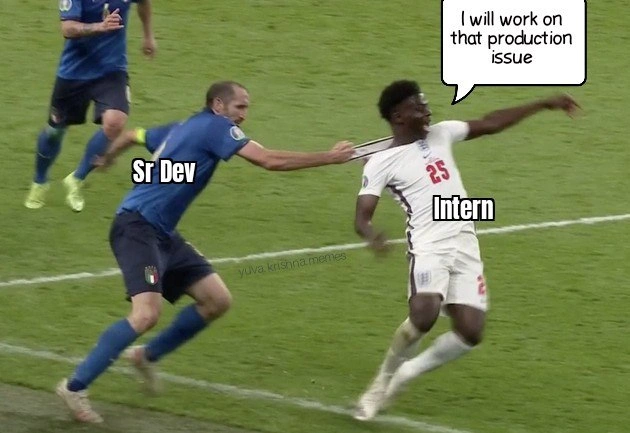
In the image, the intern says “I will work on that production issue.” They’re volunteering to jump in and solve the problem right away. That sounds helpful, right? The twist (and the humor) is that the Senior Dev is physically stopping them — grabbing them by the shirt to hold them back. This is a play on the idea that sometimes senior team members will stop junior developers from making a risky change. It’s like saying, “Whoa there, hold your horses, kiddo. Let’s not touch the live system just yet.”
Why would the senior do that? Because fixing things in production is serious business. If you make a mistake on your own computer while coding, it’s no big deal — you can try again. But if you make a mistake on the production servers, you might take down the website for everyone. It’s the difference between practicing surgery on a dummy vs. operating on a real patient. The senior dev is being cautious because the intern might not know all the gotchas of the system. For example:
- The intern might try a quick fix (a hotfix) without realizing it could crash another part of the application.
- They might not be familiar with the deployment process (how code is rolled out to production). Pushing code in the wrong way or at the wrong time — say, during peak user activity or without proper testing — can make a bad situation worse.
- There might be company rules like “no deploying to production on Fridays” or “always get another developer to review your fix.” Interns, in their eagerness, might overlook those safeguards.
- Often, only certain people are supposed to handle critical issues. There’s usually an on-call rotation – a designated engineer (often senior) who is responsible for production problems when they arise. If an intern jumps in out-of-process, it can disrupt the coordinated response.
Think of the Senior Dev as a mentor or a lifeguard. If a newbie lifeguard (intern) sees someone flailing in the deep end and rushes in without a plan, the head lifeguard (senior) might literally grab them and say, “Hold on, you need a float and backup before you go.” Here, the production issue is the person flailing, and the intern wants to dive in without thinking. The senior is stopping them to prevent a double drowning – i.e., the rescue attempt failing and making things worse.
In software terms, seniors have probably seen cases where an attempted fix did more harm than the original issue. For instance, maybe a server was slow but still working, and someone’s “fix” accidentally took it completely offline. Oops! 😬 So there’s a kind of rule: first, do no harm. Before touching production, you make sure you understand the problem and the fix. Seniors follow checklists or “runbooks” during outages. They might say: “Let’s verify the issue, maybe roll back the last change, or apply a known safe workaround. We don’t randomly change things in prod.” An intern might not know that rule by heart yet, or might be overconfident because they solved something similar in testing. The senior is there to prevent well-intentioned chaos.
The meme labels make it super clear:
- “Sr Dev” over the guy in blue pulling back: that’s the experienced engineer who’s on-call or in charge.
- “Intern” over the guy in white being pulled: that’s the newbie trying to dash in and save the day. And the speech bubble “I will work on that production issue” coming from the intern is exactly what a keen junior might say when they see something is broken. It’s both admirable (initiative!) and a little concerning (do they know what they’re getting into?).
This image is funny to developers because everyone remembers their first production incident. It’s a mix of adrenaline and panic. Newcomers might think “Aha, I can fix this bug quickly, I’m a hero!” whereas veterans are thinking “Oh no, let’s move carefully, or we’ll turn this into an even bigger incident.” The senior pulling the intern is basically saying “Not so fast, cowboy.” It’s an act of protecting the system, and also protecting the intern from a possible blunder. A mistake in a high-profile situation can be rough on a junior’s confidence (and on their resume, if it’s really bad). So, often a senior will intervene, handle the critical fix themselves or with careful guidance, and maybe let the intern watch and learn rather than take point.
In many companies, interns wouldn’t even have permission to touch production without approval. They might not have the credentials or access rights for that very reason. If something is on fire in prod, usually the senior engineers, SREs (Site Reliability Engineers) or other on-call folks swarm in to handle it, while interns might be asked to help in safer ways (like documenting the issue, communicating updates, or fixing the problem after it’s been contained, under supervision).
The humor also lightly pokes at the idea of senior dev gatekeeping. Sometimes, experienced devs get a reputation for not letting juniors do certain things. While gatekeeping in general can be bad (everyone needs to learn by doing eventually), in this context it’s shown as very necessary. It’s gatekeeping in the same way you’d keep a child from sticking a fork in an electrical socket. The senior dev isn’t saying “you’ll never get to do cool stuff,” they’re saying “not right now, this is too risky to do alone.” It’s a fun way to visualize that mentor-protector role.
Lastly, the fact that it’s a soccer match still frame adds an extra layer for those who get it. The blue jersey and white jersey are actually Italy vs England in a championship final, where the Italian defender literally saved the game by pulling the English player back (and took a foul penalty for it). In the meme, the senior dev is “taking a penalty” (maybe looking like the bad guy momentarily) for the greater good of the team, and the intern is that fast forward player who really wanted to score (fix the issue) but might have overrun and missed anyway. It’s a clever sports analogy mapped onto tech life.
So, in summary: The meme shows a senior developer stopping an intern from jumping head-first into fixing a live issue. It’s funny to us because it exaggerates a real workplace scenario: juniors are enthusiastic and want to help, but seniors sometimes have to rein them in to prevent disaster. “Hands Off Prod” is basically the senior’s message — don’t touch the live system until we’re sure of what we’re doing! It’s both a humorous and educational reminder of how production issues should be handled with care, and that sometimes the best help a newcomer can give is to step back and let the firefighters do their work, at least until they’ve learned the drill.
Level 3: Tactical Hotfix Foul
In the high-stakes world of production on-call firefighting, a scene like this is both hilarious and horrifyingly relatable. The meme reframes a famous soccer foul — an Italian player grabbing an English opponent to stop a dangerous play — as a Senior Dev yanking back an Intern who’s sprinting to tackle a burning production issue. It’s a tactical foul, tech edition: sometimes you literally have to pull junior developers away from the command line to save the day (and the night).
This image hits home because it captures a classic Senior vs Junior Developers dynamic during a Production incident. The intern’s speech bubble, “I will work on that production issue,” is dripping with well-meaning confidence. Every seasoned developer’s alarm bells ring at those words. Why? Because a fresh dev charging unprepared into a live fix is like a newbie firefighter rushing into a blaze with a water pistol. The Senior Dev, battle-hardened by countless 3 AM pages and scar tissue from past OnCallNightmares, knows the situation is akin to a fragile house of cards on fire. One wrong move and a minor outage (a P2, perhaps) can escalate into a full-blown P0 catastrophe.
Notice how the Sr Dev in blue isn’t gently tapping the intern on the shoulder — he’s yanking the jersey hard. That’s a perfect metaphor for production incident prevention: senior engineers will forcefully intervene if needed to prevent well-intentioned mistakes. It’s a form of gatekeeping born not out of ego, but out of survival instinct. In many real teams, the senior on-call might shout “Stop! Step AWAY from the terminal!” faster than you can type git push. They’ve learned the hard way that hotfixes deployed in panic by someone unfamiliar with the system can make things much worse.
This meme wouldn’t be so popular on r/DeveloperHumor if it didn’t carry a nugget of truth. Perhaps you’ve heard horror stories of the intern who accidentally deleted a production database table or took down a whole microservice cluster trying a “quick fix”. Those tales are half-urban legend, half real post-mortem material. Senior devs share them like campfire stories to ensure newcomers respect the process. So when the intern enthusiastically volunteers as tribute to slay the prod bug, the senior dev’s inner voice goes: “Not on my watch, kid.” They’ve seen the movie before — the eager hero runs in, and the on-call pager that was already shrieking only gets louder with new alerts: memory spikes, 500 errors everywhere, maybe the database locks up because of an untested migration run in a rush. A senior engineer’s nightmare is having two fires to put out: the original bug and the fallout from a botched fix.
Let’s break down the comedic mechanics here: the intern represents naïve confidence ("Sure, I can handle this!") while the senior embodies protective caution ("I’m not letting you near that mess"). This tension is familiar in tech teams:
- Production Access – Often juniors don’t even have it. Many companies restrict it strictly to prevent exactly this scenario. If an intern can directly jump on a production server, it might indicate a lack of safeguards (or a very trusting team 😅).
- Incident Protocols – On a serious outage (a Sev-1), there’s usually an incident commander, often a senior, coordinating the fix. An intern bypassing that is like a rookie soldier charging ahead of the general: bold but potentially disastrous. Proper on-call protocol says you assess first, follow the runbook, make a backup, communicate changes — steps easily skipped in youthful haste.
- Hotfix Hell – A hotfix is a quick patch to fix a critical bug in production. In theory, it’s a surgical strike. In practice, if done by someone who doesn’t fully grasp the system, it’s like performing surgery with a kitchen knife. Seniors have seen one-line hotfixes that brought down services because of an overlooked side effect. They’re understandably paranoid about uncontrolled fixes.
There’s also an element of mentorship through prevention. A senior developer might literally stop a junior’s deploy, then calmly explain: “We don’t patch prod like that without tests or approval. Let’s reproduce the bug locally or in staging first.” It’s tough love. They’re saving the intern from learning the absolute hard way — by causing a real incident. No one wants to be the newcomer who sent the company’s site offline on day one. The senior is basically saying, “I’m saving you (and everyone) a post-mortem meeting full of awkward explanations.”
The humor works on multiple levels. For those who recognize the soccer image (the Euro final shirt-pull by Chiellini on Saka), it’s a brilliant cross-domain reference: a professional foul to stop a likely goal, just as a senior performs a professional foul to stop a likely outage. Even if you’re not a football fan, the visual of someone being physically restrained mid-sprint perfectly exaggerates how desperately seniors feel about unsupervised intern hotfixes. It’s funny because it’s true — many of us have been that intern, brimming with confidence after fixing a bug in dev, thinking “Production can’t be that different, right?” Only to have a mentor or team lead yell “Hold on there!” at the last second.
In summary, the meme nails a core reality of developer life: production issues are a minefield, and experience teaches you which wires not to cut. The Senior Dev isn’t being a bully; they’re playing defense, protecting the codebase (and the intern) from blowing up. It’s a little bit of gatekeeping with a very justified purpose. Like a seasoned firefighter stopping an eager rookie from kicking open a door when there’s a backdraft behind it — sometimes doing nothing (momentarily) or proceeding carefully is the real heroic move. And sure, the intern might feel momentarily thwarted (just as the white-jersey player did in that match), but it’s for the greater good. In tech, as on the soccer field, not all heroic sprints to the goal end well – sometimes a tactical pull-back is the smartest play.
Description
This meme uses the popular image of Italian soccer player Giorgio Chiellini grabbing English player Bukayo Saka's collar during the Euro 2020 final. In this version, Chiellini is labeled 'Sr Dev' and Saka is labeled 'Intern'. The intern has a speech bubble saying, 'I will work on that production issue'. The senior dev's desperate expression and the intern's forward momentum create a comedic sense of urgency and prevention. The humor resonates with experienced developers who understand the immense risk of letting an inexperienced intern handle a live production issue. The senior developer's 'tactical foul' is a metaphor for the necessary, albeit forceful, intervention to prevent a potentially catastrophic system failure. It highlights the protective gatekeeping role seniors often play, shielding the production environment from well-intentioned but dangerous enthusiasm from junior team members
Comments
8Comment deleted
The senior dev's face when the intern's 'quick fix' for the production issue involves 'just running a script I wrote'
Sr Dev’s P99 tackle latency: 20 ms - just enough to intercept an intern mid-“git push --force” to prod
Just like Chiellini's tactical foul saved Italy from a dangerous counter-attack, sometimes the most valuable senior dev skill is knowing when to commit a 'blocking PR review' before an eager intern's untested hotfix brings down the entire production cluster at 4:59 PM on a Friday
Every senior engineer has had that heart-stopping moment when they see 'intern-fix-prod' in the deployment pipeline at 4:47 PM on a Friday. This meme perfectly captures the instinctive protective reflex that kicks in - like watching someone reach for the production database connection string with 'just a quick fix' energy. The real skill isn't just knowing how to fix production issues; it's knowing when NOT to touch them, understanding blast radius, having rollback strategies, and recognizing that 'I will work on that production issue' from a junior often translates to 'I will learn about cascading failures in real-time.' We've all been that intern once, and we've all become that senior dev who now understands why production access is earned, not given - usually after our own humbling 3 AM incident post-mortem
If your P1 runbook includes “let the intern hotfix prod,” congrats - you’ve implemented chaos engineering without the experiment plan
Sr Dev's grip: the only thing stronger than intern enthusiasm for untested prod commits
Production least privilege: intern read-only; senior dev exclusive lock on the intern
😂 Comment deleted