The Perils of Volunteering to Fix Legacy Code
Why is this TechDebt meme funny?
Level 1: Chore Trap
Imagine your classroom has a big, messy art station that everyone’s been avoiding. There’s paint and glue and scraps of paper all over the place. One day, a kind kid (let’s call them Alex) says, “I’ll clean up this huge mess.” Alex spends their recess organizing the paints, scrubbing glue off the table, and sorting all the crayons. The classroom art station looks great now, and everyone is happy using it again. But guess what happens the next week? The art station gets messy all over again (because, well, kids). Now whenever the teacher or the class sees the mess, they all look at Alex and say, “Hey, can you clean it up again? You did such a good job last time!” So Alex, the volunteer cleaner, ends up being the permanent cleaner for the art station. Alex starts thinking, “Uh oh, what did I get myself into? I don’t even get extra cookies for this!” After a few rounds of this, Alex feels a bit trapped and regrets ever volunteering. Next time there’s a big mess, do you think Alex will raise their hand to clean it? Probably not. They’re quietly saying to themselves, “Never again.”
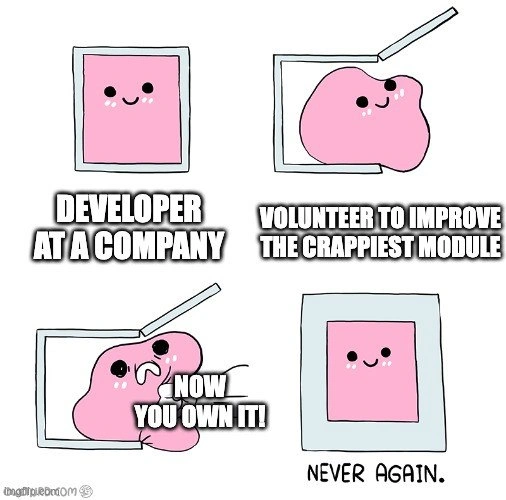
The meme is just like that story but in a software company. Fixing the worst code is like cleaning the biggest mess. The pink blob (developer) volunteered like Alex did. The phrase "NOW YOU OWN IT!" is like the teacher saying, "Since you cleaned it once, it’s your job now!" And "NEVER AGAIN." is exactly how Alex felt after being stuck with the chore. It’s funny in the comic because we can all relate: whether it’s chores or school projects, if you’re too quick to do the hard job, everyone might leave that job to you every time. The lesson is simple and silly: sometimes being too helpful means you end up doing all the work forever, and that’s why our pink blob friend decides not to volunteer so quickly next time.
Level 2: You Fix It, You Own It
For newer developers, let’s unpack the joke and the jargon. This comic is all about what happens when someone volunteers to clean up a really messy piece of code. The pink blob is labeled "DEVELOPER AT A COMPANY," meaning it represents any developer on a team. The phrase "VOLUNTEER TO IMPROVE THE CRAPPIEST MODULE" is exactly what it sounds like: a well-meaning programmer raises their hand to fix the worst part of the codebase. That worst part is often called legacy code – basically, old code that has been around for a long time, usually written by someone who left or by the team under rushed conditions. LegacyCode tends to be fragile (easy to break), hard to understand, and maybe full of hacks that made sense back then but now just cause confusion. Think of it as an old, messy module (a module is just a part of the software, like a component or a file or a set of functions) that everyone else is afraid to touch because it’s so crappy (poorly designed or full of bugs).
Now, why would a developer volunteer to improve such a module? Often, they’re trying to improve CodeQuality or fix long-standing bugs. This process of improving the internal structure of code without changing what it does is called refactoring. So "RefactoringNeeded" is an understatement for the crappiest module – it screams for cleanup! A junior developer might volunteer thinking, "Hey, I can make this better. It’ll be a great learning experience and help the team." And indeed, it is a great learning experience... just perhaps not the one they expected.
Here’s where TechnicalDebt comes in. Technical debt is a term we use to describe what happens when people choose a quick-and-dirty solution that later creates a lot more work (kind of like financial debt accrues interest). For example, imagine a past developer wrote this module quickly to meet a deadline, skipping best practices and not writing any tests. They took on a “debt” — the code works for now, but it’s messy. Eventually, someone has to pay back that debt by cleaning up the mess (with "interest," meaning it’s even harder to fix now). The volunteer in the comic is basically saying, "I’ll pay off this technical debt by refactoring the code."
However, the punchline “NOW YOU OWN IT!” captures an unexpected code ownership outcome. CodeOwnership in real life can be formal or informal. Some companies assign specific people or teams to own certain parts of the code (meaning they’re responsible for maintaining it, reviewing changes, etc.). But in many cases, ownership is more of a side-effect: the person who last worked on it becomes the go-to module maintainer. In the context of the meme, no one officially said “you’re now the owner,” but it happens implicitly. The moment our friendly developer fixed that crappy module, everyone else on the team now looks to them whenever anything related to that module comes up. Why? Because now they know the most about it (having just wrestled with its code) and frankly, everyone else is relieved they don’t have to touch it. It’s like an unspoken rule on many development teams: you fix it, you own it.
Let’s decode each panel with a junior-friendly lens:
- Panel 1 (Developer at a company): The pink blob happily sitting inside a square frame – this represents the developer minding their own business, working within comfortable boundaries on normal tasks. Life is good and simple.
- Panel 2 (Volunteer to improve the crappiest module): The blob bravely steps out of the frame. This is the developer stepping out of their comfort zone to tackle the hardest, messiest part of the project. It’s voluntary, meaning maybe in a meeting they said “I can refactor that module” or they took on a Jira ticket labeled “Cleanup old data processing code.” They’re optimistic and full of good intentions here.
- Panel 3 (NOW YOU OWN IT!): The blob is halfway back into the frame, but now with a surprised/nervous smile. This is the "uh-oh" moment. In the text under the image it says NOW YOU OWN IT! in big bold letters. This implies that as soon as the developer finished the volunteer task, everyone basically told them, "Great, since you fixed it, it’s yours now!" The blob’s face is like “hehe... okay... I guess?” – half happy they improved things, half realizing they just got extra responsibility.
- Panel 4 (NEVER AGAIN.): Now the blob is fully back in the frame (like in Panel 1) but probably a bit traumatized. The caption "NEVER AGAIN." succinctly expresses the developer’s regret. They’re basically saying "I’m never volunteering for that kind of task again!" The blob has learned a tough lesson: touching the worst code means you marry it.
In a real-world scenario for a junior dev, this could go something like: You notice the build script is super flaky or the old analytics module throws warnings. You eagerly rewrite it or clean it up. Next thing you know, any question about the build or any bug in analytics is routed to you on Slack: “Hey, could you take a look at this? After all, you worked on it last.” In team meetings, when the subject of that part of the system comes up, all eyes swivel to you. Congrats, you’re now the expert (whether you wanted to be or not). It can feel flattering at first – “wow, they trust me with this” – but then it can become overwhelming. You realize you inadvertently became the single point of contact (which can even lead to pressure, or being on-call for that component if it breaks at odd hours). This is the module_maintainer_burden mentioned in the tags: carrying the weight of that piece of software on your shoulders.
A typical DeveloperPainPoints story might be: a new dev wanted to prove themselves, so they jumped on a nasty bug that everyone had been avoiding. They fixed it, people applauded, and then every time a related issue came up, they heard, "Since you’re familiar with that code now, can you handle this?" It dawns on them that taking initiative has tied them to that code indefinitely. That’s where the DeveloperRegret comes in. It’s not that improving code is bad – it’s that doing so alone, without team support, marked you as the owner. The meme’s tagline “Never again” is exactly what that developer might think after months of being swamped with maintenance tasks: Next time, I won’t be so quick to volunteer!
It’s worth noting, this isn’t how things should work, but it often is how things do work in practice. In healthy teams, cleaning up code or fixing legacy problems might be shared or rotated responsibility. Junior devs might even get officially mentored on such tasks so they don’t shoulder it alone. But many of us learn the hard way that if you’re not careful, your eagerness can be exploited (even if unintentionally) and you become the crappy_module guru forever. It’s a bit like being the only person who knows how an old machine in the factory works: every time it breaks, they call you.
In summary, at this level: The meme is teaching that volunteering to fix the worst code can backfire. TechnicalDebt is real and someone needs to fix it, but if you do it solo, you might get stuck as the perpetual fixer. The DeveloperHumor here comes from how recognizable this situation is, especially to folks who have been through it. It’s poking fun at the idea that being a good team player (volunteering for an unpleasant task) sometimes results in you accidentally getting all the unpleasant tasks permanently. A junior dev reading this can learn the lingo: legacy code (old messy code), refactoring (cleaning it up), code ownership (being responsible for a part of code), and technical debt (the extra work caused later by quick fixes done earlier). More importantly, they learn one of those unspoken cultural lessons of software teams: when someone says “This part of the code is awful, any volunteers to improve it?”, be aware that taking that on might brand you as the “owner” of that awful part. It’s a funny warning: improve the code, but prepare to own it!
Level 3: No Good Deed Goes Unpunished
TechnicalDebt has a way of ensnaring even the most well-intentioned developers. In this meme’s scenario, a developer (our happy pink blob) spots the crappiest module in the codebase and bravely volunteers to refactor it. This module is classic LegacyCode – that scary corner of the system everyone’s been avoiding because it’s fragile, under-documented, and probably written in a deprecated framework. The volunteer dev thinks, “I’ll improve the code quality, write some tests, and be a hero.” But as soon as they step out of their comfortable little box (just like the blob leaving its frame in Panel 2), reality strikes: “Now you own it!” Suddenly that CodeOwnership is slapped on them like a lifetime curse. The once-happy blob is now nervously half-in, half-out of the frame in Panel 3, realizing they’ve become the module maintainer for life. The humor here is darkly familiar to senior engineers — RefactoringNeeded was obvious, but nobody mentioned the volunteer_ownership_trap. It’s an unwritten rule in many teams: you break it, you buy it; you fix it, you maintain it.
Behind the laughter, there’s painful truth about MaintenanceNightmares. Why do seasoned developers smirk knowingly at this comic? Because they’ve lived it. Maybe you fixed a gnarly concurrency bug in the login service and immediately became “the login guy/gal” for the next three years. Or you resurrected that ancient COBOL payroll script (nobody else dared touch it) and got crowned Module Maintainer by management decree. This meme nails the DeveloperPainPoints of stepping up: once you volunteer, everyone breathes a sigh of relief that someone (you) handled it, and they quietly move all future issues your way. It’s like an invisible transfer of ownership—congratulations, you just adopted the ugliest part of the codebase!
In an ideal world, teams would share responsibility for legacy modules and applaud you for tackling TechnicalDebt. In reality, though, the reward for heroism is often more work. The code you cleaned up now has your name all over the Git history. git blame on that module points straight to you as the last one who touched those 1,000 lines of spaghetti. Any new bug in there? It’s coming to your inbox. Feature request? Hey, you already “know” that code, so obviously you should implement it. Meanwhile, everyone else is just thrilled they don’t have to deal with it. The pink blob’s smiling face in Panel 3 is the nervous smile of a developer realizing they’ve been boxed in. By Panel 4, the blob is fully trapped back in the frame with a resigned expression saying “Never again.” The caption might as well read: Lesson learned, won’t volunteer for that kind of DeveloperHumor project again.
This pattern is so common it’s practically folklore in software teams. RefactoringNeeded? Sure. But the one who does it often becomes the de facto owner. We joke about it, but it highlights a real organizational issue: tasks involving nasty LegacyCode and heavy TechnicalDebt don’t have clear owners because nobody wants them. The moment someone shows interest or competence, management and teammates eagerly latch onto that: “Great, now we have an owner!” It’s like a game of hot potato where the volunteer catches the potato and everyone else just stops playing. The comic’s punchline “NEVER AGAIN.” is both a comedic exaggeration and a genuine sentiment. Many a cynical veteran developer has a mental list titled "Never volunteer for X again", based on hard experiences. Remember the phrase No Good Deed Goes Unpunished? In corporate coding culture, it often feels literally true.
Let’s break it down with a pseudo-code snippet, because why not add a dash of DeveloperHumor:
# Pseudo-code illustrating the volunteer ownership trap
crappiest_module = "LegacyModule42" # the module nobody wants to touch
owner = None
# Developer volunteers to improve the crappiest module
if developer.volunteer_to_refactor(crappiest_module):
owner = developer # Congrats, you're now the official owner!
developer.current_tasks.append(f"Maintain {crappiest_module}")
developer.regret = True # Developer realizes the lifetime burden 😢
In the code above, the moment developer.volunteer_to_refactor(crappiest_module) is true, we assign that developer as the owner. We also append a maintenance task to their to-do list and set their regret flag to true. The 😢 emoji comment says it all: the volunteer soon feels the DeveloperRegret of biting off more than they wanted to chew. That one-liner owner = developer is basically what happened in Panel 3’s “NOW YOU OWN IT!” scene.
The humor lands because it’s exaggerated-but-true. Everyone in software has witnessed or fallen into this volunteer_ownership_trap at some point. The meme’s pastel cute style with the smiling pink blob makes it light-hearted, but it’s talking about a real MaintenanceNightmare. Technical debt cleanup seems noble until you realize you’ve inadvertently signed an indefinite contract to babysit that code. The DeveloperRegret is real: the pink blob’s final deadpan face “Never again.” is the same face you see on a developer who just spent a weekend firefighting issues in the module they innocently volunteered to improve.
On a deeper level, this scenario hints at systemic issues in software teams. Often, CodeQuality initiatives (like refactoring a mess) are undervalued, and the work falls on volunteers or “passionate” team members. There might be a lack of formal CodeOwnership policies or rotation, so ownership defaults to whoever touched it last. It’s a bit of a trap because the team’s incentive structure is messed up: you get more work as a reward. This discourages people from fixing TechnicalDebt in the future, which is the opposite of what a healthy engineering culture wants. But alas, as the cynical veteran knows, this pattern persists in many organizations.
In summary, the meme humorously captures a DeveloperHumor truth: volunteering to fix the worst code is like stepping into quicksand — you’ll sink into maintenance duties before you know it. The pink blob went from cheerful helper to permanent custodian of the nasty module, and their final "Never again." is a mood. It’s both a funny comic and a cautionary tale told around the campfire of software development veterans. Never volunteer for the ugliest code, unless you’re ready to own it forever. And if you do, well… don't say the pink blob didn't warn you!
Description
A four-panel comic strip featuring a cute, pink, smiling amorphous blob. In the first panel, the blob is neatly shaped like a square inside a box, with the caption 'DEVELOPER AT A COMPANY'. In the second panel, the blob happily oozes out of the box, with the text 'VOLUNTEER TO IMPROVE THE CRAPPIEST MODULE'. The third panel shows the lid of the box slamming down on the blob, which is now misshapen and distressed, with the caption 'NOW YOU OWN IT!'. In the final panel, the blob is back inside the box, a perfect square again with a placid smile, and the text 'NEVER AGAIN.' This meme illustrates a common and painful lesson in software development: 'You touch it, you own it.' When a developer takes the initiative to fix or refactor a neglected, buggy, or poorly-written part of the codebase (the 'crappiest module'), they often become the default owner and go-to person for all its future problems. The reward for their proactivity is permanent responsibility for the technical debt, a cautionary tale that discourages developers from tackling the most challenging problems
Comments
7Comment deleted
In this company, 'improving' a legacy module is like making eye contact with a stray cat. Congratulations, it's yours now
Volunteering to refactor the legacy component is basically `chown -R $USER ./haunted_mansion`; congrats, you now own every 3 AM page until decommission
The unwritten rule of senior engineering: The moment you successfully refactor that 10-year-old payment module that everyone's afraid to touch, you've just signed an implicit lifetime warranty contract. Your reward for heroism? Every future bug report, feature request, and 3am production incident for that module now has your name on it - because clearly, you're the only one who 'understands' it now
The classic 'you touched it last' principle in action: volunteer to refactor that gnarly 10-year-old module everyone avoids, and congratulations - you're now the permanent on-call expert for every edge case, undocumented behavior, and production incident it spawns. It's like adopting a feral cat that turns out to be three raccoons in a trench coat, and now you're responsible for all of them. Senior engineers know: the real technical debt isn't in the code, it's in the organizational memory that forever associates your name with that dumpster fire
Touch the crappiest module and Git writes an OWNERS file with your name; the PR merges, the pager forwards, and your bus factor drops to 1
Enterprise translation: refactor(crappy_module) is a mutating call that auto-updates CODEOWNERS and PagerDuty, returns 200 OK, and your weekends become the integration tests
He who volunteers to refactor the legacy monolith shall inherit its untestable bowels - and its eternal PagerDuty shifts