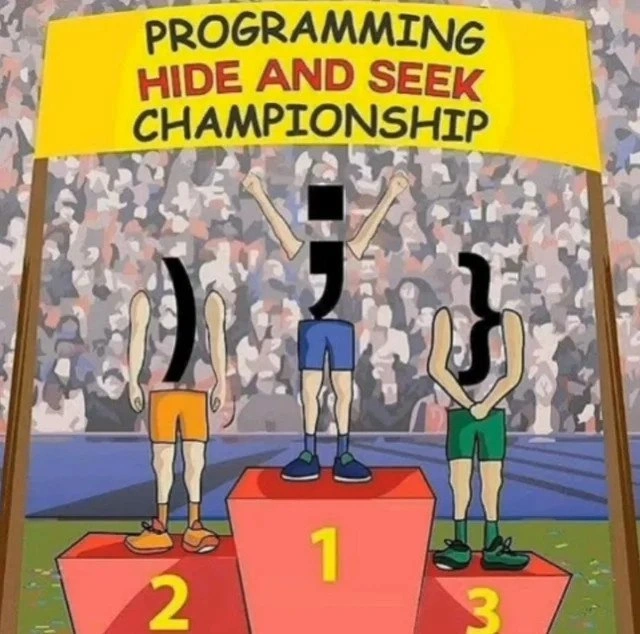
The undisputed champion of causing syntax errors
Why is this Bugs meme funny?
Level 1: The Missing Piece
Imagine you’re playing a game of hide-and-seek with friends. There’s always that one friend who finds the sneakiest hiding spot and nobody can find them for a long time – they’re the champion hider. In this meme, the semicolon (a tiny punctuation mark that looks like ;) is like that friend. In a program (which is like a set of instructions or a story you tell the computer), every little punctuation mark needs to be in the right place, kind of how every period or comma needs to be in the right place in a sentence. If one is missing, it’s like a puzzle with a piece lost under the couch – the picture isn’t complete and it bothers everyone until you find that piece.
The joke is calling the semicolon the gold medalist of hiding in code. That means when programmers make a mistake by forgetting to put in a semicolon, it often becomes a pesky game of “Where is it?!” The semicolon “hides” so well that the programmer has to search all over their code to figure out where the missing spot is – just like looking all over the playground for that hiding friend. The second and third place winners in this pretend championship are the ) parenthesis and the } curly brace. Those are like the other friends who are pretty good at hiding too, but not as legendary as the semicolon.
So, why is this funny (and a bit true) for developers? Because it happens all the time in programming: one little missing character can cause a big problem, and finding it can feel exactly like searching for a hidden object. The meme basically says “this tiny semicolon is the world’s best hide-and-seek player against programmers”. Anyone who’s tried coding knows the mix of frustration and relief when you finally find that missing piece. Even though it’s annoying in the moment, looking back it’s a little funny that such a small thing caused so much trouble. This cartoon just exaggerates that feeling in a silly way – with a semicolon on a victory podium, arms raised, celebrating how it managed to evade us once again.
Level 2: Tiny Typos, Huge Headaches
Let’s break down the meme’s joke in simpler, practical terms. In programming, syntax refers to the rules that define the structure of code – kind of like grammar in a spoken language. A SyntaxError (often also a CompilerError if you’re using a compiled language like C++ or Java) happens when the code doesn’t follow those rules. The meme is highlighting three common syntax characters that cause errors when they’re forgotten or mismatched: the semicolon ;, the closing parenthesis ), and the closing curly brace }. These might look like tiny symbols, but each has a big role:
Semicolon (
;) – In many programming languages, this symbol is used to mark the end of a statement (like the period at the end of an English sentence). If you leave it out where it’s needed, the computer doesn’t know that you meant to end that line. This results in a compile error because the compiler keeps looking for the end of the statement and runs into something unexpected. It’s such a small thing, but its absence is a huge deal to the compiler.Parentheses (
()) – Parentheses in code are used to group things and denote order, just like in math, or to wrap conditions and parameters (for example, in anifstatement or a function call). Every opening parenthesis(needs a corresponding closing parenthesis). If one is missing or you have an extra, the code’s structure breaks. The compiler might say “stray ')'” or “expected ')'” because it encountered a parenthesis it didn’t expect or it reached the end of something and a)never showed up. In other words, one parenthesis was left hanging without its partner.Curly Braces (
{}) – These define blocks of code in languages like C, C++, Java, C#, and many others. You see them around groups of statements, like the contents of a function, loop, or conditional branch. Every{must be matched with a}. If a closing curly brace is missing, the compiler keeps waiting for one. Often you’ll get an error at the very end of the file saying something like “expected '}'” or “missing '}'” because the compiler hit the end of your code and realized a brace was never closed. If there’s an extra}that doesn’t match an opening{, you might see errors like “unexpected '}'” or similar. Either way, it means your braces are unbalanced.
Now, why does the meme say these symbols are champions of hide-and-seek? Because when one of them is missing, it can be surprisingly difficult to spot the problem in the code! Imagine you have 100 lines of code and somewhere in there you forgot a ;. The compiler might throw an error for a line after the actual mistake, which sends you on a bit of a scavenger hunt. It’s like the error message is saying “something’s wrong around here” but you have to figure out exactly where the missing piece is.
A concrete example in C might look like this:
#include <stdio.h>
int main() {
printf("Hello, world") // Oops, no semicolon here!
return 0;
}
If you tried to compile this, you’d get an error (after the fact, at compile time) along the lines of:
error: expected ';' before 'return'
This message can be confusing for a newcomer: it’s complaining about the return line, but the real issue is actually the line above it missing a semicolon. The compiler only figured out something was wrong when it hit return and it didn’t see a ; to end the previous statement. So you, the programmer, have to realize “Ah, I forgot a semicolon at the end of printf("Hello, world").” It’s a tiny typo that caused a big headache.
The meme’s image literally shows a semicolon standing on a 1st place podium, a ) on the 2nd place, and a } on the 3rd. This matches how often these specific things trip up developers. A missing semicolon is famously one of the most frequent errors in languages that use them. A stray or missing parenthesis is another – even people who have been coding for years occasionally run into a “syntax error: unexpected ')'/expected ')'" situation. And missing curly braces especially happen if you copy-paste code or delete something and forget to delete the matching brace. Modern code editors help by highlighting matching braces and parentheses (for example, when your cursor is next to a {, it might highlight the matching }), but it’s still easy to make a mistake if you’re not careful.
For a junior developer or someone just learning to code, encountering these errors is a rite of passage. The first time you see a compiler error, it can be intimidating – a big red error message complaining about some symbol. It might not even clearly say which symbol is missing; sometimes it just points to an unexpected symbol or end-of-file. Part of learning programming is learning to interpret these error messages and trace them back to a root cause like a missing ; or }. After a few frustrating experiences, you get into habits like checking that every if ( has a matching ) and every { has a matching } and so on. You also learn that version control diffs or text editor plugins can show you if a brace is unmatched. There are even IDE features and linters that will put a red squiggly line in your code if you forgot a semicolon or parenthesis, precisely because these errors are so common.
The categories listed (Bugs, Compilers, Languages) and tags like SyntaxErrors and BugsInSoftware indicate exactly that: we’re dealing with a classic software bug (albeit a compile-time bug) related to programming languages syntax, and it’s something every compiler for those languages will catch. The meme is a bit of DeveloperInJoke because it’s poking fun at ourselves – “Haha, we keep losing track of these little symbols, and it’s almost like they’re playing hide-and-seek with us in our own code.” It’s a playful way to vent about a very real frustration.
So in summary for this level: the meme is saying "hey new coders, guess what trips up everyone? These little punctuation marks!" It puts them on a podium as if they were athletes winning medals in causing programmer frustration. Once you’ve written some code, you’ll likely agree with this ranking: semicolon (;) errors happen a lot (gold medal frequency), followed by parenthesis mistakes (silver), and then curly brace mismatches (bronze). The CodingHumor here teaches a mini-lesson: always double-check your punctuation in code, because missing just one can stop everything from working. It’s a humorous reminder that in programming, small mistakes can have big consequences.
Level 3: Hiding in Plain Code
For seasoned developers, this meme prompts a knowing groan and a chuckle. We've all been there: staring at a screen of code that just will not compile, only to discover that a single semicolon was missing somewhere in the chaos. The humor here is in exaggerating that frustrating experience into a sports championship. The PROGRAMMING HIDE AND SEEK CHAMPIONSHIP banner welcomes us to a tongue-in-cheek competition where missing syntax characters compete to see which can evade a developer’s notice the longest. And of course, the semicolon takes the gold medal. 🥇
Why the semicolon? In many languages (C, C++, Java, C#, and others), a semicolon is required at the end of most statements. It’s so small and so common that your eyes tend to gloss over it – until it’s not there. A missing semicolon can produce bewildering CompilerErrors that often point near the problem but not necessarily at it. For example, if you forget a semicolon at the end of a line, the compiler might throw an error on the next line or at the end of a code block, complaining about a stray '}' or an unexpected token. This off-by-one misdirection is why the semicolon is the champion of hiding: the error message doesn’t always directly say “hey, you forgot a semicolon on line 42.” Instead, it might say something cryptic like:
Compiler: error: expected ‘;’ before ‘}’ token
Developer: “Wait, before which ‘}’? Where did I miss a semicolon?!”
That confusion is pure developer deja vu. The meme captures this universally recognized CodingHumor scenario by personifying the semicolon as a victorious athlete on a podium, arms triumphantly raised. Meanwhile, on the second-place podium stands a ) (closing parenthesis) with a silver medal, and third place is a } (closing curly brace) with bronze. These are the other usual suspects in the world of annoying SyntaxErrors: an extra or missing parenthesis can cause a "stray ')' in program" or "missing ')' in expression" error, and forgetting a closing curly brace often leads to the dreaded "expected '}' at end of input" message. They’re on the podium because any developer can attest that stray_parenthesis and unmatched_curly_brace errors are runners-up in the hide-and-seek Olympics of debugging. But the semicolon wins gold for being especially sneaky.
The combination of elements here is funny because it’s absurdly relatable. It pokes fun at the idea that in the vast world of software development – filled with complex algorithms, multi-threaded processes, and memory management – one of the most common causes of failure is literally forgetting to type a single character. It’s a classic DeveloperHumor shared experience. Teams have lost hours (or days) chasing down why the build is broken, only to find a lone ; went AWOL. The packed stadium in the background of the image? That could represent all of us developers watching this scenario play out again and again, collectively cheering (or groaning) at how often these tiny punctuation marks defeat us.
There’s an implicit nod to language design issues, too. Should a single character have the power to make or break your entire build? Well, in languages that rely on explicit terminators and braces, yes. That’s the trade-off: you get flexibility in formatting and clear structure, but you must be meticulous with the punctuation. Some modern IDEs and code editors try to help by highlighting a missing_semicolon or automatically inserting brackets and quotes. Static analysis tools and linters also catch these issues early. Yet, despite all that, the human factor ensures that someone, somewhere, at 5 PM on a Friday, will miss a semicolon and then tear their hair out for 15 minutes 😅. It’s practically a rite of passage in learning to code. Senior engineers can often spot these mistakes in a heartbeat (“Ah, the code isn’t compiling? Bet it’s a semicolon or brace issue”), but that intuition was earned through many frustrating encounters. The meme’s joke is essentially: “Out of all the bugs in software, the smallest ones (like missing punctuation) are the undefeated champions at making us look silly.” Crowning the semicolon as a gold medalist is a funny way to say “this little guy causes more headaches than anything else.” The right parenthesis and curly brace bowing on the podium are like begrudging runners-up, implying “we cause trouble too, but wow, that semicolon… it’s on another level!”
In summary, at a senior perspective, the meme is both a laugh and a gentle poke at our collective pain. It encapsulates a pattern every programmer recognizes: minor syntax mistakes can halt progress entirely. It satirizes how disproportionately difficult these tiny Bugs can be to find by depicting them as world-class hide-and-seek players. There’s comfort in the meme too – it signals that you’re not alone. Even the best developers have been tripped up by a lone semicolon hiding at the end of a line. In the grand Languages arena, these punctuation problems transcend any single technology stack or programming paradigm. Whether you’re writing in C, Java, JavaScript, or even putting together JSON, forgetting a comma or bracket is a universal face-palm moment. And so we award the semicolon a gold medal for consistently giving us those moments, year after year.
Level 4: Context-Free Camouflage
At the most abstract level, this meme highlights a quirk of programming language grammar and compiler design. In formal language theory (the kind compilers are built on), code follows a strict set of rules defined by a grammar. Symbols like semicolons ;, parentheses (), and curly braces {} are terminals in that grammar – they're literally the expected punctuation that tells the compiler how to parse the structure of the program. A missing_semicolon or an unmatched_curly_brace breaks those rules, causing the compiler’s parser to get lost. Think of the compiler as a very strict reader moving through the code: when it encounters something out of place (like the absence of a semicolon where one should be), the parse tree it’s building suddenly collapses. The poor compiler can’t move forward because the code no longer fits the predefined patterns (the syntax) of the language.
In theoretical terms, many modern compilers use algorithms for parsing (like LL or LALR parsers) that rely on being able to predict what comes next based on the grammar. A semicolon in languages like C, C++ or Java is often a statement terminator in the grammar. For example, a tiny excerpt of a C-like grammar rule might be:
<Statement> ::= <Expression> ";"
This means “a statement consists of an expression followed by a semicolon.” If that ; is missing, the parser can’t find a valid parse rule to finish reading the statement, and it throws a SyntaxError. The humorous idea of a "hide and seek championship" is a playful jab at how invisible these punctuation tokens become when they’re absent – the parser might only realize much later in the code that something was wrong near the missing token. In fact, a missing } often isn’t noticed until the end of a file, causing the compiler to complain about an unexpected end-of-input. The semicolon is crowned champion in this meme because, within the formal structure of many languages, it’s the most ubiquitous little symbol that, when camouflaged (i.e., not where it should be), can wreak disproportionate havoc in code comprehension and compilation.
There’s also a bit of language history behind this joke: early languages like ALGOL (from the 1960s) popularized the idea of using semicolons to separate statements, and this carried into C and countless languages after it. Over decades of language design, punctuation rules have been a constant source of minor errors. Some languages tried to mitigate this; for example, Python completely avoids the semicolon by using newlines and indentation to infer statement ends, while JavaScript attempts Automatic Semicolon Insertion (with its own weird edge cases). Despite such innovations, the fundamental necessity of clear delimiters in code remains – somewhere, the language needs to know where one statement or block ends and another begins. And whenever there’s a human-inserted delimiter, there’s a human who will eventually forget to insert it. This meme humorously enshrines that truth in an Olympic-style setting: the semicolon wins gold for being the most stealthy syntax gremlin, with the straying parenthesis and curly brace not far behind in the competition of causing compile_time_errors. It’s a light-hearted nod to a deep reality of compiler theory and language design: tiny tokens can carry big significance, and their absence throws off the machine’s whole understanding of our code.
Description
A cartoon meme depicting a winner's podium at a sports stadium. A large yellow banner at the top reads 'PROGRAMMING HIDE AND SEEK CHAMPIONSHIP'. On the first-place platform, a semicolon character stands with its arms raised in victory. On the second-place platform, a closing parenthesis character looks down in defeat. On the third-place platform, a closing curly brace character stands with its hands clasped, looking disappointed. The background shows a large, blurred-out crowd. The humor is aimed at programmers who have spent frustrating amounts of time searching for a missing character that is causing a syntax error. The semicolon is crowned the 'champion' because in many C-style languages (like C++, Java, or JavaScript), a missing semicolon can be notoriously difficult to spot, often causing the compiler to report an error on a completely different line, making it the ultimate master of 'hide and seek' in code
Comments
118Comment deleted
A missing semicolon is the ultimate gaslighter; it convinces the compiler that the perfectly valid code on the next line is the root of all evil
Semicolon wins every year - turns out even in a cloud of 400 microservices, the most distributed thing in the system is the missing token hiding two screens above your diff
After 15 years in the industry, I've learned that semicolons aren't actually hiding - they're just practicing eventual consistency with your codebase, appearing exactly three commits after the production deployment
The real champions of hide-and-seek in programming aren't the developers - they're the race conditions that only appear in production, the off-by-one errors that survive code review, and the memory leaks that take three months to surface. This podium perfectly captures the irony: we celebrate finding what was deliberately hidden, yet spend most of our careers hunting bugs that hide themselves in plain sight within millions of lines of code, only revealing themselves at 3 AM during a critical deployment
{ snags gold because it hides decades of untested legacy bugs inside massive single blocks, forcing juniors to seek closure for weeks
Semicolon takes gold - perfect at hiding until the compiler screams or ASI rewrites your intent; ) gets silver for gaslighting diff tools, and } grabs bronze by quietly relocating your scope into prod
The semicolon always takes gold - vanishing on the previous line, passing locally via ASI, then failing CI the moment someone enables -Werror
use autoomplete Comment deleted
that's why you use Python Comment deleted
tab or 4 spaces? Comment deleted
oh I hate that whenever it happens. I always use tabs, and apparently everyone else uses spaces. Comment deleted
i mean, :s/ / /gm Comment deleted
but fuck identation based syntax in general Comment deleted
I think it looks nicer, but yeah, it's not as robust. Comment deleted
it is nice in a world where ppl don't use spaces for identation Comment deleted
true. Comment deleted
Ohno Comment deleted
Tabs that ide convert to spaces)) Comment deleted
:s/ / /gm Comment deleted
2 spaces Comment deleted
3 spaces Comment deleted
the correct answer is 2 spaces Comment deleted
the correct answer is 4: 3 and 5 alternating Comment deleted
what are you Comment deleted
i am the one who dislikes identation cringe syntax Comment deleted
reject snec embrace clang-format Comment deleted
i believe everyone does Comment deleted
4 Comment deleted
4 seems a bit too big Comment deleted
Is it? Comment deleted
8, only 8 Comment deleted
X3 I had a co-worker who always used 7 Comment deleted
Pep Comment deleted
>snek Comment deleted
Parentheses are worse than semicolons IMO Comment deleted
spaces are far, faaar worse Comment deleted
well, on even lines only, on every odd line it's 5 actually Comment deleted
Lel Comment deleted
YEP Comment deleted
ODD numbers Comment deleted
that is cursed Comment deleted
that's what linux kernel does, please reconsider Comment deleted
"if you need less than 8 you write bad code" Comment deleted
Linux kernel does a lot I don't agree with Comment deleted
i think compiling without aliasing is wrong Comment deleted
Nah, still use 4. If it starts getting uncomfortable, that's a sign that it needs to be redesigned to reduce unnecessary nesting Comment deleted
highlight what? Comment deleted
anything greater than 2 bugs me Comment deleted
because theres too much empty space Comment deleted
Anything other than 4 bugs me because there's too much or to little XD Comment deleted
that's why you should use clang-format Comment deleted
Please join the group Comment deleted
this group? Comment deleted
yes Comment deleted
You are writing on comments section Comment deleted
it has 128 members, if me typing in here is a problem then i just wont Comment deleted
I don't see any problem with 128 members Comment deleted
id just rather not be in large groups Comment deleted
Well, if you like missing messages, then ok Comment deleted
And I don't see why you wouldn't want to be in the group as you are already technically here Comment deleted
cause no notifications or giant unread counter Comment deleted
There is a discussion group Comment deleted
Every time you send a message without replying, it shows up as a reply to this image x3 Comment deleted
Not only that, but he won't see messages directly replied to him or inside the photo's reply thread Comment deleted
*her And yeah Comment deleted
I don't see anything pointing to them being a woman Comment deleted
Hence me letting y'all know :3 Comment deleted
okay Comment deleted
use per, like stallman Comment deleted
obtw sign the support letter Comment deleted
:o??? Comment deleted
per, short for person Comment deleted
Cute!! Comment deleted
they is much better tbh Comment deleted
it's plural, he laid out problems with it too Comment deleted
actually they is considered a singular pronoun for unknown gender Comment deleted
if a person has problems with "they", then they have a problem with English Comment deleted
and if they have a problem with English, they should either bear it or not communicate with it Comment deleted
Also, it's easy to remove gendered terms from most languages Comment deleted
not that easy actually Comment deleted
I would love a challenge, but I've done it in Romance languages Comment deleted
do it in russian, you'll fail miserably Comment deleted
Mhmm! I also conjugate the verbs correctly: They's baking a cake. They goes to the store. Comment deleted
i'd conjugate it as plural Comment deleted
Only when I talk about groups of individuals, andor systems Comment deleted
wrong Comment deleted
Only "wrong" to you, not to me Comment deleted
fair Comment deleted
then you are speaking English wrong Comment deleted
According to whom? Comment deleted
they're baking a cake they are going to the store Comment deleted
yes just like you pronoun Comment deleted
you need to say per's technically because: this is his bag this is per bag (this means "this is person bag") so you need to say this is per's bag Comment deleted
oh no Comment deleted
AHH and you have the curlybracket on a newline Comment deleted
function { } It's the one true way Comment deleted
yes Comment deleted
allman is the one true way, atleast in c++ Comment deleted
and enjoy the broken code Comment deleted
my computer science proffessor insists its a good idea to put curly brackets on newlines and also put system("pause"); at the end of every program (even tho visual studio automatically pauses it) Comment deleted
the system() shit, i hate it Comment deleted
mf takes off points if we dont include it too 😔 Comment deleted
it doesn't work on not shit-os machines Comment deleted
yeah exactly Comment deleted
put system("sleep 9999999"); Comment deleted
UwU Comment deleted
this Comment deleted
Oh, I thought Geg meant Sasha Comment deleted
In mine? I don't see that in Sasha's Comment deleted
ok, so we left off on clang-format being the best tool ever Comment deleted
oh and don't use python Comment deleted
REAL devs write their code on lined paper and have an AI scan and parse it Comment deleted
Yeah, and send it through fax Comment deleted
real devs compile by hand Comment deleted
nono, comile and run in their brain Comment deleted
How about " " Comment deleted
Oh yeah Python lol Comment deleted
Space Comment deleted