Skip to content
DevMeme
2587 of 7435
The Futility of Small Refactors in a Massive Legacy System
LegacySystems Post #2864, on Mar 28, 2021 in TG

The Futility of Small Refactors in a Massive Legacy System

Why is this LegacySystems meme funny?

Level 1: Tiny Fix, Big Mess

Imagine you have a huge messy room where toys and clothes are scattered everywhere. It’s so messy that you can barely walk through it – that’s like a giant old codebase cluttered with problems. Now, instead of really cleaning the room, you decide to do one teeny-tiny thing: you pick up a teddy bear and give it a nicer name tag. 🏷️😅 Sure, now the teddy bear has a great name, but does that help clean the room? Not at all! The room is just as messy as before; nothing big has changed. That’s exactly why this picture is funny. It’s showing a giant problem (the huge messy room or the stuck ship, which stands for the messy code) and a silly little solution (renaming one teddy bear or one variable) that obviously won’t fix the problem. We laugh because it’s an absurd mismatch: it’s like trying to move a mountain with a spoon. Everyone can see that such a tiny fix won’t budge the giant mess – and that’s the joke! The developer in the meme is essentially doing the smallest possible “clean-up” and hoping it will help with a huge issue, which is a goofy idea. It’s funny in the same way as watching someone use a band-aid on a broken dam – a cute effort, but nowhere near enough. This simple comparison helps even non-coders feel the humor and frustration: sometimes, at work or in life, we have really big problems and only little tools or quick fixes, and it’s pretty clear those alone won’t save the day.

Level 2: Little Dozer, Big Problem

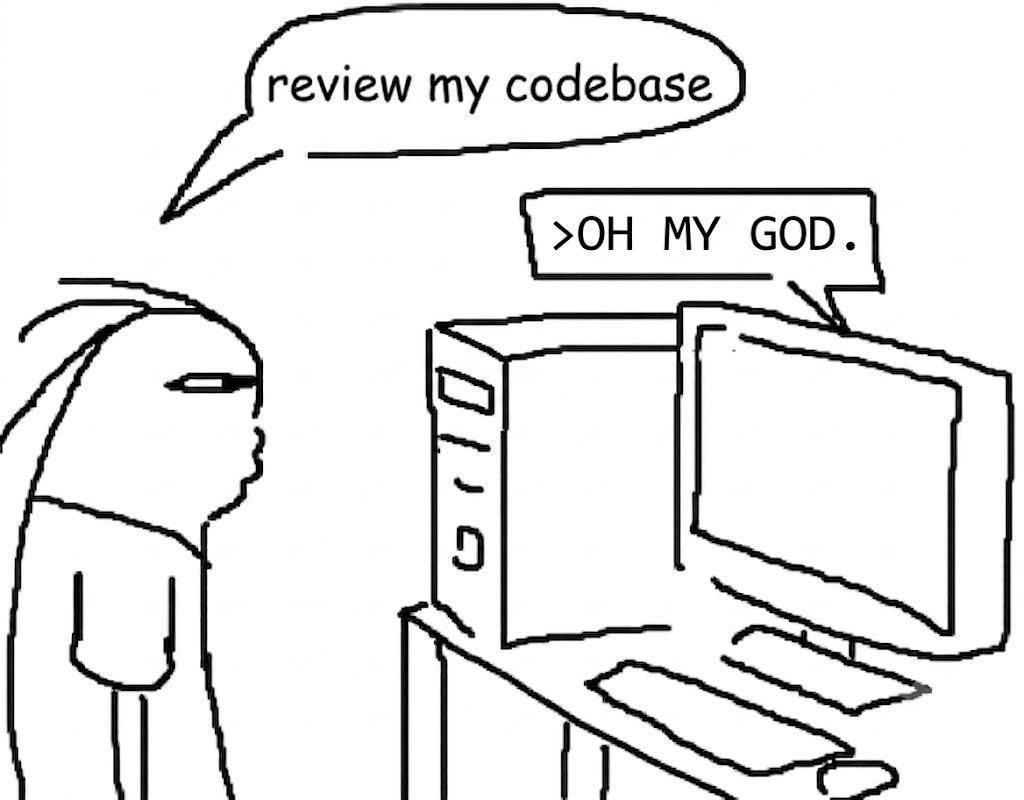
Let’s break down the scene and terminology for newer developers. The image references a real event: in 2021, the Ever Given container ship got wedged in the Suez Canal, halting global shipping for days. A photo of a tiny bulldozer trying to free that giant ship went viral. In this meme, the huge ship is labeled “LEGACY CODEBASE” to represent a legacy system – an old, monolithic codebase built up over years. Legacy systems are often large, tightly-coupled (many parts depend on each other), and hard to change, much like a giant vessel that can’t turn easily. They accumulate technical debt, which is like software “mess” that’s built up because shortcuts were taken or old code wasn’t improved over time. Technical debt makes the code harder to maintain and update. The more debt, the more “stuck” the project can get, analogous to how the ship is stuck in the canal.

Now look at the tiny bulldozer in the image, captioned “changing a variable name to be more descriptive.” This represents a very small refactor – specifically, improving a variable naming. In coding, refactoring means changing code to improve its structure or readability without altering its functionality. Renaming a variable (for example, from x to totalCustomerCount) is a basic refactoring step to enhance clarity. It’s generally a good thing for code quality and maintainability, because clear names help developers understand code. However, renaming one variable is a cosmetic change; it doesn’t change how the program works internally. The meme jokes that such a minor tweak won’t have any real impact on a massive, messy codebase. That’s like expecting the little bulldozer to single-handedly move the gigantic ship. In a huge legacy project, there are often fundamental design or architecture problems – maybe the code is poorly organized or there are logic issues – that a simple rename can’t address. Developers chuckle at this because we’ve all experienced the futility of doing a tiny fix in a huge project and seeing no noticeable improvement. It’s a form of DeveloperHumor that pokes fun at our sometimes naive attempts to improve things: “Well, I can’t rewrite the whole system today, but I can at least tidy this one name!”

Key concepts in this meme:

  • Legacy codebase: Old software system inherited from the past. Often has outdated practices and is resistant to change, like a giant ship that’s hard to steer.
  • Technical debt: The idea that quick-and-dirty solutions add up like debt. Eventually, that “debt” must be “paid off” by doing the hard work of refactoring or else the codebase gets slow and fragile. In the picture, the enormous weight of the ship is like tons of technical debt accumulated over time.
  • Refactoring: Restructuring existing code without changing its behavior. Big refactors might mean redesigning whole components; a small refactor could be as simple as renaming a variable or splitting a function. Here, the refactor in question – a name change – is so small compared to the scope of needed improvements that it barely makes a dent.
  • Variable naming / Code quality: Using descriptive variable names (instead of vague ones) is a part of writing clean code. It’s generally good for code quality because it helps others understand what the code is doing. But it’s a surface-level improvement. If the overall code is poorly structured, improving names alone won’t solve deeper issues.

Overall, the meme paints a relatable picture: working on a LegacySystem often feels like trying to dig out a stranded cargo ship with a toy bulldozer. Modernization (turning a legacy monolith into a cleaner, modern system) usually requires heavy machinery – major design changes, adding tests, breaking the monolith into services, etc. Simply renaming things (a cosmetic_refactor) is like using the smallest tool for the biggest job. It might be a nice effort, but it won’t free the ship. Junior devs quickly learn that while you should absolutely write clean, well-named code, fixing a legacy project calls for more than just surface changes – you need to address the root causes of the mess, bit by bit. And if you’ve ever been the person assigned to “improve” an old, tangled project, this meme’s exaggerated scenario probably makes you laugh and cringe at the same time.

Level 3: Legacy Leviathan

In the meme’s scene, a colossal Legacy Codebase is wedged in place like a container ship jammed in a canal. That ship is a metaphor for an entrenched monolithic system – decades of code piled high, riddled with Technical Debt. Over years, countless quick fixes and feature patches have accreted into a behemoth so rigid that even the slightest change feels perilous. The tiny yellow bulldozer labeled “changing a variable name to be more descriptive” symbolizes a cosmetic refactor: a trivial improvement that barely scratches the surface of the real problem. It’s darkly humorous because seasoned developers recognize this scenario – a well-intentioned but insignificant change pitted against an immovable architecture. We’ve all seen managers or junior devs optimistically attempt to tweak a name or comment, hoping it will somehow initiate a grand improvement, only to discover the codebase remains as stuck as ever.

This is classic developer humor: exaggerating the futility of a minor fix against a massive problem. Renaming a variable for better CodeQuality is normally good practice, but here it’s like trying to steer a supertanker software leviathan with a canoe paddle. The sheer scale of the legacy system (“LEGACY CODEBASE” painted on the ship’s hull) dwarfs the change. Why is it so funny? Because it’s painfully true. In a huge legacy system, problems run far deeper than naming. The code might suffer from a Big Ball of Mud architecture – no clear structure, modules tangled together, global variables galore – so that one neat name does nothing to untangle the mess. Everyone who has battled a legacy monolith knows that meaningful modernization requires deep, systemic refactoring (often a full rewrite or gradual modularization), not just prettier identifiers. The meme nails an entire category of software folly: believing a tiny fix can nudge a massive legacy system. It elicits a rueful laugh because we’ve been that optimistic developer, or seen one, armed with a code editor and good intentions, poking at a mountain of legacy logic as if a name change could magically dislodge it.

From a senior engineer’s perspective, the image satirizes bikeshedding — focusing on trivial improvements (like variable naming) because the big issues (outdated framework, spaghetti code, lack of tests) are overwhelming. It highlights the disproportionate scale: the monolithic codebase (think thousands of interconnected modules and hidden dependencies) versus the cosmetic_refactor (one name tweak). The humor also hides a grim reality: sometimes that’s all you can do. A legacy system can be so fragile that attempting a real refactor is risky without breaking things. So teams resort to incremental clean-ups, even if they barely move the needle. The meme’s Ever Given ship reference is apt: during the March 2021 Suez Canal blockage, a tiny excavator famously tried to dig out the immense Ever Given container ship. Likewise, in software, we sometimes find ourselves with nothing but a virtual shovel (our small code fixes) against the Ever-Given-size burden of a legacy system. The shared trauma and commiseration in this joke come from knowing exactly how it feels to stare at an intractable codebase and mutter, “Sure, let’s rename some variables. That’ll fix everything.” (Cue eye-roll.)

Description

This meme again uses the iconic image of the Ever Given container ship stuck in the Suez Canal. The colossal ship is labeled 'LEGACY CODEBASE'. In contrast, the comically small excavator on the bank, attempting to dig the ship out, is labeled 'CHANGING A VARIABLE NAME TO BE MORE DESCRIPTIVE'. The image powerfully and humorously illustrates the feeling of hopelessness that developers often experience when working with large, monolithic, and poorly written legacy systems. A small, well-intentioned effort to improve code quality, like renaming a variable for clarity, feels utterly insignificant and futile when faced with the overwhelming scale of the system's architectural problems and technical debt. It's a perfect visual metaphor for the feeling that you're just moving a single shovelful of dirt to clear a mountain
Comments

7
Anonymous ★ Top Pick The best part is when you finally rename that variable from 'data' to 'customer_record', only to find it breaks 15 obscure dynamically-generated reflection-based report writers in a part of the system no one has touched since 2003
  1. Anonymous ★ Top Pick

    The best part is when you finally rename that variable from 'data' to 'customer_record', only to find it breaks 15 obscure dynamically-generated reflection-based report writers in a part of the system no one has touched since 2003

  2. Anonymous

    By all means, rename “x” to “normalizedCustomerAccountId”; that should totally unstick the 15-year monolith wedged on 400-line triggers, XML-encoded business rules, and a decade of copy-paste cargo

  3. Anonymous

    The variable you want to rename has 47 direct references, 312 reflection-based invocations, is serialized in 8 different formats, appears in 23 stored procedures, and somehow the billing system will crash if you change it

  4. Anonymous

    This perfectly captures the senior engineer's dilemma: you know renaming 'x' to 'userAuthenticationToken' is the right thing to do, but when you're staring down a 500K-line monolith written in 2003 with zero test coverage, circular dependencies spanning 47 modules, and a deployment process that requires a blood sacrifice to the build gods - well, suddenly that variable name doesn't seem like the hill worth dying on. The real kicker? The excavator will eventually free the ship, but your legacy codebase will still be there in 2035, now with one slightly better variable name and 10,000 new lines of technical debt

  5. Anonymous

    Legacy refactor: renaming `foo` to `userId` - noble intent, until it unravels a decade of untested assumptions

  6. Anonymous

    Tech-debt theater: the monolith is Ever Given; we celebrate a PR renaming foo to customerJourneyStep - better semantics, zero throughput

  7. Anonymous

    Rename x to customerId all you want; the 400k-LOC monolith with shared mutable state and one everything table is still wedged across the canal

Use J and K for navigation