Skip to content
DevMeme
2645 of 7435
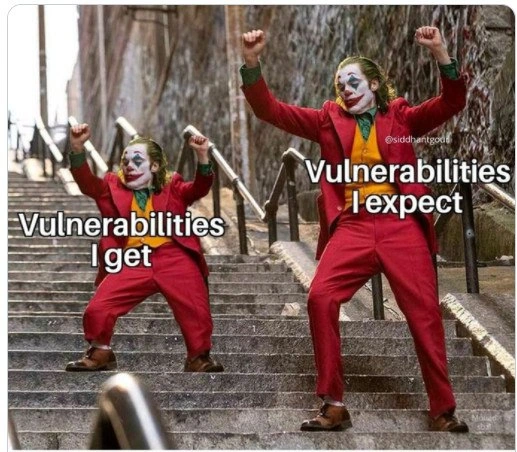
The Grand Vulnerabilities We Expect vs. The Tiny Ones We Get
Security Post #2924, on Apr 9, 2021 in TG

The Grand Vulnerabilities We Expect vs. The Tiny Ones We Get

Why is this Security meme funny?

Level 1: Just a Little Bug

Imagine you’re falling asleep at night and suddenly worry there’s a huge monster under your bed. You get really scared thinking about it. Finally, you gather the courage to peek underneath… and you find out it’s just a tiny little bug crawling on the floor. Phew! You’re super relieved there’s no monster after all. You might even feel a bit happy and start laughing because you were so scared over something so small and harmless.

That’s exactly what’s going on in this picture. The people who made a computer program were afraid that a big horrible problem (the monster) was hiding in their work. When they checked (through a security test), they only found a small problem (the little bug). They felt really happy and relieved – so much that they’re dancing, like the Joker character in the image. In simple words, they expected a disaster, but it turned out to be no big deal. The meme is funny because everyone knows the feeling of worrying a lot about something, then discovering it wasn’t worth worrying about. Here it’s shown with a big dancing Joker for the big worry, and a small dancing Joker for the tiny actual issue. It’s like freaking out about a shadow on the wall that looks like a monster, and then realizing it’s just your teddy bear. No big scare – just a little fix – time to dance and celebrate!

Level 2: Big Fears, Small Bugs

In the picture, we see two Jokers (the comic villain from Batman, played by Joaquin Phoenix) dancing on the same outdoor staircase. The one higher up is bigger and labeled “Vulnerabilities I expect,” and the smaller one lower down is labeled “Vulnerabilities I get.” This setup is a classic way to show expectation vs. reality: the big Joker represents what we imagine will happen, and the small Joker shows what actually happens. The joke here is about security testing, specifically a penetration test (or pentest). A pentest is when companies hire ethical hackers or security pros to simulate attacks on their system, trying to find weaknesses (kind of like a friendly, pre-planned hack to catch problems before real bad guys do).

Before a pentest, teams often have BIG fears. 😱 Developers and security folks start worrying about the worst possible security vulnerabilities that might be lurking in their application. For example, they might fear there’s a huge exploit like an error that would let an attacker log in as the admin without a password, or a hidden bug that could leak all their customer data. These would be critical problems – the kind that could be devastating if real hackers found them. It’s the equivalent of thinking a burglar might find an open door in your house and take everything. The meme’s “Vulnerabilities I expect” Joker is pointing to those scary, high-severity security flaws we dread. In tech terms, people expect something like a severe SQL injection (where an attacker can mess with your database through a query) or an RCE vulnerability (Remote Code Execution, meaning a hacker could run any code on your server). Those are the kind of bugs that keep security engineers up at night.

After the pentest, reality kicks in – and that’s our smaller Joker, “Vulnerabilities I get.” This is what the testers actually found, and usually it’s a list of much smaller issues. Instead of a gaping hole in the system, it might be things like: “Your website is missing the Content-Security-Policy header” or “User passwords require only 8 characters instead of 10.” These are low-severity bugs. They’re still called vulnerabilities, but they aren’t likely to let a hacker do serious damage. Think of them more like minor oversights or best-practice improvements. For example, not having a secure flag on cookies or using a slightly outdated version of a library are issues you’ll want to fix, but they’re not an emergency. It’s as if the pentester came back and basically said, “Good news! I didn’t find any open doors, just a window that’s not locked. You should lock that window, but at least no one got in.” In vulnerability terms, the team was expecting maybe a critical or high severity finding, but they ended up with only low or informational findings.

The meme is funny to developers because it captures that feeling of relief. Imagine spending a week super anxious, thinking “We’re definitely going to have at least one major hole in our system.” Then the report arrives and… nope! No major holes, just a few small things to tighten up. The Joker doing a victory dance is basically how the team feels — they’re so happy that nothing huge was wrong. It’s like they expected a disaster, but they only got some minor chores. This security_testing_expectations gap is a common experience. We call it pentest disappointment sometimes, but in a good way: you’re “disappointed” that nothing big was found, which actually means you’re really glad. It’s almost a joke in security circles — everyone talks about big scary vulnerabilities like they’re around every corner, yet a lot of the time you end up dealing with small fry.

If you’re a newer developer or just getting into security, the takeaway is: don’t panic! It’s good to be prepared and do threat modeling (imagining what could go wrong), but also trust in the security measures you’ve put in place. Use frameworks that guard against common issues, keep your software up to date, follow the OWASP Top 10 best practices, and chances are you won’t have glaring holes. A pentest is there to find the things you might have missed. And as this meme humorously shows, often what you missed are only little things, not the giant hackable flaw you were scared of. It’s a bit like studying hard for an exam and then finding out the questions were easier than you thought – you’re relieved and maybe even chuckling at how worried you were.

Also, the use of the Joker dancing meme adds an extra layer of fun. In the movie, the Joker dances on those stairs as a moment of triumph (though in a creepy way). The internet turned it into a meme for celebrating victories. Here it’s used ironically — both “expected” and “actual” Jokers are dancing, so no matter what, the persona (the person in the scenario) is dancing at the end. It implies that even though they expected something awful, they’re ultimately happy with what they got. The two Jokers being identical and dancing suggests it’s the same person before and after the pentest: first they imagine they’ll need to fight a giant clown (big Joker represents a huge bug), then they find out it’s just a tiny clown (small Joker represents a tiny bug), and they end up dancing with joy because tiny clowns are a lot less scary! It’s a playful way to say “Crisis averted.”

So, to summarize in simpler terms: the team feared a big security monster, but the pentest only found little gremlins. The meme captures that contrast with a funny image, and anyone who’s gone through a security audit can relate to both the fear and the relief behind those captions.

Level 3: Severity Staircase Showdown

This meme cleverly uses the iconic Joker-on-the-stairs scene to parody an expectation vs reality moment in software security. The larger Joker at the top labeled “Vulnerabilities I expect” represents the critical exploits everyone dreads before a penetration test – think of a catastrophic zero-day or a CVE with a CVSS 10 severity that could blow a hole through your system. In our minds, we ramp up the drama: “What if the pentesters find an RCE (Remote Code Execution) that lets them hijack our production servers? Or an SQL injection that dumps the entire user database?” These are the nightmare scenarios – the kind of security vulnerabilities that make headlines and cause panicked 3 AM phone calls. We brace for the worst, imagining the pentest report will read like a horror story of security flaws.

Now enter the smaller Joker dancing lower down the steps, captioned “Vulnerabilities I get.” This little guy embodies the actual findings from the pentest: a handful of low-severity bugs or misconfigurations. Maybe the report says something like, “Password policy allows 7-character passwords instead of 8,” or “Missing HTTP Secure flag on a session cookie.” In other words, the issues found are real but relatively minor – the kind you fix with a config tweak or a routine patch. These aren’t the career-ending exploits of our nightmares; they’re more like the nagging gotchas that security teams log as “informational” or “low priority.” It’s the classic vulnerability severity gap: we imagined critical severity, but we got trivial. The meme humorously exaggerates this gap by showing one Joker much larger than the other – our fears loomed large, while reality turned out pint-sized.

The humor really lands for anyone who’s been through a pentest or security audit. In the lead-up, there’s palpable anxiety across the team – call it pentest paranoia. Everyone’s recalling the latest exploit they read on Twitter or the OWASP Top 10 list of web app dangers. There might even be a doom-and-gloom meeting: “What if they find we left an S3 bucket public? What if there’s an authentication bypass?” But when the penetration testing report finally comes, the big Joker (our colossal exploit fears) vanishes, and what we get is the little Joker: perhaps a few outdated library versions, an overly verbose error message, or some missing security headers like X-Frame-Options. It’s a mix of relief and comic relief. The team breathes easier – no fires to fight, no databases pwned. In fact, the outcome is so much better than expected that it feels like a victory. Hence the Joker’s exuberant dance: he’s essentially celebrating “No critical bugs! Just some nitpicks!” 🎉

From a seasoned developer or security engineer’s perspective, this meme also nods to the emotional rollercoaster of vulnerability management. On one hand, you’re thrilled that your system didn’t have gaping holes. (All those security reviews and code hardening measures paid off!) On the other hand, there’s an ironic tiny pang of “that’s it?” when the bug hunting only turns up small fry. It’s like preparing for a boss fight in a video game, only to find out the boss is on vacation. Some veteran bug bounty hunters even joke about feeling a tinge of disappointment if they don’t bag a big, brag-worthy exploit. But in professional settings, finding only minor issues is a best-case scenario – it means your security posture is strong. The meme captures this shared experience: the tense build-up and the triumphant, if slightly anticlimactic, outcome. It’s a moment of joyful validation for the team’s work, depicted in the most meme-able way possible.

In short, “When your pentest finds only tiny bugs instead of the big exploits you feared” distills a common industry scenario into one image. It satirizes the gulf between our security testing expectations and reality. Every developer or security analyst who has nervously awaited test results, only to heave a sigh of relief at a tame report, can relate. The Joker’s dual appearance is both of our mental states: the worried giant imagining doom, and the happy-go-lucky dancer celebrating a false alarm. This expectation_vs_reality_meme strikes a chord because in security, no news (or only minor news) is great news. Time to do a little dance and patch those tiny bugs! 🕺💻🔒

Description

A meme using a two-figure template of the Joker from the 2019 film dancing on a staircase. On the right, a full-sized Joker dances triumphantly with the text 'Vulnerabilities I expect' overlaid. On the left, a digitally shrunken, miniature version of the same dancing Joker has the text 'Vulnerabilities I get'. The meme humorously contrasts the expectation of discovering significant, critical security flaws with the reality of dealing with a long list of minor, low-impact vulnerabilities often flagged by automated security scanners. For experienced developers and security professionals, this is a deeply relatable scenario. They might anticipate uncovering a major architectural flaw or a zero-day exploit, but instead, their daily work involves triaging numerous low-severity issues, dependency warnings (like those from npm audit), or theoretical vulnerabilities with no practical attack vector
Comments

10
Anonymous ★ Top Pick I was hoping to find a critical RCE to justify my salary. Instead, my scanner found a low-risk cross-site scripting vulnerability on a 404 page that's only accessible in IE6. Time for a promotion
  1. Anonymous ★ Top Pick

    I was hoping to find a critical RCE to justify my salary. Instead, my scanner found a low-risk cross-site scripting vulnerability on a 404 page that's only accessible in IE6. Time for a promotion

  2. Anonymous

    That feeling when you pay enterprise-grade pentest rates and the “critical” finding is a SameSite cookie flag - while the public S3 bucket called prod-db-backup is “out of scope.”

  3. Anonymous

    After spending months implementing OAuth2, JWT validation, rate limiting, and CSP headers, the actual vulnerability turns out to be an exposed .env file in a public repo from 2019 that nobody remembered existed

  4. Anonymous

    Every security audit starts with dreams of finding the next Log4Shell, but ends with 'Missing HttpOnly flag on non-sensitive cookie' and 'Outdated jQuery version with no exploitable path.' The real vulnerability is thinking your codebase is interesting enough for a zero-day

  5. Anonymous

    Expect: SSRF→IMDS→RCE to justify the budget; reality: seventy “critical” Dependabot alerts for a dev-only transitive lodash, a missing security.txt, and a DAST false positive - CVSS 9.8, reachable impact 0

  6. Anonymous

    Expected: 5 CVEs from deps. Reality: Enough to make Log4Shell look like a proof-of-concept

  7. Anonymous

    The vulns I expect: a deserialization RCE chain; the vulns I get: “critical” CVEs in dev-only transitive deps - patching them breaks CI more reliably than any attacker breaks prod

  8. @sosnovayu 5y

    their criticality though...

  9. @NiKryukov 5y

    We live in a society........

  10. Deleted Account 5y

    what?

Use J and K for navigation