The D&D Programmer's Identity Crisis
Why is this Languages meme funny?
Level 1: Context is Key
Imagine you have a word or abbreviation that can mean two completely different things, kind of like a secret code that changes meaning depending on where you are. For example, think about the word “apple.” If you’re in a kitchen or a grocery store and someone says “apple,” you instantly think of a red or green fruit you can eat. But if you’re in a tech store or looking at a phone, “apple” might make you think of an iPhone or the Apple company logo. Same exact word – totally different meaning, and it all depends on the situation. This meme is playing with the same idea: it shows the letters STR and INT which by themselves don’t mean much until you know where you are.
In one context, STR and INT are talking about a game. Imagine you’re playing a make-believe adventure game with friends (like pretending to be knights and wizards). In that game, STR (Strength) is like your character’s muscle power and INT (Intelligence) is their brain power. Now in another context, say you’re sitting at a computer writing instructions for a computer program, str and int are code words. str means a piece of text (like a word or sentence) and int means a whole number. The joke here is that this one person in the picture knows both worlds: the fantasy game world and the coding world. They see “STR” and “INT” and they’re at a funny crossroads trying to decide, “Wait, are those talking about my game’s Strength and Intelligence, or are we referring to programming terms like string and integer?”
It’s funny in a simple way: the same letters can stand for two very different things. It’s a bit like if you have two friends named Chip – one friend is a person and the other friend is a pet chipmunk. If someone says “Chip is hungry,” you’d have a moment of confusion until you figure out if they mean your buddy or the chipmunk! Here, STR and INT are like that – two meanings living in one abbreviation. The meme makes us laugh because it reminds us that context matters a lot. If you know the setting, you know what STR or INT means. And if you happen to love both programming and fantasy games, you get a special little laugh, because you’ve got both “languages” in your head and you’re in on the joke.
Level 2: Strength vs String
Let’s break down what’s going on in this meme in simpler terms. On one side, we have Dungeons & Dragons (D&D), a classic tabletop role-playing game. In D&D, characters have numeric attributes (also called stats) that describe their abilities. Two important stats are Strength and Intelligence – often written as STR and INT for short. Strength (STR) is how strong your character is: it affects things like how much they can lift or how hard they can hit in combat. Intelligence (INT) is how smart or knowledgeable your character is: it influences puzzle-solving, magic knowledge (for certain classes), and how well they recall lore. Players use these stats to figure out if their character succeeds at tasks (for example, a warrior uses STR to break down a door, a wizard uses INT to decipher an ancient text). D&D and similar Games commonly abbreviate these stats with three-letter shortcuts on character sheets to save space and make quick reference easy. So if someone says “My D&D character has 18 INT,” they mean their character is very intelligent, not that they’re carrying eighteen integer variables!
Now, on the other side of the meme, we have the world of programming and computer science. In coding, we use data types to tell the computer what kind of data we’re dealing with. Two fundamental data types (you’ll encounter them in any intro to programming course on CS_Fundamentals) are string and integer. A string (often abbreviated as str in code) is basically text – a sequence of characters, like "hello" or "Dungeon Master". An integer (abbreviated int in many languages) is a whole number, like 42 or -7. These are common primitive types (basic LanguageFeatures) across many programming languages: for example, in Java or C you declare int x = 5;, in Python you can just write x = 5 and it becomes an int type under the hood, and a string might look like name = "Alice" in code. They are so fundamental that most languages have them built-in.
So here’s the funny bit: STR and INT are the same three letters that start the words Strength/Intelligence and also the same letters used in the word string/integer. But depending on who you are (a D&D player or a programmer), those letters conjure up very different ideas! The meme’s text makes it super clear by literally labeling one side “Me, a D&D Player: Strength, Intelligence” and the other “Me, a Programmer: String, Integer.” It’s showing one person’s two mindsets. If you’re into fantasy games, you see “STR/INT” and immediately think of character stats. If you’re into coding, you see “STR/INT” and think of variable types. And if you’re both (🍀 lucky you), your brain might do a little ping-pong trying to figure out which one is meant!
To illustrate the contrast, check out this handy comparison:
| Term | In D&D (game context) | In Programming (tech context) |
|---|---|---|
| STR | Strength – a character’s physical power. (Higher STR = can lift more, hit harder) | str – short for “string”, a text data type in code (e.g. "Hello" is a string of characters) |
| INT | Intelligence – a character’s intellect or reasoning ability. (Higher INT = better at puzzles, magic, knowledge) | int – short for “integer”, a numeric data type for whole numbers (e.g. 42 is an integer value) |
Notice how identical-looking those abbreviations are, yet they refer to totally unrelated things. This meme is a classic case of datatype_wordplay — it’s playing with the meanings of words across two domains. The humor pops out when you realize someone with a foot in both worlds (the person in the picture) is encountering the same “STR/INT” sign, but to their mind it splits into two interpretations. It’s like a bilingual joke for geeks: only people who speak both “D&D language” and “programmer lingo” fully get why it’s funny.
For a junior developer or someone new to coding, it helps to know that in many programming languages (especially ones with Static Typing like C++ or Java), you must declare whether a variable is an int or a string, etc. This is part of the language’s type system and it ensures TypeSafety. Type safety means the program won’t let you, say, accidentally add a number to a piece of text without clarifying what you intend (are you concatenating it as text, or mathematically adding it as a number?). For example, if you have int score = 10; and string bonus = "5";, the computer won’t let you do score + bonus directly because one is a number and the other is text – that would be a type mismatch. You’d have to convert one to the other type on purpose. This is analogous to how in a game like D&D, rules prevent you from using the wrong kind of stat in a given situation. If the challenge is to solve a riddle, the Dungeon Master will call for an Intelligence check; if you mistakenly say “I want to use my Strength instead,” everyone will chuckle because flexing your muscles won’t solve a riddle (at least not unless you brute-force smash the puzzle, which usually isn’t an option!). Likewise, if a door is stuck and requires brute force to open, you can’t reason it open with Intelligence alone – you’d better use Strength or find another approach. In both cases, the “type” of solution has to fit the problem.
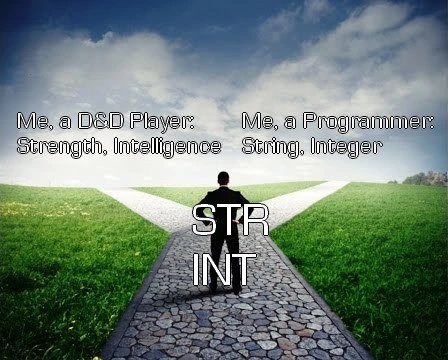
The meme’s image of a person standing where a road splits in two nicely symbolizes a context switch. One road leads to thinking like a gamer (interpreting STR/INT as character stats), and the other leads to thinking like a coder (seeing them as data types). The humor comes from the person (captioned “Me”) recognizing both meanings. It’s a moment many of us have had: you read some acronym or term and have to pause for a second to mentally sort out which version applies this time. If you were reading a fantasy novel and suddenly saw “INT 18”, you’d interpret it as a hero’s intelligence score. But if you were reading a code snippet that said int x = 18;, you’d know it’s defining an integer variable. Context is doing all the heavy lifting to tell your brain what those letters mean. The meme simply puts that split-second mental fork in the road onto the screen in a literal way.
In short, string vs. strength and integer vs. intelligence make for a fun juxtaposition. The same shorthand “STR”/“INT” lives in two universes. For someone new to either side, it’s a good reminder: always be aware of your context. What makes perfect sense in one setting might be gibberish in another. And for those who know both, it’s a chuckle at how cleverly our brain compartmentalizes knowledge. You don’t typically mix up your game stats and your data types – but seeing them together like this highlights the coincidence and makes you grin. After all, not every day do your D&D and coding worlds literally cross paths!
Level 3: Overloaded Abbreviations
At this crossroads of gaming and coding, we witness a delightful collision of context. The meme shows a lone figure facing a fork in the road – literally a fork_in_the_road_visual_metaphor – with two signs that read the same letters but point to completely different worlds. An experienced dev (who perhaps moonlights as a dungeon master) will instantly recognize STR and INT as overloaded tokens: in one world they’re attribute_abbreviations_str_int from a fantasy game, and in another they’re fundamental data types in code. It’s a prime example of how context is everything in tech and in life.
On the left path, labeled “Me, a D&D Player: Strength, Intelligence,” we’re in the realm of dungeons_and_dragons. Strength and Intelligence are core character stats – the bread and butter of any D&D character sheet. On the right path, labeled “Me, a Programmer: String, Integer,” we’re firmly in the land of programming languages, dealing with the string and integer types that every coder learns in CS 101. The giant “STR / INT” hovering above the person beautifully merges these two acronyms, preparing our brain for a context-switch. For those of us fluent in both dialects – RPG stats and code primitives – it triggers a knowing grin. We’re essentially looking at one abbreviation being overloaded with two meanings, depending on which role we’re playing at that moment. It’s like a real-life naming collision where two domains accidentally chose the same shorthand for totally different concepts.
This dual meaning arises from parallel evolutions in Games and programming Languages. In programming, int and str (or String) are common LanguageFeatures – basic building blocks of typed variables. From a CS_Fundamentals viewpoint, these are some of the first concepts you learn: a string holds text, an integer holds numeric values. Meanwhile, in gaming, particularly D&D, Strength (STR) and Intelligence (INT) are basic ability scores you assign to characters. Both worlds favored brevity (three-letter tags) for these fundamentals – early programmers kept keywords like int short (partly for memory and typing efficiency), and early game designers abbreviated stats like STR to save precious space on character sheets. By cosmic coincidence (or perhaps nerdy cross-pollination in the 1970s), the same letter combinations ended up representing key ideas in each field. No wonder developers who play D&D feel a jolt of recognition seeing string vs. strength or integer vs. intelligence side by side. It’s a datatype_wordplay jackpot!
Digging deeper, there’s an implicit joke about Static Typing and strict categories. In code, an int is not a string – and any attempt to mix them up will usually result in a compiler error or a runtime exception. This is by design: languages enforce Type Safety so that, for example, you can’t accidentally treat an integer like text or vice versa. (Try adding a number and a string in a statically-typed language – it’s a no-go without an explicit conversion.) In the fantasy realm, similarly, you can’t use brawn when brainpower is required: a high STR won’t help you solve an ancient riddle, just as a high INT won’t help you lift a boulder. The rules (whether game rules or a type system) won’t allow that kind of mix-up. It’s amusing to think of it this way: D&D’s rulebook and a programming language’s compiler are both guardians of consistency, each in their own universe. You wouldn’t roll a Strength check to decipher an arcane puzzle (that’s an Intelligence check!), just like you wouldn’t run a text-manipulation method on an integer variable without converting it. Both would be categorical errors.
There’s even a punny alignment in terminology: in programming we talk about casting data types (e.g. casting an int to a str), and in D&D a wizard literally casts spells using INT (Intelligence). But try casting Strength into a String and you’ll either get a compiler complaining or a dungeon master giving you a funny look. 🧙♂️💻 In one world, “casting STR to INT” sounds like converting a string to an integer type; in the other, it sounds like a barbarian trying to do math – equally ludicrous in either context! This kind of inside joke sits at the intersection of DeveloperHumor and a classic GamingReference, and it resonates especially with those of us who straddle both realms. We’ve all had that moment where we see INT written down and our brain does a double take: is this an intelligence stat or an int variable?
Ultimately, the meme is poking fun at how the same three letters can hold two completely different meanings that define the rules of two different games – one game being a fantasy adventure and the other the technical logic of software. It’s the Context Overload moment of a multi-talented nerd life. If you’ve ever juggled two domains (say, debugging code by day and slaying dragons by night), you immediately get the joke. Our lone adventurer/programmer at the crossroads embodies that dual identity: one path leads to rolling dice and character sheets, the other to writing code and debugging. And the poor guy can only choose one at a time! The humor comes from recognizing that STR/INT mean “boost my melee attack” in one ear and “take up X bytes in memory” in the other. It’s a geeky, joyous realization of how flexible and quirky human language (and human brains) can be – even in our engineered systems and games.
Description
The image displays a stock photo of a man in a business suit standing at a fork in the road, with one path being cobblestone and the other a grassy trail under a blue sky. Text is overlaid on the image to create the meme. At the central fork, large letters spell out 'STR' and 'INT'. On the left, above the grassy path, it reads 'Me, a D&D Player: Strength, Intelligence'. On the right, above the cobblestone path, it says 'Me, a Programmer: String, Integer'. The humor is a pun based on the abbreviations 'str' and 'int', which have distinct meanings in two different but often overlapping 'nerd' cultures. For a programmer, they are fundamental data types (String and Integer), while for a Dungeons & Dragons player, they are core character attributes (Strength and Intelligence). The meme captures the mental context-switch required when your hobbies and your profession use the same jargon for entirely different concepts
Comments
13Comment deleted
My therapist told me to work on my STR and INT. I pushed a feature branch and refactored a function to use a hash map; I don't think that's what she meant
I once named a column STR and a constant INT; the ORM tried to cast, the compiler tried to sign-extend, and the dungeon master tried to roll - context overloading is the only bug that attacks both prod and parties
When you're debugging production at 3am and realize your 20 INT wizard build didn't prepare you for someone storing phone numbers as integers and wondering why the leading zeros disappeared
The eternal struggle of the programmer-gamer: spending 20 minutes debugging why your character creation form accepts 'Fireball' as a valid INT value, only to realize you're still thinking in D&D stats instead of data types. At least when your production code rolls a critical failure, you can't just blame the dice - though explaining to stakeholders that the system 'failed its saving throw against a buffer overflow' is oddly satisfying
STR vs INT: in D&D they’re attributes; in production they’re both stringly typed JSON because someone promised "flexible contracts."
D&D min-maxers pump INT for spells; programmers pump String length until the JVM begs for mercy on that 'strong' typing
My brain's lexer keeps picking the wrong grammar: I see 'STR/INT' and start planning a schema migration from varchar to int - turns out the only nullable field is wisdom
Me, a taror user: magician, strength :3 Comment deleted
me: save from register to memory and an interruption Comment deleted
Its easy str int is for c++ Str Int is for java STR INT is for D&D Comment deleted
Me a engineer, STRessed , INTtotheUnknown Comment deleted
STRessed and INTroverted Comment deleted
true story Comment deleted