Defense in Depth vs. Dave in Finance
Why is this Security meme funny?
Level 1: Candy from a Stranger
Imagine you live in a super secure house with the best locks, alarms, and even a guard dog. You feel totally safe. But one day, a friendly stranger knocks and says, “Hey, I have a huge box of free candy for you! Just open the door.” Excited about the candy, you open your door wide and invite them in without thinking twice. Unfortunately, that stranger turns out to be a thief. In that moment, all your locks and alarms meant nothing because you let the bad guy right in. This meme shows the same idea in a funny way: the company had built an amazingly strong “door” of security, but it didn’t help because one person was fooled into letting the danger come through a big hole in the wall. It’s a cartoon way of saying: even the best locks won’t protect you if you willingly invite the wolf into the house.
Level 2: Defense in Depth vs. Dave
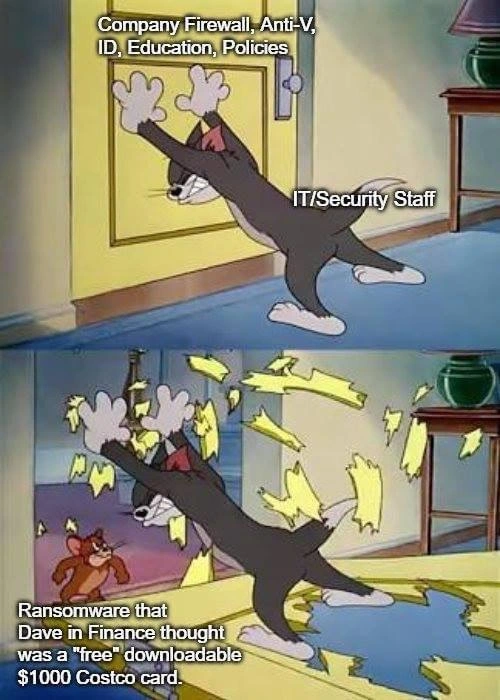
Let’s break down the scene and the jargon in plain terms. In the first panel, Tom the cat (playing the IT/security team) is using all his strength to hold a door shut against attackers. The labels on his hands and body are the security measures a company typically uses:
- Firewall: This is like a gatekeeper at the company’s network border. It blocks or permits data connections based on rules, so only the right stuff gets through. Think of it as an internet security guard – keeping out known bad guys.
- Anti-Virus: Software that scans computers for known malware (malicious software like viruses or spyware) and tries to stop or quarantine it. It’s like a doctor for your computer, checking files for infection and isolating the “sick” ones.
- ID (Intrusion Detection): Likely short for an Intrusion Detection System. This system monitors network and system activity for suspicious behavior or patterns (like an alarm that rings if someone’s sneaking around where they shouldn’t be).
- Education: This refers to security awareness training for employees. Companies often hold training sessions or send out test phishing emails to teach staff how to spot scams. Basically, it’s training Dave and everyone else not to open the door for a stranger with candy.
- Policies: Formal rules and guidelines the company expects everyone to follow. For example, a policy might say “Don’t install unauthorized programs,” “Don’t click on unknown links or email attachments,” or “Verify unusual requests with IT first.” These are the official do’s and don’ts meant to keep the company safe.
Tom straining against the door with all these tools symbolizes the company’s defense-in-depth strategy – multiple layers of defense working together. The idea is that even if one layer misses something, another layer can catch it, creating overlapping safety nets.
Now, look at Jerry the mouse in the second panel. He represents the actual threat that got inside: specifically, a piece of ransomware triggered by a user’s mistake. Ransomware is a type of malicious software that locks up your files and demands money (a ransom) to unlock them. It’s one of the nastiest surprises a company can deal with on its computers.
In the cartoon, Jerry strolls through a giant hole in the wall, casually bypassing the door Tom is guarding. How did that happen? Because Dave in Finance (the employee in this story) was tricked into letting Jerry in. The caption says Dave thought he was downloading a “free $1000 Costco card” – that’s a big red flag of a phishing scam. Phishing is when attackers send a fake email or link that looks tempting or official (like a prize offer or an urgent work document) but it’s actually a trap. If you click the link or open the attachment, you might install malware or give away your password. Here, Dave took the bait: he clicked something he shouldn’t have, and that launched the ransomware inside the company’s network.
For attackers, this kind of trick is called social engineering – basically, hacking people’s trust instead of hacking the computer directly. And it often works. None of the security tools (firewall, antivirus, etc.) stopped the attack at that moment because, from the system’s point of view, an authorized user (Dave) initiated it. It’s as if all the locks and alarms were working, but someone with the key (the user) opened the door for the bad guy. This is a defense-in-depth failure at the human layer (sometimes nicknamed Layer 8 in geek speak, meaning the person at the keyboard).
If you’re a newer developer or employee, you probably remember those mandatory cybersecurity trainings or all-staff emails: “Don’t click suspicious links,” “Watch out for phishing,” and so on. This meme is a big, cartoon example of why they stress those rules. It only takes one person like Dave ignoring the guidelines to put the whole company at risk. Maybe you’ve even witnessed a close call or an incident: one unthinking click, and suddenly the IT team is rushing to clean up a virus outbreak. It’s a lesson that while technology is crucial in security, human behavior is just as important. Good security is everyone’s responsibility – because if someone props open the back door, it doesn’t matter how many high-tech locks are on the front door.
Level 3: The Layer 8 Loophole
At a senior engineer’s level, the humor hits close to home: every security veteran has seen a situation where a single user’s lapse bypasses an entire stack of defenses. The meme’s first panel shows Tom (the ever-suffering IT/Security staff) bracing a door labeled with everything the company invested in: a firewall to block bad traffic, anti-virus scanners, intrusion detection systems (IDS), user education programs, and strict security policies. This is the classic defense in depth approach – multiple layers meant to ensure if one fails, another catches the threat. Tom’s determined stance represents how corporate IT throws its weight behind all these barriers.
But then comes panel two: Jerry the mouse strolls in smugly, not through the door at all, but through a gaping hole in the wall. The door (and Tom) remain perfectly intact, yet the breach happened around them. The caption on Jerry names the culprit:
“Ransomware that Dave in Finance thought was a ‘free’ downloadable $1000 Costco card.”
In other words, an employee was duped by a phishing email offering an obviously too-good-to-be-true reward (the classic $1000 Costco gift card scam). One careless click, and a malicious program (ransomware) executed inside the network, shredding the corporate defenses just like the wall in the cartoon. The juxtaposition is hilarious and painful: all that expensive security infrastructure, all those security awareness trainings about not clicking suspicious links, and it was all undone by one well-crafted con.
This meme nails the perennial IT vs. users conflict. The title’s phrase “Layer-8 breach” is tongue-in-cheek: in networking, we jokingly talk about an extra layer atop the OSI stack – the user layer. It’s often said the hardest problems in tech are layer 8 issues or PEBCAK errors (“Problem Exists Between Keyboard And Chair”). Here, Dave is that problem. The company’s defense-in-depth ultimately failed at this human layer. No firewall or anti-malware can help if a legitimate user intentionally (albeit unwittingly) lets the threat in. Dave in Finance wasn’t breached through a technical flaw; he was socially engineered. Attackers sent something enticing, counting on someone’s curiosity or greed to do the rest. And it worked – Dave essentially opened the door from the inside.
It’s almost a running joke in security: no matter how many times the IT team warns “Don’t trust freebies – if it’s too good to be true, it probably is!”, someone inevitably clicks anyway. Seasoned engineers have war stories of similar incidents. Maybe it wasn’t a Costco card scam, but perhaps an email from “HR” asking employees to download an urgent policy update, or a USB stick labeled “Q1 Bonuses” left in the parking lot that an unsuspecting person plugs in. Despite yearly trainings and even fake phishing tests to keep everyone on their toes, there’s always that one person who clicks. In the trenches of corporate IT, folks like Tom often feel exasperated: you can implement state-of-the-art tech and policies, but you can’t force every single person to make good choices.
The meme humorously portrays that reality – Tom (IT) doing everything right, yet looking utterly stunned as the entire wall (the company’s security posture) is obliterated by a simple human mistake. The contrast also gives a glimpse into a security breach response nightmare. A ransomware infection like this can spread and lock up critical files, meaning the IT team now has to scramble to contain the damage, restore from backups, or even negotiate with criminals – all because of one misplaced click. This resonates with senior devs and security pros because it's so common: the hardest intrusion to prevent is the one that happens with an insider’s unwitting help. It’s a comic, spot-on representation of the weakest link in action, something every security team grapples with regularly.
Level 4: The Unpatchable Layer
Security architecture is typically modeled in structured layers (consider the OSI model’s 7 layers from Physical up to Application). Yet the most notorious vulnerability lurks just beyond — an unofficial "Layer 8," often a cynical reference to the human user or organizational processes. This meme dramatizes a classic "Layer 8" issue: a breach arising from the human factor, which lies outside purely technical defenses. Unlike software or hardware vulnerabilities, human gullibility or error isn’t something you can patch with a code fix or firewall rule. It’s essentially an unbounded attack surface from the perspective of formal threat modeling: no matter how robust your encryption protocols or network segmentation, an attacker can circumvent those by manipulating a person into opening a door from the inside. In our cartoon scenario, the malicious payload is Ransomware (malware that encrypts files and demands ransom), but it didn’t break in by brute-forcing a firewall or cracking encryption – it walked in through the open door of human trust. In theoretical terms, this is akin to a side-channel attack on the system’s trust model – instead of breaking cryptography or network defenses directly, the attacker exploits cognitive biases and social trust. The humor here is underscored by a fundamental truth in security: complex multi-layer defenses often still assume a user won’t actively undermine them, yet experience (and research in social engineering) shows otherwise.
From an academic perspective, this scenario highlights the limitations of a pure defense-in-depth strategy when it doesn’t fully integrate human behavior. Formal security models (like access control mechanisms or intrusion detection algorithms) tend to treat user actions as given or trusted inputs. But in reality, a well-crafted phishing scheme can trick a legitimate user into performing a malicious action, effectively turning that user into an unwitting insider threat. This exploits what you might call a zero-day in wetware (slang for the human brain): an unpredictable vulnerability no one can systematically patch. The very notion of Layer 8 exists because seasoned engineers recognize that beyond the technical layers lies a socio-technical realm governed by psychology and CorporateCulture. The meme wittily portrays that realm: Tom (the IT/security infrastructure) secures everything according to the textbook, but Jerry (the clever attacker, enabled by Dave’s lapse) simply operates outside those layers, rendering classical defenses moot.
Ultimately, the cartoon illustrates a paradox often discussed in security engineering: the security chain is only as strong as its weakest link, and frequently that link is human. Even with mathematically provable protocols and robust systems, the inclusion of people introduces a kind of unpredictability – you can’t algorithmically predict or prevent every user mistake. There’s a tongue-in-cheek saying among security professionals: “Amateurs hack systems; professionals hack people.” By walking right through a hole in the wall (the Layer 8 breach), Jerry demonstrates how an attacker using persuasion or deceit can violate assumptions that even formal models struggle to account for. It’s a theoretical and practical reminder that any comprehensive Security strategy must extend beyond technology into training, culture, and human factors – an area as challenging and complex as any encryption algorithm.
Description
This is a two-panel meme using a template from the cartoon 'Tom and Jerry.' In the top panel, Tom the cat is desperately trying to barricade a wooden door. Tom is labeled 'IT/Security Staff,' and the door is labeled 'Company Firewall, Anti-V, ID, Education, Policies.' This represents the comprehensive, layered security measures put in place by an organization. In the bottom panel, the door has been completely shattered, with Tom still clinging to the broken frame in defeat. Jerry the mouse, looking smug, walks right through the gaping hole. Jerry is labeled, 'Ransomware that Dave in Finance thought was a “free” downloadable $1000 Costco card.' The meme humorously and accurately portrays a core frustration in cybersecurity: despite extensive technical defenses, the entire system can be compromised by a single instance of human error, where an unsuspecting employee falls for a simple phishing scam
Comments
8Comment deleted
Our multi-layered, AI-driven, zero-trust security architecture held strong for a whole 3 nanoseconds against Dave from finance clicking on 'free_gift_card.exe'
Spending seven figures on next-gen firewalls is great, until Dave treats Outlook like LimeWire circa 2003
We spent $2M on zero-trust architecture and mandatory security training, but Dave from Finance still believes Nigerian princes need his help with international banking transactions
Seven figures on zero-trust architecture, defeated by Dave's unshakeable trust in a free $1000 Costco card - the only zero-day that never gets patched is payroll
You can have military-grade encryption, zero-trust architecture, and a SOC team monitoring 24/7, but all it takes is Dave from Finance clicking on a 'free $1000 Costco card' to turn your entire security posture into a Tom and Jerry episode. The real zero-day exploit isn't in your codebase - it's in your org chart, specifically the cell labeled 'Finance Department.'
Zero Trust and EDR looked great on the architecture diagram - until Dave ran giftcard.pdf.exe and achieved lateral movement faster than our SIEM could declare a P1
Firewalls secure every port but Dave's - the ultimate unpatched backdoor
We funded Zero Trust and EDR, but Dave added an implicit allow rule to the human firewall with a “$1000 Costco card” download