The Traumatic Realization of 2022
Why is this MentalHealth meme funny?
Level 1: Please, Not Again!
Imagine you just had the worst year ever – like everything went wrong. You were stuck at home, couldn’t see your friends, and had to do school on a computer. It was super hard and not fun at all. Now picture that finally ending and feeling like, “Glad that’s over, next year will be better.” But then someone comes along and says, “Hey, guess what? Next year is basically going to be that same bad year all over again!” 😨 That’s the exact feeling of this meme. It’s like if you finished a really difficult level in a video game that took forever, and you’re so happy to be done... then the game says, “Surprise! Here’s the same level again!” You’d probably scream “No, not again, please!” In the meme, the lady clutching the wig is making a face like she just heard this terrible news. Developers see “2022” sounding like “2020 too” and feel the same way – a mix of fear and disbelief that they might have to relive a nightmare. It’s funny in a scary story around the campfire kind of way: you laugh a little, but you really hope it isn’t true.
Level 2: Production Déjà Vu
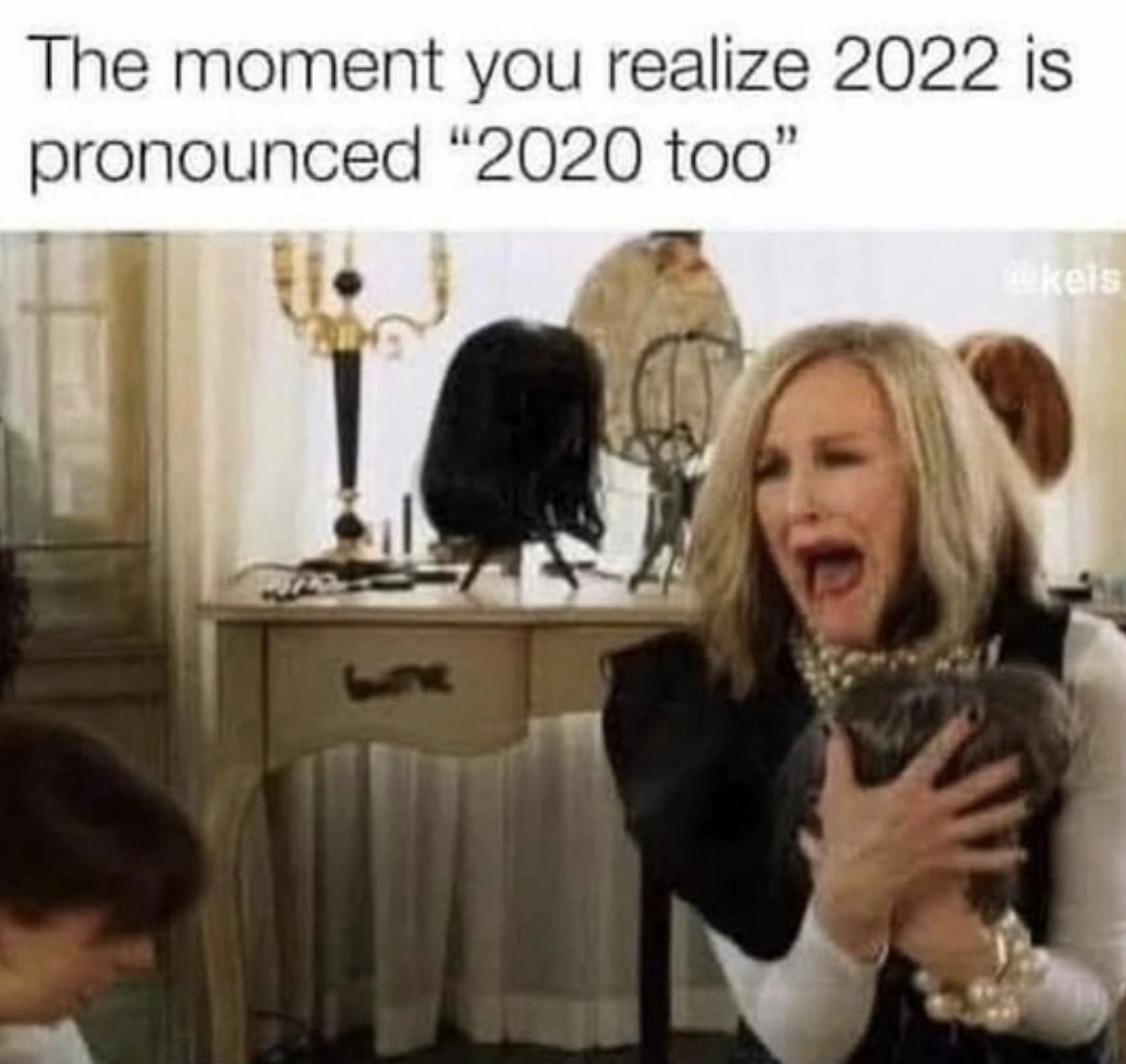
The meme text reads:
“The moment you realize 2022 is pronounced ‘2020 too.’”
For a newer developer (or really anyone), let's break down why this line instantly causes equal parts laughter and panic. First, the obvious: “2020 too” sounds just like “2020 two” (2022) when spoken. It’s a play on words – a year_pronunciation_pun. The joke is that the year 2022 can be heard as “2020, also.” That implies 2022 won’t be a new, better year, but basically 2020 all over again. For anyone who endured year 2020, that suggestion is horrifyingly funny. It’s as if someone announced a surprise encore of your least favorite performance. In developer lingo, to parse usually means to take a string (like text “2022”) and interpret it as data (like the number 2022). Here they say “parse 2022 as simply ‘2020-too’ in prod,” joking that when our mental “code” reads the input “2022”, it mistakenly outputs something that means “another 2020”. And they add “in prod” which is shorthand for “in production” – meaning this realization is happening in the real world, where it actually matters, not just in theory. In software, finding a bug in production (often called prod) is the worst, because it’s live and affecting everyone. So this phrasing adds drama: it’s like we accidentally deployed a code change that makes the calendar readout for 2022 say “2020 too,” and now the whole world sees it. The humor is geeky: treating the new year like a software version that might have a show-stopping bug.
Why does this joke land so well with developers? Because 2020 was an absolute rollercoaster for tech workers. The categories here, RemoteWork and CorporateCulture, point to what happened: almost overnight, companies went from business-as-usual to everyone working from home in their pajamas. One day you were deploying code from a comfy office chair with triple monitors; the next, you were VPN-ing into the office network from your kitchen table, juggling a single laptop and maybe a curious cat on the keyboard. It was a crash course in RemoteWorkCulture for even the most old-school corporations. Daily stand-up meetings moved to video calls on Zoom, team chats on Slack became the office water cooler, and many developers realized their home internet was now a mission-critical part of the company infrastructure. It was chaotic and stressful – but also a bonding experience. People swapped stories of accidentally unmuting at the wrong time or turning themselves into a potato with a funny video filter during a serious meeting. These are the kind of RelatableDeveloperExperience moments that became common. But there was a dark side: late-night debugging sessions got later when there was nowhere to go and nothing else to do. Work hours blurred into personal hours. A lot of developers felt DeveloperBurnout, a fancy term for being completely exhausted and mentally fried from work stress. 2020 caused a collective fatigue in the tech community like no year before.
Now, picture having gone through all that and thinking, “Phew, we made it through 2021, things are getting better.” Then someone points out that the name “2022” literally hints it’s “2020, round two.” 😱 It gives you a sinking feeling, like déjà vu but worse. Déjà vu means feeling like you’re experiencing something again. Here it’s a production déjà vu – the fear that the entire incident of 2020 (the sudden lockdowns, the emergency fixes, the high anxiety) is about to replay. In a sense, developers in late 2021 were a bit on edge: new COVID variants were in the news, hybrid work was still evolving, and everyone was hoping not to go backwards. The phrase “2020 too” perfectly captured the collective worry that we hadn’t truly escaped 2020’s shadow. It became a little ExistentialHumor meme in tech circles: we laugh, because otherwise we’d cry. The image of the woman screaming while clutching a wig (that’s a shot of actress Catherine O’Hara in a comedy role) is a dramatization of our internal scream. She’s well-dressed and in a nice room, yet she looks horrified – just like a developer who finally set up a decent home office with a fancy chair and good webcam, only to think, “Oh no, am I going to be stuck here doing crisis mode again?” The backlog mention in the description – “backlog still says Q1 2020” – refers to how many project plans from early 2020 got delayed or frozen. Backlog in software teams means the list of tasks or features to do. If stuff from Q1 2020 (the first quarter of 2020) is still pending at the end of 2021, it shows how disruptive that year was; projects had to be paused and never resumed. So, seeing 2022 might just remind us that some things haven’t moved forward since 2020. For a junior dev, imagine a Trello or Jira board with tasks that have been sitting there for two years – it’s eerie and frustrating. This meme cleverly rolls all those feelings – frustration, fear, and forced humor – into one punchline. It’s very Relatable if you were coding through the pandemic: you can’t help but chuckle and groan at the thought that we might be in a time loop with 2020.
Level 3: Temporal Regression Bug
At first glance, this meme hits like a temporal regression in our codebase called reality. The caption jokes that 2022 is pronounced “2020 too” – as in 2020, also. For a battle-worn engineer, that phrase feels like discovering an old critical bug has resurfaced in production. It's the dreaded off-by-two error of the timeline: we expected the year increment to 2022, but it’s reading as a second 2020. In coder terms, it's as if the year parser failed and 2022 got misinterpreted as 2020 (with an ominous too appended). We’ve spent years debugging date formats (remember Y2K or the Unix 2038 problem?), but this time the glitch is cosmic – a punny reminder that some failures come back to haunt us. The humor here taps into that geeky fear that the system (be it code or calendar) might revert to a previous bad state if a single variable (the year) is misread. Parse errors in production are no joke – and parsing “2022” as “2020-too” is a horrifying prospect that the next year will be a rerun of calamities. It’s a perfect example of PandemicHumor meeting programming humor: a linguistic twist triggering a very real dread_of_repeat_incidents among seasoned devs.
Beyond the wordplay, this meme is steeped in shared tech trauma. Veteran developers remember the 2020_pandemic_flashbacks all too well. When the pandemic hit, it was like an unscheduled, all-hands-on-deck prod incident that lasted for months. Offices shut overnight, and suddenly everyone had to work from home indefinitely – talk about an emergency deployment! Many senior engineers found themselves scrambling to scale VPN gateways at 3 AM and set up new remote access infrastructure on the fly. Companies rushed to shift entire orgs to Zoom and Slack over a single frantic weekend. It felt like performing a live kernel patch on the company culture: risky, messy, and absolutely necessary. The meme’s image – a woman clutching a wig in panic – hilariously captures that “Oh no, not this again!” feeling. Those wigs on stands in the background? They might as well represent the multiple incidents and roles engineers had to juggle in early 2020 (network admin hat, support hat, DevOps hat – all at once). The character’s blurred, shocked face with mouth agape is every lead developer reading an alert at 4 AM, realizing the fix from yesterday didn’t hold. It’s the SharedPain of anyone who lived through the overnight metamorphosis of work life and is terrified by even a whiff of going through that chaos again.
From an organizational perspective, 2020 was the ultimate test of CorporateCulture and readiness. Remember all those lofty disaster recovery plans and remote work policies collecting dust? 2020 called their bluff. Under the sudden pressure, lots of systemic cracks emerged: insufficient VPN bandwidth, fragile build pipelines that only ran on someone’s desktop at the office, permissions tied to on-site IP addresses – you name it. We did what any developer does in a crisis: hot-fixed everything. Quick hacks like expanding license counts on Zoom, loosening IAM policies to let folks access internal tools from home, and writing scrappy scripts to automate tasks when half the team was out sick. These patches kept the lights on, but they were meant to be temporary. Fast-forward to the end of 2021, and many of those “temporary” fixes are still in place (hello, technical debt!). The codebase of how we work got messy in 2020, and not every hacky solution was refactored. So when a grizzled engineer jokingly “parses” 2022 as “2020, too”, it betrays a grim expectation: we might be headed for the same incidents and firefights, because underlying causes (like underinvestment in IT resilience or clear remote processes) haven’t fully been addressed. In other words, the timeline_regression_bug isn’t just a pun – it’s an allegory for how easily we could slide back into crisis-mode if we’re not careful.
There’s also a psychological layer here – the MentalHealth toll. By now, terms like “pandemic PTSD” or burnout have entered the developer lexicon. Think of the meme’s terrified expression as the face of an engineer who hasn’t had an on-call-free weekend in months, suddenly recalling the worst year of their career. For many devs, 2020 was a blur of endless workdays bleeding into each other: deploying critical updates from a kitchen counter, fighting production fires with one hand while ordering groceries online with the other. RemoteWorkCulture became the norm, but it wasn’t the utopian remote setup we read about on Digital Nomad blogs – it was chaotic and isolating. The DeveloperBurnout in 2020 was real: late-night server issues, daytime Zoom fatigue, kids/pets crashing standups, and the constant background anxiety of a world on fire. Companies tried to help – virtual happy hours, bonus days off that nobody took, Slack channels full of meme therapy – but a lot of devs ended 2020 utterly exhausted. Now imagine that same tired developer on New Year’s Eve 2021, finally hoping for a fresh start, when some wiseguy points out that “2022” literally reads as “2020, part two.” It’s darkly comedic ExistentialHumor. Senior engineers laugh at this meme, then immediately cringe, because it hits too close to home. We joke that “the backlog still says Q1 2020” – implying all those goals and projects derailed by the pandemic never really recovered. It’s funny because it’s true: plenty of Jira tickets from early 2020 got postponed, then forgotten, and still linger like ghosts of a timeline that never happened. In true cynical veteran fashion, we suspect the universe’s version control might have accidentally created a branch off 2020 and is about to merge it into 2022. In short: RelatableDeveloperExperience 101 – if you survived 2020 in tech, the prospect of reliving that nightmare is both absurd and palpably frightening. This meme brilliantly encapsulates that uneasy laugh we all share when someone says, “Brace yourselves, 2020 might have a sequel,” and every engineer quietly prays, “please, not in prod.”
Description
The image features a well-known meme template of actress Catherine O'Hara as Moira Rose from the TV show 'Schitt's Creek,' looking horrified and screaming while clutching a wig. The text overlay reads, 'The moment you realize 2022 is pronounced “2020 too”'. The humor is rooted in the collective trauma and exhaustion associated with the year 2020, marked by the start of the COVID-19 pandemic and widespread disruption. The meme, posted on New Year's Eve 2021, plays on the phonetic similarity as a bad omen, suggesting that 2022 will be a dreaded sequel to 2020. For the tech community, this reflects the burnout and anxiety prevalent during the shift to mandatory remote work, supply chain disruptions, and the general stress of that era, making the prospect of a repeat universally unwelcome
Comments
21Comment deleted
Let's hope 2022 isn't a critical patch for 2020 that introduces more breaking changes
Turns out we never shipped the 2020 hotfix - management just bumped the version to 2022 and called it semantic versioning
Just like how we keep incrementing version numbers hoping 2.0 will fix all the bugs from 1.0, but then realize we're just shipping the same technical debt with a new timestamp - except this time it's reality itself running on legacy code from 2020
2022 being '2020 too' is just the universe re-running a failed pipeline with zero changes and expecting green - we all know how that retry strategy ends
When you finally understand why your sprint velocity hasn't recovered since Q2 2020 and realize it's not technical debt - it's existential debt. The backlog isn't the only thing that's been accumulating; turns out 'return to normal' was deprecated without a replacement API, and we're all still running on the 2020 runtime with increasingly desperate hotfixes
Proof that CalVer is dangerous: we shipped 2020, never closed the Sev-1, and now 2022 is just "2020 too" - a silent re-release with all the same bugs
2022? More like 2020's sneaky 'continue;' in the while(true) pandemic loop
2022 sounding like “2020 too” is the calendar’s SemVer bug - marketing shipped a “minor” update with breaking changes, and ops are still hotfixing off the 2019‑LTS branch
"Dev meme" Comment deleted
Two zero four meme reference Comment deleted
Zero day reference Comment deleted
Need some explanation Comment deleted
2022 -- twenty twenty two 2022 too -- twenty twenty too two = too Comment deleted
Ah, got it Comment deleted
Twen-tea or Two-ny? Comment deleted
twonya Comment deleted
Dvadtsat [rus: 20] Comment deleted
nijuu (jap: 二十 or 廿) Comment deleted
2020 (2) Comment deleted
Lol Comment deleted
2222 Comment deleted