Skip to content
DevMeme
4723 of 7435
When a vaunted security header turns out to be a lab-only myth
Security Post #5176, on May 5, 2023 in TG

When a vaunted security header turns out to be a lab-only myth

Why is this Security meme funny?

Level 1: Magic Word Myth

Imagine your friend at school tells you about a secret trick: “If you go to the vending machine and quietly whisper open sesame while pressing the Cola button twice, you’ll get a free soda!” It sounds exciting and you really want to believe it. But when you actually try it on a real vending machine, nothing happens. You just end up feeling a bit silly. You find out later that this “magic word” trick was never real – maybe it came from a story or a prank. This meme is laughing about the same kind of situation, but in the world of websites and hackers. Some people thought they found a “magic word” (a special hidden command in a web request) that would let them log into any site without a password. They tried it everywhere, only to discover it was just made up for a classroom example, not a real cheat code. In simple terms: they fell for a rumor about a fake shortcut, and the punchline is that there was never any easy magic word to begin with – it was all just a myth!

Level 2: Header Hype

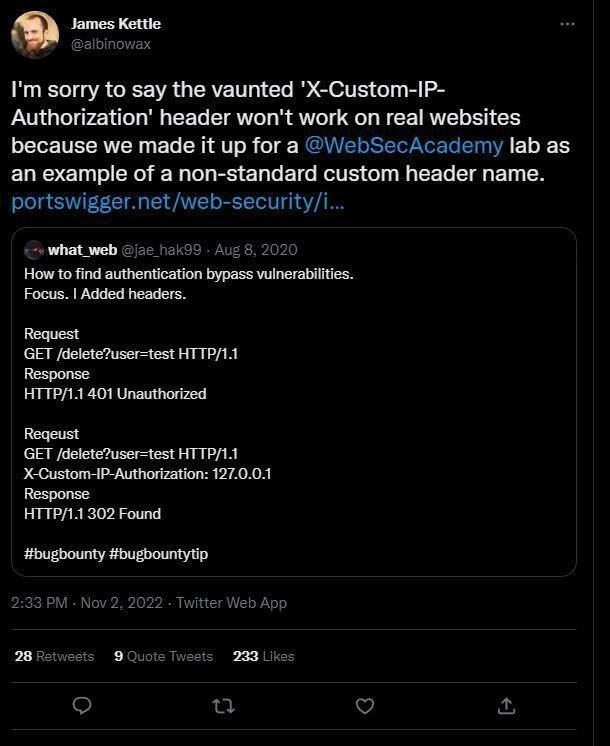
This meme is about a misunderstanding in the web security world, especially among new bug bounty hunters. Let’s break it down step by step. The image is a dark-mode Twitter screenshot of two tweets. The first tweet (by James Kettle) apologizes, saying something like: “I’m sorry to say the vaunted ‘X-Custom-IP-Authorization’ header won’t work on real websites because we made it up for a Web Security Academy lab as an example of a non-standard custom header name.” The second tweet (by @what_web) is from a couple of years earlier, showing a little hacking trick: it has two web requests and responses side by side – one without the special header that gets “401 Unauthorized,” and one with the X-Custom-IP-Authorization: 127.0.0.1 header that gets “302 Found”. The second tweet caption basically says, “How to find authentication bypass vulnerabilities. Focus. I added headers,” with some hashtags like #bugbounty.

Alright, so what’s all that jargon? We’ll start with HTTP. HTTP (Hypertext Transfer Protocol) is the language that web browsers and servers use to communicate. An HTTP request is a message a client (like your browser or a testing tool) sends to a server asking for something (like a webpage or data from an API). The request consists of a line like GET /delete?user=test HTTP/1.1 (which is asking to GET the resource /delete?user=test using HTTP version 1.1), followed by various HTTP headers. Headers are just additional lines of text in the request that provide extra information in a key: value format. For example, there’s a header called Host that specifies which website (host) you’re trying to reach, and headers like Content-Type to tell the server what format your request is in, or an Authorization header where you might put a token or credentials to prove you’re allowed access.

In the tweet’s screenshot, the person is demonstrating an authentication bypass attempt using a custom header. The header name is X-Custom-IP-Authorization, and they set its value to 127.0.0.1. This is not a standard or commonly used header at all – it looks like something invented. (By convention, headers that start with “X-” are non-standard, meaning they’re not part of the official HTTP specification but could be used by some application for custom purposes. Think of “X” as standing for “eXperimental” or just “custom.”) The value 127.0.0.1 is also significant: that’s the special IP address that means “localhost” or “this same machine.” If a web server sees a request coming from its own machine (127.0.0.1), it might consider that a trusted internal request.

Now, the second tweet’s content shows what happened in that test:

  • First request: GET /delete?user=test HTTP/1.1 with no special header. The server responded with HTTP/1.1 401 Unauthorized. A 401 status code means the request was not allowed – essentially, “you are not authorized (not logged in or don’t have permission) to do that action.” They were likely trying to delete a user (perhaps an admin-only function), and without the proper credentials, the server correctly said nope.
  • Second request: GET /delete?user=test HTTP/1.1 with the header X-Custom-IP-Authorization: 127.0.0.1 added. This time the server responded with HTTP/1.1 302 Found. A 302 is a redirection; it usually means the server is saying “okay, I did something, now navigate to this other page.” In context, a 302 after a delete action might mean “delete succeeded, now go back to, say, the user list page,” or it could even be redirecting an unauthorized user to a login page. But given the dramatic change from 401 to 302, the implication is that the second request was allowed through. In other words, adding that header made the server think the request was coming from a trusted source (127.0.0.1) and therefore it bypassed whatever security check was there. The tweet is basically claiming: “Look, by adding this header, I fooled the server into authorizing the action!”

If you’re new to this, you might wonder: is that a thing? Do websites really let you just add a header and trick them like that? Normally, no – not unless they have a specific vulnerability. Here’s what was really going on: The header X-Custom-IP-Authorization was part of a lab exercise on PortSwigger’s Web Security Academy site. PortSwigger (the company behind the popular Burp Suite tool) provides a bunch of free web security labs for learners to practice finding vulnerabilities in a safe environment. In one lab, they must have set up an intentionally vulnerable scenario where the application checks for that header. The logic might have been: “If the request has X-Custom-IP-Authorization: 127.0.0.1, then treat it as if it’s coming from localhost and let it pass (give a 302 redirect to the next page). Otherwise, if that header isn’t present, or isn’t 127.0.0.1, then it’s an external user and should be blocked (give a 401 Unauthorized).” This is an example of a bad security design, shown on purpose so students can learn why it’s bad.

Now, outside of that lab, no real website is expecting a header with that name. Unless a developer deliberately wrote the same quirky backdoor into their code, sending X-Custom-IP-Authorization: 127.0.0.1 to a random website will do nothing at all. It’d be like handing a fake VIP pass to a concert security guard who’s never heard of that pass – they’ll just shrug because it’s not something they recognize as valid.

So why did people get excited about this? Well, in the security research and bug bounty community, folks love to share tips and tricks. Bug bounty programs are where companies invite hackers (often called “bounty hunters”) to find and report bugs in their websites or APIs, often for a reward. It’s a very open field – you get everyone from seasoned pros to students trying things to see what works. A lot of knowledge is shared on Twitter, blogs, and forums. Occasionally, a tip that sounds really cool can go viral. The idea of a secret header that just instantly bypasses login checks sounds super cool, right? It’s the kind of trick that, if it worked generally, would be amazing. So some people saw that tweet or the lab write-up and started including this header in their testing checklist for websites, hoping to find an easy win. It became a bit of a meme in itself – like “have you tried the magic X-Custom-IP-Authorization header on this target? Maybe the devs left a backdoor!”

What James Kettle’s tweet is doing in the meme is essentially debunking that hype. He’s saying, sorry, this “vaunted” header that you all are excited about is basically an inside joke from a lab. We (the lab creators) just dreamed it up as an example of a custom header. It’s not a known feature of any real software. In other words, it was a made-up solution for a made-up vulnerability scenario. If you tried it on a real website’s API or pages, you'd likely just see no change – because real servers don’t have code listening for that header.

This highlights a bigger lesson for juniors and enthusiasts: always understand the context of a trick or exploit. In web security, an authentication bypass means you managed to perform an action or access something that should require logging in, but you did it without proper credentials. There are real ways these happen (like exploiting logic flaws, using tokens from an admin, etc.), but they tend to be unique to each application’s design. If you see a one-liner “just do X and bypass auth”, be very skeptical. In this case, the bypass only worked in the environment where the developers intentionally planted that weakness. It’s like a teacher giving students a puzzle with a hidden key under the mat, to teach them about not leaving keys under mats – that doesn’t mean every house in town has a key under the doormat.

To relate this to API development and web services: When developers build an API, they decide what headers or parameters to trust. For example, a real API might expect an Authorization: Bearer <token> header for authentication, or perhaps an API key header like X-API-Key: <key> if they chose that. These are documented and intended. If you send the wrong header (say you send X-API-Key to a service that expects Authorization token, or vice versa), the server will ignore it and you won’t be authenticated. The X-Custom-IP-Authorization header is not a standard part of any authentication scheme; it was purely hypothetical. So randomly adding it to a request on GitHub or Google or your bank’s website will just be ignored by their servers as irrelevant noise.

One more term to clarify: Broken Access Control. This is a category of security vulnerability (in fact, it ranks at the top of the OWASP Top 10 list of web vulnerabilities as of recent years). It means the system doesn’t properly enforce who can do what. An example would be if you, as a regular user, can somehow access an admin-only function or another user’s private data – that’s broken access control. In the lab example, the system’s access control could be broken by a simple header trick (which is pretty severe!). But again, that was an illustrative scenario. In real life, if you ever find a bug where adding a bizarre header grants admin privileges, congratulations, you found a one-in-a-million crazy bug (and the developers of that site really dropped the ball). It’s so unlikely that it’s practically the stuff of jokes, which is why the community found it funny that people earnestly believed this would work broadly.

So, in summary, the meme and the tweets are poking fun at a kind of security myth. Lots of newcomers were treating this custom header like a magical key due to a misunderstood lab exercise. The expert had to clarify, “Guys, we literally invented that name as an example, it’s not a real thing you’ll find in the wild.” It’s a lighthearted warning: be careful about believing in easy hacks, and always verify tips with solid research. Just because you read about a trick in a lab or on Twitter doesn’t mean every website is vulnerable to it. In the world of security (and development in general), understanding the why and how is crucial – otherwise you might end up copying code or tricks that don’t do anything, or worse, miss the real issues. This was a funny example where people were copying something ineffective, so thankfully no harm done, except a bit of embarrassment. The meme captures that “oops” moment when everyone realizes the cool-sounding exploit was just a myth.

Level 3: The Header That Wasn't

Seasoned security researchers smirked knowingly at this tweet. It references an infamous piece of security folklore: the X-Custom-IP-Authorization HTTP header. For a while, this mythical header was touted in bug bounty circles as a secret hack to bypass authentication on websites. Spoiler: it doesn’t actually work in the real world. In fact, as James Kettle (@albinowax) reveals in the screenshot, the header was originally made up for a PortSwigger Web Security Academy lab exercise – a contrived example, not a genuine feature of any mainstream web framework or API. The humor here comes from all the eager security newbies who copied this trick from the lab (or from hearsay) and tried to use it on real websites, expecting a quick win. It’s a classic case of cargo-cult hacking: taking something seen in a controlled scenario and assuming it’s a universal exploit. Experienced developers find it funny (and a bit cringey) because they’ve seen this pattern before – people chasing ghosts due to misunderstanding how HTTP and web security actually work.

Let’s unpack why this header became a legend. The lab scenario involved an authentication check that could be bypassed if you included a header named X-Custom-IP-Authorization with the value 127.0.0.1. In plain terms, the vulnerable code likely said: “if the request claims to come from 127.0.0.1 (which is the loopback address for ‘localhost’, i.e., the web server itself), then trust it and skip the login.” It was an intentionally insecure design put in as a teaching example. In reality, no sane developer would hard-code a secret like that into their production site – doing so would be a glaring Broken Access Control flaw (basically, letting someone in who shouldn’t be allowed). The lab designers chose a fake-looking header name (X-Custom-IP-Authorization) on purpose to drive the lesson home. But ironically, that very fakery gave it an almost mystical allure to those who didn’t know better! Some folks thought, “If it worked in the lab, maybe some real websites have this too.” They treated it like a hidden cheat code for websites.

To understand the tech backdrop: historically, custom or non-standard HTTP headers were often given an X- prefix. This was a convention meaning “this isn’t an official header, just something we invented.” For example, decades ago you’d see things like X-Powered-By or X-Frame-Options. In modern practice, standards bodies have discouraged the X- prefix, but internal teams still use custom headers for proprietary features. The key is, a server will only react to a header if its code is explicitly written to recognize and use that header. If you send some random header that the application isn’t looking for, it will be ignored completely. There’s no universal “god mode” header that magically grants admin access on all sites (if only hacking were that easy!). The X-Custom-IP-Authorization value was essentially a hardcoded backdoor in a toy environment. Outside that toy, it’s just a string of text that any normal server will shrug off as nonsense.

What makes this meme extra amusing for senior engineers is how it highlights the spread of misinformation in security research. A well-meaning individual on Twitter (the second tweet in the image) showed an example of using this header to get a 302 Found instead of 401 Unauthorized – essentially demonstrating an authentication bypass. They tagged it as a bug bounty tip, implying others should try it. And people did! For months, perhaps years, some budding bug hunters were adding X-Custom-IP-Authorization: 127.0.0.1 to their requests, hoping to strike gold. It’s the equivalent of using a secret spell from a fantasy novel in a real sword fight – a mix of hope and misunderstanding. Eventually, James (who, as one of the creators of the lab, had the inside scoop) stepped in like the MythBusters and said, “Sorry, folks, we literally made that one up.” He linked to the Web Security Academy lab write-up that presumably introduced that header just as an example of a weird custom header. Cue the collective facepalm in the community.

For clarity, here’s roughly what that lab vulnerability might have looked like in code:

# Hypothetical flawed logic from the lab (for illustration only)
client_ip = request.headers.get('X-Custom-IP-Authorization')
if client_ip == '127.0.0.1':
    user.is_authenticated = True  # Bypass auth if claiming to be localhost

In a real application, this would be a horrendous backdoor. It trusts a client-provided header (X-Custom-IP-Authorization) to decide if you’re an internal user. The PortSwigger lab used this obvious no-no as a teaching tool, but some readers took the fictional example and ran with it as if every website secretly had this cheat code waiting. From a senior security perspective, the whole saga is a mix of amusement and “oh dear” – seeing newcomers try a non-existent silver bullet. It underscores why understanding fundamentals is crucial: you need to know why something works, not just that you saw it in a tutorial. Otherwise, you might end up hunting for unicorns in an empty forest.

In the end, this meme captures a little moment of myth-busting in the Security world. It’s a gentle reminder that not everything you read in a lab or on Twitter applies to real life, and that real Security Research means testing assumptions and knowing the context. The community had a laugh and took away a lesson: always verify those “too good to be true” tricks before you go adding them to your pentesting checklist. It’s like trying the Konami Code on a banking website – it’s just not gonna do anything, except maybe make the admins laugh if they spot it in the logs.

Description

Dark-mode Twitter screenshot. The main tweet, from James Kettle (@albinowax), says: "I'm sorry to say the vaunted 'X-Custom-IP-Authorization' header won't work on real websites because we made it up for a @WebSecAcademy lab as an example of a non-standard custom header name. portswigger.net/web-security/i…". Below, an embedded tweet by what_web (@jae_hak99, dated Aug 8 2020) shows a mini pentest write-up: "How to find authentication bypass vulnerabilities. Focus. I Added headers." It presents two HTTP request/response pairs - first without the header returning "HTTP/1.1 401 Unauthorized", then with the header "X-Custom-IP-Authorization: 127.0.0.1" returning "HTTP/1.1 302 Found", followed by hashtags "#bugbounty #bugbountytip". Tweet metadata displays "2:33 PM · Nov 2 2022 · Twitter Web App" with counts: 28 Retweets, 9 Quote Tweets, 233 Likes. Visually, white text sits on a black background with typical Twitter icons beneath. Technically, the meme pokes fun at security folklore: many bounty hunters copied a fictional HTTP header, unaware it was invented for a PortSwigger Web Security Academy lab, highlighting pitfalls in relying on unverified tricks, non-standard headers, and broken-access-control myths

Comments

9
Anonymous ★ Top Pick Invent a fake header for a training lab, wait two weeks, and watch HackerOne file 30 “critical” reports citing the new industry standard - congrats, you just authored RFC-FOMO-9323
  1. Anonymous ★ Top Pick

    Invent a fake header for a training lab, wait two weeks, and watch HackerOne file 30 “critical” reports citing the new industry standard - congrats, you just authored RFC-FOMO-9323

  2. Anonymous

    The eternal cycle of security research: spend months crafting the perfect educational vulnerability example, watch it get copy-pasted into production pentest reports within days. At least when someone tries to claim a bounty with your fictional header, you've got the receipts

  3. Anonymous

    Ah yes, the classic security researcher pipeline: learn a vulnerability in a controlled lab environment, immediately try it on production systems, then discover the training wheels were load-bearing. It's like finding out your entire penetration testing methodology was based on a Konami code that only works in the tutorial level. The real tragedy here isn't just that 'X-Custom-IP-Authorization: 127.0.0.1' doesn't work in the wild - it's the hundreds of bug bounty reports that probably got auto-rejected with 'N/A' before this clarification, each one representing a developer who learned the hard way that PortSwigger's labs are more 'spherical cow in a vacuum' than 'production authentication system with 15 years of technical debt.'

  4. Anonymous

    If your auth bypass only works with X-Custom-IP-Authorization, you didn’t find a vuln - you reproduced folklore with curl

  5. Anonymous

    Labs: 'Trust this random header like it's your TLS cert.' Prod: 'Nice try, but we actually check the Host header before sipping that IP kool-aid.'

  6. Anonymous

    Nothing screams “CTF leaked into prod” like an auth bypass via X-Custom-IP-Authorization: 127.0.0.1 - RFC 6648 deprecated the “X-” headers, not common sense

  7. @shynekomaid 3y

    Vpn as it should be

  8. @anysound 3y

    I identify as localhost

  9. @AlexanderRomanov46 3y

    Any header can work, it is the matter of server, if it can process it or not.

Use J and K for navigation