Replacing biased AI with humans, then realizing the new dataset is biased too
Why is this AI ML meme funny?
Level 1: New Chef, Same Recipe
Imagine a robot chef is following a cookie recipe that accidentally says “add salt” instead of “add sugar.” The robot makes the cookies exactly by the book, and of course they come out salty and awful (yuck!). So you get rid of the robot and ask a human chef to bake the cookies instead. But if that person uses the exact same recipe, the new batch of cookies will be just as salty. The real problem was the recipe itself, not who was doing the baking. This meme is making the same point: a bad set of instructions (or training data) will lead to a bad result no matter whether a computer or a person is following them.
Level 2: Bias In, Bias Out
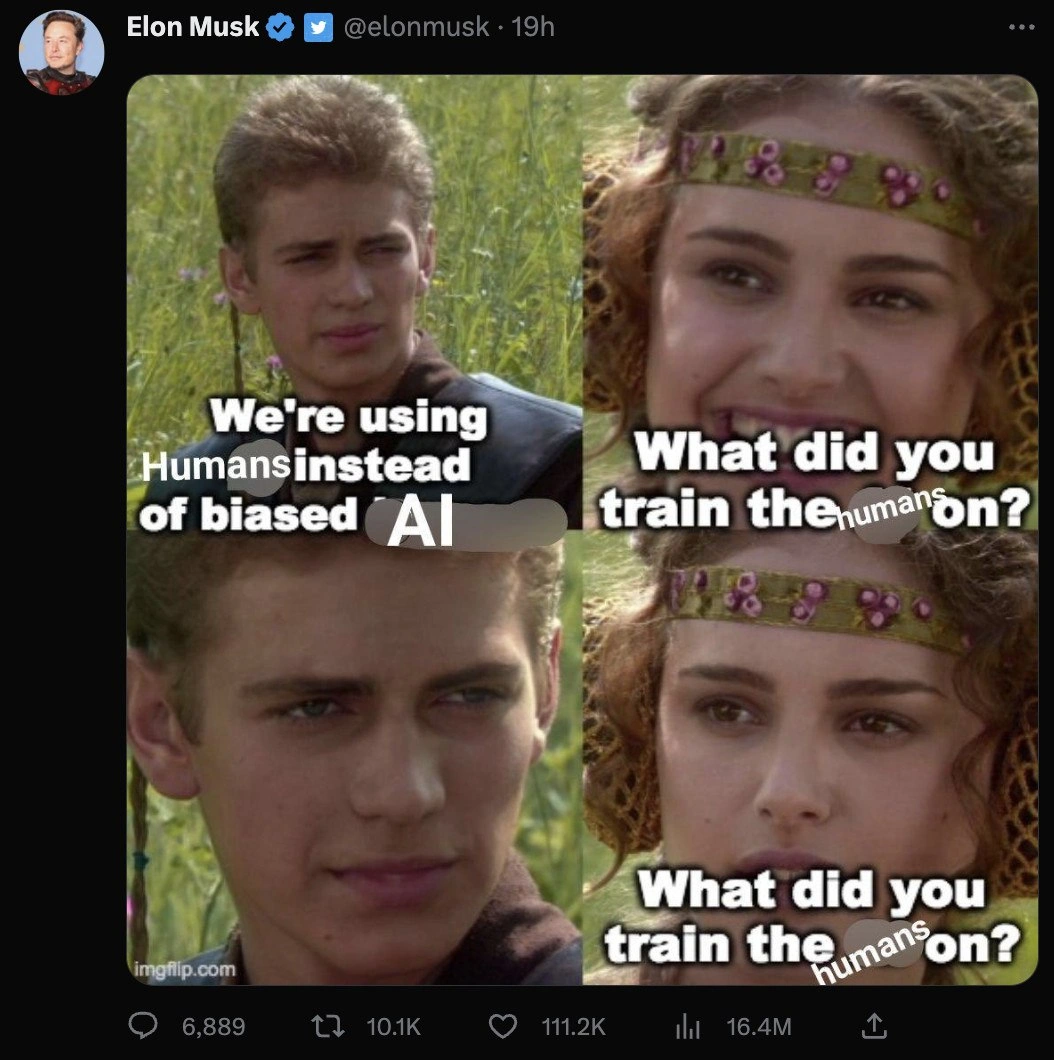
Let’s break down the joke in simpler terms. This meme uses a popular Star Wars scene (young Anakin and Padme in a meadow) to set up a question-and-answer scenario. In the first panel, Anakin confidently says, “We’re using humans instead of biased AI.” In plain English: “We had an AI program making decisions, but it wasn’t fair, so now we’ve switched to real people.” Padme responds, “What did you train them on?” meaning, “Okay, but how did you teach those humans to do the task? What examples or data did they learn from?” The joke lands when Anakin has no answer – implying the humans were trained on the very same biased material as the AI was.
To understand why that’s funny (and a bit troubling), remember how AI works. AI (artificial intelligence) systems learn from training data. Training data is the collection of examples or information we give the AI so it can learn patterns. If that data is biased – say it’s one-sided, incomplete, or full of unfair stereotypes – then the AI will learn those biases. That’s what we call a biased AI: the computer model ends up making unfair or skewed decisions because of the biased data it was fed. For instance, if you train an AI to screen job applications using data from a past where mostly men were hired for tech jobs, the AI might start favoring male applicants (since that’s the pattern it saw). The AI isn’t “evil”; it’s just mirroring the examples it learned from.
Now, in the meme, they try to solve this by taking the AI out of the loop and using humans instead. On the surface, that sounds reasonable: people can use judgment and be fair, right? But Padme’s question highlights a crucial point: humans need training too. In any complex task (like moderating online content or deciding which posts are okay), you don’t just throw people into it without guidance. You give them instructions, rules, or show them past decisions as examples. If those guidelines or examples are themselves biased (for example, if they’re based on the AI’s past behavior or the same old policies), then the humans will likely make the same biased calls. Also, keep in mind humans have their own personal biases from life experience. They might carry unconscious stereotypes or be influenced by the same cultural biases that were in the data.
This meme is pointing out that removing the algorithm doesn’t automatically remove the bias. It’s saying, “If you don’t change the bad information that’s being used to teach or guide decisions, it doesn’t matter who or what is doing the deciding.” In tech speak, “bias in, bias out” is like a twist on “garbage in, garbage out.” In other words, if you feed a system biased data, you get biased outcomes — whether that system is a computer program or a human team following those instructions.
Think about a simple example: imagine an AI content filter that learned to flag posts containing certain slang as “offensive” because of a flawed training dataset. If you turn off that AI filter and hire human moderators, but then tell them “make sure to also flag any posts that use these particular words,” the human moderators will end up flagging lots of harmless posts using that slang, just like the AI did. The result is the same unfair outcome, only delivered by a person instead of a program. To truly fix the bias, you would need to question and change the initial training data or rules — maybe those slang words weren’t actually harmful in context — rather than just changing who’s applying them.
In short, this meme is a bit of a facepalm moment for new developers. It reminds us that you have to fix the data and the training process to fix an AI’s behavior. If you simply swap out the AI for a human without changing the biased instructions or examples, you’re going to get the same mistakes all over again.
Level 3: Trained on the Dark Side
This meme cleverly underscores a deep truth in the AI/ML world: swapping out an algorithm for a human doesn’t magically eliminate bias if the training data and methodology stay the same. In the Star Wars-themed panels, Anakin proudly declares, “We’re using humans instead of biased AI.” That sounds like a straightforward fix to an AI ethics concern. But Padme’s pointed question – “What did you train them on?” – immediately pokes a hole in that plan. Her repeating the question in the final panel (as Anakin sits in guilty silence) is the meme’s punchline. It’s basically Padme saying, “You didn’t actually solve the problem, did you?”
For seasoned developers and data scientists, this is a knowing chuckle moment. It highlights an AI hype vs reality scenario we’ve seen before. The hype: if an AI system shows bias, just replace it with human decision-makers to get fair results. The reality: humans can be just as biased, especially if they learn or are instructed using the exact same data or guidelines that trained the AI. In tech we often say “Garbage In, Garbage Out,” meaning if your input is flawed, the output will be flawed. This meme applies that principle to fairness. If an algorithm learned from skewed or prejudiced data, it will produce biased results. But here’s the catch – people learn from data and examples as well! If those human replacements are drawing from the same pool of knowledge (or from a society that produced the biased data in the first place), they’ll make similarly biased judgments. In other words, the bias wasn’t just in the AI – it was baked into the dataset and the training process all along. This reveals a fundamental limitation of AI (and really, of any decision-maker): it can never be better than the data it learns from.
This points to a core issue in AI fairness. Experienced practitioners know that building unbiased systems means scrutinizing your dataset provenance – i.e. where your data comes from and what hidden prejudices it carries. The meme’s joke is a reminder that simply switching to “human intelligence” isn’t a foolproof fix, because those humans need to be taught or informed too. Often companies will fall back on human labelers or moderators thinking it’s a safer bet. But if those humans were trained on prior data that was biased (or if they bring their own cognitive biases), the outcome can be just as skewed. It’s like swapping out a biased classifier for a biased referee – the game results won’t change.
We’ve seen real-world examples that make this meme painfully relatable. One famous case involved a hiring AI that started discriminating against female candidates. The model was trained on the company’s past hiring decisions (which were mostly men), so it learned that skewed pattern. When that came to light, the company scrapped the AI. But handing those résumés back to human recruiters wouldn’t automatically remove bias, because the humans were the ones whose past choices created the bias in the data! Similarly, in social media content moderation, an algorithm might unfairly flag certain slang or communities more often. Replacing it with human moderators won’t help if those humans follow the same flawed policy or have the same blind spots. The net result is identical. Padme’s persistent question — “Where did you train them?” — is essentially the voice of an experienced engineer or ethics reviewer asking, “Did you change the playbook at all, or are we just doing the same thing manually?”
In the language of meme culture, the Anakin/Padme template is perfect for this “gotcha” moment. It’s often used to expose a flawed assumption or logical gap. Here Anakin assumes replacing AI with humans solves the bias issue; Padme reveals the gap in that logic. The humor lands because it’s a nod to something many of us in tech have learned the hard way: whether it’s a machine or a person, you can’t get an unbiased result from biased input. The meme delivers that lesson with a smirk. You can shut down the AI, but if you haven’t fixed what the AI (or the humans) are learning from, the Dark Side of bias will creep right back in.
Description
Dark-mode screenshot of a verified Twitter post (user name redacted) taken 19 hours after posting. The attached image is the four-panel Anakin - Padme Star Wars meadow meme: Panel 1 shows Anakin with overlaid white text, “We’re using Humans instead of biased AI.” Panel 2 shows Padme asking, “Where do you train them?” Panel 3 zooms on Anakin, silent and expressionless. Panel 4 returns to Padme repeating, “Where do you train them?” All faces are blurred for privacy; a small “imgflip.com” watermark appears bottom-left. Below the meme, Twitter engagement numbers read “6,889”, “10.1 K”, “111.2 K” and “16.4 M.” Technically, the joke highlights that swapping algorithms for human annotators doesn’t remove bias - reminding practitioners of dataset provenance, fairness, and AI ethics considerations
Comments
19Comment deleted
Swapping your biased model for human annotators without touching the dataset is basically `kubectl delete pod`; the container restarts, the bias configmap’s still mounted
The real production incident is when you realize your 'unbiased' human reviewers were trained on Stack Overflow answers from 2012, corporate compliance videos, and that one senior dev who still insists tabs are superior because 'that's how we've always done it.'
Ah yes, the classic RLHF paradox: we'll fix AI bias by having humans label the training data - the same humans whose cognitive biases, cultural assumptions, and systematic prejudices created the problem in the first place. It's like debugging your code by asking the compiler that generated the bug to review it. At least with AI we can version control the bias; with humans, it's just 'legacy wetware' running on millions of years of unpatched evolutionary heuristics
"We replaced biased AI with humans" is just migrating from a system with model cards and audit logs to one with undocumented heuristics, zero observability, and training data called "life."
Swapped biased LLMs for humans trained on Stack Overflow - now with confidently incorrect answers and zero hallucination disclaimers
Human-in-the-loop isn’t a fairness strategy; it’s swapping SGD for SOD - stochastic opinion descent - on the same dataset
What is imposed to be a training source? Comment deleted
*based Comment deleted
both humans and any man-made AI will be inherently biased because only data we can train either of them on is accumulated human knowledge Comment deleted
There is only one solution and total eradication of humanity is unfortunately impossible at current stage of technological development Comment deleted
how about eradicating only those w/ 120IQ(im being generous) and lower? Comment deleted
IQ doesn't mean anything. Almost entire cohort of top NSDAP members & military command of Third Reich scored pretty high on IQ tests. Comment deleted
may be that was the reason they were at the top positions?? Comment deleted
I do think rationally. Problem is that majority of human population is emotion-driven chaotic uber-apes whose consciousness has no proper way to work with from outside Comment deleted
But you wouldn't want those people left alive, would you? Comment deleted
*intelligency Comment deleted
kinda Comment deleted
IQ references how quick humans can recognize patterns and figure out abstractions Comment deleted
High IQ people just learn and analyze life experience faster. Unless they fall into IQ trap of self-reflection and stay in overthinking loop without doing action. Comment deleted