Skip to content
DevMeme
4724 of 7435
Poll reveals the true 2.4 GHz champion: the humble microwave oven
Networking Post #5177, on May 5, 2023 in TG

Poll reveals the true 2.4 GHz champion: the humble microwave oven

Why is this Networking meme funny?

Level 1: Loudest in the Room

Imagine you and your friends are having a quiet conversation in a room. Each friend is politely taking turns to speak so everyone can hear one another. Now suddenly, someone in the corner turns on a very loud vacuum cleaner (or better yet, a loud old microwave oven). The noise is so overpowering that none of you can hear what anyone is saying anymore. Essentially, the loud appliance has “won” the room simply by being the loudest, even though it’s not part of the conversation at all. This meme is joking about a similar situation, but with wireless signals. Wi-Fi, Bluetooth, and Zigbee are like the friends trying to talk on the same frequency “channel,” and the microwave oven is like that noisy vacuum cleaner that drowns everyone out. The poll humorously crowns the microwave as the “favorite” communicator at 2.4 GHz because, in reality, it often overpowers all the real communicators. It’s funny in the same way it’s funny when a toddler banging on a pot steals the show from a group of adults talking – the loudest voice wins, even though it isn’t actually saying anything. So the meme is basically winking and saying: in the world of wireless gadgets, the microwave in your kitchen might as well be the king of the 2.4 GHz hill, simply because it’s so loud!

Level 2: Microwave vs. Wi-Fi

Now let’s break down the joke in simple technical terms. The 2.4 GHz band is a specific radio frequency range (around 2.4 billion cycles per second) that many wireless systems use to send data without wires. It’s popular because devices don’t need a special license to use it, making it a go-to for consumer electronics. For example, Wi-Fi routers often use 2.4 GHz (alongside other bands) to provide wireless internet in your home. Bluetooth gadgets (like wireless headphones or keyboards) also use 2.4 GHz to pair and communicate. Even Zigbee, which is a wireless protocol for smart home and IoT devices (like smart bulbs and sensors), operates on 2.4 GHz. Think of this frequency band as a free public road that many different technologies are driving on.

Now, a microwave oven isn’t a communications device at all – it’s for heating your food. But here’s the catch: microwave ovens use microwaves (a form of electromagnetic wave) around the 2.45 GHz frequency to cook. That’s almost the same frequency that Wi-Fi, Bluetooth, and Zigbee signals occupy. The oven’s high-powered waves make water molecules in food vibrate (heating the food). Normally, the oven’s metal enclosure (a Faraday cage) keeps most of the radiation inside. However, it’s not perfect – some of that energy leaks out as radio noise in the surrounding area. When the microwave is running, it’s like a boom box blaring on the same channel that Wi-Fi and others are trying to use for delicate two-way talking. We call this microwave interference. Essentially, the microwave doesn’t communicate following any protocol; it just overwhelms the channel with a loud electromagnetic hum.

So what happens in “Microwave vs. Wi-Fi”? In practical terms, if you’re on a Wi-Fi video call or streaming music to a Bluetooth speaker, and someone starts the microwave nearby, you might notice the Wi-Fi connection slowing down or dropping, or your Bluetooth audio getting choppy. This is because the microwave’s noise is confusing the wireless receivers. They can’t “hear” the tiny Wi-Fi or Bluetooth signals clearly over the roar. Those protocols do try to cope – Wi-Fi devices will wait and retry sending data if they sense the band is busy – but if the microwave keeps running, it’s almost like the network is jammed. Zigbee, being used in many IoT setups (like a sensor network in a smart home), transmits at low power, so it’s even more likely to get completely drowned out when a microwave is on. For anyone learning about networking, it’s a surprise at first: an ordinary household appliance can mess up your high-tech wireless gear! But it’s a well-known quirk: the 2.4 GHz spectrum is shared by convenience (no licensing costs), and the trade-off is that you get all sorts of RF congestion from many devices – including unintended ones like microwaves.

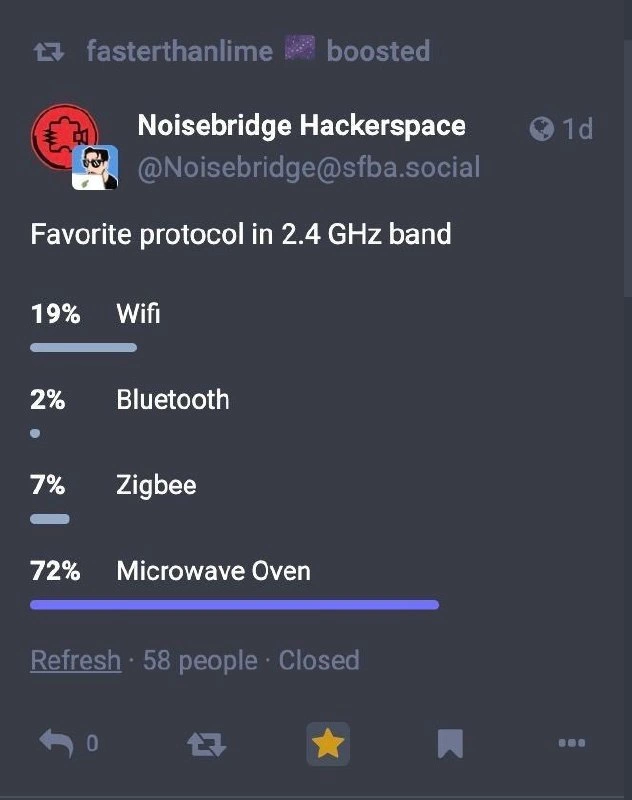
The meme shows a poll asking “Favorite protocol in the 2.4 GHz band,” listing Wi-Fi, Bluetooth, Zigbee, and, humorously, Microwave Oven as if the microwave were just another wireless standard. The joke is that 72% of people voted for “Microwave Oven,” far more than those who chose Wi-Fi or the others. Of course, nobody actually thinks a microwave oven is a real communication protocol! But people voted for it as a joke because they’ve experienced how strongly it affects all the real protocols. It’s a funny way to say, “The microwave kind of runs the show in the 2.4 GHz range because it can overpower the rest.” This is classic NetworkHumor: taking a frustrating real situation in networking and laughing at it. Even if you’re a junior dev or just getting into tech, you might have seen something like your Wi-Fi acting weird when the microwave is on. Now you know why – they clash over the same band. The poll meme just personifies the microwave as the big bully on that block, and clearly a lot of people related to it.

Level 3: The 2.4 GHz Bake-Off

For seasoned developers and network engineers, this poll’s outcome is a smirking acknowledgment of a real-world wireless headache. The listed contenders – Wi-Fi, Bluetooth, Zigbee – are all well-known wireless protocols in the 2.4 GHz band, each with its own niche. But the inclusion of “Microwave Oven” as a poll option (and its landslide 72% victory) pokes fun at the all-too-familiar experience: the moment your Wi-Fi dies because someone’s reheating their lunch. It’s a classic bit of NetworkHumor grounded in truth. In crowded offices, apartments, or hackerspaces, many have learned that a running microwave can knock a WiFi network offline or make your Bluetooth audio cut out. Seasoned network folks might recall troubleshooting mysterious Wi-Fi drops at noon, only to discover the culprit was the breakroom microwave (the informal term Lunch Time DOS attack gets a chuckle). This meme’s poll format frames it as a wireless protocol popularity contest, where ironically the device with no communication protocol wins first place simply by flooding the airwaves. It highlights an open secret in NetworkEngineering: the 2.4 GHz band is a wild west of signals, and the microwave oven is the chaotic neutral character no one invited but everyone has to deal with.

The humor really lands for those who know the history and quirks of the 2.4 GHz spectrum. This band is unlicensed, meaning it’s a free-for-all — great for innovation (Wi-Fi’s existence owes to it), but also a recipe for RF congestion. Over the years, we’ve crammed Wi-Fi networks, cordless phones, baby monitors, wireless security cameras, game controllers, IoT gadgets and more all into 2.4 GHz. But the microwave oven was here first (commercial ovens using 2.45 GHz have been around since the mid-20th century), and it isn’t going anywhere. Experienced devs also know that modern Wi-Fi has partially escaped this chaos by using 5 GHz or 5.8 GHz bands, precisely to avoid the microwave and other interference. Still, a ton of cheap IoT devices and older tech are stuck on 2.4 GHz, so the joke remains painfully relevant. The poll numbers themselves (Wi-Fi only 19%, Bluetooth 2%, Zigbee 7%, versus Microwave’s 72%) exaggerate what it feels like: the microwave dominates the moment it’s on. It’s the “winner” in terms of impact – a tongue-in-cheek metric where causing everything else to freeze counts as a win. Everyone who’s struggled with a choppy Zoom call when someone nukes a burrito can relate to that 72% vote.

To put it in context, here’s a light-hearted comparison of the “contestants” in this poll:

2.4 GHz User What It’s Meant For How It Behaves in the Band
Wi-Fi (802.11) Fast data (internet, LAN) Uses polite sharing (CSMA/CA), fairly robust but can be knocked out by heavy noise
Bluetooth Gadgets & audio (PAN devices) Short range, hops channels to avoid interference, usually okay unless noise is very strong
Zigbee (IoT) Smart home sensors, IoT devices Low power, short messages on fixed channels – easily drowned out by stronger signals
Microwave Oven Heating food (not communication) Blasts ~1000W of continuous 2.4 GHz energy when on, zero respect for protocols – the bully of the band 😅

(PAN: Personal Area Network)

In day-to-day engineering life, the WiFi vs microwave problem is well known. Veteran developers might joke, “We can send rockets to Mars, but my wireless internet dies when the microwave runs.” It’s funny because it’s true: all the elegant WiFi standards and Bluetooth codecs can be rendered useless by a $50 kitchen appliance. The Noisebridge hackerspace poll tapped into that collective experience. Folks at a hackerspace are exactly the type to notice RF quirks – imagine trying to run a demo of a Zigbee-controlled robot, and every time someone makes popcorn in the microwave, the bot loses connection! The poll treats the microwave’s interference as if it were just another protocol with an obnoxious 72% market share. It’s a snarky commentary on our hardware reality: sometimes spectrum sharing isn’t about fancy algorithms or polite negotiation; sometimes it’s about an old microwave in the corner that simply drowns everyone else out. The meme gets a knowing laugh from senior devs because it encapsulates a persistent, absurd truth in networking: when it comes to the 2.4 GHz band, the best “communicator” is often just the loudest noise.

Level 4: Spread Spectrum Showdown

At the deep technical level, this meme is a nod to how multiple wireless technologies must share the unlicensed 2.4 GHz spectrum – and how a seemingly out-of-place player, the kitchen microwave oven, can utterly disrupt them. The 2.4 GHz band is an ISM band (Industrial, Scientific, and Medical), originally allocated for equipment like microwave ovens and scientific apparatus. The irony is that modern wireless protocols like Wi-Fi (IEEE 802.11), Bluetooth, and Zigbee (IEEE 802.15.4) all operate in this same band under spectrum sharing rules. In theory, these protocols are designed with techniques to minimize mutual interference: Wi-Fi and Zigbee use spread-spectrum modulation and listen-before-talk (CSMA/CA), and Bluetooth rapidly frequency-hops across the band. These methods are grounded in information theory and radio physics – they leverage concepts from Shannon’s theorem and DSSS/FHSS to tolerate noise and other transmitters. However, a microwave oven’s interference is a brute-force onslaught. Its core component, the magnetron, emits a continuous wave at around 2.45 GHz (right in the middle of the Wi-Fi/Bluetooth range) with hundreds or thousands of watts of power. Even though the oven is shielded, a tiny fraction of that energy leaking out can raise the ambient noise floor by orders of magnitude. In wireless communication terms, the microwave creates a massive spike of RF noise – effectively a jamming signal with no protocol, no handshake, and definitely no polite backing off.

From a theoretical perspective, this is a spectral interference nightmare. Wireless protocols assume interference will be relatively low-power or short-lived so that error correction, spread-spectrum coding, and retransmissions can handle it. But a microwave in use violates these assumptions: it’s an uncooperative emitter that doesn’t follow any medium access rules. Signal-to-Noise Ratio (SNR) plummets when the microwave is running; Shannon’s Channel Capacity formula ($C = B \log_2(1 + \text{SNR})$) tells us that as noise power increases (SNR → 0), the theoretical maximum data rate drops toward zero. In practice, Wi-Fi devices perform a Clear Channel Assessment and detect the microwave’s energy as occupying the channel. As long as the oven is blasting, 802.11 frames get deferred or collide with interference, leading to severe packet loss. Bluetooth’s frequency hopping might dodge a few frequencies momentarily, but a strong microwave can splatter noise across the whole 2.4 GHz band, so many hops hit static. Low-power IoT protocols like Zigbee, using direct-sequence spread spectrum on a narrow channel, are even more helpless – their tiny signals get drowned out by the microwave’s electromagnetic roar. It’s essentially the RF congestion scenario from hell: a high-power analog device overwhelming carefully engineered digital communication schemes. No sophisticated coding or acknowledgment scheme can entirely overcome such a microwave interference blast if you’re close enough; the fundamental physics (per Maxwell’s equations) of wave superposition means the microwave’s carrier swamps the delicate modulated signals. So in this unlicensed band battlefield, the microwave isn’t a “protocol” at all – it’s more like an unintentional Denial-of-Service transmitter. The meme humorously crowns that rogue emitter as the true champion of 2.4 GHz, underscoring a core reality of wireless engineering: the laws of physics and the regulatory free-for-all of ISM bands can trump even the most elegant network protocols.

Description

Image is a dark-themed Mastodon poll from the account “Noisebridge Hackerspace @[email protected].” The caption reads “Favorite protocol in 2.4 GHz band.” Four poll options are listed with horizontal progress bars and percentages: 19 % Wifi, 2 % Bluetooth, 7 % Zigbee, and a comedic 72 % Microwave Oven, which has the longest purple bar. Below the choices it says “Refresh · 58 people · Closed.” Standard Mastodon UI icons for reply, boost, star, and bookmark appear at the bottom. The humor comes from treating microwave ovens - famous for flooding the 2.4 GHz spectrum with interference - as if they were a legitimate wireless protocol, highlighting everyday RF contention issues that plague Wi-Fi, Bluetooth, and IoT devices

Comments

9
Anonymous ★ Top Pick 2.4 GHz feels like our legacy monolith: Wi-Fi, Bluetooth and Zigbee try to be polite microservices, then the microwave shows up with a 1 kW UDP broadcast and hogs the global lock until the popcorn’s done
  1. Anonymous ★ Top Pick

    2.4 GHz feels like our legacy monolith: Wi-Fi, Bluetooth and Zigbee try to be polite microservices, then the microwave shows up with a 1 kW UDP broadcast and hogs the global lock until the popcorn’s done

  2. Anonymous

    The real winner of the 2.4 GHz spectrum war isn't the protocol with the best error correction or lowest latency - it's the one that heats your leftover pizza while simultaneously dropping every IoT device in a 30-foot radius

  3. Anonymous

    Every senior network engineer knows the real reason for WiFi 6E's push to 6 GHz wasn't about capacity or latency - it was finally admitting defeat to the microwave oven's decades-long dominance of the 2.4 GHz band. When your packet loss correlates perfectly with someone reheating lunch, you know it's time to find new spectrum

  4. Anonymous

    We spent weeks tuning channels and CCA thresholds; then the kitchen deployed a 1 kW, no-ACK, no-backoff protocol at 12:00 sharp

  5. Anonymous

    In 2.4 GHz, Wi‑Fi backs off, Bluetooth hops, Zigbee whispers - and the microwave runs a magnetron‑powered lunchtime DDoS with zero regard for CSMA/CA

  6. Anonymous

    72% microwave win: proof that in shared 2.4GHz spectrum, the noisiest appliance outscales every protocol - CAP theorem be damned

  7. @revolutionarygirlutena 3y

    fuck it 5ghz microwave oven

    1. @SamsonovAnton 3y

      5G cellular oven 👌

  8. @revolutionarygirlutena 3y

    duh

Use J and K for navigation