Skip to content
DevMeme
5550 of 7435
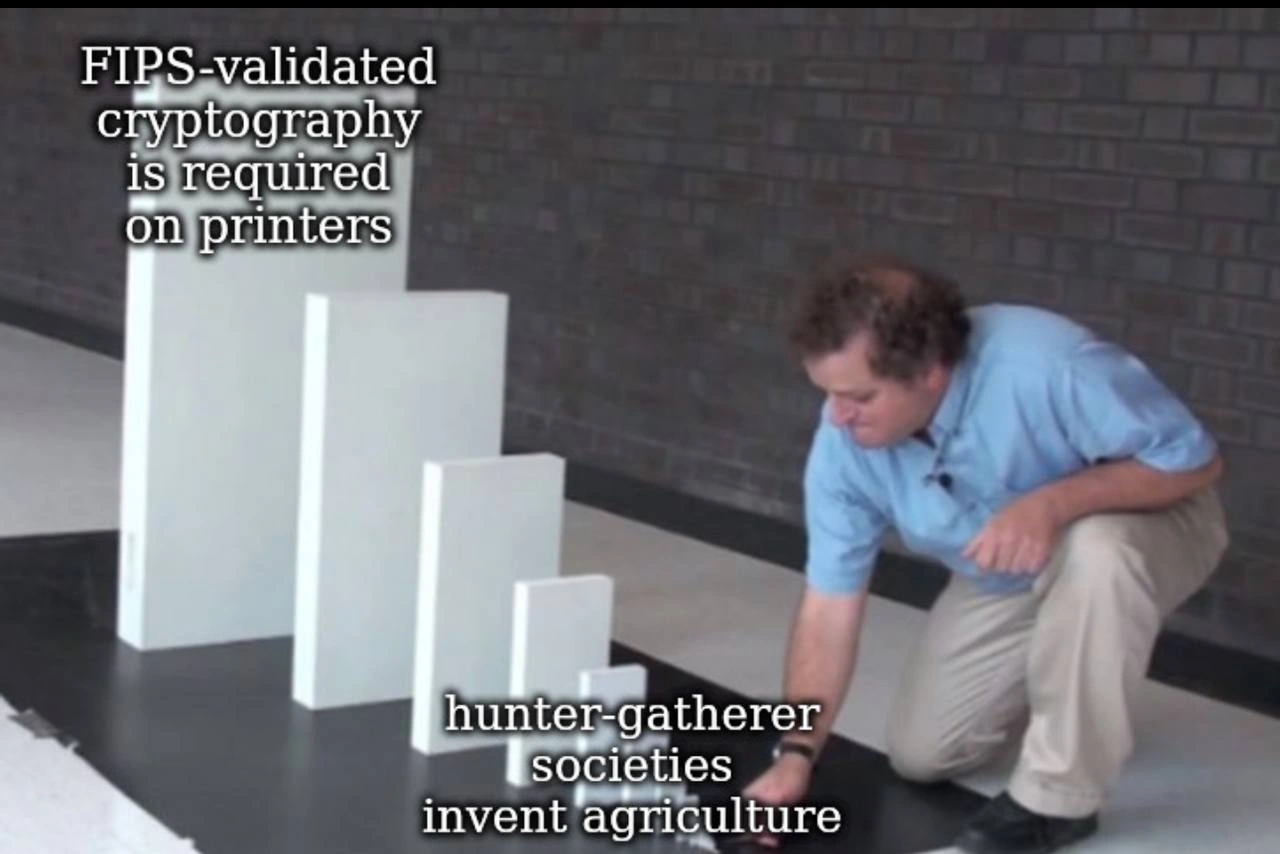
The Agricultural Revolution to FIPS-Compliant Printers Pipeline
Security Post #6092, on Jul 5, 2024 in TG

The Agricultural Revolution to FIPS-Compliant Printers Pipeline

Why is this Security meme funny?

Level 1: One Thing Leads to Another

Imagine you line up a row of dominoes, each one bigger than the last. You tip over the small first domino, click – it knocks into the next, which knocks into the next, and eventually the huge final domino falls down. This meme is saying that’s what happened in real life from long ago to today. Think of the first little domino as people learning to farm. That was a small start that changed how we live: farming led to villages, then cities, and over a loooong time people invented machines and computers. Now, in modern times, we worry about keeping information safe, kind of like keeping secrets locked up. That big last domino in the picture is basically saying, “now we even have a rule that our printers must use special secret codes to keep data safe.” It’s a surprising leap – farming to printer rules?! It sounds silly because farming and printers seem totally unrelated. But the funny idea is that step by step, one thing caused another: farming -> big societies -> new technologies -> needing to protect information -> even printers needing security. It’s like saying because we planted crops, now we have to lock up our paperwork. The reason this is amusing is that it shows how one thing leads to another, sometimes in a very complicated way. It makes us laugh and wonder, “how did something so simple so long ago end up making life so complicated now?”

Level 2: Tiny Seed, Huge Tree

Let’s break down what’s going on here in simpler terms. The meme shows a series of dominoes getting increasingly larger. The idea of a domino effect is that a small push can cause a chain reaction knocking over bigger and bigger domino pieces. In the image, the smallest domino is labeled “hunter-gatherer societies invent agriculture.” That refers to early humans learning to farm crops instead of just hunting animals and gathering plants. It’s a tiny seed of an idea – literally planting seeds – that changed everything. Once people could grow their own food, they settled down, built villages, and eventually cities. This led to inventions like writing, money, governments, and technology over thousands of years.

Now jump to the biggest domino: “FIPS-validated cryptography is required on printers.” Cryptography is the practice of creating secret codes so that only intended people can read information. It’s what keeps things like passwords, bank transactions, and messages secure in the digital world. FIPS stands for Federal Information Processing Standards, and FIPS 140-2 is a specific set of rules from the U.S. government about how to implement cryptography securely. If something is FIPS-validated, it means it uses encryption methods that were tested and approved by security experts (for example, using approved algorithms like AES or SHA-256 and proper key handling). So the meme is saying that today, even a common device like a printer may be required to use officially approved secret code techniques to protect the information it handles. That sounds a bit crazy, right? Printers just put ink on paper! But modern printers are actually small computers: they receive documents over networks, they store data in memory, and some even scan and fax sensitive documents. In a high-security environment (say a government office or a bank), printer_security matters — you wouldn’t want an intruder stealing data from the printer’s hard drive or intercepting print jobs. So the rule is, if the printer is handling confidential stuff, it must follow the approved security standards. This is an example of a compliance requirement – basically a rule organizations must comply with to meet security laws or policies.

The humor of the meme comes from connecting the very first domino to the very last in one ridiculous leap. It’s implying that historical_scope_creep over centuries took us from the invention of farming all the way to bureaucratic rules about cryptography on office equipment. Of course, a lot of intermediate steps aren’t shown. (There’s an entire regulatory_cascade of events in between, like inventing computers, discovering encryption methods, and governments worrying about data leaks.) But by skipping straight to the endpoints, the meme highlights how one thing leads to another in unexpected ways. It’s a playful exaggeration. For a newcomer: imagine someone says, “because people started farming long ago, now I have to put special locks on my printer’s data.” You’d scratch your head – farming and printers? The connection is all the in-between history. The domino meme format makes this clear by showing a visual chain reaction. The tiny domino (farming) eventually topples the huge domino (modern security rule). In essence, the meme is teaching a mini-lesson: even a tiny seed of an invention can grow into a huge tree of consequences over time. And in the world of tech, those consequences often appear as new rules and standards we all have to follow.

Level 3: From Plows to Printers

For seasoned engineers, this meme hits close to home as a tongue-in-cheek commentary on industry irony and the avalanche of compliance requirements we face today. The smallest domino is labeled “hunter-gatherer societies invent agriculture,” and the largest reads “FIPS-validated cryptography is required on printers.” The juxtaposition is absurd on purpose – and yet completely relatable if you’ve seen how one technical mandate begets another. It’s illustrating a domino_effect_meme: a tiny, ancient innovation eventually triggering a gigantic modern rule. Senior developers recognize the pattern: small decisions or discoveries can snowball into massive, systemic obligations over time. In this case, the invention of farming set humanity on a trajectory of civilization-building that, many dominoes later, has us dealing with cryptographic certification for something as mundane as a printer.

Why is FIPS on printers funny? Because it’s true! In highly regulated sectors (like government, finance, or healthcare), even an office printer might need to run in FIPS 140-2 compliant mode. That means the printer’s software can only use encryption algorithms and methods approved by NIST. If you’ve ever toggled a “FIPS mode” setting or swapped out a library to meet a security checklist, you’ve felt this pain. One moment you’re just trying to enable secure printing, and the next you’re neck-deep in documentation ensuring that every cryptographic function on that device is FIPS-validated. The humor comes from the exaggeration: connecting the dots from a caveman planting wheat directly to an IT admin enabling FIPS 140-2 on a network printer for compliance. It satirizes the epic scope creep: how initial good ideas (grow food reliably, secure our data) morph into extensive protocols and paperwork. Experienced devs have lived through similar cascades on smaller scales – like a tiny feature request that evolves into a full-blown framework change due to unforeseen requirements. Today’s trivial fix could be tomorrow’s architecture overhaul, and here, yesterday’s farming experiment is today’s cryptography mandate.

Consider the unseen intermediate dominoes implied: Agriculture led to surplus and settlements; settlements led to written contracts and secrets; secrets led to early ciphers (gotta protect those clay tablet trade records!); fast-forward to computers which made ciphers incredibly advanced; advanced cryptography became critical for protecting data; governments and industries, burned by security failures, imposed strict standards (e.g., FIPS, PCI, HIPAA) to ensure Security. Each step is logical, but the end-to-end connection feels comically disproportionate. This regulatory cascade means that a modern developer might be debugging why a printer’s firmware won’t boot, only to discover FIPS_mode is enforced and rejecting a non-compliant algorithm. It’s both funny and a little tragic: the historical_scope_creep of technology and regulation results in very real headaches (and late-night patches) for engineers today. In other words, the meme is laughing at the fact that a humble change in human lifestyle (switching from foraging to farming) set off a chain reaction culminating in us having to prove our office gadgets use approved cryptography. Thanks, agriculture, for all the JIRA tickets.

Level 4: Crops to Cryptography

In a grand causal chain spanning millennia, this meme connects the Neolithic revolution to modern cryptographic standards. At first glance, agriculture and FIPS-validated cryptography seem universes apart, but they bookend an evolutionary timeline of technology and bureaucracy. The first domino – hunter-gatherers inventing agriculture – represents a small but pivotal technological advancement (~10,000 BCE) that allowed human societies to settle, specialize, and accumulate knowledge. Fast forward to the towering last domino – “FIPS-validated cryptography is required on printers” – and you’re looking at an extremely specialized mandate in today’s high-tech world. This leap in scale is reminiscent of an exponential domino effect: each successive innovation and institution built upon the last, growing in complexity like ever-larger dominoes.

Under the hood, cryptography itself is a deep technical field grounded in mathematics and computer science. Modern encryption algorithms like AES (Advanced Encryption Standard) or RSA public-key cryptography rely on hard math problems – from finite field arithmetic to large prime factorization. These are the cryptographic primitives that secure everything from your web traffic to, yes, even your office printer’s data stream. Now, FIPS validation adds another layer of complexity. FIPS 140-2 (a specific Federal Information Processing Standard) defines a rigorous cryptographic module validation process. That means any software or hardware that handles encryption – the printer’s firmware included – must implement algorithms in a way that’s been lab-tested and certified by NIST. This involves formal reviews and even physical security measures (for higher FIPS levels) to ensure keys can’t be extracted and algorithms don’t falter. It’s cryptography meets bureaucracy: mathematical rigor colliding with governmental ComplianceRequirements.

From a theoretical lens, this domino cascade illustrates the law of unintended consequences in complex systems. A modest change in initial conditions (domesticating crops) enabled surplus food, which led to settlements, then writing and accounting to manage that surplus. Writing systems gave rise to record-keeping and eventually secret messages – the seeds of Security concerns. Jump ahead centuries: advanced trade and warfare drove the creation of sophisticated ciphers (from Caesar’s substitution cipher to the Enigma machine), which then evolved into the cryptographic algorithms underpinning digital communication. As these technologies became vital, governments introduced standards to trust them – enter FIPS. The result is a regulatory_cascade spanning eras: early agriculture set humanity on a path that, through many intermediate dominoes, led to today’s labyrinth of security standards. It’s almost a historical butterfly effect in action: the butterfly was the first farmer planting seeds, and the tornado is a world where even a network printer must obey federal crypto rules. No good innovation goes unregulated, it seems. The meme’s humor lies in compressing that epic timeline into a simple image – a wink at how historical_scope_creep can escalate to almost absurd heights.

Description

This meme uses the 'Domino Effect' format to illustrate an absurdly long chain of causality. The image shows a man in a blue shirt kneeling to push over a very small, white domino block. This action is set to trigger a chain reaction with progressively larger dominoes. The smallest domino is labeled 'hunter-gatherer societies invent agriculture'. The largest domino at the end of the chain is labeled 'FIPS-validated cryptography is required on printers'. The humor stems from the extreme butterfly effect depicted, connecting a foundational moment in human history - the invention of agriculture - to a highly specific, bureaucratic, and seemingly excessive modern technological requirement. It satirizes how civilization's progress has led to complex, and often comical, layers of regulation, where even a peripheral like a printer needs government-grade encryption (FIPS)

Comments

12
Anonymous ★ Top Pick Civilization started with agriculture, but it really peaked when we decided the most critical threat to national security was an unencrypted print job of someone's lunch menu
  1. Anonymous ★ Top Pick

    Civilization started with agriculture, but it really peaked when we decided the most critical threat to national security was an unencrypted print job of someone's lunch menu

  2. Anonymous

    Somewhere between “let’s try planting wheat” and “our laser printer must pass NIST entropy tests” lives the true timeline of scope creep

  3. Anonymous

    Somewhere between inventing the wheel and requiring quantum-resistant algorithms for IoT lightbulbs, we decided that printers - the same devices that can't reliably connect to WiFi or print PDFs without summoning dark spirits - absolutely need FIPS-validated cryptography to protect those TPS reports from nation-state actors

  4. Anonymous

    Ah yes, because nothing says 'critical infrastructure' quite like requiring FIPS 140-2 Level 3 validation on the office printer that still jams on page 2 of every print job. Next sprint: implementing quantum-resistant encryption for the coffee machine's Bluetooth connectivity, because clearly that's the attack vector keeping our CISO up at night - not the Excel macro someone downloaded from a sketchy forum to automate their timesheet

  5. Anonymous

    FIPS on printers: the architectural triumph where even toner cartridges demand NIST-certified entropy sources over inventing the wheel

  6. Anonymous

    Only in enterprise security can “invent agriculture” eventually mean my RFP demands CMVP‑validated TLS on a copier, and enabling FIPS mode promptly bricks half the floor

  7. Anonymous

    Ten millennia after the first harvest, I’m porting a FIPS‑validated TLS stack to a 64MB printer SoC so procurement can tick a box - proof that security theater scales better than paper trays

  8. @Sp1cyP3pp3r 2y

    Industrial revolution was a grave mistake

    1. @Bitals 2y

      FCC ceasing to split up megacorporations was a mistake.

  9. @seyfer 2y

    Alles ist Scheisse

  10. @Agent1378 2y

    So this picture depicts it as something wrong. What's wrong with FIPS cryptography in printers?

    1. @SamsonovAnton 2y

      I think the point is that crypto is required. (I don't think that this is wrong in cases where FIPS-grade crypto is used elsewhere.)

Use J and K for navigation