Skip to content
DevMeme
5551 of 7435
Arch Linux Forums: A Journey into 'RTFM' Culture
DevCommunities Post #6093, on Jul 6, 2024 in TG

Arch Linux Forums: A Journey into 'RTFM' Culture

Why is this DevCommunities meme funny?

Level 1: When Help Isn’t Helpful

Imagine you’re trying to build a new LEGO set, but the instruction booklet is super confusing. You ask your older brother for help. Instead of guiding you, he just pushes the booklet back at you and says, “Here, read this and figure it out yourself.” Then he goes, “Alright, I’m gonna tell everyone you’re all done now.” You’re left sitting there with pieces still everywhere, feeling frustrated. You’d probably mumble “Gee, thanks a lot...” with a big eye-roll, because he didn’t actually help at all. That’s the joke of this meme: someone asked for help and basically got told to help themselves, which is both annoying and a little bit funny when you look back on it.

Level 2: Pacman Flags and RTFM

Let’s unpack the humor in simpler terms. Arch Linux is a version of the Linux operating system that is famous for expecting its users to be self-reliant and read documentation. Its command-line package manager is called pacman – that’s the tool you use to install or update software by typing commands. In the meme, the user was trying to install a package using pacman and ran into an issue with pacman’s options (also known as flags in command-line lingo).

Here’s what happened: The user originally used a command with the --force flag to install something (pacman -S --force MYPACKAGE). In pacman, -S means “sync” or install a package. The --force flag used to tell pacman to ignore certain safety checks and overwrite files if needed. However, deprecated means an option is outdated and should no longer be used. Pacman printed a warning saying --force is deprecated and to use --overwrite instead. This means the developers changed how you’re supposed to force an install.

So the user tried the new recommended flag: --overwrite. But they got errors because --overwrite wasn’t meant to be used by itself. Pacman’s --overwrite requires you to specify what you allow it to overwrite. It needs a glob pattern right after it. A glob pattern is like a wildcard match for filenames. For example, *.txt could represent “all files ending in .txt”. In this case, the user might need something like --overwrite '*' (with quotes) to tell pacman “you can overwrite everything if there’s a conflict” – essentially mimicking what --force did, or better yet a specific pattern like --overwrite '/usr/lib/libfoo.so*' to only overwrite certain files. Because the user didn’t provide any pattern, pacman got confused. When they wrote pacman -S --overwrite MYPACKAGE, pacman treated "MYPACKAGE" as the pattern of files to overwrite (since it immediately followed the --overwrite flag), and then it found no actual package name given to install. That’s why it complained “no targets specified” – in simpler words, “you didn’t tell me which package to act on.” The user was understandably puzzled by this, especially since the Arch Wiki (Arch’s official documentation site) still told users to use the old --force flag at that time. The documentation hadn’t caught up with the new pacman behavior, so it was easy to get mixed messages.

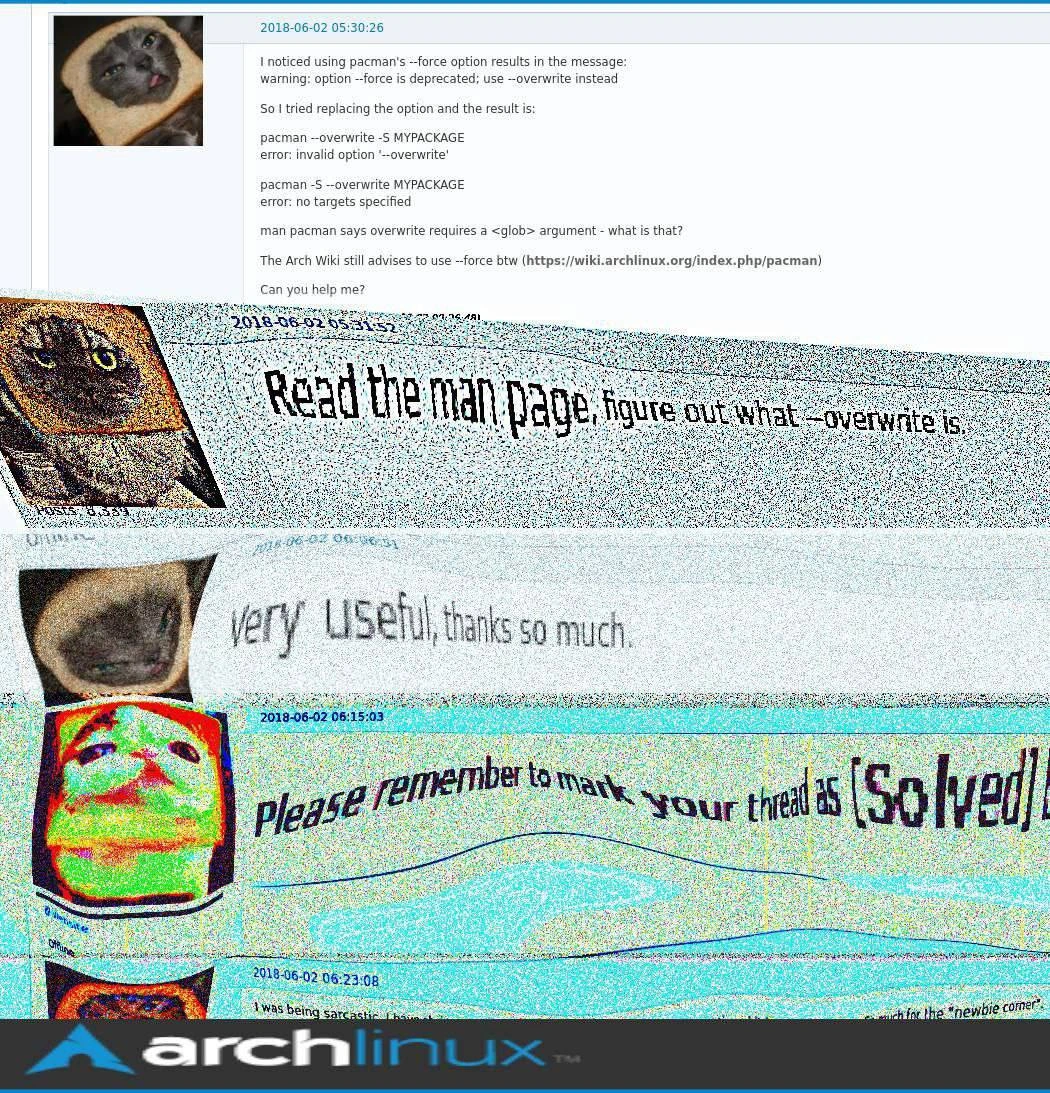
Now, when the user asked for help on the Arch Linux forum, they encountered the community’s well-known attitude. Arch users pride themselves on reading the manual and the wiki. In fact, there’s a long-running joke (and sometimes serious rule) in such communities: RTFM, which stands for “Read The _Manual” (the ‘F’ is a spicy adjective we’ll politely skip here). Telling someone “RTFM” is basically saying “you should have looked it up yourself in the documentation.” It’s not the friendliest advice, but it’s common in more elite tech circles. In the forum thread from the meme, one experienced member essentially gave an RTFM response: “Read the man page; figure out what --overwrite is.” The “man page” is the manual you can access on Linux by typing man <command> (for example, man pacman shows pacman’s manual). So the expert was telling the newbie to go read pacman’s manual page to understand how the --overwrite flag works. In their eyes, the information was already out there.

The newbie (OP) didn’t feel helped by this. They responded with “very useful, thanks so much.” That line is sarcasm – they said “thanks” but actually meant the opposite. You can imagine them rolling their eyes. They were frustrated because the reply felt dismissive, as if the expert couldn’t be bothered to give a quick explanation. Instead, the OP was sent on a homework assignment to find the answer themselves.

Then comes the kicker: a moderator swoops in and reminds the OP to mark the thread as [Solved]. On many tech forums, when your question gets answered, you mark it “solved” so others know the solution is in the thread. But here it’s ironically funny, because from the OP’s perspective nothing was solved at all! The OP even had to clarify, “I was being sarcastic,” because the mod (or others) might have thought that his "thanks so much" was genuine and that the problem was resolved. The moderator was following standard procedure, but it almost reads like a comedy sketch – the newbie is still confused, yet the forum regulars are ready to wrap a bow on the discussion and call it resolved.

This comedic scenario highlights a few things about developer communities: Arch Linux’s community in particular has a reputation for bluntness and expecting you to help yourself. They maintain amazing documentation (the Arch Wiki is famous), but they also expect you to read it. Newcomers often stumble because they’re used to more hand-holding, whereas Arch is more like a tough mentor. The cat avatars and the glitchy, exaggerated text in the meme just amplify the contrast – the avatars are goofy and friendly-looking, while the actual conversation is a bit cold and sarcastic. For many developers, this meme is funny because it’s a common experience turned up to eleven: asking a question, getting a “read the docs” response, and then being told to consider the matter closed. It’s both relatable and cringeworthy, which is exactly why it’s humorous.

Level 3: Glob-ally Confused

At the highest level, this meme spotlights an Arch Linux command-line snafu tangled up with classic forum snark. The user was struggling with pacman (Arch’s package manager) and its changing flags. Pacman had recently retired its blunt --force install option in favor of a more precise --overwrite flag. This wasn’t just a trivial tweak – --overwrite expects a specific glob pattern (like a wildcard for file names) to be provided. In practice, that means you can’t simply replace --force with --overwrite and call it a day. The meme’s OP (original poster) tried exactly that and pacman balked:

$ sudo pacman -S --overwrite MYPACKAGE  
error: no targets specified

Pacman interpreted "MYPACKAGE" as the thing to overwrite (since it came right after --overwrite), leaving no actual package to install – hence “no targets specified.” The correct usage would be something like including a file pattern, e.g. --overwrite '/usr/lib/libfoo.so*', to tell pacman which files it’s allowed to clobber. Without that glob, pacman refuses to proceed. This design is intentional: the old --force was a sledgehammer that could overwrite anything and everything (often dangerously), so the newer approach forces users to be specific about what to overwrite.

Now, mix in the documentation gap: the Arch Wiki page at the time still advised using --force for certain installs, even though pacman was now scolding users that --force was deprecated and to use --overwrite. Talk about a documentation lag! So our hapless OP was caught in a classic bind – the tool’s guidance vs. the wiki’s guidance – and understandably sought help on the forums.

Enter the Arch Linux forum’s notorious RTFM culture. Instead of a friendly step-by-step answer, the OP receives a curt directive steeped in “figure it out yourself” attitude:

Forum Answer: "Read the man page; figure out what --overwrite is."

In one sentence, the forum veteran basically said: “Hey, the answer is in the manual, go find it.” Telling someone to "read the man page" is the quintessential old-school response, implying the user should have consulted the program’s manual (man pacman) before asking. It’s a rite-of-passage type response in the Arch community – harsh, but not uncommon. The needed info (that --overwrite requires a glob argument) was indeed documented in the man page, but the delivery here is anything but hand-holding.

The OP’s reply drips with sarcasm: “very useful, thanks so much.” – a polite wording with an obviously impolite tone. You can almost hear the frustrated sigh between the lines. They were essentially saying, “Thanks for nothing.” It’s a textbook reaction when someone feels blown off by a condescending RTFM response. And in true form, the helper either didn’t notice or didn’t acknowledge the sarcasm.

To top off the absurdity, a forum moderator soon chimed in with the classic bureaucratic coda: “Please remember to mark your thread as [Solved].” This line (glitch-distorted in the meme image for emphasis) is the cherry on this irony sundae. Formally, marking a thread solved is meant to signal that the issue was resolved, helping others with the same problem find it. But here it comes across as comically tone-deaf. The poor OP clearly doesn’t feel solved at all – they even had to clarify in fine print, “I was being sarcastic.” Nonetheless, the moderator is more concerned with housekeeping than whether the OP truly got help. It’s a perfect snapshot of that awkward disconnect often seen in tech communities.

All of this unfolds with goofy cat avatars next to the posts – notably a cat with a piece of bread on its head for the OP. The avatars (and the Arch Linux logo banner) accentuate the humor by juxtaposing a silly, lighthearted visual against the heavy dose of snark in the text. It’s as if a cute cat is sternly telling you to RTFM. Seasoned developers, especially those familiar with Arch or tight-knit Linux forums, laugh (and wince) at this meme because it captures a dev community trope they know too well: a genuine technical confusion (how to use a new CLI flag) met with dry, tough-love advice and a sprinkle of sarcasm. The joke shines through the pain: sometimes the support in developer communities can feel as rough as the problem itself.

Description

A multi-panel, deep-fried meme compiling screenshots from an Arch Linux forum thread. The first panel shows a user asking for help with the `pacman --overwrite` command after seeing the `--force` option is deprecated. The second, heavily distorted panel, shows a user replying condescendingly, "Read the man page, figure out what --overwrite is." The third panel is the original poster's sarcastic reply, "very Useful, thanks so much." The fourth panel, also distorted, shows another user reminding them, "Please remember to mark your thread as [Solved]". The final visible text confirms the sarcasm. The meme humorously critiques the "RTFM" (Read The F***ing Manual) culture prevalent in some technical communities, where new users are told to find answers themselves rather than being helped directly. The absurdity is amplified by the "solved" request, highlighting the disconnect and lack of actual support provided
Comments

24
Anonymous ★ Top Pick The Arch Linux community's five stages of grief: 1. Denial (that the wiki is confusing), 2. Anger (at the user for asking), 3. Bargaining (they don't), 4. Depression (the user's), 5. Acceptance (that the thread is now '[Solved]')
  1. Anonymous ★ Top Pick

    The Arch Linux community's five stages of grief: 1. Denial (that the wiki is confusing), 2. Anger (at the user for asking), 3. Bargaining (they don't), 4. Depression (the user's), 5. Acceptance (that the thread is now '[Solved]')

  2. Anonymous

    Arch follows a strict rolling-release model: pacman switches flags weekly, but the forum API still returns HTTP 200 "RTFM" with zero breaking-changes tolerance

  3. Anonymous

    The real package conflict here isn't in pacman - it's between the user who just wants their system to work and the Arch community's sacred tradition of turning every support request into a philosophical debate about reading documentation while your system remains broken

  4. Anonymous

    Ah yes, the Arch Linux forum experience: where asking about deprecated flags gets you a RTFM response so condescending it corrupts the very pixels of the screenshot. The visual degradation perfectly mirrors the quality of help received - by the time someone sarcastically tells you to mark it '[Solved]', the thread has decayed into digital noise. It's the circle of life in distro communities: you either die a newbie asking about pacman flags, or live long enough to become the seal avatar telling people to read man pages they've already consulted

  5. Anonymous

    Only in Arch support does the runbook read “RTFM,” then ask you to mark it [Solved] while pacman’s --overwrite is still waiting for a glob, not goodwill

  6. Anonymous

    Pacman's --force RIP: Finally, a package manager that won't let you nuke your configs without homework

  7. Anonymous

    Arch’s consistency model is eventual: pacman deprecates --force, the wiki lags a few epochs, the forum replicas reply “man pacman; use a glob,” and then they require a write acknowledgment: mark it [Solved]

  8. @deerspangle 2y

    💻

  9. @xlsoftware 2y

    Для тех кто хочет прочитать For those who want to read

    1. @sylfn 2y

      please use English in this chat

  10. @elonmasc_official 2y

    Fucking nerds

  11. @waifu_anton 2y

    And then Linux community wonders why your average Joe avoids the OS

    1. @Le_o_R 2y

      The Arch wiki is excellent. There's a difference between being helpful and doing your work for you.

      1. @qtsmolcat 2y

        Yes, dig through four wiki pages just to find out they don't apply to any hardware released after 2017 and then when you ask for help get told well ur doing it wrong LOL here's a free ban from the forum

        1. @Le_o_R 2y

          Personally, I never had an experience like that.

      2. @azizhakberdiev 2y

        This thread was indeed "helpful"

  12. @anilakar 2y

    > Documentation for the OpenBSD project is considered of the same importance as the code it documents. An error in the documentation is seen as just a big of an issue as a bug in the code. This has led to high quality man pages for both programs as well as configuration files.

  13. @realVitShadyTV 2y

    It remind me a situation from fee days when I try install newest Ubuntu on very old Mac (maybe 2009 or older). Same „useful” advices on internet when I asked how to fix issue keybaord and mouse wont work.

  14. @amurylev 2y

    Fuck this shit

  15. @amurylev 2y

    Don't be a "dushbag"

    1. @ZgGPuo8dZef58K6hxxGVj3Z2 2y

      He spent the effort to reply twice instead of just telling him what to do

      1. @amurylev 2y

        I don't spend effort for speaking to memes, I speak for the people reading comments to it 🧠

        1. @ZgGPuo8dZef58K6hxxGVj3Z2 2y

          Sorry I didn't mean you I mean the dude in the meme being a dushbag

  16. @amurylev 2y

    *Dushnila*

Use J and K for navigation