The Secret Meanings of Programmer's Bracket Symbols
Why is this Languages meme funny?
Level 1: Brackets with Personalities
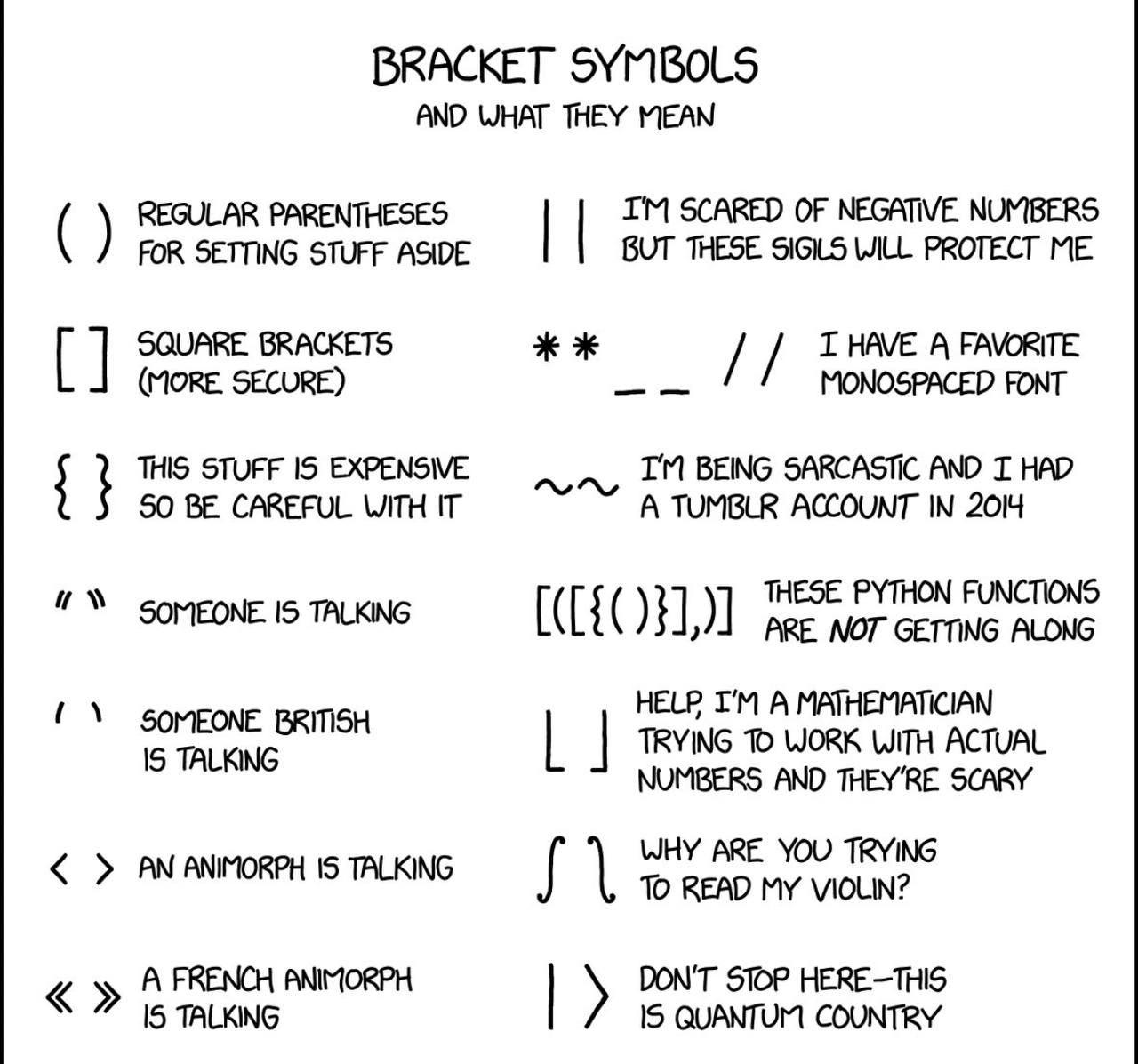
Imagine all the little symbols on your keyboard came to life as characters at a party – each with their own quirky personality. This comic treats brackets and punctuation as if they’re people or creatures doing funny things, which is why it’s so amusing to programmers. It’s like giving each type of bracket a costume and a role in a skit.
For example, parentheses ( ) are portrayed as someone whispering a side comment – think of a friend who leans in to give you extra info quietly. They’re used to set something aside, just like in a sentence when you use ( ) it’s a subtle aside. Square brackets [ ] are shown as a bit more serious, like a strong lockbox – the joke says they’re “more secure,” so picture them as a security guard holding content safely. Curly braces { } look fancy, so the comic pretends they’re a high-priced item or a fragile vase you only handle carefully (“this stuff is expensive”). It’s like a sign on a museum exhibit: handle with care! So curly braces became the posh, delicate ones of the bracket family.
Now, when you see quotation marks " ", the comic says “someone is talking,” which makes perfect sense: quotes in writing literally show someone’s speech. So imagine the quote marks as little speech bubbles over a character’s head. If the quotes are single ‘ ’ instead of double, the comic humorously says that person must have a British accent! (In real life British books do use single quotes for dialogue, so it’s playing on that.) Then it gets fantastical: angle brackets < > are described as an Animorph (a person turning into an animal) talking. That one is silly on purpose – maybe think of those brackets as the open jaws of a creature speaking, or just a way to say “this conversation is getting weird!” And if those brackets are the double angle « », suddenly the creature is French – wearing a beret and saying “bonjour” in an animal form! By now our little punctuation party has gone from normal folks to imaginary shape-shifting animals with accents, which is pretty funny because brackets normally have nothing to do with any of that.
The second column of the comic goes even further into crazy-town. Double vertical bars || are drawn like magical protective gates. The caption says they protect someone who’s afraid of negative numbers – picture a person holding up two big fence pieces to block a swarm of minus signs. It’s making fun of the math idea that putting negative numbers inside two bars (an absolute value) makes them positive, like magic. Next, we see pairs of stars, underscores, and slashes (** __ //) laid out. The joke here is that only a true typewriter or computer nerd cares about these symbols enough to line them up. It’s as if someone proudly shows you their collection of perfectly aligned ASCII art – it means they really love their old-school computer font where everything lines up nicely. In plain terms, think of it like someone who loves writing in a diary with a very specific pen – here the “pen” is a monospaced font, and the aligned symbols are their fancy calligraphy. Only they appreciate it, and they show it off as a flex.
Then we have tildes ~~, which look like little wiggles. The comic says “I’m being sarcastic and I had a Tumblr in 2014.” Imagine a teenager rolling their eyes while saying “Oh suuure~~” with a drawn-out sarcastic tone – that’s the vibe. Those wiggles are like the universal emoji for sarcasm in text form, coming from an era (not so long ago) when people on the internet used quirky punctuation to show they’re joking. It’s poking fun at that specific internet phase when everyone had inside jokes on their blogging sites.
Near the end, the symbols turn into pure chaos for comedic effect. The string of mixed brackets [[[()3,]] is basically a big mess, like a bunch of puzzle pieces thrown together wrong. The caption says those Python functions are not getting along, so imagine a group of robots (each type of bracket is a little robot) all arguing and clattering into each other, not forming a neat line. It’s illustrating a coding error in a fun way – like toys that can’t connect right. |] is another odd one, where you can picture a very brainy mathematician character who normally deals with symbols and letters (like chalkboard equations). Now we put that character in a simple grocery store to do basic arithmetic with actual numbers on a calculator, and they’re screaming for help. The symbol |] is like them mixing up their fancy notation with reality – holding the wrong tool and going “Oops!” It’s a humorous exaggeration of how someone really smart in theory might act clumsy in practice.
Finally, |> comes with the line “Don’t stop here—this is Quantum Country,” which feels like a dramatic warning. By this point our party of brackets has ascended into a rocket ship and flown into outer space, apparently landing in Quantum Country. This is a playful way to say “beyond this point, things get really weird and scientific.” Quantum physics is famously strange and hard to grasp, so it’s as if the comic ends by opening a door to a bizarre landscape where normal rules don’t apply (hence the phrase like a road sign: Welcome to Quantum Country). If all the earlier jokes were progressively nerdy, this final one basically says, “Alright, we’ve hit maximum nerd level now!” It leaves you with an absurd mental image: a quantum physicist cowboy in a surreal country where bra-kets roam free. It’s completely off the deep end, which is why it’s funny – it’s the ultimate inside joke far removed from everyday life.
In simple terms, the meme is funny because it turns symbols into characters and scenarios we’d never expect. It starts out making a little sense (quotes = someone talking, okay that’s normal), but as it goes on, the explanations get more and more outlandish. This surprise factor makes us laugh – each line catches us off guard (“Wait, French Animorph? What?!”) yet has a clever connection (French quotes symbol). For someone not in on tech or math, it’s just goofy nonsense, but with a bit of context you see the pattern and the wit. Essentially, it’s the keyboard’s brackets putting on a talent show, each acting out a goofy stereotype. By the end, the show has gone from a simple play to a full-blown sci-fi opera. That escalating craziness – while still winking at real uses of those symbols – is what makes the comic delightfully nerdy and memorable.
Level 2: Decoding the Geek Hieroglyphs
If you’re a newer developer or just starting to explore programming, this meme might look like a bunch of gibberish symbols with random captions. Let’s break down what each of these bracket symbols usually means in real life coding or math, and why those captions are funny to the tech crowd. Think of it as translating from “developer inside-joke language” to plain English.
()— Parentheses: In both math and programming, parentheses are used to group things or indicate order. For example, in arithmetic,(2 + 3) * 4makes you add 2 and 3 first. In code,()wrap the parameters of a function call, likeprint("Hello"). The meme says “regular parentheses for setting stuff aside,” which is basically true: we often put side ideas or separate operations in parentheses. It’s playing it straight – nothing crazy here. This is the simplest bracket, like the bread-and-butter of expressions.[]— Square brackets: These are commonly used for lists or arrays in many languages. For instance, in Python,[1, 2, 3]defines a list of three numbers. In documentation or grammar, square brackets can indicate optional elements or placeholders (like<optional>or[optional]). The joke calls them “more secure,” which isn’t a technical term, it’s just whimsical. Picture a square bracket as a little box; a box might feel sturdier than a pair of curved parentheses. So “more secure” is like saying you’ve put something in a safe container. Technically, square brackets also appear in other contexts (like array indexingmyList[0]or in regex patterns[A-Z]meaning “any capital letter”). They do often guard things in a way – e.g., you use them to access or define tightly controlled parts of data. For a new dev, just know[]is your go-to for lists or arrays, and here it’s humorously dubbed a security upgrade from().{}— Curly braces (also called curly brackets): These are big in languages like C, C++, Java, JavaScript, and many others. They typically define a block of code. For example:if (isHungry) { eat(); }The
{ ... }encloses what should happen if the condition is true. Curly braces are also used in JSON to define objects (e.g.,{"name": "Alice"}) and in some math to denote sets or matrices. The meme says “This stuff is expensive so be careful with it.” Why expensive? In computing, we sometimes jokingly refer to operations as “expensive” if they consume a lot of resources (CPU time, memory). A block inside{}might be doing heavy lifting, or an object in braces might allocate memory – so there’s a playful suggestion that whatever lives inside curly braces costs more computationally. It’s not a literal rule, just a tongue-in-cheek caution. Also, curly braces look a bit like fancy ornate brackets, so one might imagine they hold precious content. As a new dev, you’ll primarily see{}to group multiple statements together in languages that don’t use indentation for scope. They’re crucial syntax in many “curly-brace languages.” Here, the comic is anthropomorphizing them: consider curly braces as fancy vaults for code – handle with care!""— Double quotes: These are used to denote speech in English writing and to define string literals in many programming languages. A string is just text data, like"Hello, world!"(the quotes aren’t stored, they just mark where the text begins and ends in code). The caption “someone is talking” is a straightforward play on the fact that quotation marks in writing indicate someone’s dialogue. In code, it’s not literally someone talking, but it does mean a piece of text, often something that might be shown or said (like an error message or output). So if you see text in quotes in code, imagine it as a spoken phrase or a label. The meme just takes that and treats the symbol as if it were a stage direction: you see quotes, you know someone’s saying something.''— Single quotes: These can also define strings in many programming languages. For example,'c'might denote a character in C, or'Hello'a string in Python (Python and JavaScript allow either single or double quotes for strings as long as they match). The humorous bit is “someone British is talking.” This is a cultural joke: British publications often use single quotation marks where American publications use double quotation marks for dialogue. For instance, a UK book might print: ‘Hello, world!’ she said. So the meme pretends that if you see single quotes, the speaker must have a British accent! Technically in code, there’s no accent difference – it’s just style. But interestingly, some coding style guides consistently use single quotes for strings (like AirBnB’s JavaScript style guide prefers'Hello'over"Hello"), while others prefer double quotes. It’s a minor thing, but as a new coder you’ll notice teams pick one or the other for consistency. Here you learn not only about quotes for strings, but a fun fact: punctuation styles differ by region, and we geeks find a way to joke about even that.< >— Angle brackets: These pointy boys have multiple roles. In math,<and>mean “less than” and “greater than”. In HTML/XML, they form tags like<title>DevMeme</title>to mark up content. In some programming languages, angle brackets are used for generics or templates (e.g., C++std::vector<int>or JavaList<String>), and in others for operators (like Python uses<in list comprehensions or comparisons obviously, but nothing exotic). The meme’s caption, “an Animorph is talking,” is pure silliness. Animorphs are fictional characters that can turn into animals, from a book series popular in the late 90s. There’s no direct technical link between angle brackets and Animorphs – this one is meant to be random and absurd to get a laugh. Perhaps the logic is: we had normal people talking with quotes, then a British person with single quotes, so naturally the next escalation is not a person at all but an Animorph (half-human, half-animal) speaking in some alien way – maybe using< >as if it’s an alien language tag. Another angle (pun intended): sometimes online role-playing or chat uses angle brackets around actions or non-verbal sounds, like<growls>or<transforms into a cat>, which would fit an Animorph context. As a junior dev, you don’t need to assign any real syntax meaning to this one – just know angle brackets commonly show up in markup and generics, but here they’re an excuse for a goofy sci-fi reference.« »— Double angle quotes (guillemets): These are actually used in certain languages (written languages, not programming ones) to denote speech, much like English uses regular quotes. French, for example, uses « Bonjour » to quote “Bonjour”. They’re also seen in other European languages and sometimes in typesetting. In programming, you won’t use « » for code (they’re not on standard keyboard layouts for coding), but you might see them in UTF-8 strings or printed as symbols. The meme calls them “a French Animorph is talking.” This follows the previous joke through: if< >was an Animorph speaking, then upgrading to the fancy French-style angle quotes implies the Animorph is now French. It’s stacking absurdity on absurdity. The deeper wink here is to people who recognize those symbols as French quotation marks – the kind of thing you might only notice if you’ve dealt with internationalization or read French comics or, say, studied typography. For a new developer, the takeaway is: there are many kinds of quote symbols beyond the basic ones on your keyboard. But mostly, this is included to be over-the-top. By now the list of symbols has gone from common to extremely niche, which is part of the humor.
Now, moving to the right column of the comic’s entries, which get a bit more technical and niche:
||— Double vertical bars. In coding,||usually means logical OR. For example, in C-like languages,if (isHot || isHumid)means “if it’s hot or it’s humid (or both) then...”. In mathematics, the same symbol, but often written as just|x|(single on each side of a value), denotes absolute value. Absolute value of -5, written |−5|, is 5. It turns negative numbers positive (distance from zero). The caption “I’m scared of negative numbers but these sigils will protect me” is describing exactly what absolute value does in a funny way. Think of|−5|as putting -5 inside magical walls| |that turn it into +5 – no more negativity! As a new dev, you’ll encounterabs()as a function for absolute value in many languages, but mathematically the vertical bars are the notation. It’s not that anyone literally fears negative numbers, but negative values can cause different behavior in code (like an index -1 might mean something different, or subtracting might flip conditions). So this person “uses these sigils to protect” themselves – i.e., uses absolute value to avoid dealing with a minus sign. It’s a cute, melodramatic way to describe a normal math function. If you see|x|in code comments or math-heavy algorithms, now you know it’s making sure x isn’t negative. And if you see||in code, that’s likely an OR condition – which is unrelated, but the meme repurposed the look of the symbol for the joke.** __ //— A sequence of symbols often associated with text formatting or coding. Let’s break that down:**could be the marker for bold text in Markdown or many chat applications (like**bold**becomes bold).__(two underscores) in Markdown is another way to denote bold (the same as double asterisks) or underlined text in some other markup systems.//in programming is commonly the start of a single-line comment (telling the compiler/interpreter to ignore the rest of the line). In old-school bulletin board or IRC chat formatting, sometimes slashes were used like italics, but that’s less standard.
The key is that all three of these are pairs of symbols that mean something in a formatted context, but here we see them raw, side by side. The phrase “I have a favorite monospaced font” is hinting that someone typed these out and is viewing them in a environment where they don’t get converted into formatting – likely a code editor or plain text with a monospaced font (where every character aligns in columns). Monospaced fonts are what developers use in code editors (each character has the same width, so your text lines up nicely, like on a typewriter or in a terminal). People who love monospaced fonts sometimes appreciate patterns created by symbols lining up. For instance:
** __ //If you wrote these on separate lines in a monospaced font, you’d see a cool little alignment (the stars might be high, underscores low, slashes diagonal – it’s like ASCII art flair). The joke is that only a true nerd who obsesses over their coding font would care about how
** __ //look together. It’s poking fun at developer aesthetics – having a “favorite monospaced font” is absolutely a thing among programmers (you’ll hear debates about Consolas vs. Source Code Pro vs. JetBrains Mono and so on). So a person who proudly writes out** __ //and draws joy from the pure look of it definitely loves their font and the coding vibe. As a newer dev, you might not have a favorite font yet, but give it time – after staring at code for hours, you develop strong opinions on what’s easiest on your eyes! This line is just nerd humor about that eventual pride. Technically, if you see**or__around text in a README, know they might make text bold, and//in code means a comment. But if you see them all together like this…someone’s just being cheeky.~~— Double tildes. In Markdown, putting~~around text, like~~example~~, willstrike it through. Strikethrough text often implies something that’s beencrossed outor said ironically. Outside of Markdown, internet users (especially on Tumblr or forums around 2010-2015) would use a tilde at the end of a sentence or around a word to convey a playful or sarcastic tone. For example: “Oh, you’re a real genius ~~” might read as sarcasm. The meme’s caption, “I’m being sarcastic and I had a Tumblr account in 2014,” directly points to that subculture. If you’re new to coding you might not immediately link~~with tone of voice, but remember, developers are also internet citizens. Many of us were on platforms like Tumblr, where silly textual habits formed. So~~has nothing to do with programming logic; it’s about developer communication style. When devs document things or comment in code, they sometimes carry over these habits (for instance, using strikethrough in a pull request description to jokinglycross outa suggested change). If you ever see double tildes in a Markdown file, check if it’s around text – it likely means the author is crossing something out for effect. And yes, if someone jokes “I had a Tumblr account back in the day,” it’s a wink-wink to being an internet veteran.[[[()3,]]— This one is meant to look like a chaotic snippet of Python (or pseudo-Python) code. What it literally shows is a series of opening brackets[[[, then()3,with a curly brace{inside (depending on how you read it), and then closing brackets]]. Honestly, this doesn’t correspond to any valid syntax in Python or another language; it’s deliberately jumbled. The caption says “These Python functions are not getting along.” This implies that we’re trying to do too many nested things and the components are fighting each other (i.e., the brackets don’t match up properly). For a junior developer, this highlights a common early headache: mismatched brackets or parentheses. For example, if you forget a parenthesis in a function call or put one too many, you’ll get errors. In Python particularly, mixing up brackets[], braces{}, and parentheses()is a no-go — each has a specific purpose:()for function calls or grouping,[]for lists or indexing,{}for dictionaries or sets. You can’t just swap them around arbitrarily. So[[[()3,]]looks like maybe someone tried to have a list of lists of lists[[[...], then call a function(), throw in a number3, and close with wrong brackets. The Python interpreter would throw up its hands at this mess. It’s a comedic exaggeration of a syntax error. The phrase “not getting along” anthropomorphizes the error: the brackets are like bickering children that won’t pair up properly. If you’ve just started coding, trust me, everyone encounters an “unexpected EOF while parsing” or “SyntaxError: mismatched parentheses” at some point. It can feel like your brackets are misbehaving. This meme just makes a joke out of that frustration. The key learning: each type of bracket has to open and close correctly. Python enforces that strictly. When you see something like this snippet, it’s basically a fake example of “what NOT to do.” And the humor is in imagining those functions/brackets as characters who just refuse to cooperate.|]— A vertical bar followed by a square bracket. This isn’t standard syntax in any programming language that I know of. It looks like someone started to write| |(maybe the absolute value of something in math) but closed it with a]instead. The caption clarifies the intent: “Help, I’m a mathematician trying to work with actual numbers and they’re scary.” This is poking fun at how a pure mathematician might accidentally use math-y notation in a computing context incorrectly. Mathematicians often use vertical bars for various notations (as mentioned, absolute values, norms, conditional probabilities P(A | B), etc.), and square brackets for intervals or floor functions (e.g., the floor of x is sometimes ⎣x⎦ which looks like |] kind of). If a mathematician inexperienced in programming were to write code, they might try something funky like|x]expecting it to mean something, and the computer would be very confused. The joke here is also the stereotype that mathematicians prefer symbols and theoretical constructs (like ∞, ε, etc.) and rarely plug in concrete numbers – so when they actually have to calculate with numbers (say, 3 or 7.5), it’s out of their comfort zone. To a new developer, this highlights a cultural difference: CS fundamentals vs pure math. In CS or programming, you’re often dealing with explicit numbers and data, whereas in advanced math you might prove things generally without ever using a specific number. So when this mathematician says “actual numbers are scary,” it’s exaggerating that difference. There’s no literal programming use for|]— it’s just a wrongful mash of characters to illustrate confusion. If you ever see something like that in code, it’s probably a typo or misuse. This part of the meme is more about the humor of someone out of their element (the mathematician in the land of code).∫∫— Two integral symbols. Integrals come from calculus, and are not something you type in most code (unless you’re using a special math library or symbolic computation tool that can handle Unicode math symbols, which is rare in everyday dev work). A single integral ∫ is used to calculate areas under a curve or accumulations. Two in a row (∫∫) might mean a double integral, as mentioned – like volume under a surface, or iteratively integrating twice. But in plain programming, you’d never literally write∫; you’d write a function or use math functions to compute an integral numerically. The caption jokes, “Why are you trying to read my violin?” It’s totally whimsical – the integrals here look like ornate characters, perhaps like musical notation or some Baroque script. The idea is that someone might mistake the integral sign for something artsy (like treble clefs or the fancy squiggles inside a violin’s sound holes). This is basically saying: if you’re reading integrals and you’re not a mathematician, it might as well be a foreign language or music. For a junior developer, the main thing to know is integrals = advanced math concept. If you haven’t taken calculus yet: an integral is kind of like a sum of infinite tiny pieces (for area, volume, etc.). But the comic isn’t teaching calculus; it’s just using the symbol as a visual gag. You likely won’t encounter∫in your code, unless you venture into mathematical programming. However, you might see it in math equations in documentation or comments if someone’s describing a formula. If you do, don’t panic – it’s just math, not executable code. And perhaps think of this meme and remember you’re not expected to “read the violin” unless you’re doing something very specialized!|>— Vertical bar and angle bracket together. Some programming languages do use|>as an operator. For example, in F# and Elixir,|>is the pipeline operator, which feeds the output of one function into the next function. (It’s like saying: take the result of the left side and “pipe” it as input to the right side.) There’s even a proposal to add|>to JavaScript for chaining functions. So a relatively new developer might actually see|>in modern code, depending on the language. But the meme’s context is different – it explicitly mentions “Quantum Country,” which is not a programming language but rather a term referencing quantum mechanics education. In physics, the notation|ψ⟩(with a matching angle bracket at the right) is used in quantum theory (Dirac notation) to represent quantum states, as touched on earlier. Seeing just|>implies a quantum “ket” without its contents, something you’d only recognize if you’ve seen quantum equations. The phrase “Don’t stop here—this is quantum country” is telling you that we’ve gone way beyond normal stuff. It’s as if a tour guide said, “Careful now, past this point it’s all quantum physics!” Quantum mechanics is notoriously non-intuitive and complex, so it’s a humorous warning that this is terra incognita for most folks. As a junior developer, you’re not expected to know quantum notation (unless you’re specifically studying quantum computing). So don’t worry if this one flew over your head. The meme expects that – that’s part of the joke. It’s deliberately ending on a WTF note. If you got everything up to∫∫and felt good, and then|>left you scratching your head, congratulations: you just experienced exactly what the comic wanted – that sense of “Okay, now we’ve gone off the deep end!”. The takeaway:|>might mean a pipeline in some code, but here it’s more about a physics reference. Quantum Country, by the way, is the name of some interactive essays that teach quantum computing with spaced repetition (flashcards) – a very niche thing even among developers. So it’s perfectly fine if you didn’t know that; most juniors wouldn’t.
So as a newcomer looking at the whole meme, you can now see it’s listing various symbols and giving each a joke definition that riffs on either how that symbol is used in code/math or how it looks or sounds. Many of the jokes require familiarity with specific domains:
- Basic coding syntax (parentheses, brackets, quotes for strings).
- Cultural style differences (American vs British punctuation).
- Nostalgic pop culture (Animorphs).
- Markdown and dev tooling (monospaced fonts, sarcasm tildes).
- Programming pitfalls (mismatched brackets in Python).
- Math notation vs code (absolute values, integrals, quantum notation).
Each line escalates in required knowledge. Early ones you might get right away (“quotes mean someone’s talking, got it”), and later ones might be “Wait, what does that even mean?” That’s intentional – it’s mapping the journey of a developer accumulating knowledge. Over time, you’ll likely encounter all these symbols in one context or another. Someday you might even chuckle at a stray |> because you’ll remember this explanation. And if any of these still doesn’t make sense, don’t fret; even many experienced devs would need a second to recall the quantum stuff. The meme is essentially a collage of developer humor and *language quirks meant to be an inside joke buffet. Now that we’ve translated it, you’re in on the joke too!
Level 3: Bracket Battles of a Senior Dev
For an experienced developer, this comic hits all the right nerdy notes by assigning absurd meanings to familiar symbols from code, math, and beyond. It’s essentially a snarky field guide to syntax quirks – the kind of inside joke you appreciate after you’ve been exposed to a dozen programming languages (and remember a bit of high school math and 90s pop culture too!). The humor comes from mashup references: each bracket type carries a double meaning that only a well-seasoned geek would catch. A senior engineer can immediately see why it’s funny that {} are labeled “expensive” or that '' (single quotes) are “someone British is talking.” It reflects the accumulated lore of the field: after years of coding, you’ve likely debated square vs. curly braces, fought over single vs. double quotes, encountered sarcastic tilde strikethrough markdown, and maybe even dabbled in languages so exotic that |> means something real. This meme rewards that hard-earned knowledge by turning it into a checklist of “Look how far down the nerd rabbit-hole we can go!”
Consider the left column of the comic – it starts innocently enough. () labeled “regular parentheses for setting stuff aside” is straightforward: in code and writing, parentheses encapsulate an aside or group logic. No surprises there; it’s practically the first thing you learn after “Hello World.” Next, [] as “square brackets (more secure)” is a gentle poke at how square brackets often denote something a bit more guarded or optional. In many languages, [ ] create arrays/lists (containers for data). The meme jokingly calls them “more secure” perhaps because a square feels sturdier than a parenthesis, or it’s riffing on how array indices are like safeguarded slots. It’s absurd, but a senior dev might think of how in documentation [] often indicates optional elements – you know, the stuff you lock away unless needed. Then we have {} with “This stuff is expensive so be careful with it.” Curly braces typically mark code blocks or object literals. In languages like C, Java, or JavaScript, they contain entire scopes and resources. Seasoned coders have learned that whatever you put inside {} can be “expensive” in computing terms – maybe it’s a heavy operation or a critical section. There’s a grain of truth under the joke: treat what’s inside those braces with care, because it often represents significant logic or memory (think of initializing an object {} or a big loop). It’s also poking fun at how curly braces look fancy, almost like ornate treasure chests, implying “handle with caution!” If you’ve been around verbose curly-brace languages and then seen a minimalist style (like Python where braces are omitted), you’ll grin at the notion that curly braces are a precious commodity. It’s a syntax quirk seasoned devs love to tease: some languages make you sprinkle {} everywhere, so it feels like you’re writing something weighty (and maybe costly in CPU cycles).
The list quickly escalates into playful cultural references. When the meme says " " (double quotes) mean “someone is talking,” and ' ' (single quotes) mean “someone British is talking,” it’s blending coding with grammar humor. Developers know quotation marks in code delimit strings (pieces of text), and in English writing they denote speech. The British vs American quote style difference is a subtle nod: American convention uses double quotes for dialogue, while British English often starts with single quotes. A senior developer who’s also a book nerd or has dealt with internationalization might chuckle, “Ah, I see what you did there – British dialogue uses single quotes, clever!” It’s a tiny detail that shows the meme’s XKCD-like attention to nuance. Plus, in programming, there’s often a holy war over 'single' vs "double" quotes for strings (particularly in languages like JavaScript or Python where both do the job). Many style guides actually treat it as a trivial but heated issue – e.g., Python folks quip that single quotes are for Brits and double for Americans as a lighthearted explanation. So this joke works on two levels: typography and coding style. A senior dev recognizes the familiar bike-shedding: “Which quote style do we use?” – and here the answer is comically nationalistic.
Then we veer into angle bracket territory, and things get delightfully weird. < > labeled “an Animorph is talking” is a curveball. Angle brackets are ubiquitous in computing – from HTML tags (<div>...</div>) to generic types in C++/Java (std::vector<int>), to comparison operators (a < b). But none of those directly scream “talking Animorph,” which is exactly why it’s funny. This is the meme’s randomness at play, channeling internet/pop culture. Animorphs was a 90s sci-fi book series where characters morph into animals. Why link that to < >? Possibly because angle brackets are used in fan-fiction or online roleplay to denote actions or transformations (e.g., <growls>), or maybe it’s just absurdism – we had someone talking, someone British talking... the next logical escalation: an alien or animal talking! Angle brackets look like little arrowed mouths, if you use your imagination. To a veteran nerd, “Animorph is talking” immediately paints a mental image of some shape-shifter speaking in a hissy alien voice enclosed in < >. It’s nerd humor crossing domains: from coding symbols to YA science fiction references. And just when that sinks in, the next line « » one-ups it: “a French Animorph is talking.” Here the meme uses the French-style angle quotes, known as guillemets (« »), which are actually used in French and some other languages for dialogue instead of our quotes. So we’ve gone from normal speech to British-accented speech to animal-alien speech to French animal speech, simply by swapping out types of quotation marks. This is classic senior-dev humor – it starts logical and then snowballs into ridiculous edge cases. It gently mocks how pedantic we can get with symbols. Only someone who’s seen a variety of language quirks would appreciate the progression from practical to preposterous. It’s like the comic is saying: “If you thought single vs double quotes was a picky detail, wait till we bring out the French angle quotes for shapeshifting creatures!” By this point a seasoned reader is both laughing and maybe shaking their head, recalling all those endless style arguments and the endless capacity of nerd culture to niche-ify anything.
Now, the right column of the meme lists even more eccentric bracket usages that hit close to home for veteran devs (and mathematicians). First in that column, we have || with the text “I’m scared of negative numbers but these sigils will protect me.” This one operates on a couple of levels of insider knowledge. In many programming languages (C, Java, JavaScript, etc.), || is the logical OR operator. But clearly “scared of negative numbers” has nothing to do with Boolean logic. That line is referencing the absolute value notation from math, where wrapping a number in vertical bars (e.g. |−5|) “protects” you from negativity by turning the result positive. To a developer who’s done some math or seen this symbol in algorithms, |x| means “if x is negative, make it positive.” It’s like a talisman against minus signs. The meme exaggerates that into a funny mental image: someone nervously surrounding a negative number with vertical bar “sigils” to ward off evil negatives. It’s a perfect example of syntax abuse for comedic effect – taking a math concept and pretending it’s magical thinking. Senior coders find this hilarious because they’ve likely wrestled with negative numbers causing bugs (index out of bounds, anyone?), and wouldn’t it be nice if a couple of symbols could just banish those bugs? Also, as an aside, older devs might think of how in certain languages (like some assembler or BASIC dialects), absolute value was sometimes denoted with vertical bars, or how bitwise OR vs logical OR in C (| vs ||) could trip you up – but here, none of that serious stuff, just a playful math-meets-fantasy joke.
Next up, a real gem for the text-formatting nerds: ** __ // with the caption “I have a favorite monospaced font”. This one screams DeveloperExperience_DX in-joke. The symbols **, __, and // are reminiscent of markup for formatting text. For example, in Markdown (which devs use all the time for README files and docs), **bold** is bold text, and __underline__ or __bold__ (depending on context) might also signify bold or emphasis. // isn’t standard Markdown, but in some older forums or wiki syntaxes, double slashes were used for italics or comments. In code, // starts a comment line in languages like C++ or Java. So what is this line telling us? “I have a favorite monospaced font” implies the speaker is showing off these raw symbols instead of their formatted result. It’s like writing in Markdown but not actually rendering it – something you do when you’re literally working in a text editor with a monospaced font (where every character is equally wide, like in code). Only a true font/layout geek cares about seeing the raw asterisks and underscores lining up just right. In a normal proportional font (like in a Word document), these characters might misalign or look odd. But in a coding font (say, Courier New or Fira Code), **, __, and // will each occupy exactly two character cells, making a neat little stack if you wrote them in a column. There’s a bit of flex here: the person flaunting that they prefer the raw look of syntax in monospaced text. It’s humor that touches on the pride developers take in their tools – some devs are very particular about their IDE theme and font (there are endless debates about the best monospaced font for coding). And on another level, it’s poking fun at how developers sometimes speak in Markdown or code even outside of coding – for instance, leaving asterisks in chat messages or writing __underscores__ in plain text, betraying how much time we spend in markup. A seasoned dev reading “** __ //” might recall accidentally sending a Slack message like **Oops** and turning it bold, or nostalgically remember bulletin boards where you’d literally see those markup symbols. The meme is effectively saying: if this line makes sense to you (and you can visualize those symbols in a code editor), you are definitely one of us.
Following that, ~~ gets the caption “I’m being sarcastic and I had a Tumblr account in 2014”. This digs into internet culture that a lot of older developers lived through. Before the mainstream adopted the sarcasm “/s” tag or tone indicators, early social media and forums had their own quirks. On Tumblr (around 2014), it was common to use tildes ~ for a certain sarcastic, whimsical tone or to indicate one is joking flirtatiously or speaking in a singsong voice. Separately, in Markdown and many chat applications, enclosing text with ~~double tildes~~ renders it as a strikethrough (a line through the text), which people often use to imply irony or say something and “cross it out” as if they didn’t really mean it. Both interpretations fit the idea of “I’m being sarcastic.” So the meme’s ~~ line is a hat-tip to those in the know: if you used Tumblr or early internet forums, you remember when adding a tilde or striking out text was the way to convey “just kidding” or a snarky tone. A senior engineer likely chuckles here because it’s oddly specific – 2014 Tumblr sarcasm is not something a newcomer would pinpoint, but those who were Extremely Online™ back then (many of whom are now seasoned devs) get it instantly. It’s also a self-own: acknowledging one’s past on a platform known for its meme-able subcultures. The humor lands because it’s true – we’ve all seen technical writing spiced with ~dripping sarcasm~ or commit messages that include ironic strikethroughs. It’s language quirks mixed with a bit of personal history.
Then we see the truly chaotic [[[()3,]] which comes with the note “These Python functions are not getting along”. Any developer who has wrestled with nested brackets or mismatched parentheses will both laugh and cringe at this one. The string [[[()3,]] looks like a syntax error on steroids. It’s as if someone tried to nest a bunch of lists and a function call and completely messed up the order. Let’s try to parse that: [[[ opens three square brackets (maybe an attempt at a 3-dimensional list?), then () could be an empty parenthesis pair (perhaps calling a function with no arguments?), then a 3, thrown in (maybe intended as an element or argument), then ]] closes two of the three brackets. We’re left with one unmatched [ and one unmatched { in there as well (there’s a { in the middle of ()3, string in the description – possibly a typo or deliberate confusion). The exact sequence doesn’t actually correspond to valid code, which is the point – it visually conveys a bunch of brackets fighting each other. In Python specifically, unmatched or misordered brackets will cause an immediate SyntaxError. The caption “not getting along” anthropomorphizes the brackets as if these functions or data structures are in a brawl. A senior dev finds that hilarious because it evokes the memory of chasing down that one missing parenthesis or extra ] that broke everything. We’ve all seen the meme of the missing semicolon or spent 15 minutes debugging only to find an extra { – this is that frustration turned into a sight gag. It’s nested_bracket_hell exemplified. Additionally, “Python functions” is mentioned: Python is a language that prides itself on clean syntax (no curly braces for blocks, for example), so seeing such a Cthulhu-like tangle of brackets in a Python context is extra absurd. It’s like the comic is winking, “Imagine writing Python that looks like Lisp with extra steps – ridiculous, right?” Senior developers likely recall times where someone forced convoluted one-liners or deeply nested list comprehensions in Python that did become a pain to read. This panel is a cheeky exaggeration of those worst cases. And as a final flourish, notice the emphasis on NOT – in the text it’s all-caps, channeling the frustration of a Python interpreter shouting “these brackets are NOT aligned!” or a dev’s inner voice screaming in irritation. Been there, fixed that, now we laugh about it.
Finally, the |] “mathematician with actual numbers” and the ∫∫ “violin music” bits we unpacked in Level 4, but from a senior dev perspective, they’re part of a pattern: the comic’s right column drifts from pure programming problems into the world of theoretical math and science, which is territory many engineers tiptoe into. Senior devs often have to interface with academics or work with algorithms where math notation meets code. These two lines play on that intersection. The mathematician one is a nod to the trope that pure math folks write elegant proofs but give them a simple computation or a bit of real-world data and they get uncomfortable. Considering many computer science foundations come from math, an experienced engineer might have witnessed this first-hand (say, a brilliant algorithm theorist who writes pseudo-code full of Greek letters that’s hard to turn into real code with actual numeric checks). And the integral one – well, it’s just delightful absurdity to picture integrals as musical notation. But even that has a senior joke angle: how often have we seen a regex or a bit of dense code that looks like line noise or “Perl poetry” and joked it’s like reading music or ancient scripture? The ∫∫ gag is akin to those times you stare at someone’s hardcore one-liner formula and go, “I can’t even read this – is it math or magic?” As a grizzled dev, you learn to appreciate clear code and clear notation; this meme underscores that by joking about the least clear scenario (mixing an integral into casual conversation!).
In summary, a senior engineer reading this meme gets a tour through the history of syntactic quirks and cross-discipline references that they’ve collected over the years. It’s funny because it’s true: every symbol on that keyboard does have a story in our field. We’ve seen them start as mundane (parentheses for order of operations) and become specialized (vertical bars for matrix determinants, anyone?). The comic exaggerates those stories into punchlines. It satirizes the language wars (“we should use [] instead of {}!”), pokes at the overly clever use of markdown and Unicode, and ultimately says: there’s always a new level of nerdiness beyond the one you know. For a veteran developer, it’s a pat on the back – “You’ve made it this far, you even got the quantum joke” – and also a gentle tease – “Look at the arcane knowledge we juggle, isn’t it absurdly wonderful?” This shared recognition of both the depth and goofiness of our expertise is what makes the meme instantly relatable in senior circles.
Level 4: The Quantum Frontier
At the extreme end of this meme’s bracket safari, we veer into quantum mechanics and high-level math notation. The final panel’s |> symbol is a tongue-in-cheek nod to Dirac’s bra–ket notation, a formalism from quantum physics. In Dirac notation, a “ket” looks like |ψ⟩ – the vertical bar with an angle bracket encloses a quantum state vector (like |0⟩ for a qubit in state zero). Here we only see the half-ket |>, which is like an unfinished quantum state dangling out there in space. The caption “Don’t stop here—this is quantum country” riffs on a famous meme (“Bat Country”) and the title of an interactive quantum computing textbook called Quantum Country. In other words, if you understood the |> reference, you’ve wandered far beyond everyday programming into the wild realm of quantum theory. It’s a playful edge-case where code syntax and physics notation collide. Senior engineers who’ve dabbled in quantum computing or remember their college physics will smirk at this one – it’s a badge of ultra-nerd humor to spot a bra-ket joke in a dev meme.
Just a step back from quantum country, we encounter ∫∫ – the double integral sign from calculus. Integrals are mathematical operators that sum up infinitesimal parts (areas, volumes, probabilities, etc.), and a double integral means you’re integrating over two dimensions (like finding volume under a surface). In plain calculus terms, ∫∫ is already advanced territory (multivariable calculus). But the meme doesn’t dive into the math; instead it quips “Why are you trying to read my violin?” This surreal caption plays on the idea that ∫ signs look like fancy script or musical notation to the uninitiated. (Indeed, the integral symbol was historically an elongated S for “sum,” but here two in a row might vaguely resemble the intricate f-holes on a violin or a musical clef.) It’s a nerd pun: to someone who hasn’t seen an integral, a line of calculus could look as inscrutable as trying to read sheet music. By including integrals in the list, the comic jumps to a higher plane of abstraction – one that mixes mathematics and art. A seasoned developer with a background in math will catch the double meaning; it’s the meme signaling, “We’re not in simple code syntax anymore, we’re doing calculus at the symphony!”
Even the odd |] entry is a high-brow jab at how mathematicians use notation versus how coders do. |x| in math denotes absolute value (distance from zero, always non-negative), and mathematicians also use vertical bars for things like norms (||v|| length of a vector) or order of a group (|G|). But |] is nonsensical on its own – it’s a broken piece of notation, like someone started an absolute value |...| and never finished. The caption “Help, I’m a mathematician trying to work with actual numbers and they’re scary” alludes to the stereotype that pure mathematicians live in an ideal world of symbols and proofs, rarely plugging in concrete numbers. It’s a light academic roast: the mathematician, used to abstract notation, panics when faced with “actual numbers.” The malformed |] suggests they tried to apply some theoretical notation in a practical coding context, and it just doesn’t fit. This joke resonates with developers who have seen theoretical folks struggle with real-world programming (or vice versa) – it’s the clash of abstract math and down-to-earth computation. In a broader sense, the meme’s right column is exploring the cultural crossover between programming, math, and physics. Each of those fields has its own special brackets and symbols, and mixing them together creates both confusion and comedy. A veteran engineer recognizes the deeper truth here: as you advance in tech, you inevitably bump into these esoteric notations (from absolute value bars to quantum bra-kets), and it’s both humbling and hilarious to see them misapplied on purpose.
Description
A webcomic-style chart titled 'BRACKET SYMBOLS AND WHAT THEY MEAN'. The image is in a minimalist, black-and-white, hand-drawn style, reminiscent of XKCD. It presents a two-column list of various typographical and mathematical symbols, each paired with a humorous, absurd, or niche technical definition. For example, '()' are 'REGULAR PARENTHESES FOR SETTING STUFF ASIDE', while '{}' means 'THIS STUFF IS EXPENSIVE SO BE CAREFUL WITH IT'. The jokes escalate in specificity, referencing Python data structures ('[[{()}],]' means 'THESE PYTHON FUNCTIONS ARE NOT GETTING ALONG'), mathematical notation ('| |' are 'SIGILS' to protect from negative numbers), quantum mechanics ('| >' indicates 'QUANTUM COUNTRY'), and font ligatures ('** -- //' means 'I HAVE A FAVORITE MONOSPACED FONT'). The humor is derived from assigning anthropomorphic and overly dramatic interpretations to common syntax, playing on the nuanced and often overloaded meanings these symbols have in programming and mathematics
Comments
10Comment deleted
My code's emotional state is written in the brackets. Parentheses mean it's stable, square brackets suggest it's feeling a bit boxed in, and curly braces indicate it's going through an expensive and complex phase. A mix of all three means it's having an identity crisis and will probably throw a syntax error
At least now my code reviewer can’t complain about eight levels of nesting - it’s not spaghetti, it’s just an Animorph arguing with a quantum physicist inside a secure bracket sandbox
After 20 years of explaining to junior devs why their JSON has a trailing comma, I've finally discovered the real problem: those Python functions in nested brackets were having relationship issues all along. No wonder my code reviews keep finding 'expensive' curly braces in production - should've used the 'more secure' square brackets from the start
After 20 years in the industry, I've learned that the real difference between junior and senior engineers isn't their mastery of algorithms - it's knowing that '{ }' means 'production code that will cost $50K to refactor' while '( )' is just 'that TODO I'll get to next sprint.' And if you see '[([{( )}],)]' in a Python codebase, that's not functional programming - that's a cry for help from someone who discovered list comprehensions and decorators in the same afternoon
Code review heuristic: if the diff starts with ‘[[[’ you’re debugging a parser; if it ends with ‘|⟩’ a VP just pitched quantum microservices
Unary minus: the silent killer of expression trees - brackets, assemble to enforce that precedence!
When a repo mixes (), [], {}, ⟦⟧ and ⟨| |⟩ in one file, it’s not polyglot - it’s a parser generator with tenure
https://xkcd.com/2954/ Comment deleted
das rite! Comment deleted
<!-- what are you looking here? --> Comment deleted