Skip to content
DevMeme
6504 of 7435
ChatGPT Offering Unsolicited Diagrams While User Already Left
AI ML Post #7129, on Sep 15, 2025 in TG

ChatGPT Offering Unsolicited Diagrams While User Already Left

Why is this AI ML meme funny?

Level 1: Thanks But No Thanks

Imagine you’re building a simple sandcastle, and a friendly neighbor runs over with a huge, detailed blueprint for a sandcastle skyscraper. The neighbor is super excited, saying, “I can draw a fancy plan to help y…” – but you’ve already got your castle halfway built and the tide is coming in soon. You smile politely and close the gate while they’re still talking. You don’t have time for a big fancy plan; you just want to finish your little project before the waves hit. The scene is funny because the helpful neighbor (like the AI in the meme) is offering something way too much and a bit late, and the builder (like the senior dev) just shuts the door mid-offer. It’s a friendly “thanks, but no thanks.” In everyday terms: sometimes when you’re busy and know exactly what you need to do, someone’s elaborate help or advice – even if well-meaning – just isn’t what you need. The quick door shut says, “I’ve got this!” in a comically blunt way.

Level 2: Eager Assistant vs Seasoned Dev

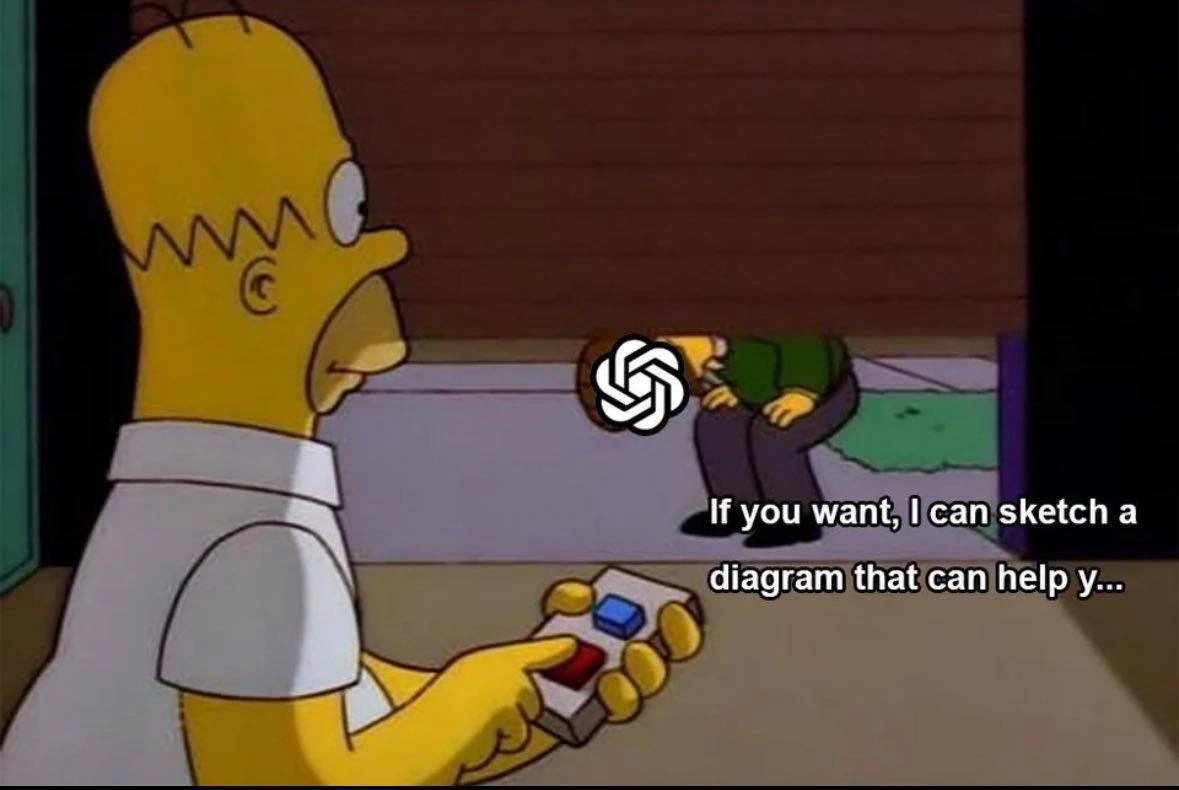
This image shows a funny scene: a very experienced developer (Homer Simpson in the garage) is closing the door on an AI helper (Ned Flanders outside, who has the ChatGPT logo for a face). ChatGPT is basically a chat-based AI assistant – think of it like a super-advanced computer program that can answer questions and give suggestions in plain English. It often tries to be helpful with all sorts of advice. Here, ChatGPT was in the middle of saying, “If you want, I can sketch a diagram that can help y…” and then bam! – the garage door comes down, cutting off the offer mid-sentence. The senior dev (Homer) literally presses a big red button to make that door shut. You don’t need to hear the rest of the sentence to get it: the developer absolutely does not want that diagram. It’s a comical way to show the dev saying “Nope, stop right there” without even speaking a word.

Now, why would a developer refuse an offer for a diagram, especially an architecture diagram that’s supposed to be helpful? To explain, let’s break down a few terms:

  • Architecture diagram: This is basically a picture that shows how different pieces of a software system fit together. Imagine drawing boxes for each part of an app (like a database, a server, a client) and arrows to show how data flows between them. It’s like a map of the software. These diagrams are part of documentation – writing things down (or drawing them out) so people can understand the design.
  • Senior developer: This is someone who’s been coding and building systems for years. They’ve probably seen a lot of projects succeed, fail, and everything in between. Because of this, they tend to be practical and know the value of time. They’re often focused on delivery – getting the software working and shipped to users. If something doesn’t directly help the project move forward (especially if a deadline or an urgent issue is looming), a senior dev might be very tough on it.
  • ChatGPT / AI assistant: ChatGPT is an AI that can generate text and ideas. In a programming context, people use it to get help with code, generate documentation, or even brainstorm designs. It’s like having an encyclopedia and a eager junior developer rolled into one, available 24/7. But it doesn’t truly know your specific project – it gives advice based on general knowledge it learned from lots of data.

In the meme, these worlds collide. The AI assistant (ChatGPT) is offering to make an architecture diagram for the system. Maybe it detected a conversation about design, or the user asked for help – the exact trigger isn’t shown, but we see the AI enthusiastically starting to help. The seasoned dev, however, clearly doesn’t want this interference. It’s an unsolicited suggestion, meaning nobody asked for it, and it’s coming at the wrong time. Perhaps the team has had too many meetings with drawings and nothing to show for it, and the senior dev is tired of “talking” and wants to get back to coding or solving the actual problem. This reflects a common communication gap: the AI thinks any help is good, but the human expert knows that sometimes more input (especially generic advice) can slow things down or cause second-guessing.

Think of it from a junior developer’s perspective: early in your career, you might love making neat diagrams before writing code, because it helps you understand the problem. It’s like planning a road trip route on a map before driving. But after you’ve driven that route 100 times, you kind of know it by heart and you might find sitting down to draw a map a bit unnecessary – you’d rather just hit the road. The senior dev here is like that experienced driver. He’s been down this road many times. He likely already has a mental model (a clear picture in his head) of the system’s architecture. Another formal diagram might feel like overkill, or maybe he knows that any diagram will be outdated as soon as the next change happens. Developer frustration can come from experiences where too much planning or documenting means lost time – time that could have been spent building or fixing something.

Also, consider the dynamic: ChatGPT, represented as Ned Flanders, is famously the annoyingly helpful neighbor from The Simpsons. Ned’s always offering help or advice, even when Homer (his neighbor) isn’t in the mood for it. By putting the ChatGPT logo on Ned, the meme suggests that ChatGPT is similarly well-intentioned but maybe a bit tone-deaf. The AI doesn’t realize the senior dev is not interested. In tech teams, this can happen with human communication too! Sometimes a well-meaning project manager or an architect might jump in and say “Let’s draw this out” when the devs are already confident about the plan. If overused, those sessions can feel like they’re just repeating known information. That’s why the meme’s subtitle references architecture-review dynamics – those are meetings where people review the system’s design. They’re important, but if you have them too often or at the wrong time, engineers start feeling like, “Ugh, not another review – we already know what to do, let’s just do it.” Here, ChatGPT appears to trigger that exact aversion; it’s like a reflex for Homer to shut the door as soon as he hears the words “I can sketch a diagram…”. You can almost imagine him thinking, “Nope! I’m not spending another evening on a fancy diagram, I have code to deploy.”

From a learning standpoint, this meme also subtly highlights architecture trade-offs and the difference between theory and practice. A diagram from an AI might show an idealized picture: for example, it might draw a perfect microservices setup with every service neatly separated, or it might suggest a classic design pattern (like Model-View-Controller, or a layered architecture) because those are common solutions. But an experienced dev might know specific details: maybe two of those “separate” services actually need to share a database for legacy reasons, or maybe the system can’t be perfectly divided because of a hardware constraint. These are the gritty details that generic diagrams don’t capture. The senior dev possibly thinks, “I already know the ideal pattern, but I also know why we can’t fully do that here – and I don’t need an AI to tell me the idealized version.” It’s like someone reciting textbook advice that doesn’t quite apply to your unique situation. Sometimes that can be more irritating than helpful, especially if you’re short on time.

Finally, let’s talk about the emotional tone – developer humor often comes from exasperation. The dark evening colors in the image set the mood: it’s late, the lights are on, and Homer’s expression is one of those classic annoyed looks. The poor ChatGPT/Ned character is bent over, cut off mid-proposal. You don’t even need to see Homer’s face fully to sense the “Enough of this” vibe. It’s a funny exaggeration of what might really just be a curt reply in a chat. In real life, a senior dev might respond to such an offer with a short message like, “Not now, thanks,” or by ignoring it completely. The meme visually amplifies that feeling by literally showing the door coming down. It’s a great comedic metaphor: closing the garage door is like closing the conversation in the most direct way possible. No room for misinterpretation there!

In summary, for a newcomer: this meme is showing a clash between new tech help and old-school experience. The AI assistant (ChatGPT) is eager to help by drawing a diagram (because diagrams are usually good for understanding complex systems). The senior developer is having none of it, likely because he’s confident in what needs to be done and is tired of delays. It’s funny because we can empathize with both sides a bit – we know ChatGPT only wants to help, but we also totally feel why the dev shuts it up. It’s a high-tech twist on a classic situation: someone tries to “help” you with a complicated explanation when you’re already busy doing the thing. And the seasoned person’s response is basically, “Please, just let me do my job.”

Level 3: Not Another Diagram

This meme brilliantly captures a scenario every senior engineer knows too well: the moment when a helpful assistant (or sometimes a well-meaning coworker) insists on yet another architecture review or fancy diagram, and the seasoned dev is just done with it. Here we have Homer (the senior dev) silently lowering the garage door on Ned Flanders, whose head is replaced by the ChatGPT logo. Ned’s cut-off line, > “If you want, I can sketch a diagram that can help y…”, tells us everything: ChatGPT is cheerily offering an unsolicited architecture diagram to “help” – and it gets literally shut out mid-sentence. The developer humor here comes from how relatable that abrupt shutdown is to anyone who’s been stuck in endless design discussions. The senior dev isn’t even arguing; he’s wordlessly hitting the button to close the door, which is about the most succinct communication of “no thanks” you’ll ever see. It’s the ultimate silent treatment to a suggestion he never wanted in the first place.

Why is this so funny (and painful) for engineers? Because it satirizes the AI assistants hype meeting the cynicism of real-world engineering. ChatGPT — standing in as this era’s ultra-smart AI tool — can indeed whip up design documents, UML diagrams, or design patterns suggestions on demand. In theory, that’s great for documentation or brainstorming. But to a veteran dev who’s survived production outages and shipped complex systems, a shiny diagram can sometimes feel like a distraction or even an insult when you’re knee-deep in code. They might be thinking: “Oh, now the chatbot wants to play software architect? How adorable.” This reflects a common frustration: when you’re pushing toward a deadline or firefighting a critical issue, the last thing you need is a high-level diagram that states the obvious or, worse, adds confusion. Developer frustration builds up after years of meetings where architecture astronauts pontificate about ideal designs while your real system has literal fires to put out. The senior dev’s patience for diagram overload is zero. In fact, many of us have a kind of diagram_overload_aversion: an almost allergic reaction when yet another box-and-arrow sketch is proposed instead of tangible progress.

There’s also an undercurrent of satire about modern AI in the workplace. In many companies today, people are experimenting with chatbots in code reviews, design sessions, and documentation writing (some call it ChatGPT-driven architecture half-jokingly). Often the AI enthusiast of the team will say, “Hey, let’s ask ChatGPT to draft the design doc or draw the system diagram!” It’s a trendy idea, given how these models have ingested tons of public design patterns/architecture knowledge. But the meme highlights the reality: those AI suggestions can be overly generic or not context-aware. The swirling ChatGPT icon on Ned’s face represents the AI’s eager-but-clueless grin. Ned Flanders, known in The Simpsons for super friendly unsolicited advice (“Hi-diddly-ho, neighborino!”), is the perfect avatar for ChatGPT here. It’s always polite, always available, and a little oblivious to the vibe. Homer’s response – slamming the door – is basically the senior dev saying, “Enough. I don’t need a Clippy 2.0 popping up with design tips.” Remember Clippy from Microsoft Word? That cheerful paperclip would chirp “It looks like you’re writing a letter, need help?” at the worst times. ChatGPT offering “I can sketch a diagram…” unasked feels like Clippy’s spiritual successor in the programmer world. And just like Homer’s garage door, we often just want to hit the close button on such pop-ups.

The humor also lies in the architecture tradeoffs that the senior dev is implicitly prioritizing. By shutting down the conversation, Homer is saying “we have to prioritize shipping and solving real problems over theoretical exercises.” In real projects, there’s a constant trade-off between spending time on documentation/diagrams versus writing or deploying code. Diagrams and high-level designs are valuable, but past a certain point they yield diminishing returns – especially if the team has deep tacit understanding or if the requirements are changing quickly. The unsolicited nature of the offer suggests ChatGPT didn’t read the room: maybe the team didn’t ask for an architecture diagram because they either already have one, or they know that at this stage a new diagram won’t magically resolve their issues. It’s poking fun at the communication gap between AI’s textbook perspective and a senior dev’s real-life perspective. An AI might assume “more info can’t hurt, right?”, whereas the seasoned coder is like “I already have 10 outdated diagrams in Confluence, I don’t need an 11th.” It’s quality over quantity – the dev would rather have one accurate, battle-tested understanding than another polished but abstract diagram drawn from generic templates.

To ground this in a real scenario: imagine an architecture review meeting running late. The team is tired, the release is imminent, and suddenly someone (or some AI) chirps “Hey, I can draw a fancy chart of our microservices!” Many of us can almost hear the collective groan. The pathos and comedy of this meme come from shared experience: developer humor often springs from pain we all know. We chuckle because we’ve either been Homer, forcibly ending a fruitless discussion, or we’ve seen Homers on our teams who cut through the B.S. with a single decisive action. Maybe you recall a senior engineer who would literally unplug the projector during an overlong slide presentation, or end a Zoom call once the conversation went in circles. That moment is cathartic and funny in hindsight. Here, the garage door is Homer’s way to physically end the “meeting.” The darkness outside in the scene even suggests it’s late in the day (or after hours), reinforcing how done he is with talk – he’s literally and figuratively “in the dark” about why another diagram would help at this hour.

And let’s not forget the seasoned pragmatism vs. shiny AI dynamic. ChatGPT is a fantastic tool, but it often operates like a super-smart junior architect: it’s very good at regurgitating well-known solutions, patterns, and documentation with a confident smile. However, it doesn’t truly share accountability for what happens if that diagram is wrong or if following its advice leads to trouble. The senior dev on the hook for delivery would rather rely on battle-tested knowledge (even if it’s all in his head or scribbled in a rough notebook) than a polished suggestion from an AI that won’t be on call at 3 AM. It’s a harsh, somewhat cynical outlook, but it’s rooted in experience: after all, when production is down, you can’t ask ChatGPT to jump in a War Room call and help patch servers (not yet, anyway). So Homer’s dramatic door slam is basically saying, “Appreciate the offer, but I trust my own plan here.” In a world overflowing with AI_humor and hype, this meme gives a nod to the grizzled engineer mindset: tools are fine, but talk is cheap – show me running code. Or, as an even more classic mantra goes, Works on my machine,” and no diagram needed for that.

# Pseudocode dramatizing Homer's decision
if chatgpt.offer_diagram():
    # Senior dev instantly shuts down the unsolicited advice
    close_garage_door()
    focus_on_delivery()

In essence, communication in engineering is as much about knowing what not to discuss as it is about planning. The senior dev chooses to communicate volumes by saying nothing and pressing a red button. It’s a hysterically relatable image of developer frustration: when faced with a wall of text (or a would-be wall of diagram boxes and arrows), sometimes the best response is a literal wall (or door) coming down. The meme exaggerates to make a point: sometimes, to keep a project on track, the experienced folks will politely shut down even the fanciest suggestion if it’s not the right time. And from the peeking ChatGPT/Ned outside to Homer’s deadpan expression, every detail screams: “Not now, AI. Not now.”

Level 4: UML vs 2 AM

In the software architecture world, there's a classic tension between formal diagrams and on-the-ground reality. In theory, an architecture diagram (think of the official UML blueprints of a system) is supposed to bring clarity, much like an architect’s blueprint for a building. But a battle-hardened engineer knows that at 2 AM in production when the database cluster is on fire, those pretty diagrams aren’t going to restart a crashed service or debug a null-pointer. The meme nails this dichotomy: ChatGPT – a cutting-edge AI assistant brimming with textbook knowledge – is offering a polished, formal plan, while the senior dev (like Homer) responds with visceral pragmatism. It’s theory vs. reality in one frame.

On a theoretical level, this scenario evokes some deep principles of software engineering:

  • Conway's Law: This law posits that system architecture mirrors the organization’s communication structure. A generic diagram from ChatGPT can’t capture all the messy inter-team interactions and tribal knowledge that shape the real system. The senior dev knows any outsider’s diagram (even one by a smart AI) will be an oversimplification – missing those hidden architecture tradeoffs and workarounds that evolved over years.
  • Brooks’ Law (from The Mythical Man-Month): “Adding manpower to a late software project makes it later.” Similarly, adding an AI’s unsolicited advice in the eleventh hour might just slow things down. An experienced engineer has internalized that last-minute documentation or brand-new design ideas can introduce more delay than relief.
  • Polanyi’s Paradox: “We know more than we can tell.” The senior dev’s intuition and tacit knowledge – gained from countless deploys and post-mortems – can’t be fully written down or drawn up. It’s the kind of know-how that an AI (trained only on written text and common patterns) simply doesn’t possess. The AI’s suggestion might check all the design pattern boxes on paper, but it lacks the lived context.
  • YAGNI (“You Aren’t Gonna Need It”): This principle warns against over-engineering. A shiny comprehensive diagram for every little feature often violates YAGNI by planning for problems that might never occur. The veteran developer has likely been burned by big design up front before. They’d rather ship a simple solution that works than indulge in architecture astronautics.

In academia, people have tried for decades to bridge this communication gap between abstract design and code. There are entire research fields on architecture description languages and model-driven engineering aiming to have diagrams that generate code or stay in sync with it. But these efforts grapple with the inherent complexity and entropy of real software systems – things change faster than any static diagram can keep up. The open secret is that documentation tends to rot the moment it’s published, especially in fast-paced projects. A senior dev’s dark humor often comes from repeatedly witnessing this drift: the best-laid diagrams often go stale, while the code takes on a life of its own in production. No surprise then, that an unsolicited AI-generated schematic gets metaphorically smacked down like an overeager popup. In short, fundamental forces (from human factors like team communication to theoretical limits on system modeling) fuel the humor here – it’s the inevitable clash of meticulous AI-generated formalism with the rough-and-tumble reality of building and running software. The garage door slamming shut is basically saying: “Nice theory, kid, but I’ve got a real system to save.”

Description

A Simpsons meme showing Homer Simpson holding a remote control with the OpenAI/ChatGPT logo overlaid on his face. In the background, a character (resembling Ned Flanders) is slumped over asleep/passed out. The subtitle reads 'If you want, I can sketch a diagram that can help y...' The meme captures ChatGPT's well-known tendency to offer verbose, unsolicited additional help like ASCII diagrams and flowcharts when the user has already gotten their answer and mentally checked out

Comments

7
Anonymous ★ Top Pick ChatGPT's favorite design pattern is the Decorator pattern - it decorates every simple answer with three paragraphs of context, a Mermaid diagram, and an offer to refactor your entire codebase
  1. Anonymous ★ Top Pick

    ChatGPT's favorite design pattern is the Decorator pattern - it decorates every simple answer with three paragraphs of context, a Mermaid diagram, and an offer to refactor your entire codebase

  2. Anonymous

    Every platform review has two buttons: red deploy, blue diagram; seasoned leads keep the blue one disconnected

  3. Anonymous

    It's like when ChatGPT confidently offers to 'help debug your kernel panic' and then proceeds to suggest you try turning it off and on again - technically correct, but we both know that's not why the OOM killer just nuked your production database container

  4. Anonymous

    When your production system is on fire with a distributed consensus failure across three availability zones, and ChatGPT cheerfully offers to 'sketch a quick diagram' showing boxes and arrows - as if your CAP theorem nightmare can be solved with a napkin drawing. It's the AI equivalent of a junior dev suggesting 'have you tried turning it off and on again?' during a Byzantine fault scenario

  5. Anonymous

    Senior rule: if the AI’s diagram lacks latency budgets, failure domains, and idempotent retry paths, treat it as clip art - apply GarageDoorClose()

  6. Anonymous

    Unless that diagram is generated from prod traces and checked into the repo with ADRs, it's just another picture that’ll be wrong by the next deploy

  7. Anonymous

    Diagrams: the senior dev's Excalibur, instantly slaying confusion when verbal CAP theorem rants hit the loading spinner

Use J and K for navigation