When every headline adds “cyber” to make history sound scarier
Why is this Security meme funny?
Level 1: The Boy Who Cried Cyber
Think of it this way: suppose someone always tries to make everything sound scarier than it really is. It’s like a kid on the playground who loves to exaggerate. If they see a stray cat and start shouting, “It’s a monster cat! Run!”, at first you might worry or pay attention. But if they do this every day – calling a harmless cat a monster, or a tiny ant invasion “the end of the world” – you’d eventually just laugh or ignore it. You’d realize they’re just using big, impressive-sounding words for effect. This meme is joking about the same kind of thing, but with the word “cyber.”
Imagine your friend telling a story and adding “cyber” to everything to make it sound like a huge deal: “I had a cyber homework disaster” or “We don’t want another cyber dinosaur extinction.” It sounds pretty silly, right? You’d giggle because putting “cyber” in front of something ordinary or something from long ago doesn’t actually make it dangerous or new – it just makes the person saying it look kind of foolish. The tweet in the meme is basically doing that: making fun of people who add cyber- to serious events to scare others. It’s funny because we all recognize that trick of using big spooky words to get attention. Just like the tale of “The Boy Who Cried Wolf,” if someone keeps yelling about big bad threats that aren’t really happening, pretty soon no one will take them seriously. This meme makes us laugh and remember not to be too easily frightened by fancy words. Sometimes a big “cyber” warning is just a regular problem wearing a costume.
Level 2: Adding "Cyber" to Everything
Let’s break down the jargon and humor for those newer to the scene. The word “cyber” basically means “related to computers or computer networks.” It comes up in terms like cybersecurity (protecting computers and data from attacks), cyberspace (the online world), and so on. In theory, calling something cyber- is just specifying that it’s happening in the digital realm. For example, a cyber attack is a hack or intrusion into computer systems, as opposed to a physical attack. So far, so good. But in recent years, “cyber” has turned into a buzzword prefix that people stick onto anything to make it sound high-tech or scary. That’s why we see expressions like cyber warrior, cyber pandemic, or yes, cyber Pearl Harbor pop up in the media.
Now, Pearl Harbor refers to a very real historical event: a surprise military strike on a U.S. naval base in 1941 that led the United States into World War II. It’s remembered for its devastating impact and the shock of being caught unprepared. When someone says “cyber Pearl Harbor,” they’re drawing an analogy to a surprise digital attack of similar scale – imagine an unexpected hacker strike that knocks out a country’s power grid or financial system without warning. It’s a dramatic way to talk about worst-case scenarios in cybersecurity. However, hearing this phrase over and over can feel like overkill. It’s such a dramatic comparison that if it’s used too often, it starts to sound hyperbolic (over-exaggerated). The tweet jokes about using “cyber Pearl Harbor” so much that one could just start adding cyber- to anything historical and see if anyone notices the nonsense. That’s where Caligula comes in: Caligula was a Roman emperor famous for being assassinated. Of course, his assassination had nothing to do with computers (it happened in the first century!), so calling it a “cyber assassination” is completely absurd. By choosing such a silly example, the joke shows how adding cyber- randomly can turn a serious conversation into a farce.
This leads us to the idea of a buzzword. In tech and business, a buzzword is a trendy term or phrase that gets used so much that people start using it more to sound impressive than to actually communicate information. Words like “synergy,” “blockchain,” or “machine learning” often become buzzwords when they’re tossed into every discussion whether they apply or not. In the realm of security, cyber- is one of those fashionable prefixes. It’s gotten to the point that we joke about “buzzword bingo.” Buzzword Bingo is a game (usually tongue-in-cheek) where people make a bingo card with buzzwords instead of numbers. Then, during a meeting or conference talk, you mark off a square whenever a speaker says that buzzword. If you get five in a row – bingo! 🏆 It’s a way to stay sane (and amused) during presentations that are overflowing with fancy terms but light on substance. If you had “cyber” on your bingo card, you’d probably mark it off in the first 2 minutes of a typical security keynote. The meme’s joke is practically a perfect Buzzword Bingo moment: imagining a security “expert” on TV warning about a “cyber Pearl Harbor” one minute and a “cyber assassination of Caligula” the next. It paints a picture of someone who’s possibly just stringing together scary terms to sound knowledgeable.
The humor is also pointing at media hype in the tech industry. Hype means exaggerated publicity or claims, and in tech it often happens with new trends (“This new app will revolutionize everything!”) or threats (“Hackers will cause an apocalypse!”). Industry trends come with their own hype cycles – periods where everyone’s talking about a thing as the next big deal. For a while, cybersecurity (just meaning computer security) became a hot topic in news and politics, so we started hearing dramatic warnings about “cyber Armageddon” or “cyber Pearl Harbor.” To a newcomer, these terms might sound genuinely frightening or at least super important. And indeed, they refer to real concerns: a big cyber attack could be very disruptive. But the joke here is that pundits keep reaching for ever-more-epic comparisons until it just sounds silly. It’s like if every time there was a computer virus, someone compared it to the Black Plague – eventually it feels over-the-top.
For someone junior or just outside the field, the key takeaway is: Don’t be intimidated by the word “cyber.” It’s often used to hype things up. A “cyber Pearl Harbor” isn’t a specific event you missed; it’s just a dramatic way to say “a really bad hack that surprises everyone.” The meme is laughing at how adding “cyber” to well-known historical disasters is a cheeky way to make fun of that hype. It’s reassuring in a way – even the experts think those buzzwords can be ridiculous! If you’ve ever sat in a meeting where a manager kept saying vague things like “we must fortify against advanced cyber threats on the horizon” without specifics, you’ve tasted this flavor of buzzword soup. The tweet basically says: imagine pushing that to the extreme and seeing if anyone calls out the nonsense. It’s both funny and a little pointed – encouraging critical thinking about whether the scary tech term someone uses actually makes sense.
Level 3: Buzzword Blitz
In the security world, certain grandiose phrases keep resurfacing to stir up drama. One recurring offender is "cyber Pearl Harbor." This ominous term evokes the surprise attack on Pearl Harbor in 1941 – a devastating historical event – but transplants it into the digital realm. The idea is to warn of a massive, catastrophic cyberattack that catches a nation off-guard, just like that infamous morning in WWII. It’s a favorite of sensational headlines and security pundits trying to sound alarm bells. Over the years, officials and analysts have repeatedly predicted a coming “cyber Pearl Harbor” to emphasize the potential severity of hacking threats. For seasoned tech folks, though, the phrase has turned into a cliché that triggers more eye-rolls than goosebumps. It’s the kind of buzzword you hear in every keynote about cyberwarfare – a dramatic nickname for an event that (thankfully) hasn’t actually occurred at that scale. The meme’s title nails it: “When every headline adds ‘cyber’ to make history sound scarier.” It’s pointing out how simply tacking on the word cyber can inflate a threat’s perceived magnitude, often to absurd levels.
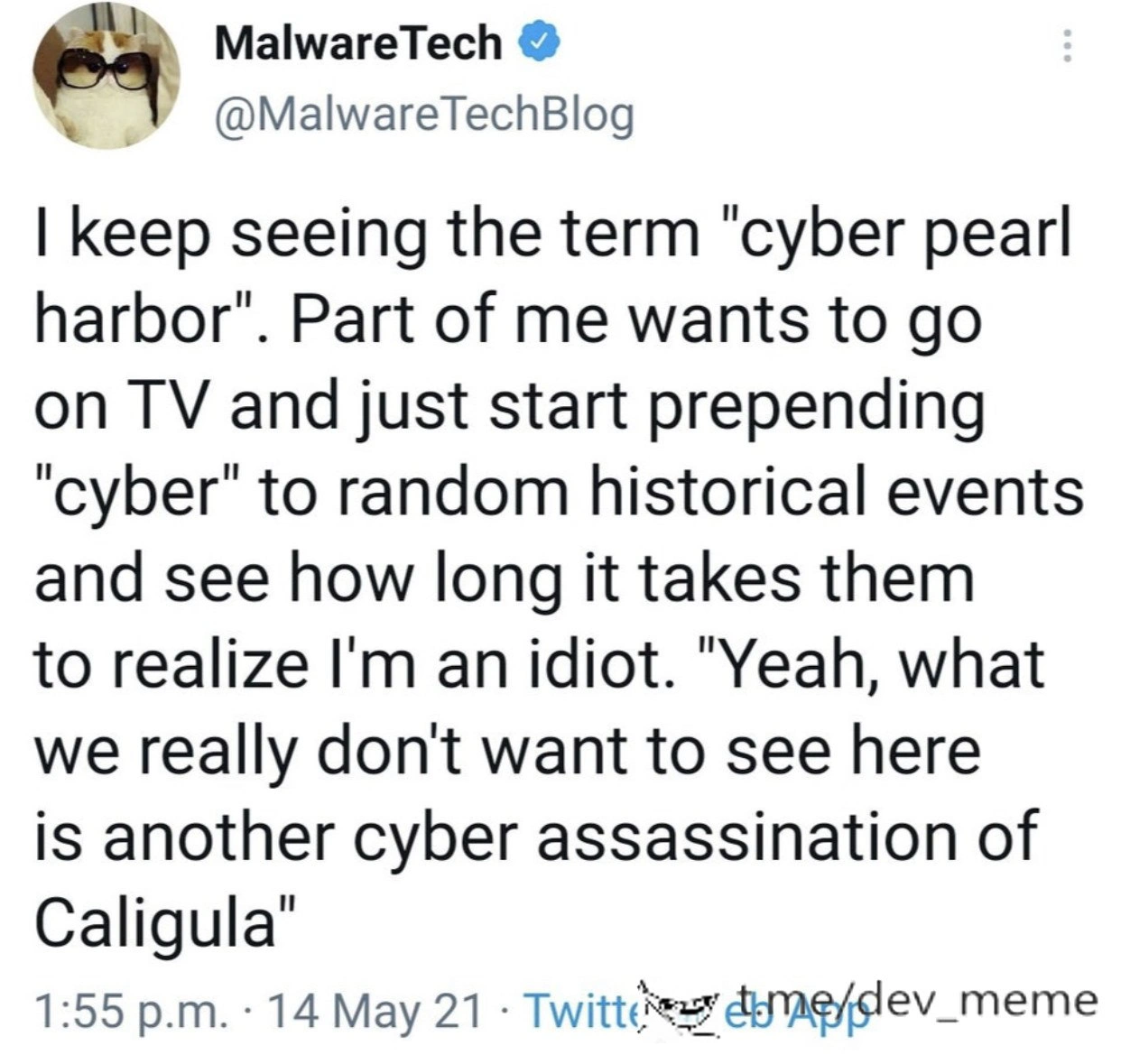
The tweet in this meme comes from MalwareTech (security researcher Marcus Hutchins, known for halting the WannaCry malware). With tongue-in-cheek humor, he muses about going on live TV and randomly prefixing “cyber” to historical disasters: “Yeah, what we really don't want to see here is another cyber assassination of Caligula.” 🤨 The absurdity is immediate – Caligula was a Roman emperor assassinated in 41 A.D., roughly 2,000 years before computers or “cyberspace” existed. By suggesting a cyber version of an ancient assassination, the tweet highlights how ridiculous it sounds when commentators slap high-tech jargon onto events just to amp up fear. The humor here comes from contrast: mixing the ultra-modern term cyber with something completely anachronistic and unrelated. It’s a form of satire that security professionals love, because it mocks the way non-technical media sometimes talk about threats. If someone seriously talked about a “cyber assassination of Caligula,” any knowledgeable listener would instantly know they’re spouting nonsense – and that’s exactly the point MalwareTech is making about certain so-called experts on TV.
This resonates with developers and InfoSec veterans because we’ve all witnessed the buzzword inflation phenomenon. It’s like a linguistic arms race – to sound more urgent and important, people keep escalating their language. A run-of-the-mill data breach might get dubbed “cybergeddon” or an ordinary phishing scam becomes a “digital apocalypse”. 🙄 By prefixing everything with cyber-, commentators hope to tap into the mystique of hackers in hoodies and Matrix-style cyber warfare. The result? Tech jargon that borders on self-parody. In internal chats, engineers joke that adding more buzzwords doesn’t fix anything – it just makes the uninformed audience panic. It’s industry satire at its finest: we’re essentially poking fun at how IndustryTrends and media hype cycles churn out scary-sounding phrases to grab attention. Remember when every product suddenly had “AI” or “Blockchain” in its pitch whether it needed it or not? The same thing happens in security with cyber-everything. It’s a running joke that if you’re not getting enough traction, just sprinkle “cyber” liberally and watch the funding or clicks roll in.
This tweet specifically calls out the buzzword bingo that many techies play mentally during security conferences or TV interviews. Buzzword Bingo is the game where you secretly keep a bingo card of trendy terms and check them off as an executive or pundit inevitably uses each one. Terms like “zero-day,” “next-gen firewall,” “state-sponsored actor,” and of course “cyber Pearl Harbor” are the free squares in this game. By now, “cyber Pearl Harbor” has become such a trope that it’s practically a meme on its own. It’s the “it’s always DNS” of the security news world – an overused explanation that draws groans. When a developer sees yet another headline warning of a “cyber Pearl Harbor,” they know it’s likely an exaggerated scare story rather than a nuanced analysis of security risks.
Why does this keep happening? Part of it is genuine concern – large-scale cyber-attacks are a real threat. But there’s also an incentive to amplify fear. Sensational metaphors like “Digital 9/11” or “cyber Pearl Harbor” make abstract tech dangers concrete and visceral for the general public. They grab eyeballs, justify budgets, and sell products. If you’re a cybersecurity vendor or a government security agency, warning about a hypothetical Cyber Doomsday can help unlock funding or attention. It’s much less sexy to say, “We need to patch old servers and enforce good password policies” – even though that’s usually what prevents breaches. Instead, calling it “preventing the next cyber Pearl Harbor” sounds way more urgent. 😅 This is why a cynical veteran in IT might chuckle at the meme: it’s funny because it’s true. We’ve sat through executive briefings where every minor incident is hyped as if the sky is falling. The meme exaggerates to make a point: if you can get away with “cyber Pearl Harbor,” why not push it to “cyber assassination of Caligula” and see if anyone even blinks?
In essence, this meme is industry irony aimed at the hype machine. It underscores a shared fatigue in the tech community with alarmist TechHypeCycle language. Just as developers groan at marketing fluff like “enterprise-grade synergistic cloud solution,” security folks cringe at overwrought predictions of digital armageddon. By adding an obviously ridiculous example, MalwareTech highlights how out-of-touch these buzzword-laden warnings can be. It’s a clever way to encourage both experts and the audience to think critically: Are we using meaningful language, or just scary buzzwords? The funniest part is, if someone did go on TV and drop “cyber assassination of Caligula” with a straight face, there’s a non-zero chance a few commentators would solemnly nod along. This meme invites us to laugh at that possibility – and maybe, to be a bit more skeptical the next time we hear “cyber [Insert Disaster]” on the news.
Description
Screenshot of a tweet by MalwareTech (@MalwareTechBlog) with a small cat-wearing-sunglasses avatar and a blue verification badge. Tweet text: “I keep seeing the term 'cyber pearl harbor'. Part of me wants to go on TV and just start prepending 'cyber' to random historical events and see how long it takes them to realize I'm an idiot. 'Yeah, what we really don't want to see here is another cyber assassination of Caligula'”. Timestamp reads “1:55 p.m. · 14 May 21 · Twitter Web App”. A small “t.me/dev_meme” watermark sits in the lower-right corner. The humor targets security pundits and media who inflate threats by affixing the word “cyber” to everything, highlighting buzzword fatigue familiar to developers and security professionals
Comments
37Comment deleted
Calling last night’s fat-fingered kubectl apply a “cyber Chernobyl” got us the monitoring budget in 30 seconds - turns out apocalyptic FUD scales better than our cluster
The same executives who warn about "cyber Pearl Harbor" are the ones who approved storing passwords in plaintext because "we've never been cyber-assassinated like Caligula before, so why spend the budget?"
The cybersecurity industry's obsession with dramatic historical analogies has reached peak absurdity - we've gone from 'cyber Pearl Harbor' to the point where seasoned security researchers fantasize about trolling cable news with 'cyber assassination of Caligula.' It's the perfect encapsulation of how threat intelligence briefings to non-technical stakeholders have devolved into a game of Mad Libs where every incident becomes 'the [historical disaster] of cyberspace,' while actual practitioners are left wondering if anyone noticed we're still struggling with SQL injection in 2024
‘Cyber Pearl Harbor’ is the Decorator pattern applied to fear - adds no new behavior, just inflates budgets; maybe patch the VPN and segment the network before booking the TV spot
Cyber Pearl Harbor? It's infosec's 'microservices for monoliths' - hype that justifies every RFP line item eternally
If the board needs a 'cyber Pearl Harbor' metaphor to fund MFA, your risk register has a taxonomy bug - not a budget problem
Cyber Tiananmen square Comment deleted
Cyber 9/11 Comment deleted
r/cursedcomments Comment deleted
Funny Comment deleted
Cyber holocaust Comment deleted
localhost 6 million packets lost! Comment deleted
🤣🤣🤣🤣🤣 Comment deleted
lmao Comment deleted
how could they lost 6 million packets with such few sockets. even if they were working 24/7, they wouldn't send that many packages Comment deleted
Cyber War of 1812 Comment deleted
🤣🤣🤣🤣🤣 Comment deleted
We used marble calculators. And the US sabotaged the European calculators by putting 11 marbles in it instead of 10 Comment deleted
Give me perevod, pohzaluista) Comment deleted
translation of the post in russian я часто вижу термин "кибер перл харбор". часть меня хочет пойти на ТВ и начать добавлять слово "кибер" к началу случайных исторических событий и узнать, когда же всё-таки люди поймут, что я идиот. "Да, мы точно не хотим, чтобы случилось ещё одно кибер убийство Калужди" Comment deleted
Thank's, prosto ya yazik norm znayu, no tur chto-to ne poluchilos' perevesti( Comment deleted
обращайся) feel free to ask anything) Comment deleted
Я вообще боялся, что токсики набегут, типо ты что язык не знаешь.... но я забыл, что я не в совсем русскоязычном канале) Comment deleted
Может все таки убийство Калигулы? Comment deleted
Я тоже об этом подумал. Яндекс переводчик мне показал Калуджи, я подумал хрен с ним Comment deleted
Вот такой классный у Яндекса переводчик Comment deleted
Не, с ним всё нормально. Я написал Calugia, а не Caligula xd Comment deleted
Please, refrain from the usage of Russian. Only English is ok in this channel discussion/comments Here always was and will be only content in international format Comment deleted
Why only english? Are you raсist?😂 Comment deleted
no, we are trying to make this chat understandable for everyone. Comment deleted
I was kidding) Comment deleted
good Comment deleted
Please, refrain from the usage of Russian. Only English is ok in this channel discussion/comments Here always was and will be only content in international format Comment deleted
Cyber civil war Comment deleted
ping me next time you see something like this please Comment deleted
Cyber judgement day Comment deleted