Google thinks Chromium forks are non-Chromium - browser monoculture irony
Why is this WebDev meme funny?
Level 1: Same Engine, Different Paint
Imagine you asked for a list of different cars that don’t use Ford engines, but the list you got included a couple of cars that actually have Ford engines inside, just with different car brands. That’s what happened here. Google was asked for web browsers that aren’t based on Chrome’s engine (Chrome is like the “engine maker”), and it gave a list. But oops – some of those browsers, like Opera and Edge, are basically using the same engine as Chrome under the hood. It’s like putting the same motor in different car bodies and calling them totally different cars. For a regular person, it’s a funny mistake: Google’s answer is listing things as “different” even though inside they’re pretty much the same thing. Essentially, the joke is that you thought you were getting variety, but you’re actually seeing the same stuff in a different wrapper. It’s a bit like asking for candy with no chocolate, and the list includes candy bars that are filled with chocolate just wrapped in a different label. No matter how fancy the wrapper, the inside is what counts, and in this case the inside is all Chrome. That’s why developers find it ironic and laugh – even a smart system like Google can get confused by names and forget to check what’s inside the box.
Level 2: Engines Under the Hood
Let’s break down what’s going on in simpler terms. A web browser (like Chrome, Firefox, Opera, Edge, etc.) is the application you use to surf the web. Inside each browser is a browser engine – that’s the core technology that actually displays websites (handles the HTML, CSS, and JavaScript). Think of the browser engine as the “brain” or rendering machine under the hood. Different browsers can share the same engine, even if they have different names or looks on the outside.
Now, Chromium is an open-source project started by Google. It’s basically the base for the Chrome browser. One major part of Chromium is its engine called Blink (which draws and lays out web pages) along with Google’s fast JavaScript engine V8. When we say a browser is “Chromium-based,” we mean it uses this open-source Chromium code (including Blink). Google Chrome itself is built on Chromium, but so are other browsers. Companies can take Chromium, add their own UI, features, or branding, and ship it as a separate browser. That’s what happened with Opera, Microsoft Edge, Vivaldi, Brave, and others – they are all built on the Chromium engine Blink. They might have different icons, features or privacy settings, but when it comes to displaying web pages, they’re using the same engine as Chrome.
On the other hand, Firefox is not based on Chromium. It uses Mozilla’s own engine called Gecko. Firefox’s developers maintain Gecko separately, which means Firefox might behave slightly differently on some web features than Chrome does. Another example is Apple’s Safari browser, which uses an engine called WebKit (Blink was originally a branch of WebKit years ago, but they’re separate now). So Safari isn’t using Chromium either. These are what we truly mean by “non-Chromium browsers” – browsers that do not use the Chromium/Blink engine at all. They have their own independent engines (like Gecko or WebKit).
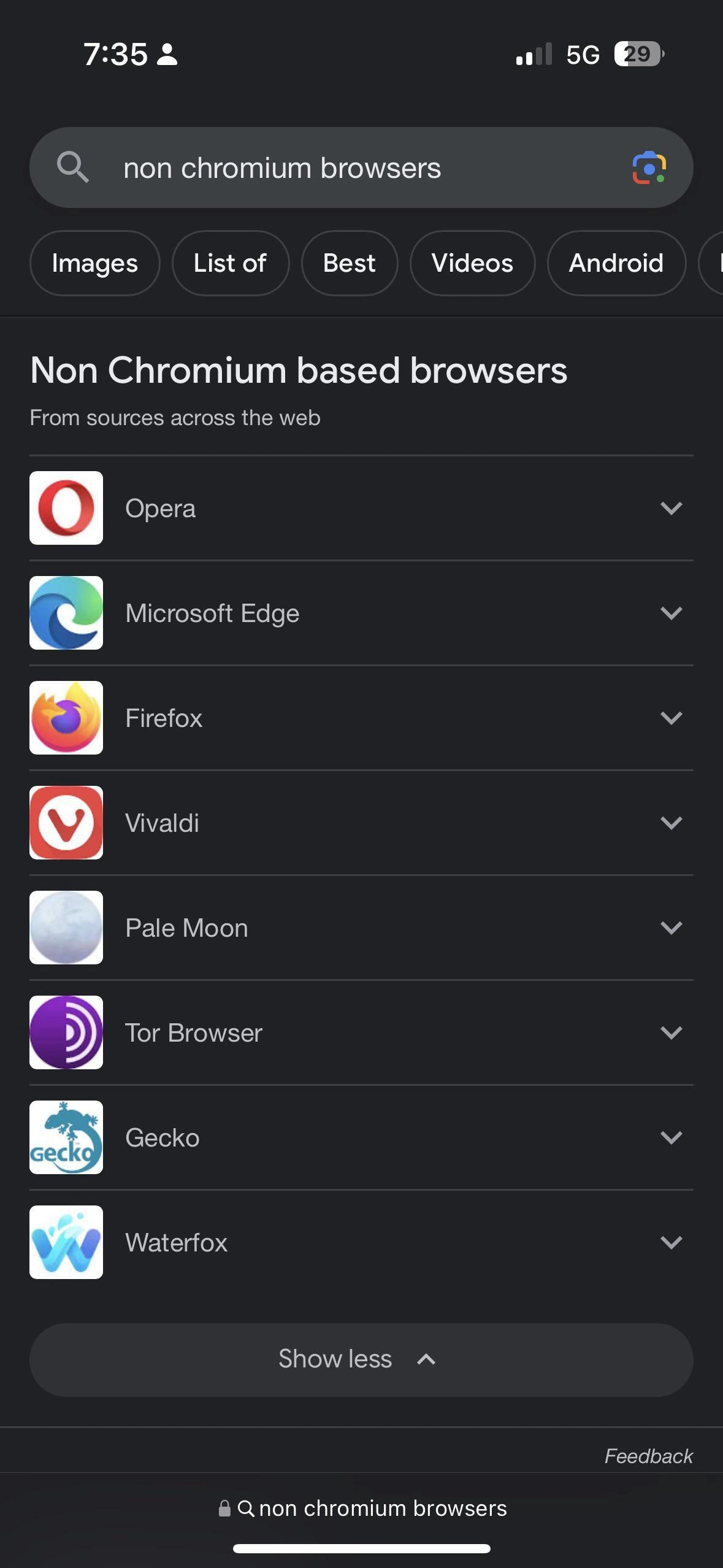
The meme screenshot shows Google’s search result for “non chromium browsers”, and it lists eight items. The funny/ironic part is that the list includes some browsers that do use Chromium. Let’s clarify each item from that list:
| Listed Item | Engine Under the Hood |
|---|---|
| Opera | Blink (Chromium-based engine from Google) |
| Microsoft Edge | Blink (Chromium-based since 2019) |
| Firefox | Gecko (Mozilla’s own engine) |
| Vivaldi | Blink (Chromium-based engine) |
| Pale Moon | Goanna (a fork of Mozilla’s Gecko engine) |
| Tor Browser | Gecko (uses Firefox under the hood) |
| Gecko | Not a browser – it’s the Firefox engine itself |
| Waterfox | Gecko (Firefox-derived browser) |
From this you can see: Opera, Edge, and Vivaldi all use Blink, the same engine as Chromium/Chrome – so they are actually Chromium-based browsers. Listing them as “non-Chromium” is incorrect. Firefox, Pale Moon, Tor Browser, Waterfox are indeed non-Chromium (they use Gecko or a variant of it). “Gecko” appearing in the list is a bit odd because Gecko isn’t a standalone browser, it’s just the engine inside Firefox and some others. That probably got pulled in by mistake.
So why does this matter? Well, web developers often talk about browser compatibility. Websites can behave differently depending on which engine is showing them. For example, Chrome’s Blink engine and Firefox’s Gecko engine might handle a new CSS feature a little differently, or one might have a bug the other doesn’t. Developers usually test their sites on multiple browsers to make sure everything looks right everywhere. If someone says “test on a non-Chromium browser,” they typically mean “test on something not using Chrome’s engine (like Firefox or Safari) to catch differences.” If you only test on Chrome and, say, Opera, you might think you tested two browsers – but since both use Blink, you actually only tested one engine. It’d be like testing your app on what you think are two independent systems, but both are essentially the same under the hood. That’s why it’s a bit of a trap for developers who are trying to be thorough.
Now, how did Google end up showing a mixed-up list? Google search often shows a special featured snippet (like a highlight box) if it thinks it can answer your question directly. It automatically pulls info from websites. In this case, the snippet title “Non Chromium based browsers – From sources across the web” suggests it aggregated info from various pages. Possibly one page listed major “Chrome alternatives” (not distinguishing engine), and others listed actual engine-different browsers, and the algorithm merged them. It likely didn’t understand that Opera and Edge shouldn’t count as “non-Chromium” in terms of engine. This is the irony the meme points out: even Google’s algorithm got tripped up by the difference between a browser’s name and its underlying technology. It’s a small example of misinformation (though probably unintentional) in search results. For a web developer or a tech-savvy person, it’s obvious that Opera and Edge being on that list is wrong — hence the laughter. Google, the very company behind Chromium, is suggesting that its own Chromium-based offspring are independent alternatives. FrontEndHumor often highlights these kinds of slip-ups.
In summary, the meme is poking fun at the browser monoculture we have today. “Monoculture” in tech means one system dominates. Here, Chrome’s engine is everywhere, to the point that even when you ask for “not Chrome” you still get Chrome-based answers! Developers worry about this because if one engine (Blink) controls most of the web, we lose the healthy competition and diversity that usually drive web standards forward. But Google’s search didn’t catch the nuance, and delivered a funny, if flawed, list. It’s both amusing and a little concerning, especially for those in WebDevelopment who remember why having multiple, truly different browsers is a good thing.
Level 3: The Monoculture Mirage
In this meme, Google’s own search results unwittingly highlight a browser engine monoculture problem. The search query is “non chromium browsers”, but the featured answer ironically lists Opera, Microsoft Edge, and Vivaldi – browsers that are actually built on Chromium (Google’s open-source browser project). In other words, Google is presenting Chromium forks as if they were independent “non-Chromium” alternatives. Seasoned web developers see this and smirk: the very Blink engine (Chromium’s rendering core) is hiding inside those browsers, yet Google’s snippet treats them as distinct. It’s a delicious bit of irony and TechHumor. The industry has long lamented a chromium_monoculture where one engine dominates. Now Google’s own ML-driven snippet has conflated “browser” with “browser engine,” basically reinforcing the monoculture while trying to do the opposite. Talk about browser wars déjà vu.
This highlights a deeper BrowserWars saga and an IndustryTrends concern. A decade ago, we had more diversity under the hood: Firefox’s Gecko, Internet Explorer’s Trident, Opera’s Presto, Safari’s WebKit, etc. There was true competition in how browsers rendered the web. But over time, Chromium’s engine (Blink, with Google’s hefty engineering behind it) steamrolled ahead. Opera ditched its own Presto engine in 2013 to adopt Blink. Edge (after struggling with its EdgeHTML engine) gave up in 2019 and switched to Blink as well. Vivaldi launched already using Blink, since it’s effectively a custom UI on top of Chromium. All these browsers look different and add unique features or UIs, but under the hood they speak Chrome’s language. This has led to a blink_engine near-monopoly. The only big holdouts are Firefox, which uses Mozilla’s Gecko engine, and Apple’s Safari, which uses WebKit (a cousin of Blink). So when a Google snippet lists Opera and Edge as “non-Chromium based,” any senior dev will roll their eyes. It’s as if the algorithm itself fell for the non_chromium_myth that a different brand means a different core. Browser diversity at the engine level is much lower than it appears by logos alone.
The humor really lands because this snippet is a textbook search_result_fail. Google’s rich answer is presumably compiled “from sources across the web” without understanding the nuance. Maybe some SEO-chasing article listed “browsers other than Chrome” and included Opera and Edge (since they’re alternatives to the Chrome browser, if not the engine). Google’s ML saw multiple sources listing those names under “non-Chromium” and just aggregated them. The result: an authoritative-looking list that’s misleading to anyone actually seeking engine diversity. It’s a subtle form of google_snippet_misinformation. Essentially, Google is unintentionally promoting the chromium_monoculture it helped create, by suggesting there are more independent options than there really are. The featured list even bizarrely includes Gecko by name – which isn’t a browser at all, but Firefox’s engine – as if it were its own product. That’s a dead giveaway that the algorithm scraped data without context, mixing up a browser engine with browsers. It’s a facepalm moment for any web engineer: the data pipeline doesn’t grasp that browser ≠ engine, so it serves up a nonsensical line like “Gecko” alongside actual browser names.
For veteran web developers, this irony cuts deep. We remember the BrowserCompatibility nightmares of the past – writing CSS hacks for IE6, or testing WebDevelopment layouts on five different engines to make sure a page behaved. In theory, a single dominant engine (Blink) makes a dev’s life easier (the “works in Chrome, likely works everywhere” hope). But in practice, engine monoculture brings its own FrontendPainPoints. It can breed complacency and WebStandards deviations. If every browser is just Chromium in disguise, a glitch or non-standard behavior in Blink can quietly become the de-facto standard. Fewer independent engines mean fewer checks and balances on web standards compliance. That’s why Mozilla’s crew and many Web standards folks worry about Blink’s dominance – with only Gecko_engine and WebKit left as alternatives, we desperately want them to survive to keep the web healthy. As the meme caption says, “It’s a trap!” – the trap being that developers think they have choice, but end up in the same Chrome boat anyways.
"It's a trap!"
– Every web dev realizing Opera and Edge are just Chrome under a different logo
The shared exasperation is palpable. This meme packs all that context into a single screenshot: Google inadvertently showcasing that our “diverse” browser ecosystem is an illusion. It’s the BrowserEngine equivalent of a monoculture irony – a Monoculture Mirage. Front-end developers who keep an eye on WebDevelopmentTrends find it both funny and frustrating. Funny, because even Google’s mighty algorithms botched this tech detail in a public way. Frustrating, because it underscores how widespread the misunderstanding is — even an automated system backed by Google’s knowledge graph doesn’t get the difference between an HTML rendering engine and a browser’s brand name. In short, the meme hits on a truth in a humorous way: on the modern web, you can pick any browser you like, as long as it’s Blink. 😉
Description
Mobile screenshot of a dark-mode Google search at 7:35 a.m.; the query in the omnibox reads “non chromium browsers.” Search pills like “Images,” “List of,” “Best,” and “Videos” sit below the bar. The top featured list card, titled “Non Chromium based browsers - From sources across the web,” enumerates eight rows, each with an icon, name and dropdown arrow: 1) Opera, 2) Microsoft Edge, 3) Firefox, 4) Vivaldi, 5) Pale Moon, 6) Tor Browser, 7) Gecko, 8) Waterfox. A “Show less” button ends the card, with a locked address bar repeating the search at the bottom. The technical gag is that Opera, Edge and Vivaldi are all Blink/Chromium under the hood, so Google’s own rich snippet ironically perpetuates the very engine monoculture senior web engineers complain about, highlighting how even search ML pipelines conflate ‘browser’ with ‘browser engine’ and why true diversity (Gecko, Servo, WebKit) keeps fallback CSS rules and spec compliance testers employed

Comments
22Comment deleted
When even Google’s knowledge graph can’t tell Blink apart from Gecko, you realise the real single-point-of-failure isn’t the browser engine - it’s the search engine driving your PM’s ‘just support Chrome’ requirement doc
This is what happens when your search algorithm is so deeply integrated with Chrome that it literally can't comprehend a world where browsers aren't just Chromium in different outfits - it's like asking a fish to recommend non-water environments and getting 'swimming pool, ocean, and bathtub.'
Searching for non-Chromium browsers in 2024 is like asking for restaurants that don't serve Coca-Cola products - technically they exist, but you're really just choosing between Firefox, Firefox-with-extra-steps, and that one place that still runs on Gecko because they refuse to let go of XUL extensions from 2008. The real irony? You're using Google to escape Google's browser engine dominance, which is like asking the Death Star for directions to the Rebel base
Apparently “non‑Chromium” now means “Chromium with a different favicon” - which explains why our cross‑browser QA plan is three logos and one engine
Nothing says browser diversity like a “non‑Chromium” list containing Edge, Opera, Vivaldi - and, sure, Gecko; a textbook knowledge graph with no foreign keys
Searching for non-Blink browsers on Blink-powered Chrome: Top results remind you diversity was so 2013
gpt moment Comment deleted
Majority in the top five is Chromium based, well done ... 🤔 Comment deleted
Firefox? Comment deleted
Pale Moon and Firefox are not Chromium-based. But they're only 2 out of the top 5. Comment deleted
everybody: spring the trap! Comment deleted
gecko isn't even a browser Comment deleted
amogus Comment deleted
no matter how Microsoft treats Chrome, Google still tolerates them. Wait, hold on... Comment deleted
💀💀💀😂 Comment deleted
TOR Browser is based on Firefox isn't it? Comment deleted
Yes Comment deleted
That’s the reason why this screenshot is funny 😄 Comment deleted
when google wants to conceal chromium footprint Comment deleted
Akshually 🤓 The list makes sense if you go before 2016 lol Edge and Opera weren't chromium based (using EdgeHTML and Presto engines accordingly) Comment deleted
Vivaldi and opera also chrome based though Comment deleted
That’s an entire point There’s more chromium based browser Comment deleted