Skip to content
DevMeme
5001 of 7435
Unity's Per-Install Runtime Fees: The Spreadsheet Every Indie Dev Now Dreads
GameDev Post #5469, on Sep 17, 2023 in TG

Unity's Per-Install Runtime Fees: The Spreadsheet Every Indie Dev Now Dreads

Why is this GameDev meme funny?

Level 1: Surprise Bill at the Lemonade Stand

Imagine you’re running a little lemonade stand. You got a free lemonade mix and a stand from a friendly company to help you start out. They told you, “Go ahead, it’s free to use! If you start doing really well – say, making over $200 in a year – you might need to buy our deluxe kit, but nothing to worry about for now.” So you happily make lemonade and give it out.

Suddenly, one day the company announces a new rule: if you serve more than 200 cups of lemonade, you now have to pay them 25 cents for every extra cup you give out beyond that! At first you think, “This must be a joke, right?” But they’re serious. Let’s say you already handed out 200 cups in total over time. On cup number 201 (and 202, 203, and so on), each one will cost you a quarter that goes to the mix company. It doesn’t matter if those cups of lemonade were free or if you only charged a dime – you still owe 25 cents per cup to the company just for using their lemonade mix.

How would you feel? Probably shocked and a bit betrayed. You might do some quick math: if you plan to give out 1,000 more cups, that’s 800 cups over the limit × $0.25 = $200 you’d have to pay them. What if a famous YouTuber happens to mention your lemonade and tomorrow 1,000 people show up wanting a free cup? You’d owe $200 in fees overnight! That’s scary – you’d actually be afraid of becoming too popular.

You might even start keeping a spreadsheet (a big table of numbers) to track how many cups you’ve given out and how much money you’d owe. Instead of just focusing on making great lemonade, you’re now worried about charts, thresholds, and fees. Maybe you consider switching to a different lemonade mix from another company, or making your own from scratch (even though that’s a lot of work), just so you don’t have this unpredictable bill hanging over your head.

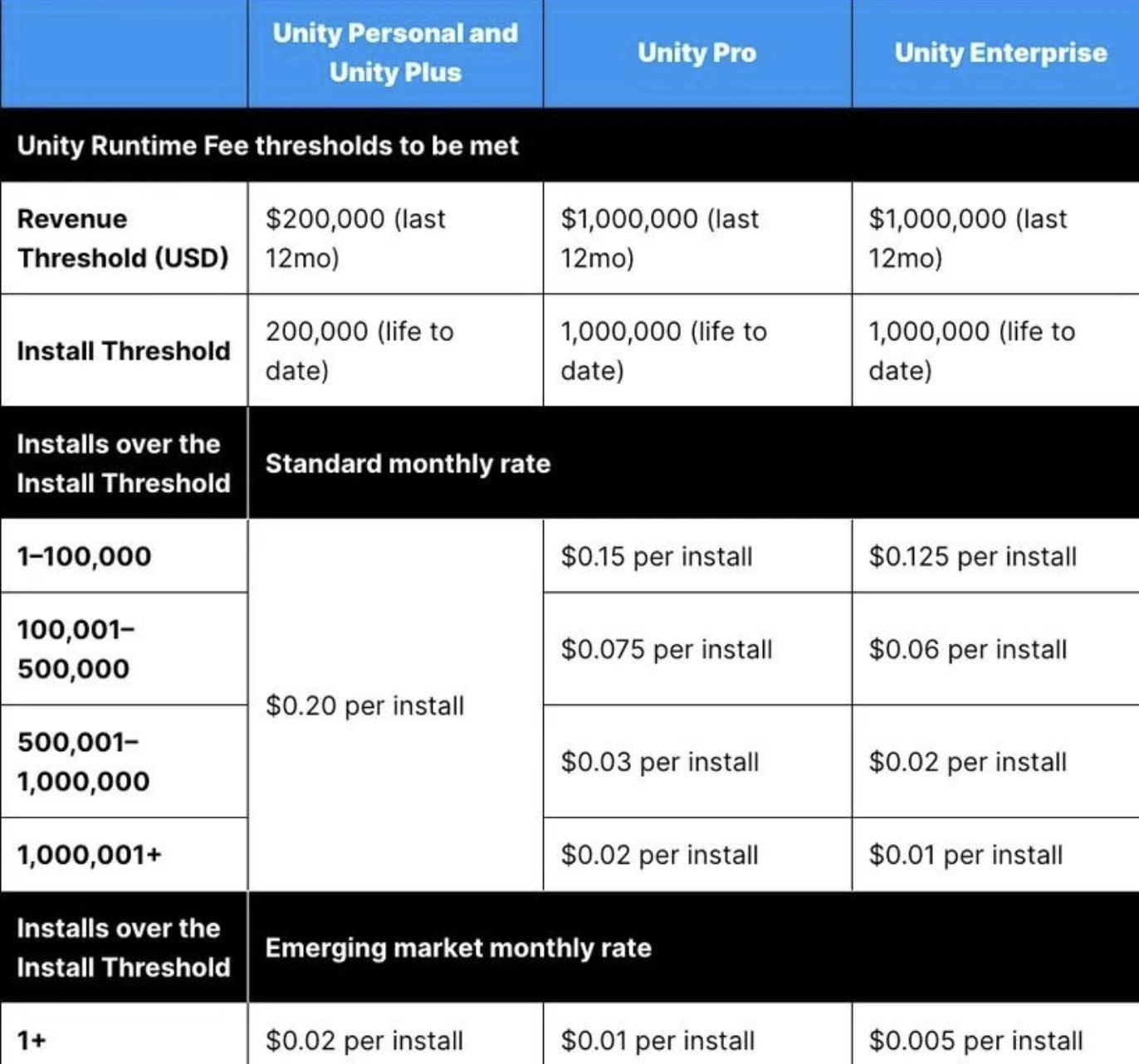
This lemonade story is exactly what happened with Unity and game developers. Unity was like the company giving out the “free mix” (the free game engine for devs to make games). If a game got really successful, Unity’s new rule says the developer has to start paying per game install (just like per cup of lemonade). Developers felt stunned and upset, just like our lemonade seller. The meme shows the complicated fee table (kind of like the company’s chart of how much to pay after so many cups) and jokes that every indie developer is dreading it.

In simple terms, the meme is funny because it’s a big surprise bill in a place no one expected. It's as if success came with a hidden price tag. Just like a kid would be confused and angry if their free lemonade deal suddenly wanted quarters for each cup, game devs were caught off guard that their “free” engine could start charging them for every copy of their game. The emotions are easy to understand: confusion (“Where did this come from?!”), worry (“Can I afford this?”), and a bit of dark humor (“Of course this would happen right when things were going well…”). It highlights how something that should be good news — lots of people wanting your game or lemonade — turned into a potential problem because of an unexpected new rule. That twist is the heart of why this meme strikes a chord, even for those who don’t know Unity: nobody likes a sneaky fee that makes good news feel like bad news.

Level 2: The Cost of Unity

For those newer to game development or not following the drama, let's break down what’s happening in simpler terms. Unity is a very popular software platform used to create games – a game engine. It provides tools so you don’t have to reinvent the wheel for things like graphics rendering, physics, audio, etc. Many indie (independent) developers and small studios choose Unity because it’s been affordable and user-friendly. Historically, Unity had a free tier (Unity Personal) for small projects, and paid tiers (Unity Plus, Unity Pro, Unity Enterprise) for professionals or larger companies which added extra features and support. Usually, the deal was: if your game made over a certain amount of money (like $100k), you were expected to upgrade to a paid plan, but Unity didn’t take a cut of your sales or charge per player. That was pretty straightforward.

Now Unity dropped a bombshell: a new pricing policy that charges a “Unity Runtime Fee” for each install of a game once that game becomes successful beyond certain thresholds. Think of an “install” as each time a person puts your game on their device (their PC, phone, console, etc.). So if 1 person installs the game on 2 devices, that could count as 2 installs. Unity said, starting in 2024, if your game made more than a certain amount of money AND has been installed a lot, they will bill you for every additional install. The thresholds differ by plan:

  • Unity Personal/Plus (the lower tiers): If your game made more than $200,000 in the last 12 months and has more than 200,000 installs total (ever), you cross the line. Beyond that, you’d pay $0.20 per install for the first chunk of installs (up to 100k installs), with the price per install decreasing for larger totals (as the table in the meme shows). There’s also a special lower rate for installs in “emerging markets” (regions Unity considers lower-income markets) – e.g. $0.02 per install for those areas, presumably because developers earn less per user there.

  • Unity Pro/Enterprise (higher, paid tiers): These have higher starting thresholds (game needs to earn > $1,000,000 and > 1,000,000 installs before fees apply) and slightly cheaper install fees (starting around $0.15 or $0.125 per install, dropping as low as $0.01 for very high install counts). Essentially, if you’re already paying for Pro or Enterprise licenses, Unity gives you a bit of a discount on the runtime fees, and assumes you’re a bigger fish who can pay more upfront anyway.

This was a huge change from before. Imagine you’re a new game developer using Unity Personal (the free version). You might have been dreaming, “If my game does well, I might earn money from sales or ads, and maybe I’ll buy Unity Pro or pay a small royalty.” Instead, Unity is saying, “If you do well and lots of people install your game, we’ll charge you for each install on top of everything else.”

Why does that matter? Well, a lot of indie games are low-price or even free to download (Free-to-Play). They might earn money through other means like in-game purchases or advertisements. With a per-install fee, even a free download that doesn’t directly make money could cost the developer. For example, suppose you have a free game that makes about $0.10 per player through ads. If Unity wants $0.20 per install, you actually lose $0.10 each time someone new gets the game! That’s not sustainable – you’d go broke if your game got popular, which is completely upside-down.

No wonder developers are upset: it feels like being punished for success. Normally, success (lots of players) is a great thing. But here, success could mean a big bill from Unity. The meme jokes about a spreadsheet that indie devs dread because now they literally have to calculate and budget for “How many installs can we afford?” It used to be “Yay, 1 million players!” and now it’s “Uh-oh, 1 million players = potentially $200k in fees to Unity.” Developers are furiously opening Excel to model different scenarios: “If we get X installs and make $Y per player, are we okay? What if a popular streamer gives us a shout-out and we suddenly get 50k installs in one day – how much will Unity charge us?” This is totally new territory for game makers, who are more used to worrying about game bugs, not surprise costs.

Let’s clarify some terms that are thrown around in this meme and context:

  • Revenue Threshold: This is the amount of money your game needs to have made (in the last 12 months) before Unity starts paying attention for fees. For Unity Personal, that’s $200,000. So if you made less than that in the past year, you’re safe from fees, even if you had a bunch of installs. It’s meant to not hurt truly small hobby projects or very early-stage indies. For Pro/Enterprise users, the threshold is higher ($1,000,000 in a year), since those users are usually bigger companies anyway.

  • Install Threshold: This is the total number of times the game has been installed (ever, since its release). For Personal/Plus, it’s 200,000 installs; for Pro/Enterprise, it’s 1,000,000 installs. Only after you cross that line (and the revenue threshold simultaneously) do fees begin.

  • Per Install Fee: Once thresholds are passed, this is how much money you pay Unity for each new install of your game. It’s tiered, meaning the first block of installs are charged at one rate, and if you have more beyond that, the extra ones are a bit cheaper per unit. Look at the meme’s table: for Unity Personal, 1–100k installs beyond the threshold are $0.20 each, then the next 400k installs (100,001 up to 500k) drop to $0.15 each (actually that part of the image is a bit hard to parse in text, but the idea is a volume discount – albeit still a net increase in total cost). The more installs, the lower the fee per install, down to 2 cents at over a million extra installs. Unity Pro and Enterprise have their own tiers, slightly cheaper per install at each step. And there’s a separate row for “Emerging market rate” which is a flat low fee (2 cents, 1 cent, or 0.5 cents depending on plan) if the installs come from certain countries – an acknowledgement that $0.20 is a lot in some regions where games also typically earn less money per user.

  • Retroactive: This word came up because Unity initially said these changes apply even to games already on the market (not just new releases). That means if you made a game two years ago with Unity and it’s still getting lots of new installs (maybe you had a recent spike of interest), suddenly those could count toward the threshold and incur fees after Jan 1, 2024. Usually, when we talk about software licenses, retroactive changes are a big no-no ethically – developers plan their businesses around the rules that existed when they shipped the game. Changing the deal after the fact feels like moving the goalposts. That’s why there was such an outcry; it broke a sort of unwritten contract between Unity and its users. (Amid backlash, Unity later tweaked the policy, like saying the fee would only apply to new installs after Jan 1, 2024, not counting previous ones, but a lot of trust was already lost.)

  • Vendor Lock-In: This is a general tech term for when you rely so heavily on a particular company’s product that it’s really hard to switch away. Unity engine lock-in means your game’s code, assets, and pipeline are all built for Unity. If Unity does something you don’t like (such as introducing a new fee), you can’t easily pack up and move to another engine – at least not without massive effort. Think of it like building your house on rented land; if the landlord raises the rent, moving the house is possible but extremely costly! Indie devs with games far in development or already shipped on Unity felt stuck: they either swallow the new costs or undertake the herculean task of rewriting their game in another engine.

  • Engine Migration / Unreal / Godot: These are mentioned because they’re the escape hatches devs are considering. Unreal Engine is another very popular game engine (behind games like Fortnite, and many AAA titles). Its business model is you pay nothing upfront; if your game makes over $1 million, you then owe Epic Games (Unreal’s creator) 5% of your revenue beyond that. So if you earned $2 million, you pay 5% of $1M (which is $50k). Many developers find that acceptable because it scales with success and, importantly, if nobody buys your game, you owe nothing. With Unity’s install fee, you could theoretically owe money even if you didn’t make money (in some extreme cases). Godot Engine is an open-source engine that’s completely free; it’s getting attention because it has no fees at all – the trade-off is that it’s a bit less proven for big 3D projects compared to Unity or Unreal. When the Unity news hit, there was a spike in downloads and interest in Godot as indie devs started thinking, “maybe it’s safer in the long run to use a community-driven engine so I’m not at the mercy of a single company’s decisions.”

Now, the meme itself is essentially showing the Unity fee table (the dreaded spreadsheet) in visual form. It’s highlighting how complicated and business-like this all is. It’s the kind of chart you’d expect when you sign up for a cell phone plan or a cloud computing service (with various tiers and prices), not something a game creator expected to deal with from their engine provider. The humor (tinged with frustration) comes from the absurdity that indie game developers, who just want to make fun games, are now forced to worry about and discuss things like “install thresholds” and “monthly install rate fees” and “customer acquisition costs” as if they suddenly became actuaries or CFOs.

Imagine you’re a junior developer who got into game dev because you love games. You’re excitedly working on your first indie title, maybe dreaming of it becoming the next big hit on Steam or the App Store. Then you see this meme/chart and realize, “If I use Unity and lightning strikes (i.e., the game gets super popular), I might wake up with a huge bill?!” It’s almost comical – like a fairy tale where the hero is told “if you succeed in your quest, you must pay the king a gold coin for every happy villager.” Wait, what? Shouldn’t success be… rewarding, not punishing? That confusion and ironic twist is what gives the meme its punch.

This also touches on corporate culture and industry trends. Unity was one of the more developer-friendly companies (at least in image), and this move aligns them more with the stereotypical profit-driven corporate mindset, which many indie devs find off-putting. It’s part of a broader trend where tools and platforms are trying to find ways to squeeze more revenue (we’ve seen social media apps introducing fees, software moving to subscriptions, etc.). The backlash itself became a big industry event – almost everyone in the game dev scene was talking about it in September 2023. Unity eventually apologized and adjusted some details (after seeing developers rage-cancel subscriptions and publicize engine switches), which shows how powerful the community’s response was.

So, at Level 2, we see that this meme is funny (in a facepalm way) because it turns something as exciting as a game going viral into a scenario of dread due to unexpected costs. It lampoons Unity’s new policy by presenting it as this dry, complex table – something you’d normally never associate with the creativity of game making. It’s basically saying: “Welcome to GameDev in 2023, where you not only have to code and design, but also manage a potential pay-per-install spreadsheet from hell.” And for a junior dev or someone learning about the field, it’s an eye-opener about the kind of business surprises that can lurk beneath the technical fun of making games.

Level 3: Insert Coin to Install

This meme zooms in on Unity’s sudden per-install fee scheme, a move that blind-sided the game development community. The black-and-blue pricing matrix in the image looks eerily like a cloud services tier chart (think AWS billing, but for game installs). For veteran developers, this table triggers flashbacks of late-night vendor nightmares: it's essentially a toll booth slapped onto your game's success.

In Unity’s new plan, once a game crosses certain thresholds (more than $200k revenue in the last 12 months and over 200k installs total for the basic Unity Personal tier), Unity starts charging a fee per install of the game. Yes, you read that right – a literal charge each time a user installs your game, after you've hit the “success” benchmarks. The rates in the meme show a sliding scale: for small indie devs on Personal/Plus, it starts at $0.20 per install for the first 100k installs beyond the threshold, then drops in steps (e.g. $0.20 → $0.10 → $0.02) as the install count climbs into the millions. Unity Pro/Enterprise subscribers (who already pay for Unity) get slightly friendlier rates ($0.15 starting, dropping to $0.01 at high volumes) and higher thresholds (1M installs, $1M revenue) before fees kick in. It's like Unity went “freemium” on the engine itself – free to start, but scaling costs for big hits.

Why is this darkly hilarious (or rather, horrifying) to seasoned devs? Because it upends the usual expectations in game development. Typically, engine licensing costs were predictable – either a fixed seat fee, an upfront license, or a revenue share after a certain point. But charging per install is unprecedented in mainstream game engines, introducing new operational chaos. Now every indie developer’s worst fear isn’t just a game-breaking bug – it’s their game becoming too popular. Imagine celebrating 1,000,000 downloads of your free game, only to realize you owe Unity a fat check that could bankrupt your studio. It's a twisted scenario of "success tax": the more popular you get, the more you pay, even if popularity doesn’t translate to equivalent revenue.

This leads to all kinds of absurd edge cases that grizzled engineers immediately sniffed out:

  • Multiple Installs Madness: What if a single enthusiastic player installs your game on 5 different devices? Under initial rules, that could be 5 charges. If someone uninstalls and reinstalls (maybe to free up phone space temporarily or to troubleshoot), is that another fee? Unity had to scramble to clarify things like “reinstalls won’t count,” but the fact we even have to ask these questions shows how half-baked the plan was. Developers joked (with a touch of panic) about trolls maliciously installing-uninstalling repeatedly to rack up a dev’s bill. It’s a chaotic new metric to worry about: “install attacks.”

  • Free-to-Play Fear: The meme caption says “imagine the faces of F2P game dev companies” – no imagination needed, it was sheer terror. Free-to-play games often rely on a small fraction of players spending money (via in-app purchases) while the vast majority play for free. Now, every free player would cost the developer real money (say 20 cents each) even if that player never watches an ad or buys an item. That flips the economics. Customer Acquisition Cost (CAC) – normally the marketing dollars spent to get a new player – just got a built-in boost from Unity’s fee. If your game makes only $0.10 of ad revenue per player, but Unity wants $0.20 for that install, you’re losing money for each new user. Ouch. Suddenly, devs have to crunch numbers in spreadsheets, estimating lifetime value of players vs. per-install fees like they’re running a telecom company, not a game studio.

  • Retroactive Wrath: Unity didn’t just announce this for new games; they initially applied it retroactively to existing games made with Unity. That was the real sucker punch. Imagine having launched a game years ago under a completely different understanding of costs, and now Unity says come January 1, 2024, surprise – those million installs you accumulated could start generating charges. Seasoned devs likened this to a landlord changing your rent contract after you’ve already moved in and furnished the place. It’s a huge breach of trust in the CorporateCulture of developer relations. Unity was historically popular for being accessible and indie-friendly (their old slogan might as well have been “we got your back, devs!”). This move felt like a betrayal: corporate greed taking precedence over the community. No wonder there was an enormous unity_pricing_backlash online — it’s the textbook way to torch your goodwill.

  • Vendor Lock-In Reality Check: This meme screams VendorLockIn because it highlights the trap of proprietary technology. Many studios chose Unity years ago, investing heavily in that ecosystem (training staff, building tools, writing thousands of lines of Unity-specific code). Switching engines is an architecture rework from hell — akin to changing the foundation of a skyscraper that’s already built. Unity’s sudden fee is the classic gotcha of lock-in. As a senior dev, you always keep in mind: any third-party tool or engine can change terms unexpectedly, so plan exit strategies or at least cushion margins. Now teams are dusting off contingency plans: executives who green-lit Unity are picturing nightmare meetings about engine migration. Indeed, a flurry of studios (from indies to mid-size) started openly exploring ports to Unreal Engine or Godot. I’ve heard colleagues half-joking, half-serious say: “Better to spend months porting than pay Unity forever – at least the pain ends after the port.” Unreal’s model (5% royalty after your first $1M revenue) suddenly looks downright merciful and predictable by comparison, and open-source Godot, which has zero fees, looks like a refuge of sanity (if you can live without some of Unity’s conveniences).

To put in context, here’s how Unity’s new plan stacks up against other game engines’ business models:

Engine / License How It Charges Developers
Unity (old model) Free tier for small devs; paid Pro plans for advanced features; no per-install fees, no revenue share (just upgrade license when revenue > $100k).
Unity (new 2024) Free/Personal until >$200k revenue and >200k installs; then charges ~$0.20 per install (tiered down for higher volumes). Essentially a per-install runtime fee after success.
Unreal Engine Free to develop and publish; after your game earns $1M, pay 5% royalty on additional revenue. No fees per download/install, only on actual revenue.
Godot Engine Completely free and open-source. No fees or royalties at all (funded by donations and grants).
Other engines (etc) Most follow either upfront licenses, subscriptions, or revenue share. Unity’s per-install charge is a unique (and controversial) approach.

Seeing it side by side, Unity’s change is basically demanding a slice per user, not just per sale. It’s like Unity looked at mobile app monetization (where every user might yield a few cents in ad revenue) and said “we’ll take our cut directly, thank you very much.” The reaction from developers has been visceral. Forums, Twitter (X), and Discord communities exploded with DeveloperFrustration and disbelief, spawning countless memes (like this one) and angry open letters. Even Unity’s own employees and some of its legendary founders reportedly disagreed with the move. It’s a fiasco that will be studied in IndustryTrends history as a case of how to alienate your user base overnight.

From a senior engineering perspective, the humor here is tinged with déjà vu and cynicism. We've seen platforms try to squeeze users dry once they're dominant – from databases changing license terms to frameworks introducing paid tiers – and it usually follows the same script. A once beloved tool succumbs to Industry Hype and corporate pressure (perhaps Unity’s investors smelled higher revenue), then implements a policy that sounds reasonable only in boardrooms but is utterly detached from developer reality. The spreadsheet in the meme is a perfect symbol: instead of thinking about game design or code, devs are now forced to act like accountants, forecasting install counts and monetization curves to make sure a “Unity tax” doesn’t kill their company.

It’s darkly funny because it’s true: every indie dev suddenly dreads opening Excel, plugging in install numbers to see if they’d survive a success. It used to be “break out the champagne if our game goes viral”; now it’s “better break out the calculator – did we just go bankrupt from too many players?” The meme caption nails it: this is “the spreadsheet every indie dev now dreads.” It’s a joke, but one that hurts, because it represents real fear. As a grizzled dev might sarcastically quip: "Living the dream, huh? Our game’s so popular that we owe unity four mortgages. Cheers to that."

And of course, the fine-print stinger: license changes are retroactive and take effect Jan 1, 2024. So there’s a ticking clock for games already out in the wild. Many of us imagine some poor f2p studio head shaking their fist at a calendar, watching the days count down like it's Y2K all over again, muttering “Winter is coming… and so are the fees.”

In summary, Level 3 analysis sees the meme as gallows humor for senior devs: it highlights the absurd intersection of technology and profit, where a beloved game engine’s policy change spawns fear and spreadsheet angst. It’s funny the way a disaster is funny only after you’ve survived it (or if you have a very grim sense of humor). Developers share this meme not because they find it ha-ha funny, but because it painfully encapsulates a collective betrayal and the new logistics hell they must navigate. It’s a nod and a sigh: we’re all in this mess together.

Description

The image is a black-and-blue table with three columns labeled "Unity Personal and Unity Plus," "Unity Pro," and "Unity Enterprise." The first block, headed "Unity Runtime Fee thresholds to be met," lists a "Revenue Threshold (USD)" of "$200,000 (last 12mo)" for Personal/Plus and "$1,000,000 (last 12mo)" for both Pro and Enterprise, followed by an "Install Threshold" of "200,000 (life to date)" versus "1,000,000 (life to date)." The next section, under "Installs over the Install Threshold - Standard monthly rate," shows tiered fees: 1-100,000 installs cost "$0.20 per install" for Personal/Plus, "$0.15 per install" for Pro, and "$0.125 per install" for Enterprise; 100,001-500,000 installs are "$0.075 per install" and "$0.06 per install" for Pro and Enterprise; 500,001-1,000,000 installs drop to "$0.03 per install" and "$0.02 per install;" 1,000,001+ installs hit "$0.02 per install" and "$0.01 per install." A final block titled "Installs over the Install Threshold - Emerging market monthly rate" notes "1+ $0.02 per install" for Personal/Plus, "$0.01 per install" for Pro, and "$0.005 per install" for Enterprise. Visually it mimics a pricing matrix you’d expect from a SaaS vendor, but here it starkly highlights Unity’s controversial shift to per-install billing. For seasoned engineers, the table screams "new vendor lock-in risk" and foreshadows architecture discussions about engine migrations, sudden CAC spikes, and unforeseen operational accounting overhead
Comments

82
Anonymous ★ Top Pick Finally, a revenue model that combines the transparency of telecom billing with the predictability of AWS egress - just pay every time someone rage-reinstalls your game
  1. Anonymous ★ Top Pick

    Finally, a revenue model that combines the transparency of telecom billing with the predictability of AWS egress - just pay every time someone rage-reinstalls your game

  2. Anonymous

    Unity just invented the software equivalent of changing your database schema in production and then billing everyone who ever ran a SELECT query against the old one

  3. Anonymous

    Ah yes, Unity's infamous 'pay-per-install' model - because nothing says 'we understand game development economics' quite like charging developers every time someone reinstalls after a bug fix, or when a pirated copy gets distributed, or when your QA team runs automated install tests. It's the pricing model equivalent of 'move fast and break trust,' where the runtime fee threshold creates a perverse incentive to pray your game doesn't go viral. At least they're transparent about the tiers, though I'm sure indie devs loved discovering that hitting 200K installs meant suddenly owing Unity $40,000 in retrospective fees. Classic enterprise move: monetize success in a way that makes developers nostalgic for the simplicity of Unreal's 5% revenue share after $1M

  4. Anonymous

    Unity's per-install fees: the ultimate viral coefficient killer for your startup metrics

  5. Anonymous

    Our finance model now depends on deduplicating installs better than the engine vendor - otherwise every hotfix becomes a tax event and DAU stands for ‘debt‑accruing users.’

  6. Anonymous

    Billing on at-least-once delivery semantics; somewhere a CTO just asked SRE to add an idempotency key to the installer so Finance stops paging

  7. @RiedleroD 2y

    the retroactive change is illegal, they can't do that lmao

  8. @RinStar2770 2y

    This is inside trading, I can't imagine any other reason. This is literally killswitch of the company

    1. @RiedleroD 2y

      all the executives inside unity announced they're selling their stocks 6 months before this happened, so that's very likely

      1. @RiedleroD 2y

        oh, context: employees (a CEO is technically still an employee) of companies have to announce stock sales and purchases relating to their company 6 months ahead of time to limit insider trading

      2. @ercolebellucci 2y

        Ok that’s 100%

  9. @waifu_anton 2y

    I still don't understand why the heck they did this

    1. @Zloysvin 2y

      Because Unity doesn't earn shit

  10. Deleted Account 2y

    nothing is free, agreed with unity

  11. @callofvoid0 2y

    right when I wanted to learn unity for future projects damn it I am a white crow

    1. @RiedleroD 2y

      learn unreal instead

      1. @callofvoid0 2y

        and for 2d ?

        1. @callofvoid0 2y

          godot or gamemaker studio?

          1. @RiedleroD 2y

            I've heard bad things about gamemaker studio, but I don't remember what that was, exactly

        2. @RiedleroD 2y

          godot I guess? unity isn't really made for 2D either tbf

          1. @callofvoid0 2y

            oh really? so I didn't lose anything

            1. @RiedleroD 2y

              people do use unity for 2D stuff, but it's really bad at it afaik

              1. @RiedleroD 2y

                people don't really use unreal for 2D stuff because people using unreal know what they're doing :P

                1. @callofvoid0 2y

                  maybe 'cause it doesn't have the potential for 2d

  12. @Johnny_bit 2y

    Best godot marketing move ever :P

  13. @chipmunkcustodian 2y

    I don't think it's retroactive, these are prices for new installs, but thresholds are retroactive. So you won't have to pay if you pull your game. The problem is, they changed TOS so that you can't keep using old versions of Unity. Free to play titles will be dead basically.

    1. @RiedleroD 2y

      changing TOS only applies to new versions of unity, so people can just stick with a version before this shit happened

      1. @RiedleroD 2y

        unless you're using online unity services, ofc. That includes downloading unity itself, ironically

    2. @LonelyGayTiger 2y

      You do still have to pay if you pull your game. Because it's not based on sales, it's whenever someone installs your game. So you cant avoid paying unless you prevent anyone who's ever bought your game from installing it.

  14. @SheepGod 2y

    i heard nintendo is already suing

  15. @V0W4N 2y

    as they beg for devs to switch to a more stable engine

  16. @Zloysvin 2y

    Issue is that, their profits mostly covers theirs expenses, and so, right now they need to increase their overall profit, otherwise, Unity can go bankrupt

    1. @RiedleroD 2y

      skill issue

      1. @Zloysvin 2y

        No doubts

      2. @RiedleroD 2y

        they should've focused on monetizing B2B via a percentage cut of the profits

        1. @callofvoid0 2y

          b2b ?

          1. @RiedleroD 2y

            business to business

    2. @kandiesky 2y

      Maybe they shouldn't have bought IronSource at an inflated rate It's all the board's/ceo's fault. They made the worst decisions ever and everybody who payed attention saw it coming

      1. @RiedleroD 2y

        and guess who the CEO of unity is? that's right, a former CEO of EA that got removed because idk incompetency or something

        1. @kandiesky 2y

          Exactly. He fucked EA, now he's fucking Unity Opening capital is a cancer for any business

          1. @RiedleroD 2y

            I said it many times, and I'll say it again: eat the rich

  17. @Zloysvin 2y

    Code Monkey did a good explanation/discussion of this issue

  18. @foverzar 2y

    > So applied even to games that were released before that license change I doubt that this is even legal.

    1. @RiedleroD 2y

      it is kind of legal; only if the games update their version of unity or use some kind of unity service after 01.01.2024

      1. @LonelyGayTiger 2y

        Except it doesnt. For some bizarre reason in the US it's so far been considered totally legal to force customers to agree to allow the company to update the contract at any time.

        1. @RiedleroD 2y

          only if you continue to use services. updating ToS is completely legal, but you don't have to agree to them if you just stop using the service before the terms change

          1. @RiedleroD 2y

            and using a piece of software you've licensed and downloaded before the change is absolutely not using a service. That's using a product, which isn't bound by contracts.

          2. @LonelyGayTiger 2y

            The legal definition for 'continuing to use a service' is a bit complicated here though. As in unity's perspective, you're continuing to use the unity runtime. Which they continue to own and can legally control access to however they want.

            1. @RiedleroD 2y

              true, but I think that's not gonna hold up in court. the question is if unity is going to sue a small dev despite that

  19. @LonelyGayTiger 2y

    If you agree to a contract that says it may be changed at any time and you must abide by the current version, as far as US law is concerned, that's legal. At least currently.

    1. @RiedleroD 2y

      what the hell

    2. @RiedleroD 2y

      well it isn't in austria at least, so (probably) europe is safe

      1. @LonelyGayTiger 2y

        Even anywhere it might not be legal, it only matters if you can win a lawsuit.

        1. @RiedleroD 2y

          technically yes, but (most) european states also have protections against that; the losing party usually has to cover the costs of the attorney and stuff. depends on circumstances ofc

          1. @LonelyGayTiger 2y

            You still have to pay for it until you win, and on the off chance that you lose for whatever reason, that's a big bill.

            1. @RiedleroD 2y

              assuming a win, it's probably doable for most small dev studios. It's going to at least be a big diruption though

              1. @LonelyGayTiger 2y

                And you still have to pay Unity until you win.

                1. @RiedleroD 2y

                  no you don't, that's why you're fighting the case in the first place

                  1. @LonelyGayTiger 2y

                    That's up to the Judge to decide.

                    1. @RiedleroD 2y

                      when the judge decides, that's the end of the case. At most you'll have to pay unity after you lose the case.

                      1. @LonelyGayTiger 2y

                        Generally speaking, when you're suing over something, that thing is allowed to continue until the end of the case. Unless the judge says otherwise, usually though some kind of injunction. But unless the judge grants an injunction, you'd be required to pay Unity's fees until the end of the case.

                        1. @RiedleroD 2y

                          I doubt that's going to be the case, since the dev is struggling as is, and there's no real reason for unity to need the money now as opposed to after a decision is made

                          1. @LonelyGayTiger 2y

                            That's legally how it's supposed to work. The judge isnt supposed to change anything unless they absolutely have to. They're only supposed to change things after the case has been decided.

  20. @LonelyGayTiger 2y

    Which is expensive.

  21. @LonelyGayTiger 2y

    Additionally, a judge would be unlikely to grant an injunction. The requirements to grant an injunction are irreparable harm, and how likely you are to win. If you can be financially compensated for the harm, it's not irreparable.

    1. @RiedleroD 2y

      also, I assume that's still USA law, which doesn't apply to …well, any country besides the USA

      1. @LonelyGayTiger 2y

        The standards for an injunction are largely universal. They're based out of European common law, which through colonialism, spread around the world.

        1. @RiedleroD 2y

          are you a lawyer or something? that's an impressive amount of knowledge you seem to have

          1. @LonelyGayTiger 2y

            Not a lawyer, not legal advice. It's definitely not the same in all countries, but from what I've seen it's usually pretty similar.

            1. @RiedleroD 2y

              ok fair. in any case, all we can do as bystanders is wait and see. It's going to be interesting…

              1. @LonelyGayTiger 2y

                The other problem here, is that if a company does business in the US, they're bound by US law, so they're fucked.

                1. @RiedleroD 2y

                  true

                2. dev_meme 2y

                  And there’s ±0% chance to have no bussines in US if you have anything close to functional scaled business

      2. dev_meme 2y

        Sadly, US laws unlike laws of other countries are appliead to citizens of almost all countries 🙁

  22. @Saeid025 2y

    Why they're doing this to themselves... It can even be end of unity...

    1. @RiedleroD 2y

      nah, unity is too big to fail. If they go bankrupt, some bigger company will just buy them

      1. @phpzapecanus 2y

        I think.this special move was on purpose. Just to get in troubles and get bought

        1. @RiedleroD 2y

          I don't think so. bankrupcy severly diminishes their value, so they'd get less money. If they wanted a buy-out, they'd just have offered, and some greedy company would've bought them.

          1. @phpzapecanus 2y

            I mean yes, but what if this is diversion from some top managers to decrease company price and buy it by low price. Lil speculative , but funny tho

      2. @Saeid025 2y

        Well that's true But it'll for sure have some big impact on it One of which people use it less for their future projects... There are some free (or paid) engines that they can use, I mean yeah not as big as unity but at least they pricing make more sense... One good example is Godot

    2. dev_meme 2y

      Also there’s a bunch of really big projects (Genshin Impact, Heartstone, etc-etc-etc) who have no chance to change game engine. Basically they will be forced to pay those money. So while being totally immoral and leading to HUGE long-term problems it may generate some really big profits for company in the perspective of the single year of 2024

  23. @Saeid025 2y

    Tbh this unity action is kinda nice! This will make people look for new engines and one that they find soon or later is Godot... This can help it to get bigger easier

Use J and K for navigation