Skip to content
DevMeme
4999 of 7435
Quantum Bogosort: Sorting So Bad It Reliably Partitions The Multiverse
CS Fundamentals Post #5466, on Sep 16, 2023 in TG

Quantum Bogosort: Sorting So Bad It Reliably Partitions The Multiverse

Why is this CS Fundamentals meme funny?

Level 1: Sorting Gone Crazy

Imagine you have a bunch of toys scattered on the floor and you want to arrange them in order, say from smallest to largest. A normal person would pick them up and organize them one by one. But a ridiculously silly person might do this: toss all the toys into the air, let them crash down randomly, and see if by pure chance they ended up in perfect order. If they’re not in order (which is almost certainly the case), this person does something insanely extreme — they decide to destroy the whole world and then look at a different world where magically the toys did land in the right order. Sounds crazy, right? That’s exactly the over-the-top idea the meme is joking about. It’s funny because it’s such an absurd way to solve a simple problem. The meme pretends there’s an “official” description of this method, written all seriously, saying essentially: keep randomly shuffling things and if it’s not sorted, well, that universe is gone. In at least one universe, by dumb luck, the shuffle will be perfect and you’ll have your sorted toys instantly. Of course, in real life no one can (or should!) do that — you wouldn’t blow up worlds just to sort some items. But by imagining it in a straight-faced way, the meme makes us laugh. It’s highlighting how silly it would be to go to any lengths (no matter how ridiculous or disastrous) just to avoid doing the boring step-by-step sorting. In simple terms: it’s a joke about a crazy method of sorting things that shows why doing it the normal way is a whole lot better!

Level 2: Sorting at Any Cost

At this level, let’s clarify the technical terms and why this scenario is humorous. Sorting algorithms are methods to arrange a list (say, numbers or words) in order (like from smallest to largest). In computer science, we care a lot about how efficient a sorting method is, which we describe using Big O notation. For example, a very efficient sorting algorithm might run in about $O(n \log n)$ time (where n is the number of items, and $\log n$ grows slowly, so this is quite good). A simpler but slower one like bubble sort runs in $O(n^2)$ time (if you double the items, it takes four times as long, roughly). Now, bogosort is a deliberately absurd sorting method often mentioned as a joke. Here’s how bogosort works in plain language: take your list and shuffle it into a random order, then check if it’s sorted. If it’s not sorted, shuffle it again randomly, check again, and repeat this over and over until by pure luck the items happen to end up in sorted order. You can imagine this is insanely inefficient — it’s like trying to sort a deck of cards by repeatedly tossing the deck in the air and hoping it lands perfectly sorted. The chance of that happening is astronomically low for any reasonably sized list, so bogosort could take practically forever. In Big O terms, the expected time for bogosort grows on the order of $n \times n!$ (read as “n times n factorial”), which for even modest n becomes a mind-boggling number. In short, bogosort is so bad that it’s never used in real applications — it’s a joke algorithm that computer science folks chuckle about, an example of the worst possible way to sort things.

Now, what about the quantum part? Quantum computing is a cutting-edge field where computers use quantum physics principles (superposition, entanglement, etc.) to potentially perform certain computations much faster than normal computers. You might have heard popular descriptions like “a quantum computer can explore multiple possibilities at once” or seen hype that they can solve very hard problems instantly. While quantum computers are real, their abilities are often exaggerated in pop culture. The meme plays on that exaggeration. It introduces “Quantum bogosort” as if combining our silly bogosort with a quantum twist to somehow make it efficient. The description says the algorithm uses a quantum source of entropy (meaning a truly random generator based on quantum physics) to shuffle the list. Then it checks if sorted. Here’s the kicker: “if it is not, destroys the universe.” Wait, what?! This is where the many-worlds interpretation comes in. In quantum physics, the many-worlds interpretation is an idea that whenever there’s a quantum event with multiple possible outcomes, the universe splits into parallel universes for each outcome. It’s a mind-bending concept: essentially, for every random quantum coin flip, one universe goes one way, another universe goes the other way, and so on, branching out for every uncertainty.

So how does Quantum bogosort supposedly use this idea? The algorithm assumes that each random shuffle outcome happens in some branch of a multiverse. If in one branch the list isn’t sorted (which is almost guaranteed on a random shuffle), that branch’s universe is destroyed (in other words, that outcome is pruned; those observers see their world end). But at least one branch of the multiverse might get lucky: the list was randomly shuffled into a perfectly sorted order. In that branch, the algorithm is done immediately — sorted on the first try! So from the perspective of that one lucky universe, the sort took only one pass, making it effectively $O(n)$ time. The meme humorously concludes that “assuming the many-worlds interpretation holds, this algorithm will result in at least one surviving universe where the input was successfully sorted in O(n) time.” In plainer terms: if there are infinitely many parallel universes, one of them will hit the jackpot and sort the list by chance super fast, even though all the other universes blew up because they got unsorted outcomes. It’s a ridiculously extreme way to guarantee a fast result somewhere.

Of course, Quantum bogosort is not a real algorithm you’d ever implement! It’s a hypothetical sorting method created as an in-joke among computer scientists to poke fun at the idea of brute forcing a problem by offloading the “cost” to something absurd — in this case, the destruction of entire universes. The meme uses the very formal, serious tone of a Wikipedia article to describe this insane process, which makes it extra funny. It reads like an encyclopedia entry, with a title, a description, and even a little citation [9] at the end, as if this concept had academic backing. Seeing phrases like “if the list is not sorted, destroys the universe” written in such a matter-of-fact way is so outlandish that it makes people who understand the references burst out laughing.

For a junior developer or a student, the key takeaways of the humor are:

  • Bogosort = terribly inefficient sorting by random shuffling (a classic “don’t do this” example in algorithms).
  • Quantum many-worlds interpretation = the idea that there are practically infinite parallel universes for all random outcomes.
  • Quantum bogosort (the meme) = a fake algorithm that says “just shuffle randomly, and if it’s not sorted, oh well, that universe ends.” There will be some parallel universe where it was sorted on the first try, and only that one remains to claim victory.
  • Big O notation: When they say sorted in O(n) time in one universe, that means it took linear time relative to the number of items – essentially the fastest you could ever hope for, much faster than bogosort would normally allow. It’s like a miraculous shortcut that shouldn’t be possible under normal rules, which is precisely the joke – it’s not possible unless you entertain this science-fiction scenario.

This resonates as AlgorithmHumor because it exaggerates the lengths one might go to achieve better performance. We often joke in programming that if something is too slow, one solution is to “try everything in parallel” or use quantum magic. Here that idea is pushed to a comical extreme: try everything in parallel universes and simply don’t allow the bad outcomes to exist. It’s humor with a lot of nerdy layers: you have to know a bit about sorting algorithms (especially bogosort) and a bit about how quantum mechanics is sometimes misinterpreted, to get why it’s so clever. If you’re new to these concepts, just imagine a programmer so desperate to sort a list quickly that they’re willing to blow up entire universes when the sort isn’t done after one random shuffle – clearly a parody of any sensible method! The straight-faced “encyclopedia” presentation only amplifies the silliness, making this a memorable joke in the programming community.

Level 3: O(n) or Bust

From a seasoned developer’s perspective, this meme hilariously skewers both algorithmic absurdity and quantum hype. We have bogosort, the quintessential “worst sorting algorithm” known for its outrageous inefficiency, combined with a quantum-mechanical deus ex machina: destroying all universes where the outcome isn’t sorted. It’s a perfect storm of satire. Why is that funny? Because it reads like a dry, authoritative Wikipedia article outlining a method to achieve the holy grail of sorting – linear time (notated as O(n)) – by paying the ultimate price everywhere else. The formal tone makes it even better: the description calmly states "if the list is not sorted, destroy the universe" as if that’s an acceptable algorithmic step, complete with a pseudo-citation for credibility. In other words, it describes an algorithm with a side effect so extreme it’s comically disproportionate to the problem being solved. It’s basically the cosmic-scale version of “works on my machine!” – the sort succeeded somewhere, so we’ll call it a success and ignore the (literal) universe-crashes that occurred in other branches of reality.

To appreciate the layers of this humor, you need some background. Sorting is a fundamental task in programming, and a lot of effort in CS_Fundamentals goes into finding algorithms that are as efficient as possible (typically $O(n \log n)$ is the best we can do for comparison-based sorts). Bogosort is the antithesis of those well-engineered solutions – it’s a parody algorithm that just randomizes and hopes for the best. Its expected run time is so terrible that it grows factorially with the number of items, meaning it becomes essentially impossible to finish for even moderately sized lists (imagine trying random orders of 10 items – there are 3,628,800 possibilities; for 20 items, over 2 billion billion possibilities!). In practice, bogosort is never used except as a joke or a teaching example of what not to do. Now, the meme imagines a joke_algorithm upgrade: Quantum Bogosort. By invoking quantum mechanics, it lampoons a popular misconception that quantum computing can solve NP-hard or exhaustive search problems instantly by “trying all possibilities in parallel.” In reality, quantum computers don’t quite work like the Sci-Fi interpretation – you can’t just brute force every permutation without consequence – but here the meme runs with that exaggerated premise to comedic effect.

Let’s break down the proposed steps in plainer terms: you shuffle your list randomly using a true quantum random source (so that, hypothetically, all outcomes happen in parallel universes). Then you check if the list is sorted. If it’s not, well… this particular branch of the universe ends. Boom, program terminated along with all of reality in that branch. Because the many-worlds interpretation suggests that every outcome of a quantum event occurs in some branch, there should be at least one fortunate universe where the list just happened to come out perfectly sorted on the first random shuffle. In that one, the algorithm doesn’t need to repeat – it’s done in one iteration (O(n) time, just the cost of checking the sorted list once). The meme even cheekily notes “assuming that the many-worlds interpretation holds” – as if an algorithm’s correctness might depend on a physics interpretation being true! This is computer science humor gilded with physics: it posits a solution that redefines “worst-case scenario” (normally, worst-case for sorting is maybe your algorithm takes longer; here, worst-case means the end of the universe). By ordinary standards, a sorting algorithm that could obliterate existence on a bad day would be considered slightly problematic. But the Wikipedia-style entry treats it deadpan, as if it’s just another trade-off: hey, at least one universe gets a sorted array quickly! 🌀

To illustrate the contrast, here’s a pseudocode comparison between a normal bogosort and the quantum variant:

# Traditional Bogosort (brute force via random shuffling)
def bogosort(arr):
    while not is_sorted(arr):
        random_shuffle(arr)   # keep trying random orders
    return arr
# Hypothetical Quantum Bogosort (brute force via multiverse)
def quantum_bogosort(arr):
    random_quantum_shuffle(arr)         # quantum-entangle the list into a random permutation
    if not is_sorted(arr):
        destroy_universe()             # oops, this branch failed, bail out (literally)
    # No loop needed: if this universe still exists, arr was sorted in one try!
    return arr

In the quantum version, there’s no explicit loop in the code – the looping is conceptually happening across parallel universes. The instant a branch finds itself unsorted, it self-destructs, pruning the search. The only execution path that continues is the one where the list was magically sorted from the get-go. So from the perspective of anyone still alive to observe the result, it looks like you sorted in one shot. Algorithmic complexity solved! Except… you know, for that trivial downside of mass obliteration. It’s a brilliant satirical analogy: we always talk about making software fail-fast – Quantum Bogosort takes that idea to its ultimate conclusion.

Seasoned devs also chuckle at the undercurrent of truth in the joke. It reminds us of those far-fetched performance “solutions” we occasionally hear about in real life. For example, sometimes people suggest ridiculously overkill approaches to avoid doing hard work (like “let’s just regenerate the entire database from scratch to avoid writing a complex migration” or the classic fix of rebooting the production server to solve a minor glitch). Quantum bogosort is like an extreme caricature of the attitude “I don’t care what it costs, just get the result quickly.” It’s also riffing on quantum computing hype: there’s a tendency in pop culture to think qubits can just try every possibility simultaneously with no drawbacks. Here, the meme says “Sure, we can try every permutation at once… we’ll just eliminate the universes where we fail.” It’s pulling our leg with the idea that ultra-fast results might come with hidden, catastrophic complexity costs.

Finally, let’s not overlook the presentation. The meme mimics a Wikipedia article down to the formatting and [9] citation. This dry, scholarly tone contrasts with the outrageous content for comedic effect. It reads as if some researcher actually documented this insane procedure with a straight face and even sourced it! Senior engineers and CS geeks adore this kind of humor because it rewards you for knowing the references: you recognize bogosort as a notorious bad algorithm, you catch the sly nod to quantum many_worlds_interpretation from physics, and you appreciate why getting O(n) time “in at least one surviving universe” is a facetious twist on how we normally evaluate algorithms. In short, it’s a multi-layered satire that lampoons the idea of sacrificing everything (literally) for a performance improvement, and it does so by blending a fundamental CS concept (sorting complexity) with a sci-fi level quantum gag. The result? A hilarious entry in the annals of AlgorithmHumor that can make even battle-hardened engineers smirk and say, “Now that’s one way to optimize!”

Level 4: Partitioning the Multiverse

At the cutting edge of computer science humor, Quantum bogosort fuses SortingAlgorithms with theoretical QuantumComputing in a way that’s equal parts ingenious and absurd. To unpack this, we venture into computational complexity theory and the realm of quantum physics. First, recall that bogosort (aka "stupid sort" or "monkey sort") is the ultimate brute-force sorting method: it repeatedly generates random permutations of the list until one happens to be sorted. In formal terms, its expected time complexity is on the order of $O(n \times n!)$ (incredibly slow – even for modest n, $n!` grows faster than you can imagine). It’s the textbook example of an intentionally terrible algorithm, often used as an in-joke to illustrate what not to do in CS_Fundamentals. Now enter the quantum twist: quantum mechanics, specifically the many-worlds interpretation, postulates that every possible outcome of a quantum event actually occurs, each in its own parallel universe. In a computation sense, this is sometimes informally described as a form of extreme parallelism across alternate realities.

Quantum bogosort leverages this idea in a hypothetical way: you use a quantum source of randomness to shuffle the list – effectively placing the list in a superposition of all possible permutations. Upon observation (i.e. checking if the list is sorted), all the parallel universes “collapse” into different outcomes: in most of those universes, the list is not sorted, and (per the joke) those failed branches are immediately terminated (a universe-destruction side effect!) so they no longer continue the computation. However, by the Many-Worlds logic, there should exist at least one universe in which the random shuffle produced a sorted order. In that lucky branch of reality, the algorithm stops after one try, achieving a sort in O(n) time – a blisteringly fast result, as if by magic. Essentially, the multiverse gets partitioned into countless failures and one dramatic success, and only the successful universe gets to report the answer. This is a play on the notion of quantum parallelism: whereas real quantum algorithms (like Grover’s or Shor’s) use interference of amplitude to find answers faster than classical algorithms, Quantum bogosort satirically uses the many_worlds_interpretation to brute-force every permutation in different universes and then prunes away (quite literally annihilates) the bad outcomes.

Of course, this algorithm isn’t physically realizable – it’s a hypothetical sorting method taken to a ludicrous extreme. In reality, quantum computers don’t actually spawn new universes we can tamper with; they operate within one universe’s quantum state by leveraging superposition and interference. The meme’s brilliance is treating universe destruction as just another step in an algorithm, as casually as one might discard a bad random sample. It’s referencing a thought experiment akin to “quantum suicide” or quantum immortality, where an observer only ever experiences branches of reality where they survive – here, the code only “experiences” the branch where the sort succeeded immediately. By invoking these deep theoretical ideas (the probabilistic nature of bogosort and the ontology of quantum multiverses), Quantum bogosort highlights the absurdity of trying to cheat computational complexity: you can only guarantee a perfect bogosort run in $O(n)$ by incurring an astronomically high cost (literally the annihilation of all unsuccessful universes!). It’s a tongue-in-cheek commentary on how far one might go – partitioning the entire multiverse – to sidestep the mathematical inevitability of a slow algorithm. The humor lands because it’s both pedantically logical and completely over-the-top, blending serious concepts from ComputationalComplexityTheory and quantum physics into a cosmic joke algorithm.

Description

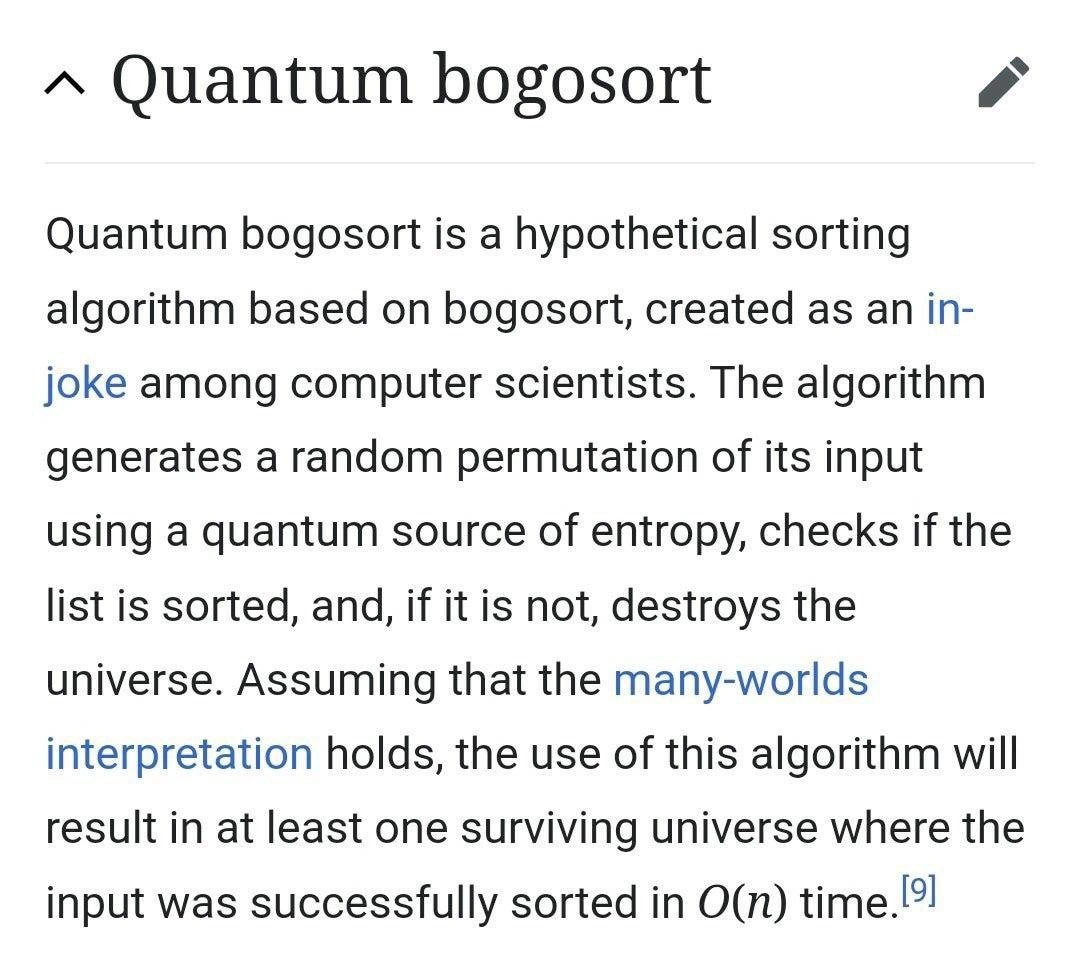
Screenshot of a Wikipedia-style article headed “Quantum bogosort,” with the familiar large serif title and pencil-edit icon. Body text reads: “Quantum bogosort is a hypothetical sorting algorithm based on bogosort, created as an in-joke among computer scientists. The algorithm generates a random permutation of its input using a quantum source of entropy, checks if the list is sorted, and, if it is not, destroys the universe. Assuming that the many-worlds interpretation holds, the use of this algorithm will result in at least one surviving universe where the input was successfully sorted in O(n) time.” The visual evokes the dead-serious layout of an encyclopedia entry, but the content parodies both worst-case algorithms and quantum-computing hype by treating universe-level side effects as an acceptable trade-off to obtain linear complexity. Senior engineers will immediately recognize the satire on computational complexity, bogosort’s absurd expected time, and the tongue-in-cheek misuse of the many-worlds interpretation to ‘guarantee’ performance


Comments

20
Anonymous ★ Top Pick Great news - quantum bogosort just passed the architecture review; platform risk is acceptable as long as the blast radius stays confined to timelines where the SLA is missed
  1. Anonymous ★ Top Pick

    Great news - quantum bogosort just passed the architecture review; platform risk is acceptable as long as the blast radius stays confined to timelines where the SLA is missed

  2. Anonymous

    Finally, an algorithm with a disaster recovery strategy that makes our "we'll just restore from backup" look conservative

  3. Anonymous

    Quantum bogosort: the only algorithm where 'it works on my universe' is a legitimate production deployment strategy. Sure, it achieves O(n) time complexity, but the operational overhead of destroying infinite parallel universes makes the on-call rotation particularly challenging - especially when you're the one who has to explain to the VP of Engineering why the incident postmortem includes 'heat death of the cosmos' as a root cause

  4. Anonymous

    Quantum bogosort proves any system can hit O(n) if your SLO excludes failed universes - also known as “works on my universe”

  5. Anonymous

    The sort where Big O hides the constant factor of infinite doomed timelines

  6. Anonymous

    Quantum bogosort is “works on my machine” generalized to “works in at least one universe” - amortized O(n) if your OKRs count survival bias as a metric

  7. @ygerlach 2y

    wouldn't that be O(1) ?

    1. @nightingazer 2y

      no.

    2. @trainzman 2y

      You need complexity of n for generating a sequence of length n

      1. @pwnzkk 2y

        I would assume o(n) is for sorting checking, not generating. Quantum source of entropy generates random values at once I guess

        1. @trainzman 2y

          You're right

    3. @hdrsd 2y

      O(♾️)

  8. @pwnzkk 2y

    That’s even better

    1. @ZgGPuo8dZef58K6hxxGVj3Z2 2y

      The other one gives you instant result, i think thats better.

      1. @pwnzkk 2y

        Unless you end up in the universe, where the array is not sorted. Although if you believe in quantum immortality, that’s not an issue lol

        1. @ZgGPuo8dZef58K6hxxGVj3Z2 2y

          Even if I don’t if it happens fast enough I won’t know it happened lol

          1. @pwnzkk 2y

            Yeah I hope the devs up there don’t implement some gruesome algorithm of universe destroying. Sort of power shutdown is fine I guess

            1. @pwnzkk 2y

              New meaning of high level programming. Higher order function, that kind of stuff

            2. @SamsonovAnton 2y

              The last time they powered-on our universe, it was quite a big bang though!

  9. @ZgGPuo8dZef58K6hxxGVj3Z2 2y

    Careful if you implement it be aware of possible race exceptions, especially if your following logic uses more APIs that could affect other universes

Use J and K for navigation