Meetings Then vs. Now: From Boardrooms to Arts and Crafts
Why is this Agile meme funny?
Level 1: Serious vs. Silly
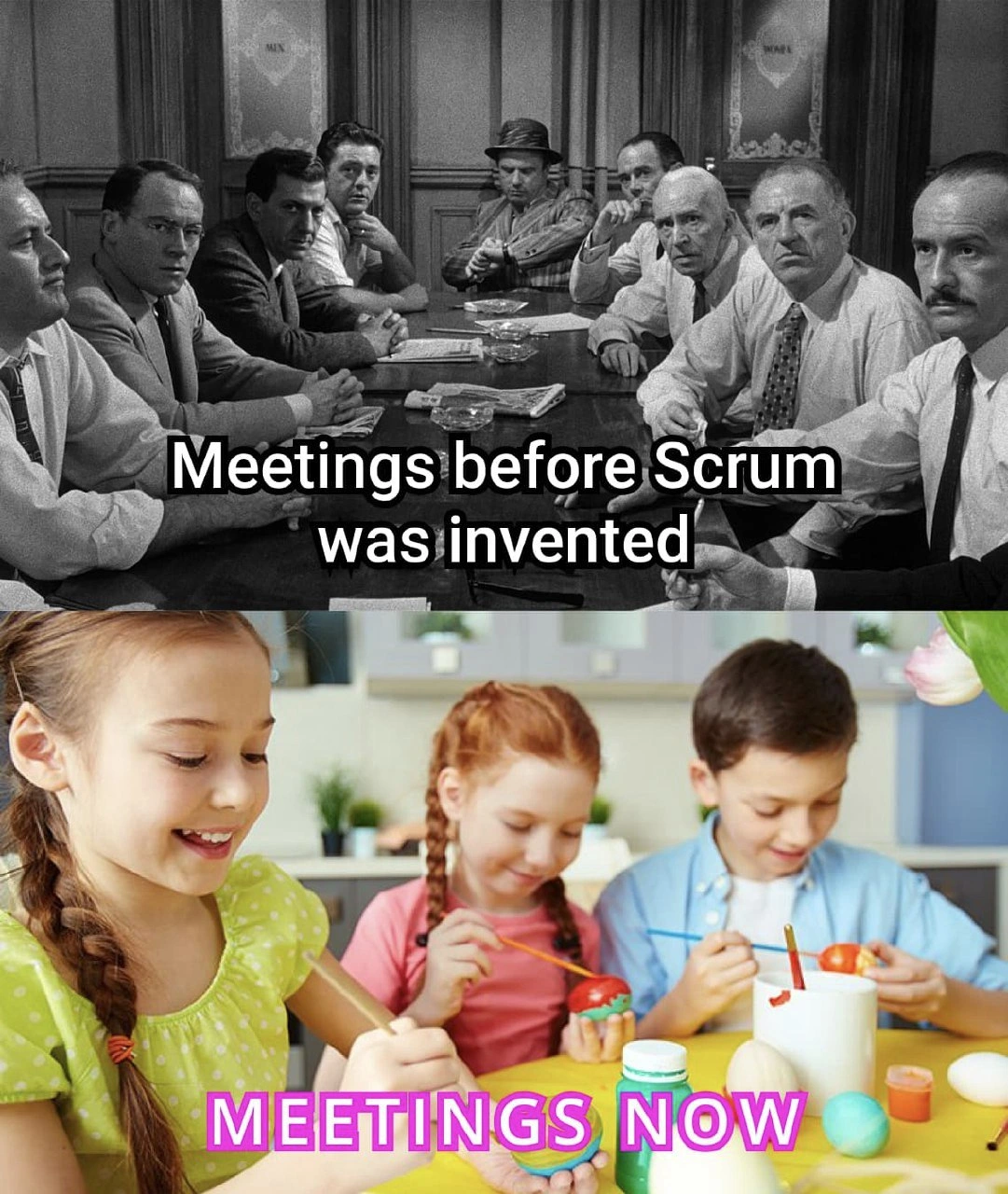
Imagine your school principal once held very serious meetings with teachers – everyone quiet, listening, all the grown-ups in suits doing important talk. Now, imagine a new rule says, “Let’s have quick meetings every day where everyone can speak and even use colorful stickers or toys to share ideas!” Suddenly those meetings feel more like a kindergarten class where kids are painting and playing. That’s exactly the joke here: the first picture shows a very formal grown-up meeting (all black-and-white, like an old photo of strict adults). The second picture shows children painting eggs, which is a fun, playful activity. The meme is saying that meetings used to be super serious, and now they feel child-like and casual. It’s funny because we don’t expect work meetings to look like playtime. People find it amusing (or a little frustrating) that something as boring as a meeting could turn into what looks like a craft session. In simple terms: it’s like seeing your dad leave a stuffy business meeting one day, and the next day he’s in a group sitting on the floor coloring with crayons. That big change from formal to funny makes us laugh and also think, “Huh, meetings really have changed!”
Level 2: Boardroom vs. Scrum Show-and-Tell
Let’s break down what the meme is comparing. The top image shows an old-fashioned meeting. In real life back then (and even up through the 1990s), businesses often followed a Waterfall model for projects: plan everything upfront, then execute in stages. Meetings in that era were formal: scheduled occasionally (maybe a big status meeting once a month or quarter), led by high-level managers, with strict agendas. Everyone is in suits, the tone is serious. You’d have long discussions, reports, and decisions made by the higher-ups while others mostly listened. Think of a classroom where only the teacher talks – that’s the old meeting style.
Now, the bottom image represents a modern Scrum meeting. Scrum is an Agile framework for managing work, especially in software development. Agile values more frequent collaboration, flexibility, and team empowerment. Scrum introduced a bunch of regular team meetings (called ceremonies): for example, a daily stand-up (also known as the daily Scrum) where the team quickly syncs up every morning, a sprint planning to decide what to do in the next 1-2 weeks, a sprint review to demo work, and a retrospective to reflect and improve. These meetings are meant to be informal and interactive. Team members often stand in a circle for the daily stand-up, keeping it short (usually 15 minutes). Everyone gets to speak in turn, answering the three classic questions: “What did I do yesterday? What will I do today? Any blockers?” It’s a far cry from one big boss at the head of the table doing all the talking. In fact, it can feel a bit like a show-and-tell, where each person takes a turn to share.
The meme’s children painting eggs illustrate how modern Agile meetings sometimes involve creative, playful elements. It’s exaggerating, of course – real Scrum teams aren’t literally finger painting (most of the time! 🖍️). But there are real practices that look playful: for example, in planning poker the team estimates tasks by playing cards with numbers (it’s like a game). In retrospectives, teams might use sticky notes and markers to draw smiley faces for what went well, or they might toss a ball to someone to indicate “your turn to speak.” These techniques are designed to engage the team and make meetings fun and open, rather than stiff and scary. To a newcomer or junior developer, these Agile ceremonies might actually feel enjoyable and inclusive – you get to talk regularly, share ideas, maybe even joke around a bit. It’s a big difference from the intimidating boardroom meetings of the past.
Let’s compare the two styles directly:
| Old-School Meeting (Pre-Agile) | Agile Scrum Meeting (Now) |
|---|---|
| Formal & Infrequent – e.g. quarterly project reviews in a big boardroom led by managers. | Frequent & Informal – e.g. daily stand-ups and weekly sprint meetings with the whole team participating. |
| Hierarchical – Boss or senior exec runs the meeting, others mostly listen. | Egalitarian – Every team member speaks (especially in stand-ups and retrospectives). The Scrum Master (facilitator) ensures everyone gets a voice. |
| Serious Tone – Suit-and-tie, strict agenda, meeting notes on paper, very businesslike. Maybe even ashtrays and coffee! | Casual Tone – T-shirts and jeans, people often stand or sit casually, use whiteboards, sticky notes, maybe even jokes to break ice. |
| Long and Scheduled Sparingly – Could last hours, since they happen rarely. A lot of status reporting and formal decision-making. | Short and Regular – Stand-ups are time-boxed to ~15 minutes each day. Other Scrum meetings (planning, retro) are also time-boxed (few hours at most). Decisions are iterative, happening every sprint. |
| Top-Down Decisions – Plans and decisions usually come from management in these meetings. | Team Decisions – The team collectively plans sprint tasks, discusses roadblocks, and improves their process together (guided by Agile principles). |
For a junior developer, the key point is that Agile (and Scrum in particular) changed meeting culture drastically. Instead of one big scary meeting once in a while, you have lots of small meetings where everyone contributes. The meme humorously suggests these new meetings feel almost like children playing, because they emphasize interactivity, creativity, and a casual atmosphere. This can be great for openness – you’re encouraged to speak up each day, not just silently take notes. But it can also be overwhelming: suddenly you have many meetings (stand-ups every day, plus planning, plus retrospectives…) and they might start to feel like they eat into your work time. A junior might initially enjoy that stand-ups are short and everyone is equal, but after a while even they might think “Another meeting? Can’t I just code instead?” That mix of fun and frustration is exactly what the meme is getting at. Agile ceremonies can seem like a fun group activity (almost like a classroom group project) compared to the old buttoned-up meetings – and depending on your perspective, that’s either refreshing or a bit ridiculous.
Level 3: From Cigars to Crayons
In the top panel we see a smoke-filled 1950s boardroom — think Mad Men or Twelve Angry Men, with stern executives in suits, ashtrays on the table, and a formal agenda. In the bottom panel, we’ve got kids happily painting Easter eggs with bright colors. This jarring contrast is the meme’s punchline: corporate meetings used to be serious business, now after adopting Scrum they feel like kindergarten arts-and-crafts hour. Seasoned engineers watching the Agile revolution unfold often joke that our Agile ceremonies have turned into playtime. The meme exaggerates that sentiment by literally depicting a boardroom devolving into a daycare craft table. It’s poking fun at corporate culture shifts due to Agile: the old-school gravitas is gone, replaced by sticky notes, stand-up meetings, and sometimes silly team-building games.
Why is this funny to veteran developers? Because many of us have lived through those Agile transformations, where suddenly every morning there’s a daily stand-up (in a circle, like story time) and every two weeks there’s a goofy “retro” with colored markers and sticky notes. The meme captures a common AgilePainPoint: meeting overload disguised as “fun.” In theory, Scrum was supposed to streamline communication and empower teams (no more endless monologue meetings led by your boss smoking a cigar). In practice, it often means more meetings – just different meetings. Now we huddle around a whiteboard with colorful Post-its, and it can feel a bit like finger painting. The Agile ideal is to be adaptive and collaborative, but when taken to absurd lengths, it starts to look unproductive or even childish. The “Meetings now” image with kids and paint jars satirizes how Scrum teams sometimes do things that, to a cynic, look like games: planning poker with playing cards, passing around a talking stick in retrospectives, or cheering “Yay, sprint review time!” like parents clapping for macaroni art.
There’s a layer of dark humor here about meeting culture. The top image’s formal vibe hints at the old Waterfall era of software development: infrequent but high-stakes meetings, lots of seriousness, maybe a PowerPoint and meeting minutes typed on paper. The bottom image reflects today’s Agile ceremonies (daily Scrums, sprint planning, backlog grooming, retrospectives) which, especially in a forced corporate Agile rollout, can feel like chaotic daily rituals where nothing serious gets decided. Experienced developers have seen both worlds: the stiff top-down meetings and the new agile stand-ups where everyone shares feelings about yesterday’s merge conflict. We laugh (perhaps a bit bitterly) because there’s truth in it – sometimes we traded one form of inefficiency for another. Instead of a smoke-filled war-room meeting once a week, we now have a Scrum Stand-up every single day at 9:00 AM sharp, plus planning, plus retrospective, plus review… It’s a carnival of ceremonies. Yes, we got rid of some old bureaucracy, but now we have ceremony overload. As the meme implies, it’s like we went from a formal boardroom to a kiddie table, and the corporate culture expects us to be excited about it. The veteran in me finds it painfully accurate – after the 100th stand-up that “could have been an email,” you start wondering if all we’re missing are juice boxes and nap time.
Description
A two-panel meme contrasting meeting styles. The top panel features a black-and-white still image from the 1957 film '12 Angry Men,' depicting a group of serious, formally dressed men engaged in an intense discussion around a large table in a jury room. Overlaid white text reads, 'Meetings before Scrum was invented'. The bottom panel shows a vibrant, modern color photograph of three happy children - two girls and a boy - sitting at a bright yellow table, joyfully painting eggs with colorful paints and brushes. Overlaid text in a playful, bubbly pink font reads, 'MEETINGS NOW'. The meme humorously critiques the perceived shift in meeting culture with the adoption of Agile and Scrum methodologies. It juxtaposes the grim formality of traditional corporate meetings with modern agile ceremonies, which can sometimes involve more collaborative, creative, and seemingly childish activities like using colorful sticky notes, drawing, or dot-voting. For experienced developers, this resonates as a satirical commentary on how some agile practices, while intended to foster creativity, can feel patronizing or like a departure from serious, focused work
Comments
7Comment deleted
Before Scrum, we had meetings to make binding decisions. Now, we have meetings to decide which color sticky note best represents a story point
Scrum didn’t kill the three-hour board meeting - it just refactored it into eight ceremonies where we argue whether repainting the same egg is a 2-point refactor or a net-new feature
The real irony is that we replaced one 2-hour meeting per week with daily standups, sprint planning, backlog grooming, retrospectives, and demos - effectively quintupling our meeting time while calling it 'agile'. At least the sticky notes are colorful
Ah yes, the golden age when 'sprint planning' meant running away from meetings, not scheduling four more. Back then, a 'standup' was what you did when the boss walked in, not a daily ceremony where everyone recites their Jira tickets like kindergarteners sharing show-and-tell. The irony? We invented Scrum to eliminate wasteful meetings, and somehow ended up with more ceremonies than a royal coronation - complete with story points, planning poker, and retrospectives where we discuss why we need so many retrospectives. At least the old guard got cigars and actual decisions; we get sticky notes and 'let's take this offline.' Progress!
Pre-Scrum: Agendas enforced outcomes. Post-Scrum: Finger paints enforce psychological safety
We refactored the old two-hour status meeting into five 30-minute ceremonies and called it Agile; Little's Law kept throughput constant, but velocity doubled after we switched to Fibonacci crayons
Scrum turned the boardroom into kindergarten: standup is show‑and‑tell, planning is finger‑painting story points, retro is circle time - and bikeshedding finally uses real paint