A Visual Metaphor for a Dysfunctional Software Project
Why is this SDLC meme funny?
Level 1: Everyone Loses When Teams Fight
Imagine you and three friends are supposed to work together to build a big sandcastle. Each friend has a different job: one friend designs what it should look like (like the Client who has the idea), one friend is actually shaping the sand (like the Developer building it), another friend checks if the sandcastle is strong by gently poking it (like the Tester making sure it won’t fall), and the last friend is the one who will play with the sandcastle once it’s done (like the End User who needs it).
Now picture this: instead of working together, everyone starts acting like enemies. The friend with the design (the client) is sitting on the sandcastle yelling demands and threatening to take the shovel away if it’s not done right now. The friend building the sand (the developer) is so annoyed at being poked and yelled at that they start throwing clumps of sand at the others to keep them away. The friend who checks strength (the tester) decides to test the castle by dropping a big rock on it, because they really want to prove it’s not strong enough. And the friend who wanted to play with it (the end user) got tired of waiting and started kicking the castle’s base to make their own door.
What do you think happens to the poor sandcastle? 💥 It falls apart completely, because everyone who was supposed to help build it ended up fighting each other or doing their own thing. The castle – which is the whole point of the project – gets destroyed. And nobody is happy in the end.
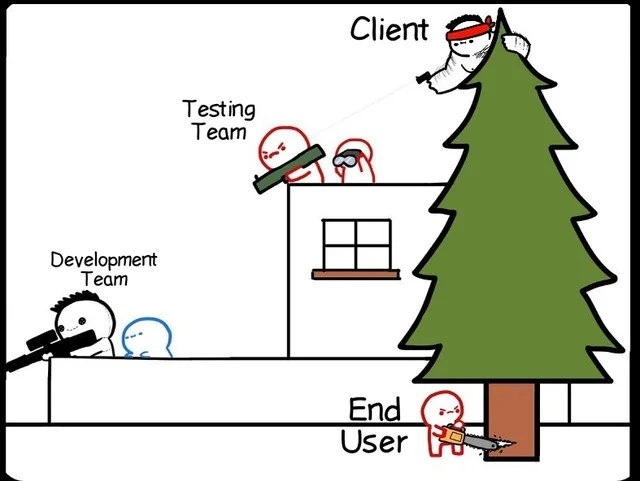
This is exactly what the tree cartoon is showing, but for a software project. The tree is like the sandcastle (the project they’re trying to build). All the people around it are the teams and people who should cooperate. But because they didn’t communicate and trust each other, they acted selfishly or aggressively, and everyone loses. The picture is funny because it’s drawn in a silly way – little stick figures with big weapons – but it teaches a simple lesson: if we don’t work together and instead we blame or attack each other, the thing we’re all trying to make (whether a sandcastle or a software project) will break.
In the end, the best way to succeed is to remember you’re all on the same team. Put down the toy weapons and help each other build the castle (or the software). When everyone works together, the tree (project) grows strong. But if they fight, the tree falls and nobody gets what they wanted.
Level 2: Siloed Teams Showdown
Let’s break down the meme’s scene and roles in simpler terms. This cartoon uses a warzone metaphor to illustrate a software project gone wrong due to poor collaboration and communication. Each colored stick figure represents a group in the Software Development Life Cycle (SDLC), and each is doing something that should help the project, but here it’s shown in an extreme, destructive way:
Development Team (blue figures on the left): These are the programmers who build the software. In the picture, they’re crouched behind a wall with a sniper rifle aimed at the Testing Team. Normally, developers write code and should work closely with testers to fix bugs. But when communication breaks down, developers might start seeing testers as enemies who only find faults. The sniper rifle symbolizes a defensive (even hostile) attitude: instead of fixing issues, a dev might say “Those bugs aren’t real” or try to shoot down the tester’s reports. In a healthy project, devs and QA are on the same side, but here the dev team is literally taking shots — a playful way to show the blame game that can happen (“It’s the testers’ fault the release is delayed, not our code!”).
Testing Team (red figures on the rooftop): These are QA engineers or testers who check if the software works correctly. They should be catching problems to improve quality. In the meme, one tester is looking through binoculars (searching for problems) and another has a rocket launcher aimed at the project (the tree). This exaggerates how testers sometimes deliver bad news: finding a severe bug can feel like blowing up the developers’ hard work, especially if it’s right before a deadline. A rocket launcher is heavy artillery – it humorously represents a big bug that can explode the timeline or require major rework. The testers aren’t literally enemies, but the image shows how, in a dysfunctional team, testers and developers can feel like they’re on opposing sides of a battlefield. It highlights a common junior experience: the first time a QA engineer reports a critical bug on something you, as a new developer, thought was finished. It can feel like a rocket hit your project. But really, the testers are doing their job – it’s just that without good communication, their actions seem destructive rather than helpful.
Client (white ninja figure in the tree): This is the customer or stakeholder who requested the project. They usually set the requirements and goals. In a perfect world, the client collaborates with the team, clarifying what they want and giving feedback constructively. However, the meme shows the client as a ninja with a handgun, perched in the tree they commissioned. This is a humorous way to say the client might unexpectedly attack the team with demands or blame. The ninja implies stealth and surprise – like when a client suddenly asks for a huge change at the last minute (scope creep) or threatens to cut funding if certain features aren’t delivered. The handgun pointing left (toward the teams) shows lack of trust: instead of working together, this client is ready to assign blame or exert pressure aggressively. This can happen when a client feels the project isn’t going their way – e.g., “Why isn’t it done yet? What are you guys doing?” They might start figuratively pointing guns (accusations, unrealistic deadlines) at the development or QA teams. It’s stakeholder pressure turned into a comic weapon. Seeing the client actually in the tree they’re helping to destroy is an ironic touch: it suggests the client doesn’t realize they’re harming their own project by behaving this way.
End User (small red figure at the base of the tree): This represents the actual people who will use the software once it’s finished. They weren’t involved in making it, but their satisfaction is the ultimate goal. In the picture, the end user is sawing through the trunk of the tree. That seems crazy – why would the user cut down the very product they want? But it symbolizes how users, intentionally or not, can undermine a project too. A classic saying in software is “Users will always find a way to break things.” They might use the software in unanticipated ways or demand changes that conflict with earlier decisions. For a junior dev, the first time you see users do something completely unexpected with your app (like input a 10,000-character name and crash the system) it’s eye-opening. In the meme, the user’s saw represents those unexpected actions or negative feedback that can “cut down” the project after release. It’s also a nod to situations where users get so unhappy (maybe the product is buggy or not what they needed) that they abandon it or leave bad reviews – effectively chopping at its support. The term end user sabotage here isn’t blaming users, but showing that if we don’t consider user needs and behaviors, the users might inadvertently cause the project to fail.
The Tree (the big evergreen itself): This is the project or product everyone is supposed to be working on together – for example, a software application or system being developed. In the cartoon, the tree is literally the “target” and also the “victim”. Every group’s actions are focused on it in a harmful way: the testers’ rocket, the client’s gun, the user’s saw, even the dev’s sniper (aimed at testers, but any crossfire will hit the tree too). The tree being evergreen might imply this project should have been long-lasting or constantly updated (“evergreen” in tech can mean always up-to-date), but at this rate it won’t survive. There’s also a likely homage to an old classic project management cartoon showing a swing on a tree, used to illustrate how different teams imagine a project differently. Here the tree is present but instead of a swing, we see warfare — suggesting not just miscommunication, but active conflict.
The whole scene is a militarized analogy for a failed team collaboration. Instead of cooperating, each group is in a silo, armed with blame and pointed at others. For example, when developers and testers don’t communicate, it can feel adversarial: testers find bugs and developers feel attacked, rather than both seeing the bug as a project problem to solve together. Similarly, a client not communicating properly can feel like they’re attacking the team with sudden demands, and users who weren’t understood or informed might “attack” the product by using it in destructive ways or leaving en masse.
In simpler terms, this is what happens when communication breaks down in a software project:
- Each team or stakeholder starts acting on their own, without coordinating.
- They may even start blaming each other for issues (“It’s the devs’ fault,” “No, it’s the testers’ fault,” “Actually, the client keeps changing things,” etc.).
- Everyone is so busy defending themselves (or attacking others) that the project itself suffers — just like that tree getting cut and blown up.
If you’re new to development, this meme is a slightly exaggerated lesson: team collaboration is crucial. All the groups – developers, testers, clients, and users – need to work in concert, not conflict. When they don’t, it’s like a team trying to win a game by tackling each other instead of the opponent. No one wins, and the product (the poor tree) collapses. This is why modern practices like Agile and DevOps put such an emphasis on communication, feedback, and shared responsibility. They’re trying to prevent the very scenario shown in the cartoon. Instead of silos lobbing missiles, you want cross-functional teams talking to each other. Because once the rockets and saws come out, it might be too late for the project.
To summarize the roles and their unintended “attacks” on the project:
| Role | Meme Action | Real-World Equivalent |
|---|---|---|
| Development Team (Devs) | Sniping at testers | Dismissing or arguing against bug reports; fixing issues in secret without QA, blame-shifting to requirements or testers |
| Testing Team (QA) | Firing a rocket at the project | Dropping last-minute critical bug findings that halt release (necessary for quality, but feels explosive if late) |
| Client/Stakeholder | Aiming a gun from atop project | Imposing sudden changes or deadlines; threatening project cancellation or blame (pressure that can destabilize the team’s work) |
| End User | Sawing through the trunk | Using the product in unexpected ways that break it; negative feedback or abandonment due to unmet needs |
Each of these actions alone isn’t malicious in real life – they’re exaggerated to show what happens when there’s no trust or communication. The developer humor here comes from recognizing each of these exaggerated scenarios from personal experience, just not usually all at once! It’s funny in the way a cautionary tale is funny: you recognize the mistake so you can avoid it (and maybe nervously laugh if you’ve been there). The meme basically says: every group in a project has the power to either support or destroy that project. When they choose to act in isolation or conflict, the result is chaos.
Level 3: Mutually Assured Project Destruction
In this SDLC battlefield, every role has effectively weaponized their role against the project and each other. It’s a darkly comic depiction of blame culture and misaligned incentives in a software team. The cartoon shows a pine tree (the project) under assault from all sides:
The Development Team (blue figures on the left) is hiding behind a wall, one dev lining up a sniper rifle. This is a tongue-in-cheek take on devs going on the defensive. Instead of collaborating with QA, they’re in a sniper stance, ready to pick off the Testing Team. In real projects, this feels like when developers push back hard on bug reports or stakeholder pressure, treating testers or requirements as threats to getting code shipped. It’s an absurd escalation of the “It works on my machine!” attitude, where devs sometimes see testers as adversaries rather than allies. Here, the developer’s sniper rifle humorously symbolizes those sneaky code hotfixes or
quick-and-dirty patchesdeployed under pressure, potentially shooting down QA’s concerns (and sometimes causing friendly fire incidents in production at 3 AM).The Testing Team (red figures on the rooftop) has literally brought out a rocket launcher aimed at the tree’s trunk. Testers are supposed to ensure quality, but this exaggeration implies they might blow up the project if it means exposing flaws. It’s a sly nod to TestingHumor: how QA sometimes feels like they’re lobbing grenades (
critical bug reports) right before a deadline. The tester with binoculars is spotting targets – much like QA scanning for any defect to call out – and the one with the bazooka is about to announce a showstopper bug that could blast the release schedule. Experienced devs have felt this: a single late-game bug report that derails a launch feels as subtle as a rocket strike. Of course, good testers aren’t out to sink the project, but in a dysfunctional team, devs and QA can become adversaries in a blame game, each accusing the other of jeopardizing the product’s stability.The Client (white-clad ninja atop the tree) is pointing a handgun toward the left, presumably at the dev or test teams. This ninja-like stakeholder is perched in the very product they commissioned, yet ready to shoot someone over it. This captures the irony of StakeholderPressure: clients sometimes demand last-minute changes or unrealistic features that effectively hold the project hostage. In the meme, the client’s gun represents weaponized expectations – the threat of “deliver what I want or else.” It’s the kind of pressure where a client might say, “If this isn’t done by Friday, heads will roll,” figuratively putting a bullet in team morale (or literally in this cartoon’s case). The ninja motif adds a layer of humor: clients can appear out of nowhere with surprise scope changes (stealth mode!) that assassinate timelines. Senior devs recognize this scenario all too well – when a client’s intervention intended to help actually endangers the whole project (here, literally shooting at the support teams while sitting in the project tree).
The End User (small red figure at the tree’s base) is sawing through the trunk, oblivious to the chaos above. This is a brilliant twist: the very user who needs the final product is sabotaging it. How? In real life, end users might misuse the software or find creative (unintended) ways to break it – think of a user finding a loophole that crashes the system, or demanding a refund en masse. It’s end_user_sabotage depicted visually. The saw cutting the tree trunk is like users abandoning the product due to frustration, or using it in a way that undermines its foundation (like overloading a system in ways developers never anticipated). It’s the ultimate irony that the product’s beneficiaries are contributing to its collapse, often because their needs weren’t met or communicated properly. Every veteran engineer has a story of a client or user doing “that one thing” you explicitly warned against, bringing the whole system down – essentially sawing off the very branch (or trunk) they’re sitting on.
All these characters create a scene of militarized team analogy – each group treating software development like a combat operation rather than a collaboration. The humor hits close to home because we’ve all witnessed this cross-team crossfire. Instead of working together, each siloed group is out for itself: testers launching figurative rockets of criticism, devs sniping back excuses, clients firing off demands, and end users inadvertently pulling the plug. The result? Mutually assured destruction of the project. The evergreen tree (perhaps nodding to the famous “tree swing” SDLC cartoon) is supposed to be something alive and growing — an evergreen project that could thrive. But here it’s being literally cut down, blown up, and shot at by the very people responsible for nurturing it.
This reflects a painful truth: miscommunication and misaligned goals in a project can turn every SDLC phase into a standoff. The meme exaggerates reality to make a point: if developers, testers, clients, and users don’t trust each other, the product doesn’t stand a chance. Each role is taking aim at others to avoid blame, rather than solving the problems. In a well-functioning team, these groups are allies with a common goal (delivering a great product). But in a dysfunctional environment, they become like armed camps in a microscopic war. Seasoned developers chuckle (or maybe cringe) at this meme because they’ve survived similar scenarios: projects where communication broke down so badly that every meeting felt like a tense negotiation at gunpoint, with the product’s future caught in the crossfire. This cartoon is an absurdist mirror of those experiences — it’s funny because it’s uncomfortably true. We laugh, and then sigh, recognizing the need for better team collaboration before our next project ends up like that poor tree.
Description
A cartoon illustration depicting a chaotic and misaligned project team. At the top, a 'Client' with a red headband hides in a tall pine tree, aiming a small pistol. Below, on a building's roof, the 'Testing Team', two red figures, are trying to hit something with a large plank. On the ground floor, the 'Development Team', a black-haired figure with a sniper rifle, takes aim, assisted by a smaller blue figure. At the base of the tree, an angry red 'End User' is cutting it down with a chainsaw. The image is a classic allegory for dysfunctional software development, where each party is working at cross-purposes: the client has a poor vantage point and inadequate tools, the testers are using ineffective methods, the developers are hyper-focused on a target while ignoring the systemic risk, and the end user, frustrated, is about to destroy the very foundation of the project
Comments
7Comment deleted
This is what happens when the client defines the requirement as 'make the target stop moving,' the devs write a single high-precision function to do it, QA's test plan is 'hit it with a board,' and the user's feedback is a support ticket titled 'How to remove tree?'
Sprint update: Dev’s sniping hotfixes at QA, QA’s returning fire with a JIRA rocket full of repro steps, the client ninja-drops a “quick” scope change from the treetop, and the end user is silently chainsawing the core with an Excel export - yet leadership still wants to interrogate the burndown chart
After 20 years in tech, I've learned that the only difference between a Christmas tree deployment and a regular one is that with the tree, at least everyone agrees it should have been artificial from the start
This perfectly captures the enterprise software development pyramid scheme: the client sits at the top in blissful ignorance, QA is trapped in the middle floor running tests nobody reads, devs are in the basement frantically patching, and the actual end user is outside with an axe, about to solve the whole architectural problem with a single root-cause analysis. The blindfolds are a nice touch - nothing says 'Agile transformation' quite like stakeholders who literally cannot see the user stories
We weaponized QA and dev, but prod falls when an end user uploads a “quick CSV” and Excel helpfully converts UUIDs to dates - the saw at the trunk we never unit-tested
Devs sniping edge cases from afar, QA tree-traversing manually, client gold-plating leaves - till end user 'rm -rf /'s the monolith trunk
SDLC in one frame: dev ships a long‑range hotfix, QA verifies the blast radius, the client ‘right‑sizes’ scope from the canopy, and an end user runs chainsaw‑as‑a‑service in prod