Skip to content
DevMeme
4673 of 7435
The Scrum Master's Promise of a 'Quick 20-Minute' Meeting
Agile Post #5125, on Apr 12, 2023 in TG

The Scrum Master's Promise of a 'Quick 20-Minute' Meeting

Why is this Agile meme funny?

Level 1: The Never-Ending Meeting

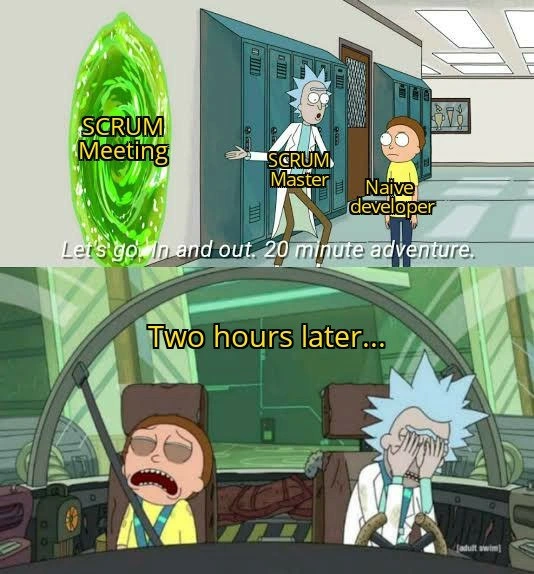
Imagine your teacher says, “This will be a quick class discussion, only 5 minutes.” You expect it to be super short – just like Rick tells Morty their errand will only take 20 minutes. But then the discussion keeps going…and going. You look at the clock, and those 5 minutes turn into a full hour. Everyone is getting fidgety, a bit tired, maybe rolling their eyes like, “When will this end?” It’s the same feeling in this meme. The first picture shows a confident person (Rick, the teacher-like figure) and a kid (Morty, the student) about to step through a magic door (the meeting). They’re thinking, “Let’s hop in and out really fast!” But the next picture, labeled “Two hours later…,” shows them exhausted, holding their heads in frustration. It’s as if that “quick chat” turned into a never-ending meeting. The joke is funny because we’ve all been promised something will be quick – like a short errand or a fast chat – and it ended up taking forever. The meme is basically saying: “Remember that daily team meeting that was supposed to be 15 minutes? Surprise! It felt like two hours.” It’s a goofy way to vent about how a short meeting can sometimes magically become a long, draining adventure. Even without knowing the characters, you can relate to their faces: “Ugh, that was way longer than it should have been!”

Level 2: Daily Stand-up 101

Let’s break down the scene and terminology for those newer to Agile and Scrum. In Scrum (an Agile framework for developing software), a daily stand-up meeting – also called the daily Scrum – is meant to be a short, timeboxed meeting (usually 15 minutes) held each day. The idea is that team members literally stand up during it (to discourage long discussions) and each person answers three questions: What did I do yesterday? What will I do today? What obstacles are in my way? This quick meeting helps the team stay synchronized and quickly flag if anyone is stuck and needs help after the meeting. It’s not supposed to turn into a full problem-solving session or a long status report. Think of it as everyone checking in so no one’s duplicating work or blocked silently.

Now, Scrum Master is the role of the person who facilitates these meetings and the Scrum process in general. They’re like a coach for the team in all things Scrum. One of their jobs is to keep the daily stand-up on track and within that 15-minute timebox. They might say things like “Let’s take that offline” if a conversation is dragging or not relevant to everyone – meaning, two people can discuss a detailed issue after the stand-up, rather than keeping everyone in the meeting. The Scrum Master is represented by Rick in the meme (the scientist with spiky blue hair). Rick opening the green portal labeled “SCRUM Meeting” is the visual metaphor: he’s inviting the team (Morty, the developer) into the daily Scrum, expecting it to be a quick adventure. The text “Let’s go. In and out, 20 minute adventure.” is actually a line from Rick and Morty (in the show, Rick tells Morty a task will be quick, which of course goes terribly wrong). Here it represents the Scrum Master optimistically (or naively) saying the stand-up will be quick and painless.

Morty, labeled “Naive developer,” symbolizes a team member (perhaps new or optimistic) who trusts that plan. A naive developer in this context means someone who hasn’t yet been jaded by experience – they genuinely believe the meeting will only take 15-20 minutes as it’s supposed to. This is often the case for newcomers to Scrum: they’ve read the guidelines or been told “stand-ups are only 15 minutes.” So they go in expecting a brief meeting. Morty’s wide-eyed nervous expression in that hallway matches a junior dev thinking, “Alright, 20 minutes, I can handle this!”

The second panel hits us with the punchline: “Two hours later…” appears at the top (a classic cartoon trope to indicate a long passage of time, often used for comedic effect). We see Rick and Morty now in their spaceship after the “adventure.” Rick is exhausted, face in hands (the universal gesture of frustration or disbelief), and Morty is slumped with a thousand-yard stare and his tongue lolling out like he’s utterly spent. In the context of a Scrum meeting, this visual means the stand-up ended up taking two hours, leaving everyone drained. Of course, in real life, a daily Scrum rarely literally lasts two full hours (that would be extremely dysfunctional!), but it sure feels that way sometimes. And indeed, some particularly bad “quick meetings” have stretched an hour or more. The meme exaggerates to drive the point home: what should be a quick check-in turned into a marathon meeting.

So why would a stand-up meeting drag on so long? Typically, this happens when the team ignores the rules of the stand-up. For example:

  • Diving into details: One person might start explaining a technical issue in depth, and then others jump in to help solve it right there. Suddenly 5 minutes turns into 30 as they troubleshoot together while everyone else waits.
  • Not deferring topics: Maybe someone brings up a discussion topic (“Hey, we need to redesign the UI flow for feature X…”) that isn’t a quick update but a whole debate. Instead of parking it for later, the group discusses it immediately.
  • Too many people or projects: If the stand-up has a large team or people from multiple projects, and everyone speaks, 15 minutes can easily get overshot even if each person takes only 2 minutes. Sometimes organizations invite extra stakeholders (managers, other teams) into the daily meeting, and they start asking questions – boom, it’s now a status meeting and it’s twice as long.
  • Lack of facilitation: The Scrum Master (or whoever is leading) might not intervene to cut off long talkers or table side discussions. Maybe they themselves start talking too much! Without someone gently enforcing “okay let’s move on,” the meeting can meander.

In Agile terms, this meme shows a timeboxed meeting fail – the fixed 15-minute container wasn’t respected. The two hours later joke text is like a big red stamp saying “FAILED” on this Scrum ceremony. It’s poking fun at how often this happens despite everyone knowing it shouldn’t. This is a form of MeetingOverload: too many meetings or meetings that go way over time, eating into the time you’d rather spend actually working (coding, debugging, etc.). Developers find it very relatable because many have been in this situation: the daily stand-up that drags on and on, leaving people thinking “Wasn’t this supposed to be quick? I could’ve written a bunch of code by now.”

The Rick and Morty aspect makes it extra funny if you know the show. Rick’s catchphrase in that scene is ironic – every time he says something will be easy or fast, Morty ends up traumatized and hours pass. The meme taps into that pop culture reference: an portal_adventure_reference where a portal = new dimension (or meeting) that you think you’ll hop into and out of quickly. But inside, it’s chaos and time warp. Rick being the ScrumMaster is also ironic because Rick is a chaotic character; a real Scrum Master should bring order, but Rick as a Scrum Master implies things might go crazy. Morty as the naive developer is the poor soul who trusted the process blindly. After “two hours,” Rick’s facepalm is basically him thinking “I can’t believe that went so wrong,” and Morty’s exhausted face is “I did not sign up for this.” If you’ve ever left a meeting rubbing your temples or needing a strong coffee, you know the feeling.

So, in summary: The meme uses a scene from Rick and Morty to illustrate a common Agile team problem – daily Scrum meetings that are supposed to be short (15 minutes) but end up taking vastly longer, to everyone’s frustration. It’s labeling Rick as a Scrum Master and Morty as a new developer to personify the situation. The humor works on two levels: if you know Rick and Morty, you get the reference to a “20-minute adventure” gone awry; if you work in software teams, you instantly recognize the ScrumHumor in a “15-minute stand-up” turning into a “two-hour status meeting.” Either way, it’s a comically exaggerated reminder to keep our stand-ups short and sweet – or at least be honest that “15 minutes” might be a portal to a much longer adventure if we’re not careful!

Level 3: Timeboxed Marathon

In theory, a daily Scrum meeting (aka stand-up) is supposed to be a quick, time-boxed sync – often 15 minutes, regardless of team size. It's one of Agile’s fundamental rituals: every dev shares yesterday’s progress, today’s plan, and blockers. No deep dives, no derailments – just a concise status update to keep everyone aligned. That’s the expectation. The reality? This meme nails it: a “20 minute adventure” turning into a two-hour odyssey. The top panel shows Rick (labeled Scrum Master) eagerly opening a glowing green portal labeled “SCRUM Meeting,” telling Morty (the naive developer), “Let’s go. In and out, 20 minute adventure.” This is a direct nod to a famous scene from Rick and Morty where a supposedly quick task spirals out of control. In the Agile world, it’s a perfect analogy for a standup_timebox gone wrong. The Scrum Master, like Rick, confidently promises a swift mission. Morty – bright-eyed new dev – believes him. Fast forward to the bottom panel: “Two hours later…” Rick is slumped over facepalming, Morty is exhausted; their spaceship cockpit might as well be a conference room where time and enthusiasm have evaporated. This punchline is painfully familiar ScrumHumor for veteran developers: the daily stand-up that should have been 15 minutes but ballooned into a status marathon. Why is it so funny (or tragic)? Because it’s true. Every experienced dev has watched a quick sync mutate into a zombie meeting that refuses to die.

What’s going on under the hood? It’s an Agile anti-pattern. The Scrum Master’s job is to guard that 15-minute timebox with their life – to be Rick with a portal gun, zapping any off-topic discussion into a different dimension (a follow-up meeting). When that fails, the stand-up portal opens into a chaos realm: team members dive into problem-solving, managers start grilling for details, people repeat what’s already in Jira, or someone derails into an unrelated tech issue. Instead of blocking this scope-creep, the Scrum Master in the meme (Rick) has lost control, ending up just as frustrated as everyone else. It’s a facepalm_reaction encapsulated in a single image. MeetingOverload ensues.

This scenario is a textbook case of scrum_reality_vs_expectation. Agile doctrine says daily scrum should be a quick huddle – literally done standing up (so no one gets too comfy and chatty). Teams are told to timebox strictly: 15 minutes, we’re done, folks. But in practice, many teams struggle. Maybe the team is distributed and this is the only time everyone talks, so issues spill out. Maybe management treats the stand-up like a traditional status meeting, encouraging grilling and detailed reporting (old habits die hard). Or maybe the Scrum Master is inexperienced or overruled, so nobody enforces the cutoff. The result: the two_hour_standup from hell, where the “15-minute” stand-up consumes an hour or more of everyone’s morning. It’s an Agile irony – we adopted Scrum to avoid long, boring meetings that plague Waterfall projects, yet here we are, stuck in an even more frequent meeting that’s just as long. As Rick might say, “Wubba lubba dub dub… why are we still talking!?”

For senior engineers and Agile veterans, the humor cuts deep. We’ve all been Morty, the naive newcomer thinking “Surely this time the stand-up will actually be 15 minutes”. Five years and hundreds of stand-ups later, we’re Rick: cynical, knowing that “15 minutes” is often a cruel joke. The meme brilliantly uses a portal_adventure_reference from Rick and Morty to highlight this shared pain. The portal promises a quick journey; stepping through transports us into a bizarre dimension where time dilation occurs (one meeting hour = five real hours, apparently). Rick’s despairing facepalm in the cockpit is every developer who planned to get coding after the stand-up, only to find half the morning gone. It’s RelatableHumor because it exaggerates just enough to be funny while echoing a truth: many Agile teams pay lip service to “20 minute adventure” stand-ups, but lack the discipline (or facilitation) to keep them short. The meme also slyly points out the ScrumMaster’s failure – even the one person responsible for keeping things on track can end up overwhelmed, which is the ultimate Agile irony. Everyone leaves the meeting feeling like they just survived a grueling interdimensional adventure rather than a simple sync-up.

Importantly, this isn't just about poking fun; there’s insight here. The fact that this joke lands so well means timeboxed_meeting_fail is a widespread issue. There are known solutions (strict agendas, speaking tokens, parking lot for off-topic issues, using a timer). But implementing them consistently is another story – it requires discipline and sometimes battling a company culture that loves meetings. The developer_frustration is real: meetings eat into coding time, and a daily stand-up stretching to hours is the worst offender because it’s supposed to be the lightweight one. This meme hits on workplace dynamics too. Often, the polite or junior folks (Morty) don’t feel empowered to cut off a verbose manager or senior engineer (maybe a Jerry or some other character in our analogy) who highjacks the meeting. So the meeting drags while everyone silently groans. Over time, teams either adapt by unofficially accepting that “our 15 min stand-up is actually 45 min” (normalizing the dysfunction), or someone has to step up and say, “This is not how it’s supposed to go.” Until then, we get scenes like this: a portal to a meeting dimension you’re afraid to enter, and you come out battered and time-lost. AgileHumor like this resonates because it’s a coping mechanism – if we didn’t laugh, we’d cry about all the wasted time. In summary, the meme’s dark humor highlights a key truth in software team life: the simplest Agile ceremonies can go horribly wrong without vigilance, turning a quick stand-up into an exhausting meeting overload adventure that nobody asked for.

Description

A two-panel meme that uses the 'Rick and Morty's 20 Minute Adventure' format to satirize the reality of agile meetings. In the top panel, the character Rick is labeled 'SCRUM Master' and is ushering a concerned-looking Morty, labeled 'Naive developer,' towards a swirling green portal labeled 'SCRUM Meeting.' Rick confidently says, 'Let's go. In and out. 20 minute adventure.' The bottom panel, captioned 'Two hours later...', shows both characters inside Rick's spaceship, looking utterly defeated. Morty is slumped in his seat, crying and traumatized, while Rick covers his face in exhaustion and frustration. This meme hilariously captures a common developer complaint: Scrum meetings, especially daily stand-ups, are intended to be brief but often spiral into long, draining discussions that far exceed their time-box, leaving the team feeling exhausted and unproductive
Comments

7
Anonymous ★ Top Pick That daily stand-up was supposed to be a quick async update, but it devolved into a synchronous, blocking call that lasted longer than the sprint itself
  1. Anonymous ★ Top Pick

    That daily stand-up was supposed to be a quick async update, but it devolved into a synchronous, blocking call that lasted longer than the sprint itself

  2. Anonymous

    The daily stand-up is just stop-the-world GC - promised 20 ms, actually two hours, and when it finally finishes nobody remembers what they were allocating for

  3. Anonymous

    The only thing more optimistic than a Scrum Master's meeting time estimate is a junior dev's first sprint commitment before discovering the codebase was written by three different contractors who never talked to each other

  4. Anonymous

    The Scrum Master's estimate of '20 minutes' operates on the same time complexity as their sprint velocity calculations: O(optimistic). In production, this meeting scales to O(n²) where n is the number of 'quick clarifications' and 'just one more things.' Senior engineers know to block out the entire morning when they see 'brief standup' on the calendar - it's not a bug, it's a feature of Agile theater. The real sprint retrospective question should be: 'Why do our 15-minute standups consistently violate the laws of spacetime?'

  5. Anonymous

    The standup had a 15 minute SLO, then turned into a meeting monolith; once grooming, estimation, and stakeholder sync were routed through it, latency spiked to 120 minutes

  6. Anonymous

    Scrum timeboxes are treated like SLOs, not SLAs - the “20‑minute standup” devolves into backlog grooming, architecture review, and group therapy until the next calendar invite preempts it

  7. Anonymous

    Scrum timeboxes: enter at sprint velocity, exit at escape velocity from sanity

Use J and K for navigation