Skip to content
DevMeme
4674 of 7435
The Sisyphean Task of Manually Correcting Persistent Bad Data
DataEngineering Post #5122, on Apr 12, 2023 in TG

The Sisyphean Task of Manually Correcting Persistent Bad Data

Why is this DataEngineering meme funny?

Level 1: Here We Go Again

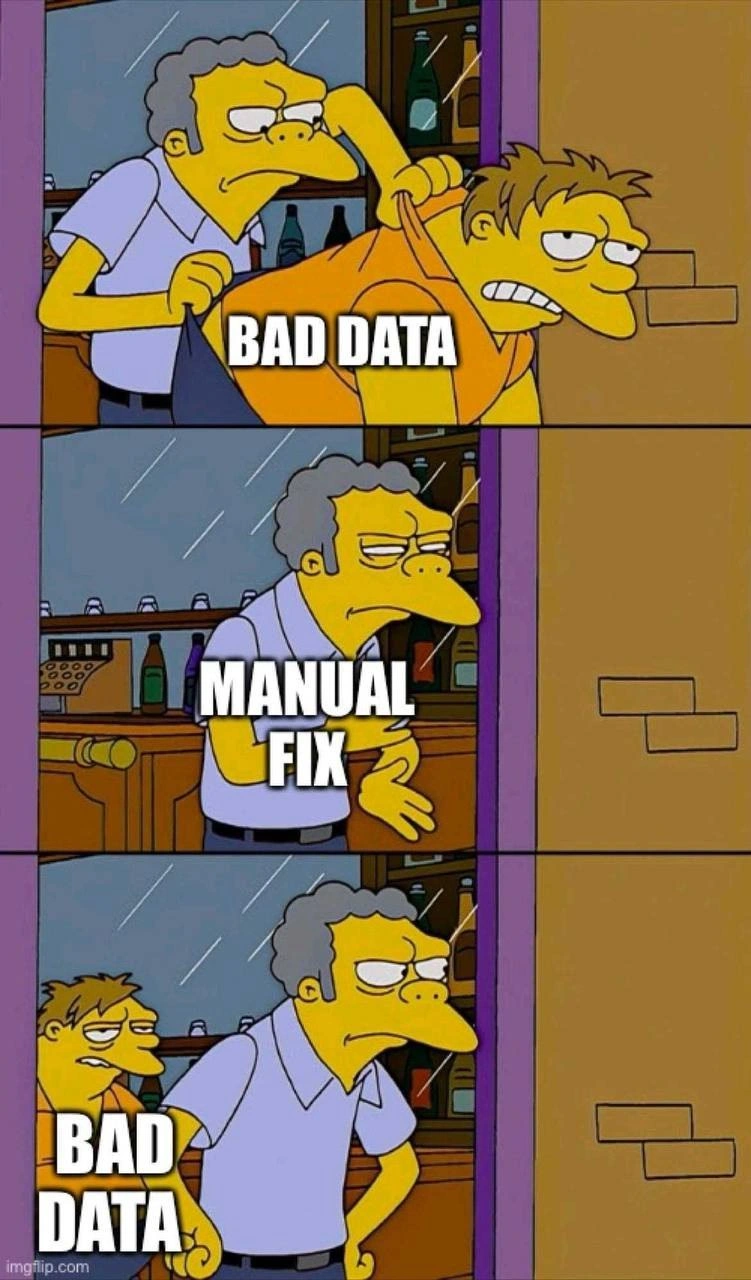
It’s like trying to mop up a puddle without fixing the leak. Sure, you dry the floor (clean the bad data) and things look fine for a moment, but since the pipe is still leaking (the underlying problem isn’t solved), water will leak out again and make a new puddle. In the cartoon, Moe throws out Barney (he gets rid of the trouble), but because the door was left open and nothing changed, Barney just sneaks back in. In real life, if you don’t fix what’s causing the bad data at the source, it will keep coming back no matter how many times you clean it up. The humor comes from recognizing this oh no, not again! moment – we laugh because we’ve all seen the “bad thing” return right after we thought it was gone.

Level 2: Whack-a-Mole Fixes

Let’s break down the meme’s analogy in plain terms. Bad data means information in your system that’s incorrect or malformed – for example, a row in a table with missing values or an impossible date (like February 30). A data pipeline is the series of steps that move and transform data (say, from raw logs to a clean database). In a perfect world, the pipeline has data validation checks at each step to catch or correct bad records. But in reality, things slip through. Imagine an upstream system keeps sending a customer entry with an invalid email that crashes your reporting job.

In the first panel, Moe dragging out Barney represents an engineer performing a manual cleanup: maybe running an SQL command or script to delete or fix the bad record. This is a manual fix – a human intervention to remove the anomaly so everything can keep running. For example, a developer might log into the database and run:

-- Remove the problematic record by hand
DELETE FROM customers WHERE customer_id = 'BAD123';

The quick fix above will solve the issue for the moment. That’s Moe tossing out the troublemaker. In the second panel, Moe shutting the door shows the team feeling relieved. They addressed the symptom: the system is back to green status, and the immediate fire is out.

However, by the third panel, Barney (our bad data) is inexplicably back inside. In real life, this means the underlying cause wasn’t fixed. Perhaps the next day, the pipeline ingests the same bad customer record again from the source, or a new equally bad record appears. Since the root cause (maybe a missing validation in upstream code or a faulty data source) is still unresolved, the problem repeats. This is the whack-a-mole nature of quick fixes: you whack one bad record down, and another pops up elsewhere. It’s a frustrating game with no end.

This cycle contributes to TechnicalDebt. Technical debt is like shortcuts in code or processes that save time now but create more work later – like a debt with interest. Each manual patch is interest accruing: someone will have to do more cleanups in the future or eventually spend a big effort to fix the system properly. Newer developers learn quickly that just editing data by hand feels like a win (UPDATE here, a little script there), but if you don’t plug the source of errors, you’ll be stuck in an endless loop of data wrangling. The meme is basically a warning wrapped in a joke: every time we patch data manually without improving the pipeline, we’re inviting the bad data to walk right back in the door.

Level 3: Sisyphean Data Fix

In the top panel, bartender Moe (the hapless engineer) is physically removing "BAD DATA" (Barney, the uninvited guest) from the premises. This is the classic late-night manual fix: you yank the offending record out of the database or patch it up by hand. Moe’s scowl says it all – he knows this is a dirty job born out of desperation. The humor hits home for any seasoned Data Engineering team: you can almost hear the grumbling “I’ve kicked this row out of prod three times this week…”.

By panel two, Moe slams the door shut with a weary satisfaction. The text “MANUAL FIX” emblazoned on his chest is our quick-and-dirty hero. In real projects, this is that one-off SQL script or hotfix deployed directly to production at 3 AM to stop an alert storm. It’s the technical debt bandaid – no unit tests, no permanent solution, just an immediate relief. Everyone knows it’s a QuickFix; future-you will facepalm, but present-you just wants to stabilize things. The meme mirrors that fleeting moment of “Glad that’s over” before reality intrudes.

Then comes panel three: Moe hasn’t even turned around before "BAD DATA" is right back inside the bar, smirking. This absurd sight gag encapsulates the inevitability of bad data returning when you haven’t addressed the root cause. It’s the data pipeline equivalent of a horror movie villain respawning for the sequel. Engineers who’ve been on call feel a pang of recognition (and maybe acid reflux): the DataQualityIssues you thought you killed are pouring back in on the next run. In enterprise systems, one manual deletion doesn’t propagate upstream – the source-of-truth (be it an external feed, a data lake, or a partner API) still contains the poison. Like a hydra, cut off one invalid record and two more outliers appear tomorrow.

The humor here is dark and too real. It’s poking fun at our tendency to reach for the quick fix (“just drop the bad rows and re-run the job”) instead of the hard fix (build validation, fix parsing logic, or pressure the data provider for clean data). This cycle creates a bad_data_loop: each manual patch is essentially painting over mold – it looks fine until the mold inevitably bleeds through again. Every senior developer has war stories of data cleanup fails: nightly scripts that silently wrangle bad inputs, cron jobs that delete known problematic entries, entire data pipelines held together by duct tape and hope. They’ll chuckle (or groan) at Moe’s plight because they’ve lived it. The meme highlights how technical debt accumulates: every time we say “we’ll properly fix it later” and just clean the immediate mess, we’re Moe dragging Barney out one more time. And just like Barney guzzling free beer, bad data will keep finding its way back until we build a better bouncer at the door.

Description

A three-panel meme using the 'Moe Throws Barney Out' format from The Simpsons to illustrate a common data engineering problem. In the first panel, Moe Szyslak, the bartender, is labeled 'MANUAL FIX' and is forcefully ejecting the perpetually disheveled Barney Gumble, labeled 'BAD DATA,' from his tavern. In the second panel, Moe dusts off his hands with a look of satisfaction, having solved the problem. The final panel delivers the punchline: Moe turns around to find Barney ('BAD DATA') has instantly reappeared right behind him with a smug look. This meme perfectly captures the frustrating and futile cycle of applying one-off, manual fixes to data issues in a system. The fix provides only temporary relief, as the underlying root cause - such as a faulty ingestion pipeline, a bug in an upstream service, or lack of input validation - ensures the bad data will inevitably return, making the manual effort feel pointless. A small watermark for 'imgflip.com' is visible in the bottom left corner

Comments

7
Anonymous ★ Top Pick That manual `UPDATE` statement feels heroic for about five minutes, right up until the next cron job runs and the same invalid data walks back in, smugly orders a Duff, and violates a dozen constraints
  1. Anonymous ★ Top Pick

    That manual `UPDATE` statement feels heroic for about five minutes, right up until the next cron job runs and the same invalid data walks back in, smugly orders a Duff, and violates a dozen constraints

  2. Anonymous

    Every time I hot-patch the warehouse with an UPDATE, the upstream CDC replay taps me on the shoulder like: “Nice try, Moe… see you in the next Airflow run.”

  3. Anonymous

    The data team spent three sprints building automated validation pipelines, but management still prefers Sarah's Excel macro from 2019 because "it just works."

  4. Anonymous

    Every data engineer knows this pain: you spend hours writing a script to clean up malformed records, deploy it to production, pat yourself on the back... and by Monday morning, the same garbage data is back because someone's Excel export is still concatenating dates as strings. The real solution isn't another manual fix - it's implementing proper schema validation, database constraints, and having that uncomfortable conversation with the upstream team about why their 'NULL' string literal isn't the same as an actual NULL value. But sure, let's just run that cleanup script again

  5. Anonymous

    Manual fixes: scaling linearly with data volume, exponentially with dev burnout

  6. Anonymous

    Manual data fix: kick the bad row out of the warehouse, then CDC/Kafka walks it back in on the next replay - eventual consistency for mistakes

  7. Anonymous

    Manual UPDATE in prod is Moe tossing Barney; the next CDC/ETL backfill strolls him right back in

Use J and K for navigation