Scrum Masters Nervously Eyeing the 'Master' Branch Debate
Why is this Agile meme funny?
Level 1: What's in a Name?
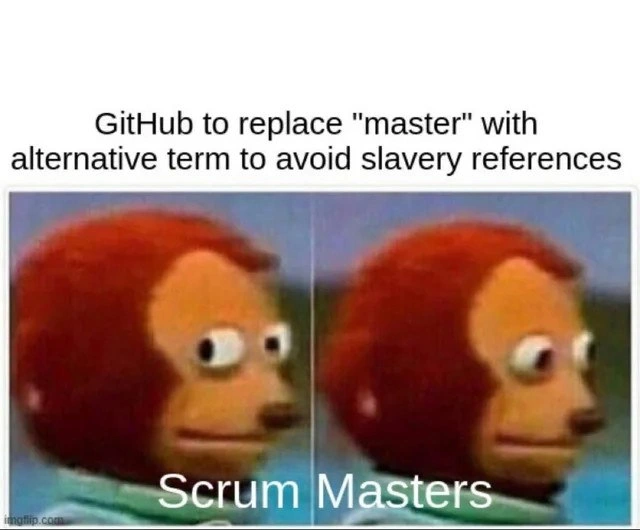
Imagine your teacher tells the class that a certain word isn’t nice to use anymore because it might remind people of something hurtful. Everyone agrees to stop saying that word. Now picture one student who suddenly realizes that this not-okay word is part of his nickname! That student would probably feel a bit embarrassed and worried, like “Uh oh, is my nickname bad now?” He might even make a funny wide-eyed face, looking to the side nervously – just like the monkey puppet in the picture.
In this meme’s story, a big coding website decided to stop using the word “master” for something (to be more respectful and kind), and a Scrum Master – which is what some people in software teams are called – is left thinking, “Wait, my title has ‘Master’ in it too!” It’s a playful way to show someone caught in an awkward situation. The joke comes from that little moment of panic when you realize a change in rules might affect you personally. In simple terms: they changed a name to be nicer, and now the person who still has the old name feels a bit uneasy. That silly, surprised feeling is what makes the meme funny.
Level 2: Same Word, Different Worlds
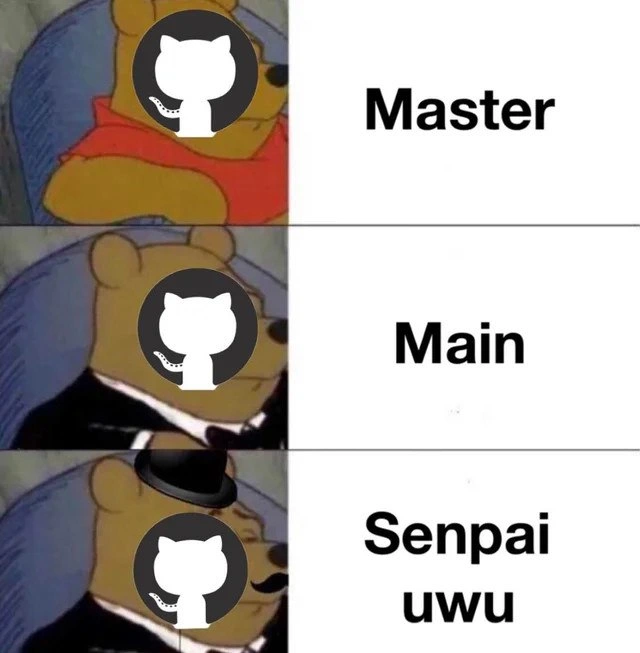
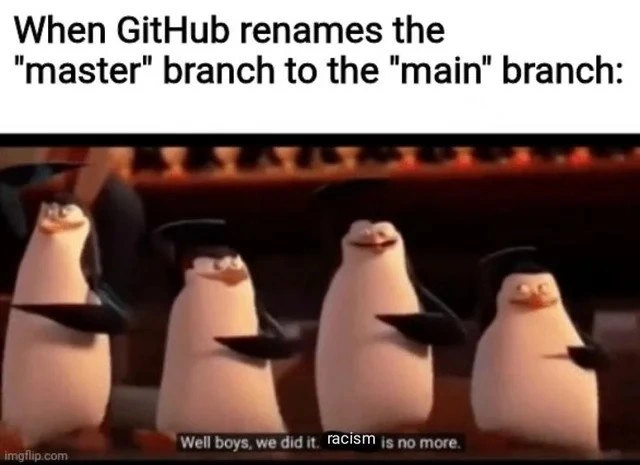
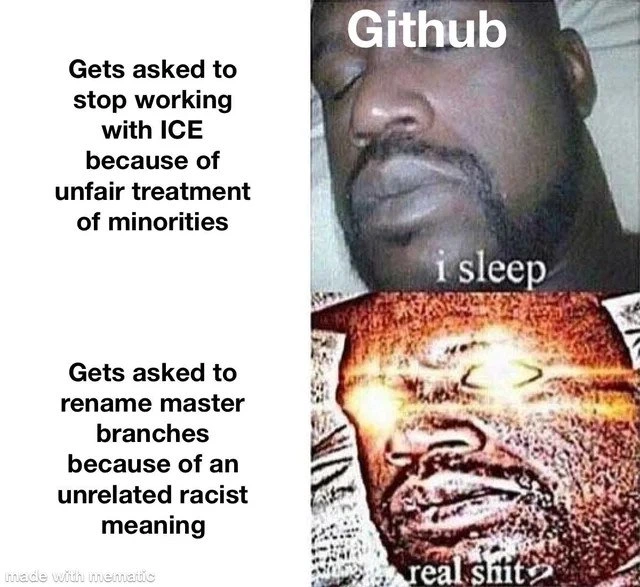
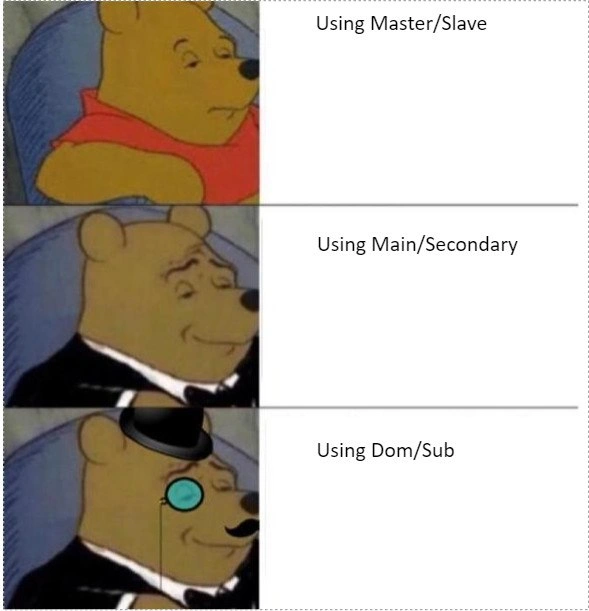
Let’s break down the joke in simpler terms. Git is a popular system developers use for version control – basically, tracking changes in code over time and collaborating without stepping on each other’s toes. When you start a new Git project (a repository), it usually creates a default branch for you. Traditionally, that default branch was named master. Think of a branch as a line of development or a separate timeline of changes in your code. The default branch is like the main storyline in a choose-your-own-adventure book – it's where the primary development happens (often this is the code that eventually goes to production). Around June 2020, GitHub (an online service for hosting Git repositories and sharing code) decided to change this default branch name from master to something more neutral like main. Why? To avoid references that could remind people of master/slave terminology, which is associated with the history of slavery. This was part of a broader movement in tech to use more inclusive language. For example, many projects started saying “allow list” instead of “whitelist” (and “block list” instead of “blacklist”), or using terms like “primary/replica” or “leader/follower” instead of “master/slave” when describing systems where one thing controls others. The idea is to choose words that don’t carry baggage or make anyone feel unwelcome.
Now, separate from Git and GitHub, there’s the world of Agile software development. Agile is a way of working on projects that emphasizes quick, iterative progress and flexibility in planning. Scrum is one popular Agile framework (kind of like a recipe for how to do Agile). In Scrum, teams break their work into short cycles called sprints, and they have specific meeting routines and roles. One key role in Scrum is the Scrum Master. Despite how it sounds, a Scrum Master isn’t an empire-building boss or anything – they’re more like a coach or team guide. Their job is to help everyone follow the Scrum process, facilitate meetings (like daily stand-ups where team members quickly share what they’re working on), and remove obstacles that are slowing the team down. The word “Master” in this context was meant as “master of Scrum methodology” – i.e. someone knowledgeable, not “master” as in an owner of people. In fact, Scrum Masters are often described as servant-leaders: they lead by serving the team’s needs.
Now here’s the funny part that the meme highlights: GitHub is moving away from using the word "master" because of its negative connotations in one context, but in the Agile world that same word is part of an important job title, and nobody’s changing it. The meme uses the picture of a monkey puppet that’s famous on the internet for looking really awkward (first looking straight, then peeking side-eye) to represent how Scrum Masters might feel hearing about the GitHub change. The text at the top says GitHub is replacing “master” to avoid slavery references, and then at the bottom it labels “Scrum Masters”. So it jokingly suggests: Scrum Masters hear that and suddenly do a double-take, making the face like “😬”. It’s as if they’re thinking, “Oh no... my title has that word too. Awkward!”
For someone new to these terms, it’s basically pointing out irony. One part of the developer world is carefully changing a word to be more considerate, while another part of the developer world still uses that very word in a common title. Neither side is wrong exactly – context is everything. “Master” means different things in Git vs. in Scrum. But the contrast is amusing. It’s a bit like if a company decided not to call their top boss the “Chief” because it sounded insensitive, but meanwhile there’s another department where someone’s official job title is “Chief of Fun” – that person might suddenly feel a little self-conscious. The categories VersionControl and Agile in the tags show that the joke spans these two realms of software development. And tags like NamingConventions and ScrumHumor hint that it’s about the quirky importance of what we call things. All together, the meme makes a light-hearted joke about how a simple word change can make someone who still has the old word in their title feel a bit uncomfortable. It’s an inside joke for developers that doesn’t require deep technical knowledge – just an awareness that names and labels do matter in tech culture.
Level 3: A Tale of Two Masters
In mid-2020 the software community saw a push for inclusive terminology. One big change was when GitHub, the popular code hosting platform, announced it would replace the default Git branch name master with an alternative (like main) to avoid any association with slavery-era language. (Similar efforts were replacing terms like “whitelist/blacklist” with “allowlist/blocklist” in many codebases to use more neutral language.) This technical decision had cultural weight. By the way, developers often joke that there are only two hard things in computer science: cache invalidation and naming things... (and then someone adds off-by-one errors as a third, proving the point). Changing a simple name can indeed turn into a surprisingly involved issue, as we see here with “master”.
Now enter the world of Agile methodologies, where the term “Scrum Master” is an official job title. Scrum Masters are facilitators in Scrum teams – they ensure daily stand-ups happen, help remove blockers, and coach the team on Scrum practices. The word "master" here means expert or teacher, with no relation to the oppressive connotation. However, the meme humorously suggests Scrum Masters might feel a jolt of self-awareness after hearing GitHub's news. In the two-panel awkward puppet monkey meme, the first image shows the puppet looking straight ahead calmly (that’s the Scrum Master listening to the announcement about “master” being problematic). In the second image, the puppet’s eyes dart sideways in an uncomfortable, side-eye glance – as if those Scrum Masters are suddenly wondering, “Wait, does my title make me part of the problem?” It’s a perfect comedic collision of version control culture and Agile terminology.
What makes experienced developers smirk at this meme is the contrast in context. They know Git inside out – how a master branch is just a name, one that can be changed with a quick config update or a git branch -m master main command. They also know that Scrum has deep roots and certified roles; you can’t just rename “Scrum Master” overnight without confusing the entire Agile community (and invalidating a lot of training materials and certification titles!). The meme pokes fun at the sometimes inconsistent nature of the tech world’s push for better naming. VersionControlHumor meets AgileHumor here: one part of the tech stack is evolving its language for inclusivity, while another part stands pat due to tradition or inertia. The joke works because of that terminology conflict – the same word "master" means very different things in two domains, yet only one domain is changing it. And of course, many of us remember the scramble when this change happened: one week you’re typing git push origin master, and the next week you’re updating scripts, CI pipelines, and muscle memory to use main instead. Meanwhile, in daily Scrum meetings, the Scrum Master still introduces themselves with that title, business-as-usual. The disparity is funny: it’s like half the industry did a quick vocabulary refactor, while the other half kept the original term for the sake of continuity (a bit like maintaining backwards compatibility in code). Developers who’ve been around the repo (and the sprint backlog) a few times appreciate this irony. They might jokingly ask, “So, is it time to rebrand Scrum Masters as Scrum Facilitators?” knowing that’s unlikely. This shared understanding of tech lingo – and how a well-intentioned change can create these awkward little moments – is exactly what the meme is playing on. It’s an “I see what you did there” moment that brings a chuckle in our developer community.
Description
A meme using the 'Awkward Look Monkey Puppet' format to humorously comment on the tech industry's move toward more inclusive language. The image is split into two panels showing a brown monkey puppet first looking forward with a neutral expression, then glancing nervously to the side. Above the puppet is the text: 'GitHub to replace "master" with alternative term to avoid slavery references'. Below the puppet, the text reads: 'Scrum Masters'. The joke is that Scrum Masters, whose job title contains the word 'Master', are nervously watching the debate around GitHub's 'master' branch, wondering if their own title will be the next to be deemed problematic and targeted for a change. It captures a moment in 2020 when discussions about terminology were prevalent in the tech community

Comments
7Comment deleted
The Scrum Master's daily standup just turned into a daily lookup... to see if their title is still on the company's approved list
Amazing that ‘git branch -m master main’ takes two seconds, but renaming ‘Scrum Master’ needs a cross-functional task force, HR sign-off, and three sprints of bikeshedding
Waiting for the day when we have to explain to stakeholders why we're renaming Scrum Masters to "Agile Facilitators" while they're still trying to figure out what a Scrum Master actually does
GitHub's 2020 decision to rename 'master' to 'main' was meant to remove problematic terminology from version control, but the meme brilliantly captures the cognitive dissonance when Scrum Masters nervously realize they dodged the renaming committee. It's the tech equivalent of renaming your production database from 'master' to 'primary' while your entire organization still runs daily standups led by someone whose literal job title contains the word you just deprecated. The real kicker? Both terms have completely different etymologies (Git's 'master' comes from master recording/copy, Scrum Master from mastery/expertise), but try explaining that nuance during a 15-minute standup when you're already 10 minutes over
GitHub: master → main. Enterprise: keep “Scrum Master” - it’s the only master without push access, and renaming it would trigger a reorg bigger than the monolith
GitHub deprecates 'master' branch for PC points, but good luck refactoring 'Scrum Master' without nuking the entire sprint backlog
We migrated hundreds of repos to main and patched every CI branch filter - yet “Scrum Master” survives because vendor trademarks have harder lock‑in than our monolith