Skip to content
DevMeme
1534 of 7435
Renaming 'master' branch sparks urgency, cancelling ICE contracts just gets snoozed
VersionControl Post #1715, on Jun 16, 2020 in TG

Renaming 'master' branch sparks urgency, cancelling ICE contracts just gets snoozed

Why is this VersionControl meme funny?

Level 1: Easy Analogy – Painting the Fence vs Stopping the Bully

Imagine there’s a school where a bully is picking on kids in a really unfair way. Some teachers and students ask the principal, “Can we please stop this bully from hurting the students?” But the principal doesn’t do much; he kind of pretends not to hear it and takes a nap instead.

Now, at the same school, someone notices that the welcome sign at the front has a word that might be mean or hurt someone’s feelings (even if it wasn’t meant that way). People ask, “Hey, maybe we should change that word on the sign to be nicer.” Suddenly the principal jumps up wide awake, super energetic, and says, “Absolutely, let’s change the sign right now!” They quickly repaint the sign with a nicer word and proudly show it off.

Do you see the problem? The principal was very quick to paint the fence and make the school look good, but very slow to stop the bully who was actually hurting kids. Changing the sign was easy and made people say “Oh wow, they care!” – but it didn’t really fix the big problem. The bully is still there, making life hard for the students, and that’s a much more important issue to deal with.

This is what the meme is joking about. It’s like saying the company cared more about fixing a small wording issue to show they are friendly (like repainting the sign) but didn’t take action on a big moral issue (stopping the bully). It’s funny in a kind of pointed way because we all know the big problem is being ignored. The meme uses a silly picture – someone sleeping through the big call for help, then waking up excited for the small task – to make us laugh about how backwards that priority seems.

Level 2: Branch Names & Broken Promises

Let’s break this down in simpler terms, especially if you’re a newer developer or not familiar with the context:

Git and the “master” branch: Git is a popular version control system that developers use to track code changes. In Git (and on platforms like GitHub), the default main line of development in a repository was traditionally named master. Think of master as the primary branch where all finished work eventually gets merged. A branch in Git is like a parallel line of development or a “save file” timeline for your code. The term “master” wasn’t originally chosen to mean “master/slave” in a human context (more like “master copy”), but because the word “master” can also evoke the history of slavery, there was a recent movement to change this term to something more neutral. Many projects and companies decided to use main (or primary, etc.) instead of master for the default branch name. This is part of a wider inclusive language effort in tech, where terms like “whitelist/blacklist” are being replaced with “allowlist/denylist”, and “slave” (for secondary replications) is replaced with “replica” or “worker”, etc., to avoid terminology that relates to racist or oppressive contexts.

Renaming master to main: In practice, renaming the master branch is a fairly simple technical task. For example, if you’ve just created a repo or you have permissions on an existing one, you can do:

# Rename the current branch 'master' to 'main'
git branch -m master main
git push -u origin main

After this, the repository’s primary branch is called main. However, all developers have to remember to update their local clones and some continuous integration (CI) or deployment scripts might need updating to point to “main” instead of “master”. It was a quick change that spread across the industry around 2020, and hosts like GitHub even automated it for new repositories.

What is ICE and why the fuss? ICE stands for Immigration and Customs Enforcement, a U.S. government agency. In the late 2010s, ICE became controversial for its role in enforcing immigration policies that included detaining migrants and separating families at the U.S. border. Many people (including employees inside tech companies) felt these practices were cruel, especially toward minorities. It turned out a number of tech companies had contracts with ICE – for instance, providing cloud services, data analytics, or software that ICE used. “Working with ICE” means a tech company is selling its technology or services to that agency. Activists and many tech workers started urging their employers to cancel those contracts as a way to protest or not be complicit in what ICE was doing.

Corporate response differences: The meme highlights that when developers and the public said to companies, “Hey, maybe don’t help ICE since they’re mistreating people,” a lot of those companies basically hit the snooze button – no immediate action. It was a serious issue, but responding to it could mean losing millions of dollars or a government client, so companies were very reluctant. In contrast, when people suggested, “Hey, maybe we should change ‘master’ branch to something less loaded,” many companies jumped on it right away. In fact, GitHub itself (the biggest Git repository hosting service) announced in 2020 that it would change the default branch name for new repos to “main.” This got a lot of positive press coverage.

For a junior developer, this might have been noticeable if you followed any coding tutorials or documentation from before 2020. They often said things like “push your code to the master branch”. Suddenly in 2020, you might have seen updates everywhere saying “push to the main branch (formerly master)” and wondered why the change. This was due to that inclusive language initiative.

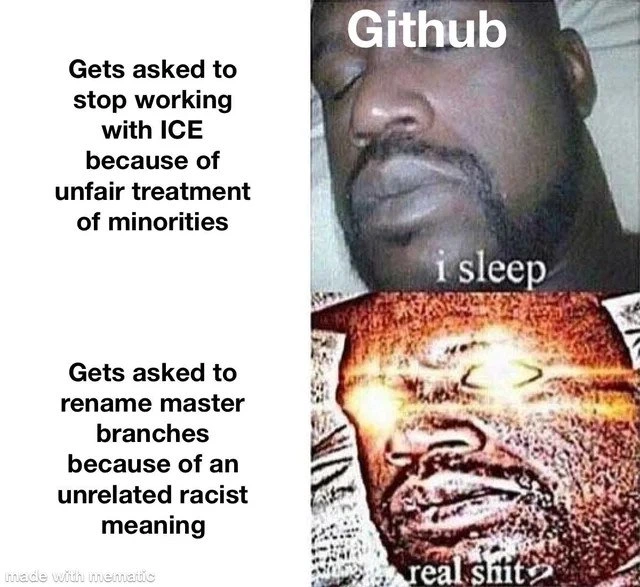
Understanding the humor: It helps to understand the meme text. The top text says: “Gets asked to stop working with ICE because of unfair treatment of minorities” next to a picture of a sleeping Shaq labeled “GitHub” — implying GitHub (or the company) is effectively sleeping on or ignoring that request. The bottom text says: “Gets asked to rename master branches because of an unrelated racist meaning” next to Shaq now wide awake with glowing eyes and the caption “real shit” — implying “Whoa, now this is important, we’re wide awake and on it!” It’s an exaggerated joke about what the company treats as urgent.

So, summarizing in plainer terms: The company snoozes on a big ethical issue (won’t drop a contract with a controversial government agency hurting minorities) but springs into action on a smaller terminology fix (changing a branch name in Git because some think “master” has racist connotations). The humor is a bit dark here. It’s calling out that the company seems to care more about looking good by tweaking language than actually doing good by changing a harmful business practice. Another way to put it: they put a lot of energy into a symbolic gesture (which is good in principle but mostly about image) and much less energy into a substantive action that could help minorities in a real way (but would cost them something).

For a junior dev, it’s a peek into CorporateCulture. It shows how big companies might operate: the things that affect their reputation but are easy to do (like a terminology change) get done immediately, often with big announcements. The things that would require difficult decisions or losing money (ending a contract, making less profit for the sake of ethics) get delayed, studied to death, or ignored — even if employees or outsiders are asking for them. This disconnect can be frustrating to many developers, especially those who care about social issues. It’s also a form of IndustrySatire: making fun of the tech industry’s tendency to hop on whatever trend is hot in social media or PR (like inclusive naming in 2020) while sweeping more uncomfortable issues under the rug.

In simpler tech terms: the company prioritized a branch name change over a branch of its business. The branch name (master to main) was changed in the name of inclusivity (which does have positive intent and effect on culture). The branch of business (the ICE contract, a revenue stream) remained intact despite ethical concerns, because canceling it was inconvenient. For many developers who were aware of both stories, this was ironically hypocritical, and that irony is exactly what the meme humorously exposes.

Level 3: Masterful PR vs ICE-Cold Reality

On the surface, this meme uses the classic “I Sleep / Real Shit” two-panel format to poke fun at GitHub (and big tech companies in general). The left panel shows GitHub (represented by a sleeping Shaquille O'Neal) when asked to cancel contracts with ICE (U.S. Immigration and Customs Enforcement) over the agency’s unfair treatment of minorities—GitHub figuratively “snoozes” through that serious moral request. In the right panel, the same GitHub suddenly has glowing laser eyes when asked to rename the 'master' branch to something else (like 'main'), treating this much smaller task as “real shit” (i.e., extremely urgent and important). This stark contrast is satirizing corporate double standards: how companies often respond with lightning speed to trendy, low-cost symbolic changes (like adopting more inclusive language in code) while dragging their feet or outright ignoring hard, substantive changes (like losing revenue by dropping an ICE contract).

Why is this funny to developers? It’s highlighting a painfully familiar hypocrisy in tech corporate culture. In mid-2020, during global discussions on racial justice, many tech firms (including GitHub) were pressured to both make ethical choices and to clean up non-inclusive terminology. Renaming the default Git branch from “master” to “main” (or another neutral term) became an IndustryTrends_Hype—a visible way to signal inclusivity. Meanwhile, those same companies were being called out for doing business with organizations like ICE, which some employees and users found morally objectionable. The meme exaggerates the typical response: the hard conversation about ending a lucrative contract with ICE gets a corporate “I sleep” (meaning we’ll pretend we didn’t hear that), but a version control naming debate gets “real shit” energy (meaning let’s solve this right now!). It’s a biting form of IndustrySatire and CorporateHumor, showing how management can be quick to virtue-signal but slow to make sacrifices.

From a senior developer’s perspective, this hits on an open secret: tech companies often prefer low-effort PR wins over costly systemic changes. Here, switching a branch name to use an inclusive_branch_names policy costs almost nothing—just run a command like git branch -m master main and update a few CI scripts. It plays well on social media and makes the company look progressive with respect to InclusiveLanguage. In contrast, terminating a government contract (especially one as politicized as ICE) could mean lost revenue, upset shareholders, and complex legal unwinding. That’s a much bigger ask with real financial consequences. Even if employees and the developer community clamor for it, the suits upstairs might hit the snooze button indefinitely. This discrepancy is sometimes cynically described as virtue_signaling_in_tech: doing something that looks virtuous publicly (renaming branches, releasing press statements in support of Black Lives Matter, etc.) while continuing business as usual where it truly counts (e.g. continuing to sell cloud services or software licenses to agencies criticized for human rights abuses).

The humor also stems from how disconnected the two issues are in weight. One (ICE contracts) affects human lives and serious ethical stakes. The other (branch naming) is largely a symbolic gesture—the term “master” in Git doesn’t even directly derive from “master/slave” terminology; it likely meant “master copy”. Yet in the summer of 2020, renaming “master” became a high-profile task for projects, with GitHub itself announcing a move towards main as the default branch for new repositories (to avoid any perceived racist connotation). Developers saw companies leaping to implement this change practically overnight. Meanwhile, internal protests like “Drop ICE” petitions were politely forwarded to /dev/null. That contrast is absurd, and that absurdity fuels the meme’s punchline.

Let’s break down the corporate_double_standards at play with a touch of sarcasm:

  • Impact on Society:
    Dropping ICE contracts could tangibly improve lives of real minority communities affected by ICE’s actions. Renaming a Git branch improves… the repository’s naming politeness? It’s largely a symbolic inclusion effort.

  • Impact on Company:
    Cancelling a contract with ICE might reduce profits or future government business opportunities. Renaming “master” to “main” costs virtually nothing (maybe a few developer hours to update docs and tooling) and even earns praise from many in the community.

  • Public Perception:
    Ending an ICE contract might stir political controversy and potentially anger certain stakeholders, while branch renaming is almost universally applauded by the industry press as progressive. It’s an easy positive headline: “Tech Company Moves to Inclusive Terminology”.

  • Likelihood of Action:
    The incentive structures favor the quick, no-cost PR gesture. It’s almost a textbook case of “appear to do good without actually losing anything.” Smart people in these orgs know that virtue signaling can pacify critics for a while. They may genuinely care about inclusion, but the trade-off is clear: one path hits the bottom line, the other hits only the repository settings.

One could say the company chose to refactor its code terminology rather than refactor its principles. Git is ironically easier to change than corporate contracts or conscience. Senior devs have seen similar patterns: for instance, engineering leadership rolling out a new Code of Conduct with fanfare (very visible, minimal cost), while ignoring toxic workplace problems coming from high-performing managers (difficult, internal issue). Here, renaming the “master” branch is like refactoring variable names in your code for clarity – a nice little improvement – whereas dropping ICE is like ripping out a major library your product depends on because you discover it’s morally problematic – a huge deal with far-reaching consequences.

The meme’s glowing eyes “real shit” caption on the bottom panel (“real shit” is slang for “this is the important stuff now”) is especially cutting. It implies that GitHub (or broadly, tech leadership) got more excited solving an arguably tangential VersionControlHumor issue than addressing real human-rights concerns. It’s a harsh commentary on priorities: branch naming triggers a red-alert all-hands-on-deck response, complete with engineers bikeshedding on whether to use main, primary, or trunk as the new term. Meanwhile, the call to cut ties with ICE gets the “I sleep” treatment – ignored, snoozed, or downplayed, perhaps shunted into an endless cycle of “we’re reviewing our policies” meetings until people stop asking.

This resonates with developers who often witness their companies making a big fuss about the latest IndustryTrends_Hype (especially public-facing ones) while neglecting deeper issues. It’s the same energy as a company launching a diversity hiring webpage and patting themselves on the back, while internally still not addressing why their retention of minority employees is terrible. The joke lands because it’s too real: many devs felt that the rush to rename branches was performative. Sure, it’s a good change to remove racially loaded jargon — no one’s really defending outdated terms — but where was that urgency when something actually concrete and morally pressing was on the table?

In essence, the meme is calling out a form of slacktivism in tech. As a seasoned observer might wryly note, the company became a “master” of PR-driven branching strategy (pun intended: branching out into social issues only superficially) while remaining in deep detached sleep on genuinely branching out of unethical ventures. The humor cuts deep because it’s a reminder that for all the progressive posturing, money often outranks morality in corporate decision-making. And developers – especially those familiar with both Git and the tech industry’s culture – appreciate the dark irony of that truth packaged in a Shaq meme. It’s laughing so we don’t cry, basically.

Description

Meme uses the two-panel "sleep / glowing eyes" format. Left side, black text on white says: "Gets asked to stop working with ICE because of unfair treatment of minorities" beside a photo of a man with eyes closed, implying indifference. Below that, left text reads: "Gets asked to rename master branches because of an unrelated racist meaning" beside the same man's face but with bright, laser-beam eyes and the overlaid caption "real shit," signifying sudden excitement. Technically, it satirizes corporate developer culture where renaming Git’s default "master" branch (inclusive language initiative) receives immediate attention, while ending lucrative contracts with U.S. ICE, a far heavier ethical issue, is ignored. Highlights Version-Control debates, inclusive-language trends, and perceived corporate double standards
Comments

6
Anonymous ★ Top Pick Enterprise backlog priorities: P0 - run `git branch -m master main` on 600 repos; P∞ - run `git rm -r $ICE_CONTRACTS` (won’t-fix, blocked by revenue dependency)
  1. Anonymous ★ Top Pick

    Enterprise backlog priorities: P0 - run `git branch -m master main` on 600 repos; P∞ - run `git rm -r $ICE_CONTRACTS` (won’t-fix, blocked by revenue dependency)

  2. Anonymous

    GitHub's PR team discovered that regex replacing "master" with "main" across millions of repos was easier than explaining government contracts to shareholders at the quarterly earnings call

  3. Anonymous

    GitHub's approach to controversy perfectly demonstrates the enterprise priority matrix: renaming 'master' to 'main' gets sprint-0 urgency and full stakeholder alignment, while terminating government contracts that actually impact human lives gets filed under 'backlog refinement needed' with a 'wontfix' label. It's the corporate equivalent of spending three sprints bikeshedding variable names while the production database is literally on fire - except the fire is a moral crisis and the variable is a Git branch. Classic case of optimizing for Twitter sentiment analysis metrics over actual ethical impact assessment

  4. Anonymous

    Master branch: oppressing merges since Git's birth, but ICE ethics? Just another upstream fetch

  5. Anonymous

    Renamed “master” to “main” and declared victory; funny how the only master we can’t seem to rename is the engineer with admin perms deploying from their laptop

  6. Anonymous

    Enterprise ethics-as-a-service: canceling an ICE contract is 'out of scope', but a master->main rename that nukes 80 Jenkins pipelines, Git submodules, and branch protections clears procurement in one sprint

Use J and K for navigation