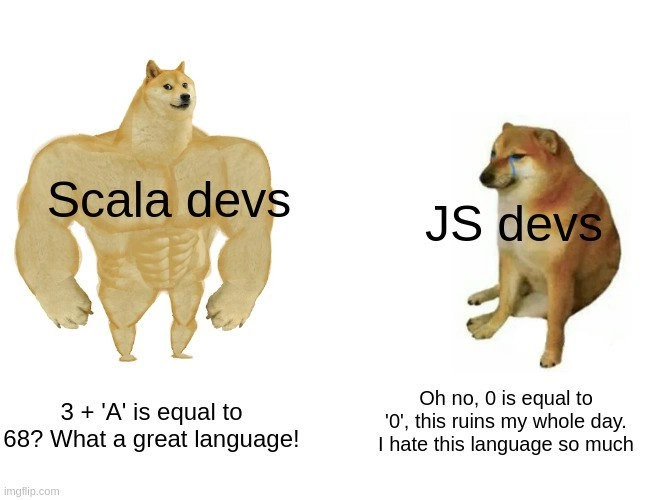
Swole Doge vs Cheems shows Scala vs JavaScript type-coercion woes
Why is this Languages meme funny?
Level 1: Comparing Apples to Oranges
Imagine you have two friends with very different ways of handling things. One friend is super strict and literal: if you give them a letter, say the letter "A", they secretly think of it as the number 65 (because in a common code, A = 65). So if you ask this friend, “Hey, what’s 3 plus A?” they’ll reply “68” with a proud grin. It sounds silly – who adds 3 and "A" and gets 68? – but that’s just how this friend’s brain works, following a strict rule every time.
Now your other friend is more easygoing but kind of inconsistent. You ask, “Is the number 0 the same as the string '0' (like the word zero)?” and this friend quickly says “Yeah, sure, they’re the same.” They figure you probably meant the same thing by them. But another time, this might confuse you because sometimes a zero and the word "zero" are treated differently (like if you asked them to count things, "0" might not count at all). This friend is trying to be helpful by guessing what you mean, but sometimes the guess is odd.
In the meme, the first friend is like the Scala programming language – very strict and consistent, even if it leads to funny answers like treating A as 65. The second friend is like JavaScript – trying to be flexible, sometimes to the point of being confusing, like saying 0 and "0" are equal. The big muscular dog (first friend) is happy and proud because his strict rule makes sense to him, and he finds it cool. The smaller sad dog (second friend) is upset because his flexible approach can backfire and make things messy.
The humor comes from seeing these two side by side. It’s like comparing apples to oranges: one is a totally different approach from the other. We laugh because the strong, buff friend is excited about something that sounds absurd, and the other friend is miserable about something that seems like common sense gone wrong. It highlights how two different ways of thinking (or two different programming languages) can lead to very different feelings: one person saying “Wow, awesome!” and the other saying “Ugh, this is terrible!” It’s a funny way to show why some people love strict rules and others get frustrated by too much wiggle-room.
Level 2: Mixed Types, Mixed Feelings
Let’s break down the joke in simpler terms. The meme uses the popular Swole Doge vs Cheems format: a buff Doge represents one group (Scala developers) confidently enjoying something, and a smaller sad Doge (Cheems) represents another group (JavaScript developers) frustrated by something. Here’s what’s happening in each panel:
Scala side (Buff Doge): The text says “3 + 'A' is equal to 68? What a great language!” Why would 3 plus 'A' equal 68? In Scala, which is a programming language with strong, static typing, characters like 'A' have a numeric value. Computers internally use codes for characters – ASCII encoding is a classic example where
'A'corresponds to the number 65. Scala treats the char'A'as the number 65 when you use it in arithmetic. So3 + 'A'becomes3 + 65, which indeed equals 68. The Scala developer is happy because this might seem odd, but it’s actually a consistent rule in their language. They jokingly call Scala a “great language” for handling this in a logical way. In other words, Scala doesn’t see'A'as just a letter; in that context it sees 65, so the addition makes sense and yields 68. This is a bit of a nerdy delight – it’s like a secret feature that shows how things work under the hood. The Scala dev is basically saying “Isn’t it cool my language can even do math with characters (by using their char codes)?”JavaScript side (Cheems): The text here is “Oh no, 0 is equal to '0', this ruins my whole day. I hate this language so much.” This is about JavaScript’s weak typing and something called type coercion. JavaScript is a language that will try to be helpful by automatically converting values to a common type when comparing them using
==(double equals). So if you ask JavaScript to check0 == "0", it will convert the string"0"into the number0and then compare 0 to 0. And of course, 0 is equal to 0, so it returns true. The JavaScript developer in the meme is upset because they probably didn’t expect that automatic conversion, or it caused a bug in their code. Maybe they had a situation where they wanted to treat the number 0 and the string "0" differently, but JavaScript’s loose equality coerced them to the same thing. The phrase “this ruins my whole day” is an exaggeration, poking fun at how such a small thing can cause big headaches in debugging. The dev says “I hate this language” out of frustration – a sentiment many JS devs have jokingly felt when encountering weird behavior due to the language’s quirks.
So, why are these two devs reacting so differently? It comes down to how the languages handle types (like numbers, strings, characters):
- Scala is statically and strongly typed. That means you usually can’t mix and match types unless it’s explicitly allowed. In the case of
3 + 'A', Scala does allow it, but not arbitrarily – it has a rule: aCharwill be treated as its integer code in numeric operations. It’s an implicit cast, but it’s a well-defined, limited case. Scala devs trust the language to enforce type rules, so they rarely get surprises at runtime. When something like3 + 'A'happens, they know there’s a definite reason (char-to-int conversion) – it won’t silently do something completely wild. That reliability makes them happy, even proud, as shown by buff Doge. - JavaScript is dynamically and weakly typed. “Dynamically” means types are checked on the fly at runtime, and “weakly” typed means the language will try to convert types to make things work instead of stopping you. This can be convenient (you don’t have to manually convert "5" to 5, for example, JavaScript will do it if needed) but it can also be unpredictable. The
==operator in JavaScript is known for these unpredictable moments because of all the behind-the-scenes conversion. In contrast, JavaScript has a strict equality operator===that does not do any conversion – it would check both the value and type, so0 === "0"would be false (since one is a number, the other is a string). A lot of JS developers learn to use===almost always to avoid the kind of surprise our Cheems dog experienced. In code, it looks like this:
console.log(0 == "0"); // true -> JavaScript converts "0" to 0, so it's 0 == 0
console.log(0 === "0"); // false -> different types, so no conversion, not equal
You can see how the choice of operator matters in JavaScript. The meme specifically highlights the loose equality (==) surprise. The JavaScript dev is basically saying, “I just found out my language considers the number 0 and the string '0' as equal in this case, and I’m super annoyed by that quirk.”
To a newer developer, these examples are a bit mind-bending. Why would any language add a letter to a number? Why would a language say a number is equal to a string? It all comes down to design decisions:
- Scala’s design leans toward explicitness and consistency with how computers work (characters have numeric codes).
- JavaScript’s design leans toward flexibility and convenience, automatically converting types, which can sometimes go too far and cause confusion.
The meme uses these specific odd cases to make a broader humorous point: developers often have a love/hate relationship with their language’s type system. The Scala dev is loving it (finding even a weird case to be a sign of greatness) and the JS dev is hating it (even a small oddity can be day-ruining). It’s a fun exaggeration of real feelings.
And let’s not forget the format itself: Doge memes (especially Swole Doge vs Cheems) exaggerate characters for comedic effect. The buff Doge says something bold or braggy, and the Cheems Doge says something whiny or frustrated. Here, Scala devs get to play the buff confident role because strong typing gives them fewer runtime surprises (and bragging rights about language “power”), whereas JS devs play the exasperated role because of the infamous pitfalls of JavaScript’s weak typing. It’s a lighthearted jab – in reality, both languages have their pros and cons, but seeing the contrast in a meme makes us laugh and think, “Haha, so true, I’ve been there.”
Level 3: Type System Flex
This meme hilariously captures a classic LanguageComparison in the software world: strongly-typed vs weakly-typed languages, and the developer reactions that result. On the left, the Swole Doge (buff dog meme) labeled “Scala devs” is proud and confident, saying “3 + 'A' is equal to 68? What a great language!”. On the right, the Cheems (sad doge) “JS dev” groans, “Oh no, 0 is equal to '0', this ruins my whole day. I hate this language so much.” It’s poking fun at how differently Scala and JavaScript handle TypeCoercion and how those quirks affect DeveloperExperience (DX). Seasoned engineers know these pain points all too well.
Why is the Scala dev so swole and happy? Scala’s strong typing means you generally can’t mix types willy-nilly – you’d usually convert types explicitly. Yet here’s a quirky allowed case: adding an integer 3 to a character 'A'. It seems absurd until you recall that under the hood letters are just numbers (thanks to ASCII encoding and Unicode). In Scala (and Java), a Char can automatically act as its numeric code point in arithmetic. So 'A' becomes 65, making 3 + 'A' compute to 68. Instead of a type error or string concatenation, Scala does straightforward math. Seasoned Scala/Java devs chuckle at this because it’s a feature, not a bug – a byproduct of how the type system was designed with numeric types. The swole Scala dev humorously boasts about it as if it’s a flex (pun intended) of the language’s consistency: “Our language is so strong, it can even add letters and numbers logically!” In day-to-day coding, this isn’t a common need, but it exemplifies how strict type rules sometimes enable neat (if nerdy) tricks. Strong typing gives Scala devs a sense of security; nothing happens without a defined rule. Even weird results are predictable if you know the rules, and that predictability can feel satisfying (hence the proud DeveloperHumor here).
Now, the JavaScript dev’s despair is instantly relatable to anyone who’s fought JavaScript quirks. In JS, the loose equality operator == has caused countless "WTF" moments. The Cheems dog represents a JS developer who just discovered that 0 == "0" evaluates to true – and he’s facepalming hard. In a weakly-typed, dynamic language, JavaScript will happily compare a number to a string by coercing types behind the scenes. The dev might have expected 0 (number) and "0" (string) to be treated as different, or perhaps was caught by a bug where a user input "0" bypassed a check due to this conversion. This feels like the language “changing the rules” on you at runtime. The meme exaggerates the frustration: “I hate this language so much.” It’s funny because every JS programmer, even seniors, have hit one of these LanguageQuirks that make you momentarily curse JavaScript. Maybe it was [] == 0 being true, or " \t\n" (just whitespace) == 0 being true, or other bizarre coercions – 0 == "0" is one of the tamer examples, yet it’s enough to ruin Cheems’ day.
Underlying this humor is an ongoing LanguageWars debate. Strongly-typed language folks (like Scala devs, or Java/C# devs) often brag that their language’s strictness prevents silly bugs: you can’t accidentally treat a string as a number unless you meant to. Everything is checked or converted explicitly, and results like 68 from 3 + 'A' are perfectly logical once you know 'A' is 65. On the flip side, JavaScript and other dynamically-typed language devs enjoy flexibility but suffer weird edge cases: the language tries to be clever and ends up giving you surprises. The joke here is that the daily developer experience in JS includes moments of “Why on earth is this equal?!” which can be maddening (hence the ruined day), whereas Scala devs are smug that even odd cases are covered by rational rules. It’s an exaggerated contrast – in reality, JS devs don’t hate their language (well, not most of the time), and Scala devs also encounter frustrations (hello, complex type inference errors!). But the DeveloperHumor lands because it’s built on a grain of truth: type coercion issues have caused real production bugs and head-scratching moments. The meme format (buff Doge vs Cheems) brilliantly amplifies that contrast: one side flexes about their language design, the other sulks in defeat.
From a senior developer perspective, this also hints at best practices and lessons learned:
- In JavaScript, experienced devs treat
==as a footgun. Many will tell you “Always use===!” to avoid these coercion surprises. The JS dev’s mistake (or the language’s design flaw) was using loose equality where strict equality would have avoided the problem (0 === "0"is false, which is usually what you’d expect). The community has effectively patched the issue by socially deprecating==in favor of===except in very controlled situations. - In strongly-typed languages like Scala, devs learn the ins and outs of the type system. The fact that
3 + 'A'compiles and yields 68 is a bit of trivia that shows understanding how chars and ints interact. It’s not a common bug source (since it’s intentional), but it’s a gotcha for newcomers. A senior Java or Scala dev might grin and say, “Yup, a char is basically a number – we’ve been doing that since C days.” It’s a point of pride that even weird operations are explicitly defined, not left to chance.
The meme plays on these shared experiences. Every JS dev remembers the first time loose typing bewildered them. Every Scala/Java dev recalls discovering that characters have integer codes. By showing the Scala dev celebrating a quirky feature while the JS dev lamenting one, it satirizes how we often defend the peculiarities of the languages we love and complain about those in the languages we don’t. In essence: “My language’s quirks are features; your language’s quirks are bugs.” It’s a tongue-in-cheek commentary on programmer pride and pain. The strong vs weak typing debate isn’t going away anytime soon – and as this meme shows, it can be mined for comedic gold based on real-world developer feelings.
Level 4: The Algebra of Coercion
Under the hood, this meme pokes at fundamental type system mechanics. In Scala, a statically typed language on the JVM, the expression 3 + 'A' exploits a widening conversion: the character 'A' is implicitly converted to its ASCII (actually Unicode) numeric code, 65, before addition. Formally, Scala (like Java) treats a Char as a 16-bit integer value in arithmetic contexts. So mathematically, it evaluates as $3 + 65 = 68$. The compiler’s type rules allow this because Char can safely promote to an Int. This isn’t a random quirk but a deliberate design: in the type algebra of Scala, Char $\rightarrow$ Int is a valid implicit cast (no precision lost), making "A" essentially just a number under the covers. The Scala dev’s exclamation “What a great language!” reflects an appreciation for this consistent, low-level reality – every character is a number to the machine, and Scala’s strong typing makes that explicit in code.
On the JavaScript side, we delve into the realm of weak typing and the infamous Abstract Equality algorithm. JavaScript is dynamically typed, so using the double-equals operator (==) triggers implicit type coercion at runtime. According to the ECMAScript specification’s rules for ==: if one operand is a String and the other is a Number, the engine will convert the string to a number before comparison. Thus, 0 == "0" invokes a conversion of "0" → 0 (a numeric zero), and then compares 0 to 0, resulting in true. In a formal sense, JavaScript’s equality is context-dependent: the language defines a series of conversions to attempt an “equal” comparison across types. This leads to non-intuitive equivalences – the language tries to be helpful by guessing your intent, at the cost of violating strict logical consistency (unlike === which checks strict equality with no coercion). Notably, this coercion algebra isn’t even consistent across contexts: for example, as a Boolean, the string "0" is truthy (non-empty string), whereas the number 0 is falsy – yet 0 == "0" returns true. These corner cases arise from historical design decisions aiming for convenience (e.g., '0' as input should match number 0). In theoretical terms, JavaScript’s loose equality is not a transitive or pure equivalence relation in the way one might expect; it’s defined by a chain of type conversions rather than straightforward value comparison. The result is a type-coercion maze that language theorists would call a trade-off between user-friendly flexibility and formal type safety. It’s a stark contrast: Scala’s compile-time type checking and simple numeric promotion vs. JavaScript’s runtime guessing game defined by the spec’s conversion table. The meme humorously magnifies this deep design dichotomy in how programming languages interpret and compare values.
Description
Two Doge meme panels illustrate language quirks: on the left, a hyper-muscular Doge labeled "Scala devs" stands proudly, captioned "3 + 'A' is equal to 68? What a great language!" On the right, a sad, slumped Doge labeled "JS devs" laments, "Oh no, 0 is equal to '0', this ruins my whole day. I hate this language so much." The image contrasts Scala’s implicit char-to-ASCII numeric addition with JavaScript’s loose equality coercion, poking fun at how different type systems and equality rules affect developer happiness. The visual uses the popular "Swole Doge vs Cheems" format, highlighting ongoing debates among senior engineers about strong vs weak typing, language design trade-offs, and daily developer experience
Comments
20Comment deleted
Scala’s implicit Numeric[Char] turns 3 + 'A' into 68 with chest-day confidence, while JavaScript’s 0 == '0' just reminds me that lenient coercion is basically Stockholm syndrome in curly braces
Scala devs explaining type coercion: "It's just ASCII arithmetic." JS devs explaining type coercion: "So we wrote a 47-page ESLint config and three custom Babel plugins to make === the default, but somehow null still isn't an object except when it is."
The real irony here is that both examples are technically runtime behaviors - Scala's implicit conversions can be just as surprising when you accidentally import the wrong scope, and seasoned JS devs learned to use === in 2010. But sure, let's pretend the language choice is what separates the 10x engineers from the rest of us mortals still debugging production at 2 AM regardless of our type system
Scala: Char is numerically widened, so 3 + 'A' = 68; JavaScript: abstract equality does ToNumber, so 0 == '0' = true - prefer === unless you enjoy on-call archaeology
Staff-level rule: enable ESLint eqeqeq and let Scala keep char-as-int math - fewer incidents than any microservice rewrite
Scala devs see type coercion as promotion; JS devs see it as grounds for a strict equality intervention
how come 3 + 'A' == 68? Comment deleted
The ascii code of A is equal to 65 Comment deleted
thanks. so scala autocasts char to integer? Comment deleted
char is a number, you don't need to cast it. it's just 1 byte of numbers from the very beginning. letters are just visual interpretation. Comment deleted
Yeah, but '0' != 0 in Scala, and that makes sense, cause Scala not suck, unlike js Comment deleted
In js we have a strict check !== 😁 Comment deleted
You also have 2 types of null, because 1 wasn't problematic enough Comment deleted
When you think 2 is too many, there comes Objective-C++ with 5 null types Comment deleted
well, 1 is undefined and it means you forgot to define result null is no result. but also you can easily implement a Maybe monad and then redefine types such as undefined and null means the same and in your code there is only a value or Nothing. by encountering a undefined or null return, you know it IS undefined indeed and needs a proper monadic return. Comment deleted
"1"-1==0 // 😭 "1"+1=="11" // 🥹 Comment deleted
People that doesn’t understand type coercion all around In JS 0 is not equal to ‘0’ unless you use type coercion to compare, which you shouldn’t unless you know what you are doing. Just use strict comparison otherwise and by default Comment deleted
You missed the point. The joke is kinda same type coercion being perceived positive and negative just depending on language adopters preferences 😄 Comment deleted
Scala is a great and enjoyable language Comment deleted
Scala is more functional. It has better implementation of algebraic data types. In all other cases (IMHO) Kotlin is better Comment deleted