Skip to content
DevMeme
3885 of 7435
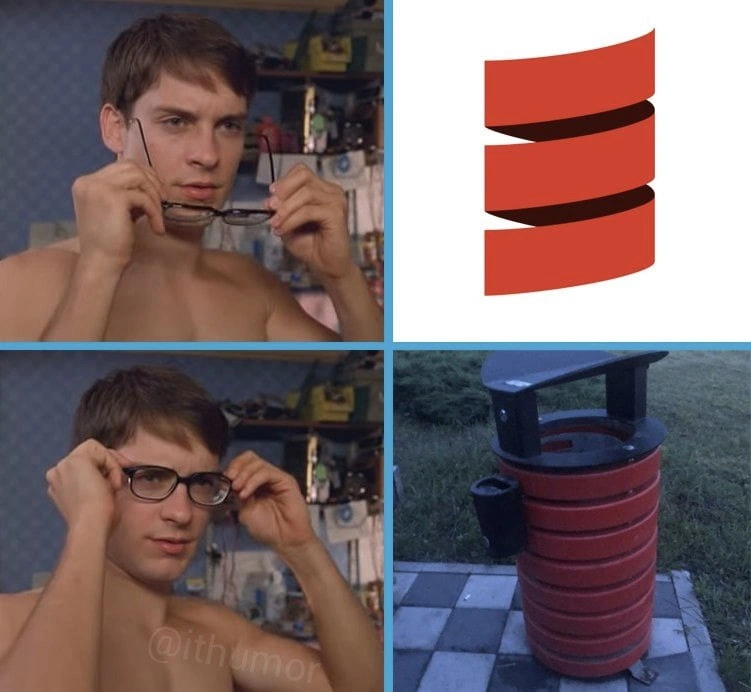
Scala's Logo vs. Its 'True' Form
Languages Post #4231, on Feb 20, 2022 in TG

Scala's Logo vs. Its 'True' Form

Why is this Languages meme funny?

Level 1: Just a Trash Can

Imagine you see something shiny and red in the distance and you get excited because you think it’s something cool – maybe a fancy toy or a special box. But then you put on your glasses and look again, and oops! It turns out it’s not what you thought at all; it’s actually just a trash can. Kind of disappointing, right? That’s the simple idea behind this joke.

In this meme, a programmer first thinks he’s looking at the logo of Scala (Scala is just the name of a computer language, kind of like how English or Spanish are languages but for computers). He’s like “Oh wow, Scala, cool!” in the blurry view. But then he puts on his glasses to see clearly and realizes “Wait a second… that’s not Scala. That’s literally a garbage can!” In other words, the meme is saying Scala = garbage in a joking way. It’s an exaggerated, silly way to say “I thought this thing was great, but nah, it’s actually junk.”

Why is that funny to some people? Well, in groups of programmers, they like to tease about which coding language is better, kind of like kids teasing each other about their favorite superhero or sports team. It’s not a serious insult, more like a tongue-in-cheek jab. Here someone who maybe didn’t enjoy using Scala is joking that Scala is as worthless as trash. They used the scene from a Spider-Man movie where Peter Parker puts on glasses to clarify what he’s seeing. So it’s a little story in four pictures: blurred vision made a logo look like something it’s not, clear vision reveals the truth. The Scala logo is red and has a funny shape, and by coincidence a real trash can had a similar shape and color, which makes the switcheroo extra funny.

At its heart, this meme is like a cartoon saying, “I thought I had something awesome, but nope, it was garbage all along!” It makes people laugh because it’s a bit mean but in a playful, over-the-top way. Even if you don’t know Scala, you get the idea: sometimes things that seem great at first can end up being disappointments – and here that idea is conveyed by literally mistaking a garbage bin for the great thing. It’s the kind of joking exaggeration you’d understand even on a playground: the thing I don’t like is so bad, I might confuse it with trash!

Level 2: Blurry Vision, Sharp Roast

Let’s break down the meme in simpler terms. We have four panels in a classic format known around the internet as the “Spiderman glasses meme.” In the first image (top-left), we see Peter Parker (Tobey Maguire from the Spider-Man movie) squinting or taking off his glasses. His vision is poor, so things are blurry. In the top-right panel, from Peter’s fuzzy point of view, there’s a big red logo – this is the Scala logo, which looks like three red curved bands stacked on top of each other. Peter, without his glasses, thinks he’s seeing the Scala symbol.

Now, in the bottom-left panel, Peter has put his glasses on. He’s looking intently; his vision is clear now. Finally, in the bottom-right panel, we see what he’s actually looking at with clear vision: a red trash can (an outdoor garbage bin) with horizontal ridges and a black lid. Turns out, that trash can’s shape and color looked a bit like the Scala logo from afar! The crucial detail is that once Peter can see properly, he realizes it’s not the Scala logo at all – it’s literally a trash can.

So, what’s the joke? Essentially, it’s saying: “I mistook Scala for something valuable, but once I looked closer, I see it’s just garbage.” This is a form of language roast – a playful insult aimed at the Scala programming language. In developer communities, a “roast” means jokingly making fun of something. Here Scala is being made fun of by equating it to trash. It’s part of a larger theme of language rivalry humor. Developers often have strong opinions about programming languages (we call these LanguageWars jokingly). You’ll find memes where, say, Python fans tease Java, or C programmers mock JavaScript, and so on. It’s a mix of genuine critique and lighthearted tribalism. In this meme, someone clearly isn’t a fan of Scala and is expressing it with a bit of dark humor.

To understand why someone would call Scala “trash,” let’s briefly explain what Scala is. Scala is a programming language (the name comes from “scalable language”). It was created to run on the Java platform (the JVM – Java Virtual Machine) and is compatible with Java code. Scala is known for combining two different programming styles: object-oriented (like Java, where you have classes and objects) and functional programming (like Haskell or Lisp, where you focus on functions, immutability, and expressions). Scala lets you write very concise code and introduces features like lambdas (anonymous functions), pattern matching (a powerful switch-case on steroids), and a strong type system that catches many errors before the program even runs. In theory, these features help developers be more productive and make fewer mistakes. A lot of big data tools (for example, Apache Spark) were built in Scala because of these benefits, and many Java developers learned Scala in the 2010s thinking it was the “next big thing.”

However, Scala also earned a reputation for being hard to learn and sometimes overly complicated. Beginners (and even experienced devs coming from simpler languages) often find Scala code challenging to read if it uses all of those fancy features. Error messages can be confusing, and if you’re not used to functional programming concepts (like map/filter/reduce, monads, etc.), Scala code can look alien. It’s not that Scala is bad at what it does – it’s that it demands more from the developer to use it well. Because of this, there’s a bit of a backlash in some circles. People who struggled with Scala or had a bad experience might jokingly call it “trash” out of frustration or just to get a laugh from others who feel the same. It’s similar to how some folks joke about JavaScript being weird or Java being verbose. Every language has its haters and comedians.

Now, the meme itself doesn’t use any words to say “Scala is trash” – it does it with pictures. That’s why the Spiderman-with-glasses format is clever here. It’s a visual metaphor:

  • Blurry vision Peter = a developer with perhaps rose-tinted glasses (or no glasses, in this case) initially seeing something in a positive or mistaken way.
  • Scala logo in blur = the developer thinks Scala is there (maybe they expected Scala to be great).
  • Clear vision Peter = the moment of truth, seeing reality without distortion.
  • Trash can in focus = the reality: “Oh, it’s actually garbage.” (i.e., “Scala turned out to be garbage”).

This meme is an example of DeveloperHumor where knowing the context is key. If someone doesn’t know Scala, they might just see “red logo became red trash can, huh?” So, let’s make sure the context is clear:

  • Scala logo: If you’ve never seen it, it’s just a stylized icon for the Scala language. It doesn’t literally depict anything (some logos like Java’s have a coffee cup, etc., but Scala’s is abstract). It looks like a red cylindrical shape with three curved segments. By pure chance (or memer’s clever observation) a certain trash can design in real life has a similar cylindrical, segmented look and the same red color! So the meme creator used a photo of that trash bin to represent “trash” in a way that visually echoes the Scala logo.
  • Spiderman glasses meme: This is a popular meme template. Even outside programming, people use it to joke about getting clarity on a situation. In caption form, people often write something like “X (blurry) vs. Y (clear)” on those panels. In our case, the images themselves do the talking: Scala vs trash can. The watermark “@ithumor” indicates the image circulated on an Instagram/Twitter humor account dedicated to IT or programming jokes.

All of this falls under the culture of developers poking fun at each other’s tools. It’s important to note, this is usually done in good fun. One day Scala is the punchline, another day it’ll be some JavaScript framework or a database or whatnot. The aim is to get a relatable laugh: many devs remember struggling with Scala or hearing the hype and then the grumbling later. Seeing it called “just a trash bin” in such a visual way is absurd enough to be funny. It’s that mix of recognition (“Haha, that trash can does look like the Scala logo!”) and exaggeration (“Sure, Scala has issues, but calling it literal garbage is over the top – and that’s why it’s humorous.”).

So, to recap Level 2: The meme uses a famous movie meme format to compare the Scala programming language to a garbage can once things come into focus. It’s a joke about how some developers feel disillusioned by Scala, framed as a simple “mistaken identity” gag. You don’t need to know Scala deeply to get it – just knowing that Scala is a programming language and that calling something “trash” means you think it’s bad. The language rivalry aspect (Scala being bashed here) is a common source of comedy in programmer communities. Everyone has their favorite tools and the ones they love to hate, and memes are the playful battlefield where these opinions clash. In this case, Scala ended up in the hot seat, and Spidey’s improved eyesight delivered the punchline.

Level 3: Type-Safe Trash Talk

For seasoned developers, this meme hits on the familiar language wars trope. It’s poking fun at Scala – a language known for its power and also for the divisive opinions around it. Why is this funny to an experienced dev? Because we’ve all witnessed (or participated in) the endless debates where one programmer’s gold is another’s garbage. Here Scala is the target of a roast, being literally equated to trash. The reason it lands is that Scala has a reputation: it’s powerful and expressive, but also notoriously complex and sometimes over-engineered in the eyes of its detractors. In other words, there’s enough truth (and trauma) behind the joke that developers who’ve been around the block will chuckle and maybe wince a little.

Scala’s Resume: It’s a JVM language that promised Java developers a more concise, high-level way to write code by blending functional and object-oriented paradigms. It was the hot new thing in the late 2000s and 2010s for companies wanting to modernize their Java stacks. Big players like Twitter adopted Scala early on, and frameworks like Apache Spark (for big data) are built with it. On paper, Scala offers immense power: type-safety (catching bugs at compile time), concurrency tools (Akka actors for distributed systems), expressive syntax (you can do in a few lines what might take dozens in Java), and advanced features like pattern matching and implicits (which automatically provide context without explicit code).

So, where does the trash talk come in? Well, many teams discovered that with great power comes great complexity. Scala codebases can become abstruse if developers go wild with those features. For example, heavy use of functional combinators, or deeply nested monads, or too-clever implicit conversions can turn code into an inscrutable black box. Compile times in Scala (especially Scala 2.x) could be agonizingly slow for large projects. Tooling like SBT (Scala’s build tool) had its own learning curve and quirks, often surprising folks used to Maven/Gradle. All these little pain points add up. If you’ve ever been the on-call developer at 3 AM trying to decipher a stack trace spewing through layers of abstract Scala frameworks, you might feel the meme in your soul. The logo that once stood for hope and progress starts to look an awful lot like… well, a trash bin of problems.

Let’s break down why a developer’s initial rosy view of Scala might turn skeptical:

Expectation (Hype) Reality (Frustration)
“It runs on the JVM, so it’s like Java but cooler!” Scala’s different paradigms mean you’re basically learning a whole new way to think about code. It’s Java’s world, but with alien rules.
“Less boilerplate than Java – code will be concise!” Code is concise… sometimes too concise. One-liners with overloaded operators and implicits can feel like solving a puzzle just to read it.
“Cutting-edge features (lamdas, pattern matching, monads!) will make coding fun!” Those features are powerful, yes, but using them feels like being back in a advanced CS class. Suddenly coding involves rigorous math-like thinking – not everyone’s idea of fun at work.
“We’ll get super scalable, high-performance apps.” You might, but you’ll also get longer compile times, more memory usage, and tricky bugs when the abstraction leaks. Scaling the learning curve is the first challenge to scaling the app.
“A vibrant community (Scala, Spark, Akka – all the big data folks love it)!” The community is there, but it’s smaller than, say, Java’s or Python’s. Finding help or new hires who know Scala can be harder. Some who tried it have already jumped to newer toys (hello Kotlin!).
“We’ll write elegant, type-safe code and catch bugs at compile time.” You will – along with mind-bending compiler errors when something’s off. Ever see a 20-line type error involving Functor[F] or implicit resolution failure? It’s as painful as any runtime bug.

Notice a pattern? Scala came with big promises (many of which it actually can deliver), but the cost in complexity and maintenance often surprised teams. That’s why, in memes and jokes, you’ll see Scala sometimes called “scalability through obscurity” or have its name twisted (like “Skala” with a k, implying it’s only OK-ish). The meme’s visual gag – confusing the Scala logo with a trash can – perfectly encapsulates the sentiment of a disappointed dev: “I thought it was awesome, but it turned out to be garbage (for me).” It’s harsh, exaggerated humor – the kind devs use to bond over shared struggles.

This also ties into the culture of language rivalry humor. Developer communities often form identities around languages. You’ll have the Scala enthusiasts who adore its purity and power, and then you’ll have others (maybe loyal to Java, Python, or newer JVM languages like Kotlin) who love to poke fun at Scala for being overly academic or impractical. Each side has its memes. Scala fans might joke Java devs are stuck writing ceremony and cannot appreciate higher abstractions. Java devs (or others) retort that Scala code is an unreadable write-only mess – thus the “trash” label. It’s a never-ending play-fight, much like how gamers debate console vs PC, except here it’s static vs dynamic typing, or functional purity vs pragmatic simplicity. The LanguageWars tag exists because of exactly this kind of back-and-forth.

Let’s not forget the image choice itself. To a seasoned meme connoisseur, using the “Peter Parker’s glasses” template is a wink and a nod. This format is a tried-and-true way to depict realization or coming to clarity. In the original Spider-Man film scene, Peter Parker’s vision literally sharpens (thanks to his new spider-powers) and he sees the world clearly for the first time without glasses. Meme culture took that and made it a metaphor: seeing the truth of something with clear eyes. So when devs see the Scala logo (three red tiers) morph into a red trash bin after putting on glasses, it symbolically says: “Once I looked closer at Scala, I realized it’s garbage.” It’s a blunt punchline, essentially a Scala roast.

For veteran developers, there’s probably an added chuckle at how perfectly the real trash can in the image resembles the Scala logo. That cylindrical bin with horizontal ridges — it’s uncannily similar to Scala’s spiral stack emblem. It’s as if the universe itself set up the joke for us. We’ve all seen silly comparisons where a logo looks like something unexpected, and here it’s used to land a brutal joke. Visual puns like this tickle the engineer’s love for pattern-matching (pun intended). We spot the similarity and get the joke instantly. It’s the kind of thing someone might snap a photo of at a park (“OMG this trash can looks like Scala, I gotta meme this!”) and share with their dev friends for a laugh.

In summary, at this level the meme resonates because it combines: a shared industry observation (Scala can be maddeningly complex), a familiar comedic format (Spidey’s blurry vs. clear vision), and a dash of visual coincidence (logo vs. bin) to deliver a spicy bit of DeveloperHumor. Seasoned devs might laugh, then sigh, recalling that one project that adopted Scala and became an impenetrable jungle of code. It’s humor that comes from a place of experience: “Been there, dealt with that, and yep – it wasn’t as shiny as it first seemed.”

Level 4: The Blub Paradox

At the deepest level, this meme highlights a classic programming language paradigm clash. Scala isn’t just any language – it’s a blend of object-oriented and functional programming ideas rooted in academic computer science. Scala’s design draws on advanced concepts like strong static typing, type inference, and even theoretical ideas from category theory (for example, monads show up in Scala’s use of Option, Future, etc.). These concepts are powerful and elegant in theory, but to a developer unfamiliar with them, they can seem perplexing or excessive. This disconnect is often explained by Paul Graham’s Blub Paradox: a programmer tends to dismiss any language more advanced (abstract) than what they know as “overkill” or “garbage” because they literally can’t see the value yet – much like our blurry-eyed Spidey who can’t recognize what he’s looking at.

In theory, Scala’s sophistication (its fancy type system with traits, implicits, and pattern matching) offers incredible expressiveness and correctness guarantees. There’s a whole academic lineage here – Scala was created by Martin Odersky, who also worked on Java generics and was influenced by languages like Haskell and ML. The language attempts to unify the multi-paradigm dream: you can do pure functional transformations with immutable data and higher-order functions, or fall back to JVM OO patterns when needed. Computer science research suggests combining these paradigms can yield highly scalable and safe systems. For instance, Scala’s approach to concurrency with the actor model (via Akka) is grounded in theoretical models of distributed systems (the Actor model of computation). So from a theoretical computer science perspective, Scala is far from “trash” – it’s kind of a laboratory of ideas brought into a production language.

However, in practice, that theoretical power comes at a cost. There’s a famous saying: “In theory, there’s no difference between theory and practice. In practice, there is.” Scala’s rich type system (with things like covariance/contravariance, higher-kinded types, implicits, etc.) can lead to extremely complex code – the kind of code that practically requires a PhD (or a very dedicated Google session) to understand. This is where the “trash” joke finds its footing: a frustrated developer might quip that all those high-minded concepts end up being useless baggage in real life, throwing Scala’s lofty principles into the proverbial bin. It’s a reflection of the perennial tension between academic elegance and real-world pragmatism. There’s even a known philosophy in software design called “Worse is Better” which argues that simpler, less theoretically pure solutions often win out. Scala’s design philosophy challenges that by offering something “better” in a CS-theory sense – but many developers, feeling the steep learning curve or the complexity in maintenance, respond by labeling it “too much”. The meme distills that whole saga into one image: blurry vision sees an academic marvel, clear vision sees a garbage can. The Blub Paradox in action – one person’s advanced language is another person’s junk.

Description

A four-panel meme using the Peter Parker glasses format. The top-left panel shows Peter Parker looking at something blurry without his glasses. The top-right panel shows the official red spiral logo of the Scala programming language. The bottom-left panel shows Peter putting on his glasses, seeing clearly. A watermark '@ithumor' is visible. The bottom-right panel shows a red, cylindrical public trash can that resembles the Scala logo. The humor comes from the classic programming language rivalry, suggesting that with clear vision or experience, a developer sees Scala not as a sophisticated language, but as 'trash.' This type of meme resonates with experienced developers who have strong opinions about different programming languages and their ecosystems


Comments

11
Anonymous ★ Top Pick Scala promised the power of functional programming with the familiarity of the JVM. It delivered the complexity of both, so now my code looks like this trash can: functional, but nobody wants to touch it
  1. Anonymous ★ Top Pick

    Scala promised the power of functional programming with the familiarity of the JVM. It delivered the complexity of both, so now my code looks like this trash can: functional, but nobody wants to touch it

  2. Anonymous

    I always thought Scala’s three red stripes symbolized layers of type-level elegance - then I put my glasses on and realised it’s actually a trash can, which explains where all my runaway implicits and 20-minute sbt builds end up

  3. Anonymous

    After 15 years of wrestling with Scala's implicit conversions, type variance annotations, and watching junior devs discover they can write the same function 47 different ways, you realize Martin Odersky's masterpiece was actually just preparing you for the ultimate functional programming paradigm: efficiently depositing technical debt into the nearest receptacle

  4. Anonymous

    Of course the logo is a garbage can - everything on the JVM eventually gets collected

  5. Anonymous

    Ah yes, Scala - the language where you need a PhD to understand the type system, three different ways to do the same thing, and a garbage collector that's ironically less efficient than the one in this meme. At least the trash can has a clear purpose and doesn't require implicit conversions to function properly

  6. Anonymous

    From afar it's Scala, but once the glasses go on it's the stylish red bin where we keep our implicits, SBT plugin zoo, and Spark 2.x/3.x cross-build grief

  7. Anonymous

    Scala logo or the CI trash can? Hard to tell - either way, that’s where sbt throws my mornings whenever implicit resolution meets typeclass derivation

  8. Anonymous

    Grafana glance: healthy green stacks. Jaeger traces: N+1 query trash overflowing

  9. @dsmagikswsa 4y

    Why Scala?

    1. @paul_thunder 4y

      Because of similar shape

  10. @Nufunello 4y

    Just, buy a house😂

Use J and K for navigation