Wordle for Cryptographers: Guess the SHA256 Hash
Why is this Cryptography meme funny?
Level 1: Guessing the Unguessable
Imagine a simple guessing game where you usually figure out a 5-letter word with some helpful hints. Now imagine someone changes the game so that the answer isn't a normal word at all, but a super long secret code made up of dozens of random letters and numbers. And they expect you to guess that entire code exactly right with almost no clues! 😮 It would be like trying to find one specific grain of sand on a whole beach—you could guess forever and still probably never get it. That's why it's funny: the idea is so over-the-top unfair and impossible that it's clearly a joke. It's as if someone turned an easy, fun puzzle into an unwinnable challenge just to make us all laugh at how ridiculous it is.
Level 2: When Wordle Meets SHA-256
Let's break down the joke in simpler terms. Wordle is a popular daily word game where you have six chances to guess a secret five-letter English word. After each guess, the game gives you feedback by coloring the letters of your guess:
- Green means a letter is correct and in the right position.
- Yellow means the letter is in the word but in a different spot.
- Gray means the letter isn't in the word at all.
Using these clues, you narrow down the possibilities until you find the word (or run out of tries). It's a bit like the board game Mastermind but with letters and vocabulary.
Now, SHA-256 (short for Secure Hash Algorithm 256-bit) is a cornerstone of modern cryptography. It's a type of function that takes any input (like a word, a password, or a file) and generates a fixed-size output that looks like a random string of characters. Specifically, SHA-256 produces a 64-character long result when written in hexadecimal. Hexadecimal (or "hex") is a base-16 numbering system that uses digits 0-9 and letters A-F to represent values. So a SHA-256 hash might look something like 3f2a1c... (with 64 characters total). Importantly, this process is one-way: it's easy to compute the hash from the word, but it's virtually impossible to go backwards from that 64-character hash to the original word. Cryptographers designed it so that even a tiny change in the input (say, changing one letter of the word) will drastically change the hash output. This makes SHA-256 great for security (like storing passwords securely) because no one can easily reverse the hash to get your password.
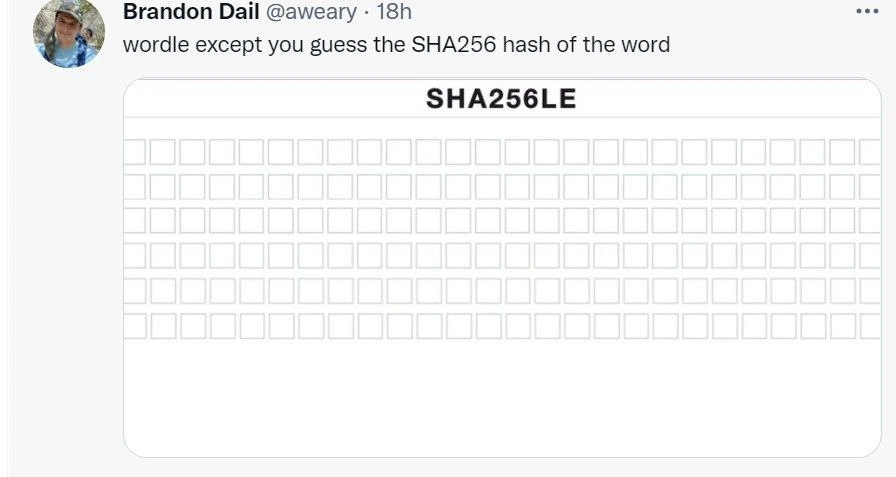
The meme combines these two very different things into one. It's basically a Wordle parody called "SHA256LE". The idea is: instead of guessing the actual word, you're supposed to guess the word's SHA-256 hash. In other words, the game picks a secret word, but it doesn't tell you any clues about letters; it only (implicitly) gives you the final cryptographic hash of that word. The mock-up image shows what this would look like: the familiar Wordle layout, but with a whopping 64 little squares in each of the 6 rows, representing the 64 hex characters of a SHA-256 hash. The title "SHA256LE" at the top is a playful nod to Wordle's name.
To appreciate how absurd this is, let's compare normal Wordle to the hypothetical "SHA256LE" version:
| Normal Wordle | "SHA256LE" Parody |
|---|---|
| Secret is a 5-letter English word (e.g. "apple"). | Secret is the SHA-256 hash of a word (64 hex characters). |
| You guess actual words like "apple" or "train." | You guess 64-character hex strings like "3f5e...7a." |
| Feedback tells you which letters are correct or misplaced. | Feedback might tell you if some hex digits are correct, but it won't reveal any actual letters. |
| Solvable with logic and word knowledge. | Essentially unsolvable without brute-force or a computer. |
As you can see, the "SHA256LE" version turns a simple word puzzle into an impossible Wordle challenge. In a normal game, each guess narrows down the solution. Here, each guess is like throwing a dart in the dark; the space of possible 64-character hashes is astronomically large (around $10^{77}$ possibilities – that's a 1 with 77 zeros!). The odds of randomly hitting the exact correct hash with just six tries are effectively zero. In practice, if you were actually given a SHA-256 hash and asked to find the original word, you'd have to use a computer program to hash millions of candidate words until you find a match (that's called a brute-force search). Doing that by hand as a little daily puzzle? No chance!
The humor lies in this extreme disparity. Everyone can understand a five-letter guessing game, but only programmers and security geeks deal with SHA-256 hashes. The meme exaggerates a typical security concept (hashing) to a ludicrous degree within a fun game context. It's poking fun at how cryptographic algorithms are so complex and secure that turning them into a casual game makes the game ridiculously impractical. In short, when Wordle meets SHA-256, you get a puzzle that's secure by design and a joke by intention. It's a lighthearted reminder of just how strong cryptographic hashes are: even a simple word's hash is so well-protected that guessing it for fun is basically impossible.
Level 3: One-Way Wordle
This meme is a perfect storm of tech humor: it mashes up a viral word game with hardcore cryptography. It all started with a developer joking on Twitter about a twisted new challenge:
"wordle except you guess the SHA256 hash of the word"
Only in developer humor would someone take the cozy daily word puzzle and crank it up to an absurd level of difficulty. Wordle had become a sensation in gaming culture, with everyone from your coworkers to your non-tech friends sharing colored square results each day. Meanwhile, SHA-256 is everyday security knowledge for programmers—a cryptographic hash function they use to secure passwords or verify data integrity. Juxtaposing the two is inherently funny: it's like someone said, "Sure, Wordle is fun, but what if we made it virtually impossible and only programmers would get the joke?"
For experienced engineers, the layers of irony are immediately clear. Wordle normally gives you useful hints: each guess yields colored feedback (green for correct letters in the right spot, yellow for correct letters in the wrong spot). You can strategically converge on the solution within six tries using logic and vocabulary. But in this "SHA256LE" parody, what would a hint even look like? You'd be guessing 64-character strings of hexadecimal (0-9 and A-F) hoping to miraculously align with the secret hash. Maybe a few of those 64 squares would turn green if by random chance some hex digits were correct and in the right position—but that feedback doesn't help you decode the word. Thanks to the hash's one-way nature, knowing that, say, the 10th character is "A" in the hash doesn't translate to "the secret word has an 'e' as the third letter" or anything human-friendly. There’s no logical pathway from partial hash matches to the original word. It's a one-way street: you can hash a word easily, but going backwards is akin to cryptographic guesswork.
The visual gag of the mock-up drives this home. The board is titled "SHA256LE" in the familiar bold font, instantly signaling a Wordle parody. But instead of the cozy 5-column grid, there are 64 tiny squares in a row for each guess, and six rows available. Any Wordle veteran immediately does a double-take: sixty-four characters per guess, only six guesses? It's Wordle on an insane "impossible mode." The empty grid with no colored tiles (in the screenshot, all squares are blank) underscores that you're likely to remain clueless from start to finish. In a normal game, by the final row you'd have some green and yellow letters to work with. Here, you'd probably still have a sea of gray even on your last attempt. The meme essentially says: "How about a puzzle where you get zero useful clues?" This is hilariously relatable to devs, almost like a parody of those days when debugging a system gives you no logs and you feel like you're blindly guessing.
There's an inside-joke in the name itself. Many Wordle spin-offs adopted playful names ending in "-le" (for example, "Nerdle" for a math version, or "Taylordle" for Taylor Swift-themed words). By dubbing it "SHA256LE," the meme follows that convention, blending the hash algorithm's name with Wordle's naming style. It's the kind of pun that makes security-minded engineers grin: it looks like it could be a real app at first glance, but you quickly realize it's a tongue-in-cheek reference. The humor comes from the sheer audacity of proposing a hash puzzle that nobody could ever solve manually. It's like a geeky dare: "Think Wordle's too easy? Hold my coffee — let's see you solve a 256-bit code!"
In the developer community, we've seen Wordle variants for everything — even coding jargon and command-line tools — but this takes the cake for extreme absurdity. The meme plays on the shared knowledge that SHA-256 hashes are practically impossible for a human to reverse without specialized tools. It highlights that impracticality in a lighthearted way: one look at those 64 blank squares and any programmer who knows cryptography just laughs. After all, we use hashes precisely so that guessing the original input is unfeasible!
Yet, the idea is presented in this casual "daily game" format, which makes the contrast even funnier. It's the collision of a friendly game and an unbreakable code that delivers the punchline. This "impossible Wordle" parody encapsulates a classic developer feeling: when a challenge is so ridiculously out of reach that all you can do is appreciate the humor. In other words, if regular Wordle is a fun brainteaser, SHA256LE is a sly in-joke saying, "Here's a brainteaser you literally can't solve." And ironically, that's exactly why engineers find it so amusing.
Level 4: Avalanche of Bits
At the core of this parody is a fundamental property of cryptographic hash functions like SHA-256: they're one-way and exhibit an avalanche effect. In cryptography terms, Wordle's secret word has been transformed into a 256-bit hash, meaning any small change to the input word produces a completely different output hash. A single letter difference in the word scrambles the entire 64-character result beyond recognition. This avalanche-like behavior ensures that partial progress is futile—guessing even a few correct characters of the hash doesn't meaningfully reveal anything about the original word. There's no gradual "warming up" or letter-by-letter deduction here; it's all or nothing preimage resistance in action.
Preimage resistance is the notion that given a hash output, finding any input that produces it is computationally infeasible. With SHA-256, there are an astronomical number of possible outcomes. How astronomical? The hash is 256 bits long, so there are $2^{256}$ possible hashes, each equally likely. That's:
$$ 16^{64} = 2^{256} \approx 1.16 \times 10^{77} $$
possible combinations of 64 hex characters. This number is mind-bogglingly large—on the order of the number of atoms in the universe. In practical terms, no amount of clever logic or elimination can significantly prune this search space; you have to brute-force and get astronomically lucky. Even using supercomputers (or a hypothetical quantum computer shaving the exponent in half), trying to reverse a SHA-256 by pure guessing remains firmly in "heat death of the universe" territory.
This is precisely by design: SHA-256 is engineered so that, without knowing the original input, every guess is essentially random with respect to the correct answer. You can't reverse-engineer the word from its hash any more than you can un-bake a cake to get back the eggs and flour. The only reliable strategy is to test candidate words until one matches the hash—essentially an exhaustive brute force—which for a general 256-bit value is practically impossible. Cryptographers count on this one-way behavior to secure passwords and data; it's why hashing is a cornerstone of security. The meme is funny because it deliberately turns this security strength into an absurd puzzle. It's proposing a challenge that defies fundamental math: guessing a secret word only by its SHA-256 hash. In other words, the game isn't just hard—it's theoretically unwinnable under normal means. It's essentially an impossible Wordle, intentionally built to be unbeatable by cryptographic design.
Description
A screenshot of a tweet from user Brandon Dail (@aweary) that humorously proposes a cryptographically difficult version of the popular game Wordle. The tweet reads, 'wordle except you guess the SHA256 hash of the word'. Below this text is a mock-up of the Wordle game interface, retitled 'SHA256LE,' showing a massive grid of empty squares. Instead of the standard 5-letter word, this version would require guessing a 64-character hexadecimal string. The humor lies in the sheer absurdity and impossibility of the task. While Wordle is a game of logic and deduction, guessing a SHA256 hash is computationally infeasible due to the one-way nature of cryptographic hash functions. A tiny change in the input word produces a completely different hash (the avalanche effect), making it impossible to guess incrementally. This joke is deeply resonant with software engineers, especially those in security and blockchain, as it plays on their intimate understanding of cryptographic principles
Comments
9Comment deleted
My strategy for SHA256LE is simple: I start with the hash of 'password' and then just give up, which is statistically indistinguishable from any other strategy
SHA256LE: finally, a Wordle variant that nails enterprise security - six guesses, 64 hex boxes, and the salt is buried in a Jira ticket from 2017
Finally, a Wordle variant where knowing the answer beforehand is computationally equivalent to breaking SHA256 - though I suppose we could always try birthday attacks if we're allowed 2^128 guesses per day
Six guesses is plenty - if the green tiles leak per-character feedback, you've just turned Wordle into a timing-oracle attack
Finally, a Wordle variant with a difficulty curve that matches enterprise password policies: technically solvable in 2^256 attempts, but you'll need to reserve a few billion years of compute time and hope the heat death of the universe doesn't interrupt your streak. At least there's no 'hard mode' - though I suppose that would just be SHA512
SHA256LE: Wordle that respects entropy - six guesses, all gray; easy mode leaks the salt, hard mode requires Grover’s and a quantum datacenter
Preimage resistance meets party games: six grays later, you're still safer than MD5
Finally, a Wordle where “just brute‑force it” has an SLA measured in heat‑death epochs; enterprise mode adds an unknown salt and the PM calls it a quick win
https://rsk0315.github.io/playground/passwordle.html Comment deleted