Skip to content
DevMeme
3884 of 7435
Management vs. A Simpler Life
Management PMs Post #4230, on Feb 19, 2022 in TG

Management vs. A Simpler Life

Why is this Management PMs meme funny?

Level 1: Player vs Coach

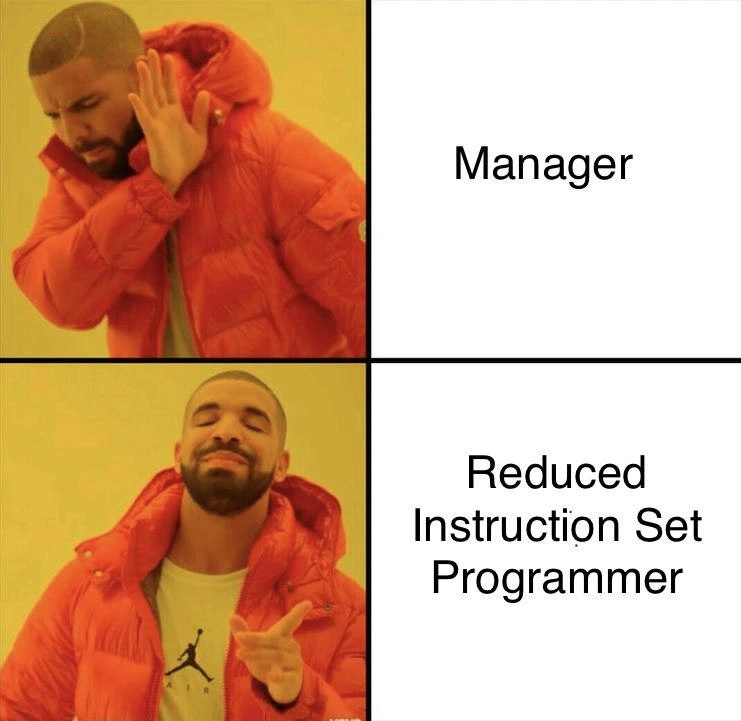
Imagine you’re on a soccer team and you absolutely love playing on the field. You spend all your time practicing kicks, scoring goals, and just enjoying the game. Now, as you get older or better, people offer you a chance to become the coach. Being a coach means you wouldn’t be playing in the games anymore – instead, you’d be on the sidelines, planning strategies, and telling other players what to do. Some people might like that, but you might think: “Hmm, I really just want to keep playing!” This meme is like that. Drake is basically saying he wants to stay a player (keep coding) rather than become a coach (be a manager). In the picture, when Drake sees the word “Manager,” he waves it off like “No way!” But when he sees “Reduced Instruction Set Programmer” (which is a fancy way of saying a programmer who sticks to the basics), he’s all happy, like “Yes, that’s me!”

In everyday terms, it’s the idea of sticking with what you love. Some people in technology have to choose between continuing to do the fun work they enjoy (building things on the computer, writing code like solving puzzles) or moving up to a job where they tell others how to do that work. This meme jokes that our guy (Drake) definitely wants to keep building things himself rather than be the boss. It’s funny because we can feel the emotion: he’s practically saying “I don’t wanna be the boss, I wanna keep doing the fun stuff!” A kid might relate if you think of it like: you’d rather keep playing with your LEGO blocks than be the one who organizes everyone else’s LEGO play. The humor comes from how clearly Drake shows his preference. He’s literally turning away from the boring option and pointing excitedly at the cool option. We laugh because in one image we see a truth that even grown-up programmers feel – it’s more fun to do the hands-on work you love than to supervise others. Just like how being the one scoring the goal can feel more fun than being the coach shouting instructions, being a coder feels more fun to Drake than being the manager. The meme makes that point in a simple, dramatic way that anyone can understand: he’d rather do the enjoyable work than be the boss, and he’s not shy about showing it!

Level 2: Coding Over Managing

This meme uses the famous Drake format – two panels with Drake (the rapper) showing dislike for one thing and love for another – to convey a developer’s career preference. In the top panel, Drake is rejecting the word “Manager.” In the bottom panel, he’s happy about “Reduced Instruction Set Programmer.” What’s that phrase? It’s a play on words. Normally, RISC means Reduced Instruction Set Computer, which is a type of CPU design. Here they’ve swapped “Computer” for “Programmer” to jokingly label a coder as a “reduced instruction set” coder. It’s a bit of insider tech humor: essentially, the meme is saying the programmer wants to stay a techie working with low-level code (like how a RISC-based machine works with a simple set of instructions) instead of becoming a manager.

Let’s break it down in simpler terms. A “Manager” in a software team is someone who leads the team. Managers plan projects, coordinate people, run meetings, and make decisions about who works on what. They usually write fewer code snippets and more emails and documents. When you become a manager, your day might fill up with talks about timelines, budgets, and helping team members grow – you have responsibilities for people and projects rather than just focusing on technical tasks. On the other hand, a programmer (especially one who might jokingly call themselves a “Reduced Instruction Set Programmer”) is someone who focuses on writing code, debugging, and building software. The phrase “reduced instruction set” implies this person is dealing with the fundamentals – maybe coding in a low-level language like C or even assembly, where you directly manage how the computer’s hardware is controlled. That’s what low-level programming means: coding closer to the hardware with simpler, fine-grained operations (similar to the simple instructions in a RISC CPU). It’s the opposite of high-level programming where a lot of complexity is abstracted away for you.

So why would Drake (standing in for a lot of developers) prefer to be a “Reduced Instruction Set Programmer”? It represents staying on the technical track. Many developers really enjoy the act of coding – solving problems, optimizing systems, and working directly with technology. Not everyone wants to give that up to become a manager, which is a different type of job. Becoming a manager (the management track) can sometimes mean you stop coding and start handling other tasks: scheduling meetings, writing performance evaluations, managing budgets, and guiding other people rather than doing the technical work yourself. Some developers find that stuff less fun or not what they signed up for. They’d rather keep doing the hands-on work. This meme jokes about that common feeling in tech: “I’d rather keep coding than manage a team.” By referencing RISC architecture (known for its simplicity and efficiency in the computing world), the meme gives a nerdy thumbs-up to the idea of staying a pure engineer. It’s saying the programmer wants to operate with a simplified set of responsibilities – just let me code! – instead of taking on the complex duties of a manager.

If you’ve taken a computer architecture class or read about how smartphone CPUs work, you might recall that RISC means a CPU has a small set of straightforward instructions. The joke extends that idea to a person: a “Reduced Instruction Set Programmer” would humorously be a coder who only has a small, straightforward set of job duties (write code, fix code, deploy code – repeat). Meanwhile, being a manager would be like having a “complex instruction set” job – many varied duties and complications. The meme’s humor plays on this contrast. It resonates with developers because it highlights a real choice they face: DeveloperRoles can evolve into a manager role, but many prefer to remain engineers. The Drake meme format makes the point in a clear, iconic way: Drake wants nothing to do with the manager title, but he’s delighted by the idea of staying a coder (especially one tinkering with cool low-level stuff). Essentially, it’s saying “Keep your fancy manager title, I just want to be an uber-geek who codes.” This hits on ManagementHumor too, because it lightly mocks the manager role as something an engineer might turn away from. Of course, in real life managers are important, but it’s a tongue-in-cheek way of expressing that coding is what the person truly loves.

In short, the meme uses a bit of technical wordplay and the Drake format to communicate a simple career preference. You don’t need to know all about CPU design to get it – you just need to know that a lot of programmers really love coding, and they often joke about avoiding management jobs so they can keep doing what they enjoy. Drake’s expressions make it obvious: “Manager? No thanks.” vs. “Heavy-duty coder? Yes, please!” It’s TechHumor reflecting a common sentiment in the engineering world, packaged in a quick visual gag.

Level 3: The Stack vs The Ladder

For seasoned developers, this meme hits on a painfully relatable career dilemma. In tech, there’s often a fork in the road as you grow: continue on the technical track (deepening your engineering expertise) or step onto the management track (leading teams and projects). The Drake format perfectly captures that choice: Drake saying “nope” to Manager and an enthusiastic “yes” to Reduced Instruction Set Programmer stands in for an engineer happily sticking to coding over becoming a manager. The humor comes from exaggerating how a lot of engineers truly feel. Many senior engineers privately (or openly) dread trading in their IDE and root access for PowerPoint and HR portals. This meme labels that sentiment with a nerdy twist – essentially saying “I’d rather stay a hardcore low-level coder than be anyone’s boss.”

Why is this funny (and a bit true)? Because in many companies, becoming a Manager is seen as the default path to advance your career – you stop coding full-time and start handling people and processes. But not everyone wants that! Plenty of veteran coders love building systems more than conducting 1:1 meetings or writing status reports. The term “Reduced Instruction Set Programmer” is a playful way to express pride (and relief) in remaining an Individual Contributor (IC) rather than moving up the management hierarchy. It’s engineering humor poking fun at the idea that taking on a manager role (with its broader, complex set of instructions to juggle) is a “promotion.” For a passionate developer, managing can feel like a move away from the craft they enjoy. There’s even a touch of management humor here – the meme implies that managing is so undesirable to this engineer that they equate it to bloated complexity. It’s like saying, “Why would I swap a clean, optimized set of tasks I love for a clunky set of responsibilities I don’t?”

We’ve all known that guru programmer who refuses to “go manager.” In meetings, when the topic of career growth or promotions comes up, they grin and say, “No thanks, I’ll keep coding.” Culturally, this divide is well-known: there’s the concept of maker vs manager schedules. Makers (programmers, designers) need long uninterrupted stretches to create and solve problems, while managers slice their day into meetings and coordination. This meme is basically Drake siding with the maker’s schedule over the manager’s agenda. It reflects the unspoken truth in many engineering circles: becoming a manager often means fewer git commits and more Google Docs and calendar invites. Some developers joke that accepting a managerial role is like “going to the Dark Side” – you get power, sure, but at what cost? (Less coding, that’s what!)

On a deeper level, the meme also hints at the “manager expectations” vs “engineer expectations.” A manager is expected to handle planning, people issues, hiring, and countless meetings. An engineer is expected to write code, review code, fix bugs, and architect systems. These are vastly different roles requiring different skills. The Drake meme format simplifies it to a blunt visual: writing code = good 😎, managing people = not for me 🙅‍♂️. It’s a bit of tongue-in-cheek career humor about personal preference. The phrase “Reduced Instruction Set Programmer” encapsulates a kind of idealized senior dev role: highly focused on technical depth, free from the overhead of managerial complexity. And indeed, many companies now recognize this by offering dual career paths – you can become a Staff or Principal Engineer (staying technical, effectively a “reduced instruction set” career growth) or go into engineering management. Not everyone wants to trade their debugger for spreadsheets, and this meme celebrates those who choose the keyboard over the conference room. As one might quip, the only ladder this programmer cares about is the function call stack, not the corporate ladder!

To put it in perspective, here’s a light-hearted comparison between the two paths encompassed in the meme:

RISC Programmer (Hands-on IC) Manager (Team Lead/Boss)
Writes and debugs code daily (even memory addresses and registers!) Writes project plans, status reports, and lots of emails 📧
Optimizes system performance and hunts down memory leaks Optimizes team process and chases down blockers in projects
Communicates with machines: code, scripts, command-line tools Communicates with people: meetings, 1-on-1s, HR chats
Focus on bits & bytes (the tech details) Focus on people & budgets (the big picture and the $$)
Success = product feature shipped, bug squashed 🐛 Success = team hitting deadlines, no one quitting 🎉

The meme humorously suggests that our engineer Drake prefers everything in the left column to everything in the right column. It’s a nod to those seasoned developers who feel more at home in front of a debugger than in a boardroom. CareerGrowth in tech doesn’t always mean becoming a boss, and this meme riffs on that truth with a hearty dose of engineering humor.

Level 4: Microcode vs Micro-Management

At its core, this meme hides a RISC architecture joke in a career context. RISC stands for Reduced Instruction Set Computer – a CPU design philosophy that uses a streamlined set of simple instructions. Each instruction does less but can execute very fast (often one clock cycle), enabling deep pipelines and efficient parallel execution of instructions. In contrast, the traditional CISC (Complex Instruction Set Computer) design packs more work into each instruction (one instruction might do the work of several RISC instructions). CISC instructions can be more powerful, but they are complex: they often take multiple cycles and may use microcode (mini-instructions hardwired in the processor) to execute. RISC, by simplifying each operation, makes it easier for the CPU to pipeline instructions like an assembly line – fetch, decode, execute, repeat – with fewer surprises. This simplicity vs complexity trade-off has been a defining theme of low-level programming and computer architecture for decades.

To illustrate, consider how a typical task (adding two numbers from memory and storing the result) might be broken down:

; RISC example: break a task into simple instructions  
LOAD R1, [X]      ; step 1: load value from memory address X into register R1  
LOAD R2, [Y]      ; step 2: load value from memory address Y into register R2  
ADD  R3, R1, R2   ; step 3: add R1 and R2, result goes into R3  
STORE R3, [Z]     ; step 4: store the result from R3 back to memory address Z  

; CISC example: a single complex instruction might do all the above at once (conceptual)  
ADD_MEM X, Y, Z   ; (not real syntax) add values at memory locations X and Y, store to Z in one go  

A RISC processor executes those four simple instructions rapidly, whereas a CISC processor might have a fancy single instruction to do it all, but internally it likely breaks it down via microcode. Modern CPUs like ARM (used in smartphones) are classic RISC designs: they use a lean instruction set and lots of registers, excelling at quick, simple operations. Even heavyweight CISC chips (like desktop x86 processors) secretly translate complex instructions into RISC-like micro-operations under the hood to speed things up. The beauty of RISC is in its focus – do a few things, but do them extremely well and fast.

Now, the meme cheekily labels someone a "Reduced Instruction Set Programmer." This isn’t an official term; it’s a nerdy pun mashing up career choices with CPU jargon. It implies the programmer is akin to a RISC CPU – a coder who prefers a reduced “instruction set” in their job role, i.e. focusing only on the essential, low-level tasks (writing code, optimizing performance, crunching bits) rather than taking on the larger, complex instruction set of management duties. It’s humor through metaphor: a senior engineer who would rather be a lean, mean coding machine than deal with the extra abstractions of managing people. In other words, they want to keep executing simple, core “instructions” (designing algorithms, debugging, pushing code) at a rapid rate, rather than operate like a managerial CISC, handling a complex repertoire of tasks like budget planning, slide decks, and endless meetings (the bureaucratic micro-management that comes with being a boss). By invoking RISC vs CISC, the meme gives an engineering twist to the classic tech career fork in the road. It’s a clever inside joke that hardware enthusiasts and systems programmers appreciate: only we would compare climbing the corporate ladder to adopting a convoluted CPU design!

Description

A classic two-panel Drake 'Hotline Bling' meme format. In the top panel, Drake is shown with a gesture of disapproval, next to the word 'Manager'. In the bottom panel, Drake is smiling and pointing in approval at the phrase 'Reduced Instruction Set Programmer'. The joke is a clever pun on RISC (Reduced Instruction Set Computer), a type of computer architecture. It humorously suggests that a programmer would prefer to be a 'Reduced Instruction Set Programmer' - someone who takes simple, direct commands - rather than dealing with the complexities and overhead of being a manager. This resonates with senior developers who often prefer focusing on technical execution over the responsibilities of management

Comments

8
Anonymous ★ Top Pick Why do senior devs prefer being a Reduced Instruction Set Programmer? Because it's like RISC vs CISC. Give me a few simple, well-defined instructions and I'll be highly efficient. Give me the complex instruction set of management and I'll spend all my cycles decoding office politics
  1. Anonymous ★ Top Pick

    Why do senior devs prefer being a Reduced Instruction Set Programmer? Because it's like RISC vs CISC. Give me a few simple, well-defined instructions and I'll be highly efficient. Give me the complex instruction set of management and I'll spend all my cycles decoding office politics

  2. Anonymous

    Why trade a well-tuned RISC pipeline for management’s variable-length instructions and a 15-cycle branch misprediction every time someone schedules a 1-on-1?

  3. Anonymous

    Finally, a career path where doing less is architecturally superior and you can legitimately claim your pipeline never stalls because of unnecessary meetings

  4. Anonymous

    Accurate microarchitecture: managers execute one instruction per quarter, but the speculative execution in planning meetings never retires

  5. Anonymous

    The ultimate career pivot for senior engineers: from managing people's emotions and sprint velocity to managing CPU registers and instruction pipelines. At least with RISC, the reduced instruction set means fewer edge cases to debug than the infinite complexity of human stakeholders asking 'are we still on track for Friday?'

  6. Anonymous

    Org design change: replacing a Manager with a Reduced Instruction Set Programmer increased IPC and cut context switches - only regression was fewer status reports to mispredict

  7. Anonymous

    Hire Reduced Instruction Set Programmers: fewer instructions, higher IPC; CISC managers turn every ticket into a macro and then wonder why the pipeline stalls

  8. Anonymous

    Managers love RISC devs: fewer instructions, higher IPC, no pipeline stalls from feature creep

Use J and K for navigation