Say 'Any Language Is Fine' in Front of Programmers, Get Crucified
Why is this Languages meme funny?
Level 1: The Playground Verdict
Imagine a kid walking up to two groups furiously arguing about whether chocolate or vanilla ice cream is the best, and gently saying, "Any flavor is fine as long as you enjoy it!" — and both groups instantly stop fighting each other, turn around in unison, and chase the peacemaker out of the playground. The joke is that being calm and fair in the middle of a silly argument is the one thing neither side can forgive, because it spoils the fun of the fight. The poor girl in the picture didn't lose the argument — she got punished for pointing out there was nothing to argue about.
Level 2: The Factions and the Heresy
Background for anyone who hasn't yet posted their first innocent question in a language subreddit:
- Language wars: long-running internet conflicts over programming languages — Python vs JavaScript, Rust vs C++, "real engineers use X." They have the structure of sports rivalries with the stakes of nothing.
- Hot take: a deliberately provocative opinion. The meme inverts this: Lucy's line is the coldest possible take, maximum reasonableness, and it gets the harshest sentence.
- Tribalism: deriving identity from group membership. Programmers self-describe by language ("I'm a Rustacean," "Pythonista") — so language criticism processes emotionally as personal criticism.
- The pragmatic truth: languages genuinely differ — performance, safety, ecosystem — but for most projects, several would work. Familiarity and team fit usually dominate the outcome, which is exactly what Lucy said.
The career-survival corollary: in your first job, the language was chosen years before you arrived, by people who left. Loving the language is optional; shipping is not. Save the flame wars for the group chat, and never say "they're all just tools" in the group chat.
Level 3: Ecumenism Is a Hanging Offense
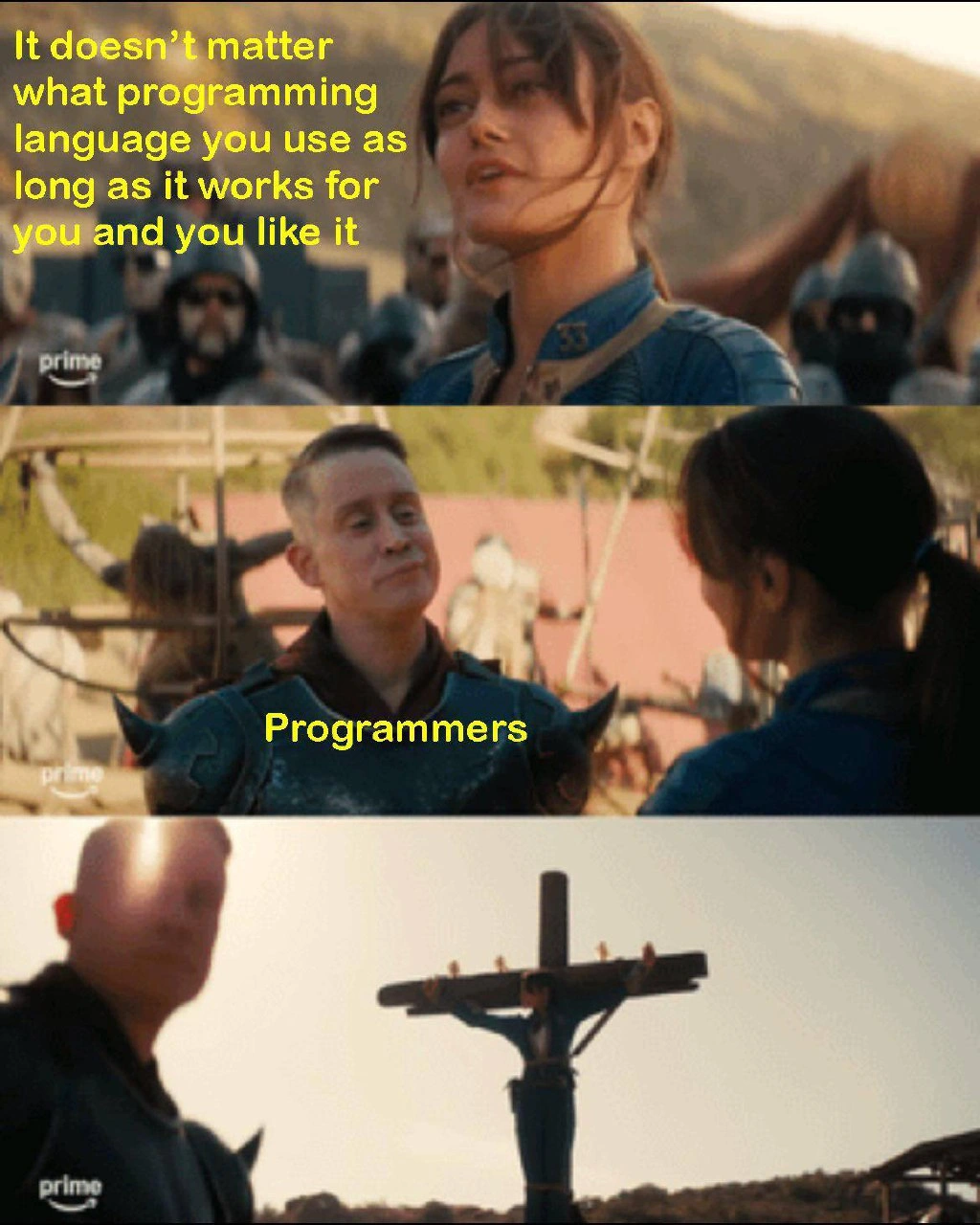
The three-panel structure, lifted from Amazon's Fallout series (Prime watermark dutifully present in every frame), executes a perfect setup-skepticism-consequence arc. Lucy MacLean, sunny in her Vault 33 jumpsuit and surrounded by armored raiders, delivers the caption: "It doesn't matter what programming language you use as long as it works for you and you like it." Panel two: a smirking spike-armored raider, labeled "Programmers", regards her with the patient amusement of a community deciding on a verdict. Panel three: she's on the cross. No trial scene needed — every developer's brain renders it automatically from memory of a thousand comment threads.
The satirical precision is in which opinion gets punished. Not a hot take. Not "PHP is good, actually" or "Rust evangelists are insufferable" — those at least pick a side. Lucy commits the one unforgivable sin of the language wars: refusing to participate. Tribal communities can metabolize an enemy; an enemy validates the tribe. What they cannot metabolize is someone declaring the entire axis of conflict meaningless, because that threatens the identity investment every combatant has made. Tell a Haskell purist that Go is fine, and you've insulted Haskell. Tell them both languages are fine, and you've insulted the thousands of hours they spent becoming a Haskell person. The crucifixion isn't anger — it's self-defense.
The deeper irony seasoned engineers will taste: Lucy's take is approximately the professional consensus. Language choice in industry is dominated by ecosystem maturity, hiring pools, existing codebases, and operational tooling — not by which type system wins a Reddit thread. The graybeards who've shipped in six languages mostly converge on "use what the team can maintain." Yet that earned wisdom reads as wishy-washy precisely because it carries no tribal signal. Holy wars — vim/emacs, tabs/spaces, static/dynamic — persist not despite being technically unresolvable but because of it: an undecidable question is a renewable resource for identity formation. Communities don't fight over settled questions. The wasteland setting is almost too apt — factions in matching outfits, fighting over ideology, atop the ruins of infrastructure their predecessors actually built.
Description
A three-panel meme built from Amazon Prime's Fallout TV series (Prime watermark in each panel). Panel one: Lucy (in a blue-and-yellow Vault 33 jumpsuit, surrounded by armored raiders) says the yellow-captioned line: 'It doesn't matter what programming language you use as long as it works for you and you like it'. Panel two: a smirking raider in spiked armor, labeled 'Programmers', looks at her skeptically. Panel three: the scene cuts to her strung up on a wooden cross against the sky - the community's response to her tolerant take. The meme satirizes programming language tribalism: the most reasonable, ecumenical opinion about language choice is treated as heresy punishable by crucifixion in dev communities
Comments
11Comment deleted
The only language take that unites Rust, Go, and Haskell communities: agreeing that tolerance is unforgivable
im rewriting my os in lua Comment deleted
Hahaha guys he said lua, like the roblox scripting language Comment deleted
no-no, roblox has its own lua, luau it's the garry's mod scripting language Comment deleted
Hahahah he said luau, like the roblox scripting language Comment deleted
i like it so much Comment deleted
I'm going to kill myself goodbye Comment deleted
I though I saw AWS in the lower left for a sec Comment deleted
And then she says "mind rewriting in Rust?" Comment deleted
This meme gains a lot from making the fine distinction between developer and programmer. Comment deleted
В☨☨ Comment deleted