Skip to content
DevMeme
7023 of 7435
Nvidia Buys All DDR5 Until 2028, Consumers Get Plowed
Hardware Post #7701, on Feb 12, 2026 in TG

Nvidia Buys All DDR5 Until 2028, Consumers Get Plowed

Why is this Hardware meme funny?

Level 1: The Big Kid Bought All the Candy

Imagine a candy store where one very rich kid walks in and says, "I'll take every candy bar you make for the next three years" — and pays with pocket change and a pinky promise. The store owner says "sure," because a guaranteed giant customer beats a hundred small ones. Then a regular kid shows up with his allowance, sees the empty shelves and the SOLD OUT sign, and just lies down on the sidewalk in despair. It's funny because the regular kid did nothing wrong — he just wasn't big enough to matter.

Level 2: Why Your RAM Got Expensive

DRAM (Dynamic Random Access Memory) is the working memory in every computer; DDR5 is its current mainstream generation, used in desktops, laptops, and servers alike. Memory is made in fabs — semiconductor factories that cost tens of billions of dollars and take years to build, which is why supply can't quickly expand when demand jumps.

The key concept here is pre-buying capacity: big companies sign contracts for future production before it exists. When the cashier labeled RAM PRODUCERS says yes to selling everything "until 2028," that output is spoken for — stores can't stock what fabs never ship to them. That's the "SOLD OUT" sign in panels five and six.

If you've recently priced out a PC build and watched a 32 GB kit jump from "impulse buy" to "budget line item," this meme is about exactly that experience. The same shortage logic you may have seen with GPUs during the crypto era now applies to memory, driven by AI datacenters that need staggering amounts of it.

Level 3: Net-2028 Payment Terms

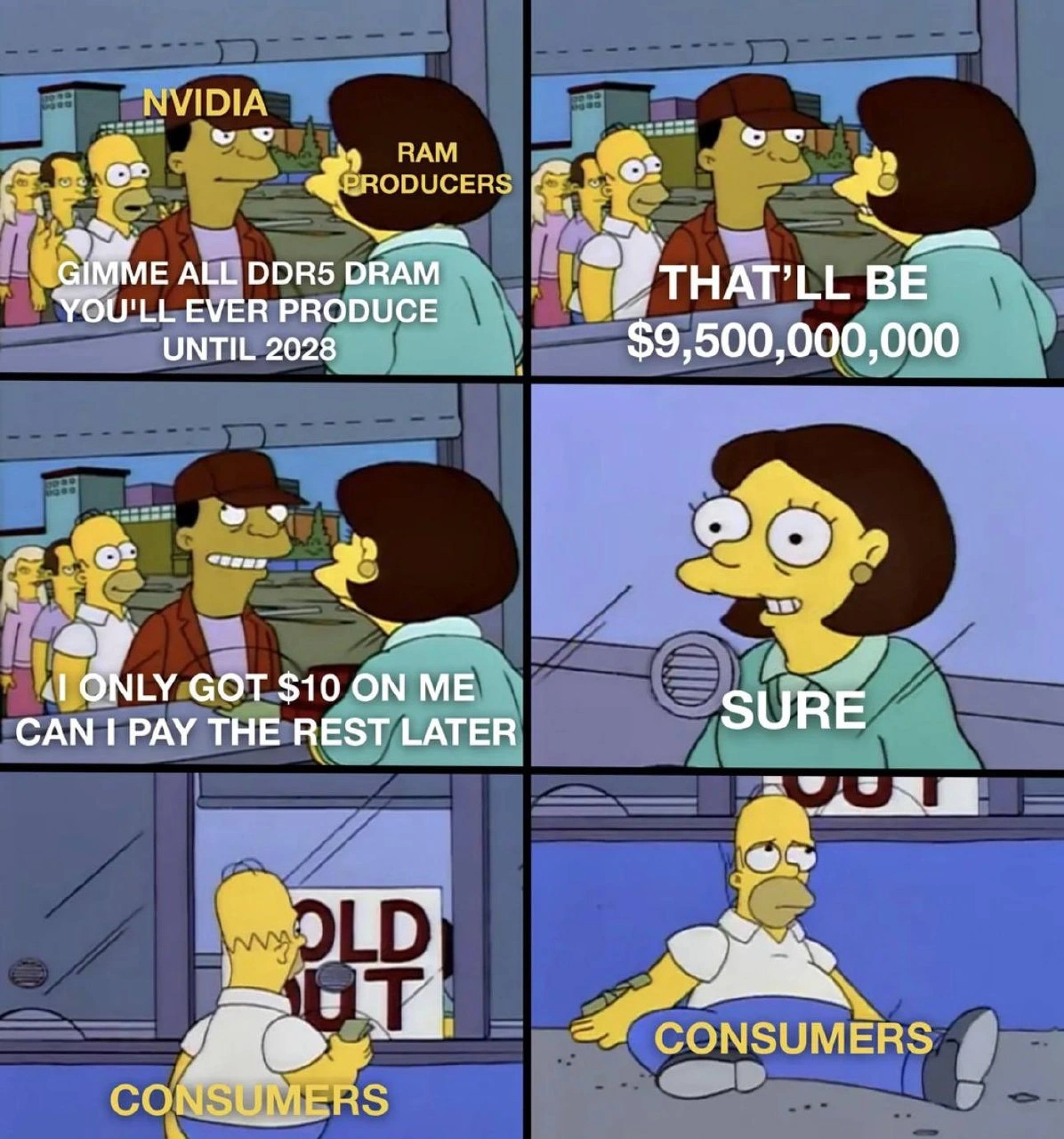
The genius of recasting the Simpsons "plow guy buys out the store" scene as Nvidia cornering the DRAM market is that it accurately captures how memory procurement actually works — and why retail consumers are structurally last in line. The customer labeled NVIDIA demands "GIMME ALL DDR5 DRAM YOU'LL EVER PRODUCE UNTIL 2028," and the punchline in panel three — "I ONLY GOT $10 ON ME, CAN I PAY THE REST LATER" answered with a cheerful "SURE" — is barely an exaggeration of how long-term supply agreements (LTAs) function. Hyperscalers and AI chip vendors don't buy memory off the shelf; they sign multi-year capacity commitments, often with deposits that are a rounding error against the contract's face value of "$9,500,000,000." The fab gets demand certainty, the buyer gets allocation priority, and everyone else gets the OLD OUT sign Homer walks past.

The systemic issue being satirized is capacity allocation in a commodity market with three suppliers. Samsung, SK Hynix, and Micron control effectively all leading-edge DRAM output. When AI datacenter demand — especially HBM (High Bandwidth Memory), which is built on the same fab lines and consumes roughly three times the wafer area per bit as standard DRAM — spiked, producers reallocated capacity away from commodity DDR5. Reduced commodity supply plus pre-sold output equals the 2025–2026 price surge where consumer DDR5 kits doubled or tripled in price within months. The meme's labeled Homer, CONSUMERS, collapsing face-down on the pavement is the PC-building community discovering that the RAM in their parts list now costs more than their GPU did.

The deeper irony veterans will appreciate: DRAM has done this before. The industry runs on a boom-bust cycle — oversupply, price crash, fab investment freeze, demand spike, shortage, panic buying, repeat. What's different this time is that a single buyer category (AI infrastructure) has enough capital to absorb years of forward production, converting a cyclical commodity into something closer to an allocated luxury good. Nobody at the counter is behaving irrationally; the incentive structure simply doesn't include a seat for the guy with one snow shovel — or one gaming rig.

Description

A six-panel Simpsons meme using the 'plow guy buys out the store' scene. Panel 1: a customer labeled 'NVIDIA' tells the cashier labeled 'RAM PRODUCERS': 'GIMME ALL DDR5 DRAM YOU'LL EVER PRODUCE UNTIL 2028'. Panel 2: the cashier replies 'THAT'LL BE $9,500,000,000'. Panel 3: Nvidia says 'I ONLY GOT $10 ON ME, CAN I PAY THE REST LATER'. Panel 4: the cashier shrugs 'SURE'. Panels 5-6: Homer, labeled 'CONSUMERS', walks past an 'OLD OUT' (sold out) sign and collapses face-down on the sidewalk. The meme captures the 2025-2026 DRAM supply crunch in which AI datacenter demand (Nvidia and hyperscalers pre-buying memory output years ahead) sent consumer DDR5 prices soaring and left retail buyers with empty shelves

Comments

18
Anonymous ★ Top Pick Nvidia bought the DRAM roadmap on net-2028 terms; consumers got the OOM-killer in retail form
  1. Anonymous ★ Top Pick

    Nvidia bought the DRAM roadmap on net-2028 terms; consumers got the OOM-killer in retail form

  2. @Lyncore 5mo

    *openai

    1. @RealMrCactus 4mo

      OpenAI doesn't pay for the ram unless you've seen an OpenAI branded GPU

      1. @Algoinde 4mo

        OpenAI is purchasing raw DRAM wafers

  3. @SamsonovAnton 4mo

    2028: AI bubble: bursts. AI companies: do not need that many RAM. Consumers: 🎉 RAM producers: "Not so fast! We need to cover the price gap between wholesale and retail, so the prices will stay high. Otherwise we go bankrupt and the shortage will get even worse, with prices skyrocketing". Consumers: 😡 AI companies: "Don't blame us!" Consumers: 🤬

    1. @azizhakberdiev 4mo

      simple, let AI companies pay for the ram they did not need and watch them liquidate the ram back into market

    2. @RiedleroD 4mo

      idk I don't think this is gonna happen. AI companies are gonna sell off their old RAM and- oh, it's not actual ramsticks? they're using it in ways that aren't transferable to end users without major retooling? drat tbh I still don't think this is gonna happen exactly, but it's not like ram is suddenly become super affordable either. things are just gonna stay more or less similar to before, with the only difference being a projected drop in demand reducing prices somewhat. but! since a lot of semiconductor companies are currently expanding massively, the price of semiconductor will drop regardless of when AI companies will fail. on the flipside, maybe china invades taiwan and the prices skyrocket. get ready for wartime-rationed semiconductors in that case.

      1. @RiedleroD 4mo

        tldr: who the fuck knows

  4. @Johnny_bit 4mo

    Maybe now so-called developers will remember the ancient technique of optimizing the code so that "8GB is the bare minimum" wouldn't be the answer to "your code doesn't run on 8GB of ram"

  5. @RealMrCactus 4mo

    Also it wouldn't be DDR5 it would be HBM manufacturers are just focusing on the HBM production rather than both

  6. @RealMrCactus 4mo

    Really?

    1. @Algoinde 4mo

      https://www.tomshardware.com/pc-components/dram/openais-stargate-project-to-consume-up-to-40-percent-of-global-dram-output-inks-deal-with-samsung-and-sk-hynix-to-the-tune-of-up-to-900-000-wafers-per-month

      1. @Algoinde 4mo

        > What remains to be seen is which company will dice the wafers and build actual DRAM chips, HBM stacks, and memory modules.

  7. @RealMrCactus 4mo

    Strange

  8. @RealMrCactus 4mo

    Dram is kinda useless here unless you've got some system like apple silicon for unified memory

  9. @RealMrCactus 4mo

    Hmm

  10. @bekzat_karayev 4mo

    Get ready to have your next laptop with chips from some Tianjian, not Micron — at least you’ll be able to afford it then

  11. @minis_spyder 4mo

    Nvidea uses ddr6 in gpu

Use J and K for navigation