Skip to content
DevMeme
5931 of 7435
Sam Altman's Six-Word Story on the AI Singularity
AI ML Post #6496, on Jan 5, 2025 in TG

Sam Altman's Six-Word Story on the AI Singularity

Why is this AI ML meme funny?

Level 1: Are We There Yet?

Imagine you’re on a long car ride to a really exciting place, like a gigantic theme park. You know that at some point you’ll cross through the gates into this new world of fun, but you’re not sure exactly when. It’s not like there’s a huge neon sign that says “You’ve arrived!” the moment you get there — it might be gradual, like first you’re in the parking area and you don’t realize you’re technically inside the park. So you keep asking your parents, “Are we there yet, or are we still on the way?”

Sam Altman’s little story is playing with that same feeling. The “singularity” is like that amazing destination (where super-smart AI changes everything), and the person in his story is basically asking, “We’re close to something big, but have we actually hit it already or not?” It’s funny and a bit spooky at the same time. It’s like not knowing you’re already in the theme park because everything around you seems normal, even though you’ve passed the big gate. The humor comes from that mix of excitement and uncertainty — just like when a kid is eagerly asking “Are we there yet?” and isn’t sure if the big surprise is right around the corner or if there’s still a long way to go.

Level 2: The Singularity Branch

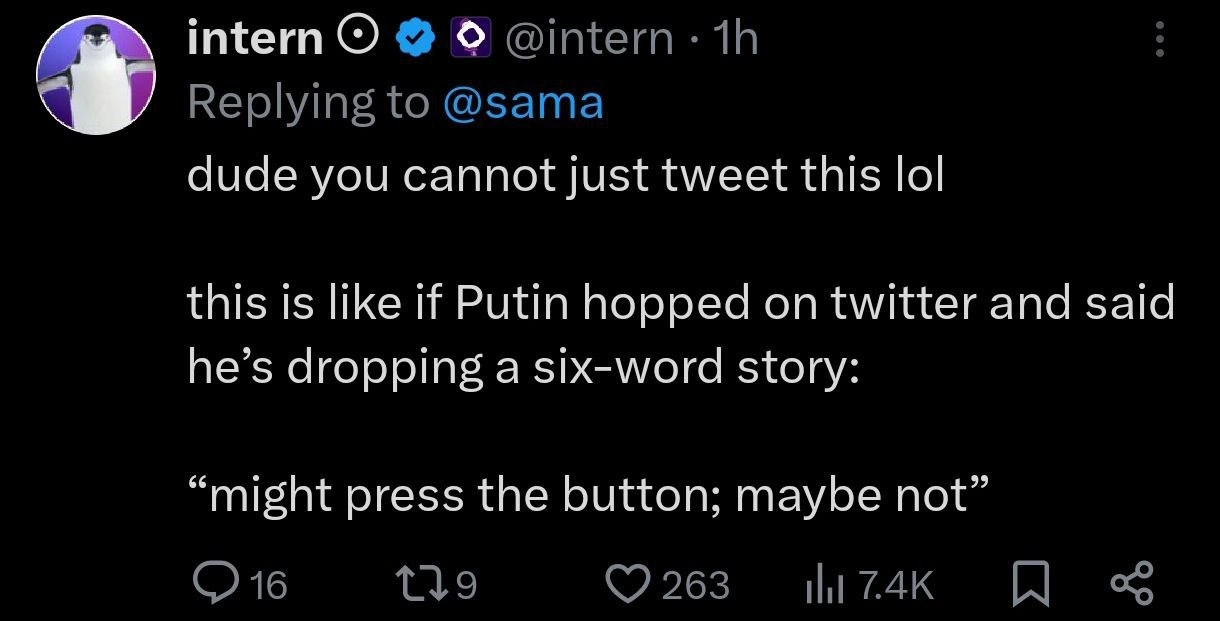
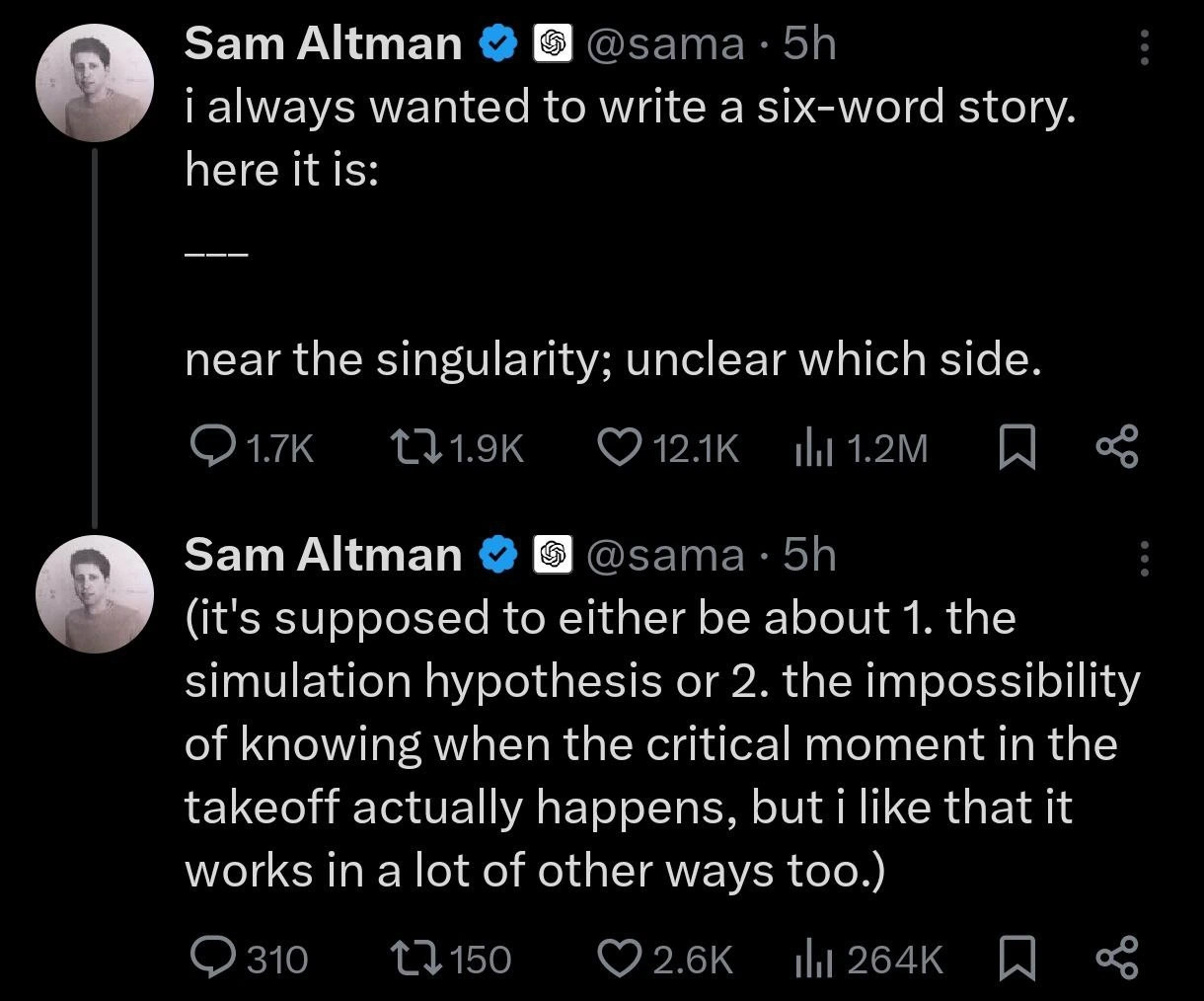
This meme is basically a screenshot of a Twitter thread (shown in a dark mode theme). The person tweeting is Sam Altman, who leads a major AI company called OpenAI (they’re the ones behind ChatGPT). In the first tweet, he posts a tiny story, and in the second tweet he explains what it means. Let’s break down the pieces to see why developers find this interesting:

  • Six-word story: Sam mentions he “always wanted to write a six-word story.” A six-word story is exactly what it sounds like – a story told in only six words. It’s a little creativity challenge (the most famous example is often quoted as “For sale: baby shoes, never worn.”). Here, his six-word creation is “near the singularity; unclear which side.” Despite being so short, it hints at a bigger scenario and leaves a lot to the imagination.

  • Technological singularity: This is a big concept in FutureOfAI discussions. It refers to a hypothetical future moment when artificial intelligence becomes far smarter than humans and starts to improve itself rapidly. After that point, everything might change in ways we can’t predict (because an intelligence beyond human level would be making major decisions or innovations). It’s like a point-of-no-return in technology. People debate if or when this might happen, and it’s often portrayed as a kind of explosive takeoff in AI capability.

  • “Near the singularity”: These words set the scene of Sam’s story. It suggests that we (or the storyteller) are close to that pivotal moment. Think of it like saying “we’re approaching this huge change.”

  • “Unclear which side”: This is the twist in the story. It means the person speaking doesn’t know whether they are before the singularity or after it. In other words, have we not yet reached that world-changing AI event, or has it already happened and we’re now living in the aftermath without realizing it? It’s a thought-provoking idea because normally you’d expect such a massive change to be obvious — but Sam is hinting that it might not be clear to us even if it did occur.

  • Simulation hypothesis: In his follow-up tweet, Sam says one possible meaning of the story is related to the simulation hypothesis. This hypothesis is the idea that our reality might actually be a computer simulation created by some advanced civilization (kind of like the movie The Matrix). If that were true, then “the singularity” might have already happened in the real world outside the simulation (allowing those beings to create simulated universes like ours). So when we say “near the singularity; unclear which side” in that context, it’s like asking: are we close to our simulation’s singularity event, or are we a simulation that exists after someone else’s singularity? The person in the story can’t tell if they’re on the reality side or the simulation side of that big event. It’s a brain-bending scenario, but tech folks sometimes play with this idea for fun (and a few take it pretty seriously, philosophically!).

  • AI takeoff and the “critical moment”: The other meaning Sam suggests is about not knowing when the critical moment in the AI “takeoff” happens. Here “takeoff” refers to AI progress taking off exponentially – like a rocket launching into the sky. A “critical moment” would be the exact point when AI becomes uncontrollably advanced or surpasses human intelligence for good. Sam is saying the story could be about how we might be at that tipping point but can’t identify it. Maybe the AI is just about to become super-powerful, or maybe it quietly did so yesterday and no one realized yet. This uncertainty – not knowing you’ve hit the big turning point until after it’s passed – is actually something people in AI safety research worry about. They want to make sure AI is safe and aligned with human values (that’s the AI alignment field), but if we don’t know the moment AI becomes truly autonomous or superior, it’s hard to prepare or intervene in time. So “unclear which side” in this interpretation means we don’t know if we’ve crossed from the safe side (before super-AI) to the dangerous side (after AI might be out of our hands).

  • The branch/diff joke: The title of this meme (“diffing which side of the singularity branch”) is a play on software version control terms, which developers use every day. In coding, a branch is like an alternate timeline of a codebase – for example, you might create a new branch to develop a feature without affecting the main code. To diff means to compare two versions or branches to see what changed (short for taking a “difference”). So, saying “diffing which side of the singularity branch” imagines that there are two versions of reality: one before the singularity and one after. The joke is that developers are comparing these like code, trying to figure out which side they’re on by seeing the differences. Of course, in reality we can’t actually do that, but it’s a clever way to phrase the question in developer lingo. It’s like joking, “If only we could run a git diff on the universe to check if the singularity update has been merged yet!”

  • Dark mode UI: As a small detail, the Twitter screenshot is in dark mode (light text on a dark background). Developers often prefer dark mode in their editors and apps because it can be easier on the eyes during long coding sessions or late-night screen time. Seeing the meme in dark mode just makes it feel more tailored to the tech crowd’s tastes. It’s the default vibe for a lot of programmers (and indeed, many of us have Twitter set to dark mode too).

In short, what’s happening here is that Sam Altman used an AI humor one-liner to pose a big question: would we even know if we’re at (or past) the moment AI takes over? The meme highlights this question in a playful way that mixes deep IndustryTrends ideas (like the singularity and simulations) with a bit of coding culture (the branch/diff reference). It caught on in dev circles because it’s both thought-provoking and chuckle-worthy — a tiny Tweet that manages to reference our grandest hopes and fears about AI.

Level 3: Schrödinger's Singularity

From a seasoned developer’s perspective, this meme hits a sweet spot between tech hype and insider humor. Here we have Sam Altman – the CEO of OpenAI (the company behind ChatGPT) – casually dropping a six-word sci-fi story on Twitter. It’s a playful nod to the famous Hemingway-style challenge of telling a story in just six words (think “For sale: baby shoes, never worn.”). Sam’s version, “near the singularity; unclear which side,” manages to condense enormous ideas into a bite-sized tweet, and the tech community instantly took notice. Many developers probably paused, counted the words (yes, exactly six), and smirked at how a major AI leader just fulfilled a literary challenge while also referencing the most extreme FutureOfAI scenario.

The humor works on multiple levels. First, there’s the sheer AIHype factor: when one of the foremost AI figures hints at the technological singularity on social media, it fuels both excitement and eye-rolls. (After all, the singularity has been “near” in tech folklore for decades now. Futurist Ray Kurzweil famously wrote a book The Singularity Is Near back in 2005, predicting AI transcendence by 2045. Many industry veterans have seen grand predictions like this come and go, so a cryptic tweet about being “near the singularity” is equal parts thrilling and tongue-in-cheek.) Sam manages to acknowledge that hype with a wink: his story implies we might already be in the big event or not — who knows? It playfully pokes at our industry’s habit of proclaiming every other breakthrough as the world-changing moment, while slyly admitting we won’t know when that moment hits for real.

Secondly, the meme taps into developer culture with its format and language. Sam actually followed up his mini-story with a clarifying tweet enumerating two meanings (1 and 2). That’s a bit unusual on Twitter — it’s like writing clever code and then adding comments because the one-liner was too dense. Engineers found this relatable and amusing. He essentially wrote a tiny six_word_story and then immediately provided documentation for it! The two interpretations he gave (simulation vs. hidden takeoff) are concepts many tech folks are familiar with, so seeing them referenced so tersely was a delight. It’s as if he pushed a commit and then wrote an explanatory commit message for those who don’t read between the lines.

The reactions across developer communities were a mix of awe and meme-making. Some took it quite seriously – folks in the AIAlignment and AISafetyResearch world nodded at the “impossibility of knowing the critical moment” part, because that uncertainty is a very real concern in their field. They’ve long debated whether there will be any clear “fire alarm” before an AI’s capabilities irrevocably outpace ours (or if we’ll only realize in hindsight). Others took the simulation ball and ran with it, joking about looking for glitches in the Matrix or wondering if they’re just NPCs in someone else’s game. A few witty devs imagined running a git diff on reality: comparing the “pre-singularity” branch to the “post-singularity” branch to see what changed. (If only we had a repository of the universe, imagine the pull request for the AI singularity – it’d be a doozy!) This ties directly into the meme’s title about “diffing which side of the singularity branch,” framing an existential puzzle as a version-control problem. It’s the kind of nerdy crossover humor senior devs love: treating the timeline of the universe like code where you could inspect the changes between now and an alternate, AI-transformed reality.

Visually, the meme itself is a screenshot of Sam’s Twitter thread (in dark mode UI, naturally — developers and their dark themes! It’s easier on the eyes for those 2 AM doomscrolling sessions 😅). The familiar Twitter layout — profile picture, verified check, and engagement stats — places us right in the daily life of a techie, as if we’re reading our feed. The fact that this philosophical zinger comes via a casual tweet makes it even funnier. It’s like scrolling through the usual industry news and suddenly stumbling on a haiku about the end of the world. For seasoned engineers, there’s an element of “here we go again” — another big pronouncement about AI’s future, delivered in a punchy, retweetable format. We’ve been through countless hype cycles, but we can’t resist the charm of this one. It’s self-aware and thought-provoking at the same time.

In the end, the meme resonates because it’s too real. It captures a genuine ambiguity that tech folks feel: we’re doing breakthrough stuff in AI… but would we even know if we’ve crossed the ultimate threshold? It’s a heady question wrapped in a joke. The six-word story format makes it artful, the Twitter medium makes it accessible, and the subject matter makes it relevant. Developers love it because it validates that sneaky thought in the back of our minds — what if the world changed and nobody told us? — and does so with style and brevity. It’s AIHumor with an existential twist, the kind of thing that makes you laugh, then pause and say, “Wait… seriously, what if?”

Level 4: Epistemic Event Horizon

This meme touches on profound theoretical questions about AI and reality. The phrase “singularity” originally comes from mathematics and physics (a point where normal rules break down, like the center of a black hole). In the context of a technological singularity, it means a moment when artificial intelligence becomes so advanced that it triggers unpredictable, exponential changes in society—beyond which humans can’t see or forecast what happens next. It’s called a singularity because, much like a black hole’s event horizon, you can’t clearly observe what’s on the other side until you cross it.

Sam Altman’s six-word story plays with that idea of an event horizon of knowledge. By saying “near the singularity; unclear which side,” he evokes the concept that we might be hovering right at the brink of this AI explosion. There’s an epistemic uncertainty here: are we still on the pre-singularity side (AI not yet beyond human control), or have we already slipped into the post-singularity side without realizing it? This is akin to a thought experiment — almost Schrödinger’s cat for AI — where we exist in a kind of superposition of “before” and “after” until reality definitively collapses into one state (and by then, it might be too late to notice the exact switch).

Sam’s follow-up tweet explicitly suggests two interpretations of his six-word tale, both steeped in advanced theory:

  1. Simulation hypothesis – the idea that our reality might be an artificial simulation created by a more advanced civilization. If that’s true, maybe the singularity already happened in the real universe (allowing those beings to run complex simulations of ancestral worlds like ours). In that reading, “unclear which side” hints at the eerie possibility that we don’t know if we’re living in the original timeline before the singularity or inside a simulated offshoot after someone else’s singularity. It’s a nod to philosopher Nick Bostrom’s famous (and mind-bending) argument that if advanced civilizations run many simulations, we’re likely living in one. In other words, the story compresses a deep question into a tiny sentence: are we approaching our own singularity, or are we effectively inside a simulation (living in The Matrix) because the singularity already happened in a higher reality?

  2. Takeoff uncertainty – the idea from AI safety research that even in base reality, we might not be able to pinpoint the critical moment when AI achieves AGI and beyond. Researchers debate fast takeoff vs slow takeoff: will a superintelligence emerge in a sudden jump (a “hard takeoff”) or gradually (a “soft takeoff”)? Sam’s story encapsulates the “impossibility of knowing when the critical moment in the takeoff actually happens.” In plainer terms, there may be no obvious alarm or milestone that shouts “this is it!” as AI crosses from merely very advanced to irreversibly super-human. We could cross that threshold in a continuum, only recognizing the singularity in hindsight (if ever). This ties into AI alignment challenges — how do you ensure an AI remains safe and aligned with human values if you can’t even tell that it’s surpassed you? It’s reminiscent of the observation that there might be no fire alarm for AGI; by the time everyone agrees it’s arrived, it could already be decisively influencing the world.

Underneath these two angles is a broader epistemological dilemma: our capacity to understand and control AI might fundamentally lag behind AI’s own growth. Whether because we’re figuratively in a cosmic git branch of a simulation or because AI’s progress lacks a clear “commit” that announces superintelligence, we face a horizon beyond which our knowledge is hazy. The humor (and gravity) in the meme arises from this intellectual vertigo. Those working on cutting-edge AI — like Sam himself, the CEO of OpenAI — are half-joking, half-pondering a scenario that is both science fiction and a serious technical/philosophical puzzle. It’s a kind of meta-commentary on the FutureOfAI: even the people driving the AI revolution are playfully acknowledging that we might not know when we’ve stepped into a new reality, or if we’ll only realize it long after the fact.

Description

A screenshot of two connected tweets from Sam Altman (@sama), the CEO of OpenAI. The first tweet presents a six-word story: 'near the singularity; unclear which side.' The second tweet, a direct reply, explains his intended meaning: '(it's supposed to either be about 1. the simulation hypothesis or 2. the impossibility of knowing when the critical moment in the takeoff actually happens, but i like that it works in a lot of other ways too.)' The content is not a traditional meme but a primary source of commentary from a key figure in the AI industry. It captures the profound existential uncertainty at the forefront of AI research - the ambiguity of whether humanity is approaching the creation of a superintelligence or perhaps already living within a reality defined by one (the simulation theory). The self-explanation in the second tweet adds a layer of meta-commentary on the difficulty of communicating such complex, high-stakes concepts
Comments

7
Anonymous ★ Top Pick We're either pre-singularity, debugging the code that might end humanity, or post-singularity, living in a simulation where the bugs are just called 'Mondays'. Sam's just not sure which git branch we're on
  1. Anonymous ★ Top Pick

    We're either pre-singularity, debugging the code that might end humanity, or post-singularity, living in a simulation where the bugs are just called 'Mondays'. Sam's just not sure which git branch we're on

  2. Anonymous

    Predicting AGI day feels like running `git bisect` on an infinite commit history - by the time you tag the bad commit, HEAD has already rebased reality

  3. Anonymous

    Sam's existential crisis is basically every senior engineer debugging production: "Are we before the catastrophic failure, during it, or did it already happen and we're just running on cached responses?"

  4. Anonymous

    When the CEO of OpenAI can't tell which side of the singularity we're on, it's like a database admin unsure if they're looking at production or staging - except the rollback strategy is 'hope we're still in the simulation and someone's keeping backups.'

  5. Anonymous

    Every exec update reads the same: nearing AI takeoff - unclear if it’s the capabilities curve or the compliance curve; only the AWS bill achieves singularity on schedule

  6. Anonymous

    The ultimate Heisenbug: observe the singularity, and it flips which side of superintelligence you're debugging

  7. Anonymous

    We’ll know we crossed the singularity when the FinOps dashboard returns NaN for GPU spend - like eventual consistency, by the time you can observe takeoff you’re already on the wrong side

Use J and K for navigation