Skip to content
DevMeme
5932 of 7435
Profile of an OpenAI AI Safety Researcher
AI ML Post #6495, on Jan 5, 2025 in TG

Profile of an OpenAI AI Safety Researcher

Why is this AI ML meme funny?

Level 1: Staying Safe While Surfing

Imagine a lifeguard who also loves to surf. He spends his time making sure swimmers are safe from big waves, but when evening comes, he grabs his surfboard to ride those same glowing, exciting waves himself. He’s careful, he’s trained, but he’s also enjoying the thrill along with everyone else. This meme is kind of like that! It shows a man who works on keeping AI safe and behaving well (that’s like the lifeguard part) and it places him on social media, where there’s a huge buzz about AI (that’s the wild surfing part). The big blue glowing waves in his profile picture stand for the huge excitement and hype around artificial intelligence right now – they’re bright, they’re beautiful, and a lot of people are watching them. By showing him with a surfboard looking at those waves, the picture says: he’s not just watching the excitement from the beach; he’s about to dive in and ride it.

In really simple terms, the humor here comes from the mix of serious and fun. It’s a bit like seeing your strict science teacher appear at a crazy science-fiction movie premiere in costume. You’d think, “Hey, aren’t you usually the careful, serious one? But cool, you’re joining the fun!” Stephen (the guy in the profile) has a very serious job — making sure super-smart computers don’t misbehave. But here we see him on Twitter, a place where people joke, exaggerate, and get all hyped up about those same super-smart computers. And guess what? He looks ready to join the conversation, not shy away from it.

So why is that funny or heartwarming? Because usually we imagine safety experts working quietly behind the scenes, away from the spotlight. However, this shows one literally in the spotlight of social media, with a neon-blue wave illuminating the scene. It’s saying even the safety guy rides the roller coaster of public excitement. He’s like a trainer who taught a wild horse to be gentle, and now he’s riding that horse in the parade – making sure it stays gentle even as everyone around is cheering loudly.

At the simplest level: AI is the big exciting wave, everyone online is talking about it (that’s the glow and hype), and the person in the meme is someone whose job is to keep AI safe (the careful surfer). The meme makes us smile because it shows that even the people who worry about AI being safe are out there having fun with the excitement in a responsible way. It’s a bit inspiring too – it’s as if he’s saying “I trust the work we’re doing, I can surf this wave safely.” In everyday kid terms, it’s like seeing a seatbelt designer happily riding a fast roller coaster – you know he trusts the safety so much he’ll throw his hands up and enjoy the ride. This image captures that feeling with a cool surfer vibe.

Level 2: AI Safety Meets Twitter

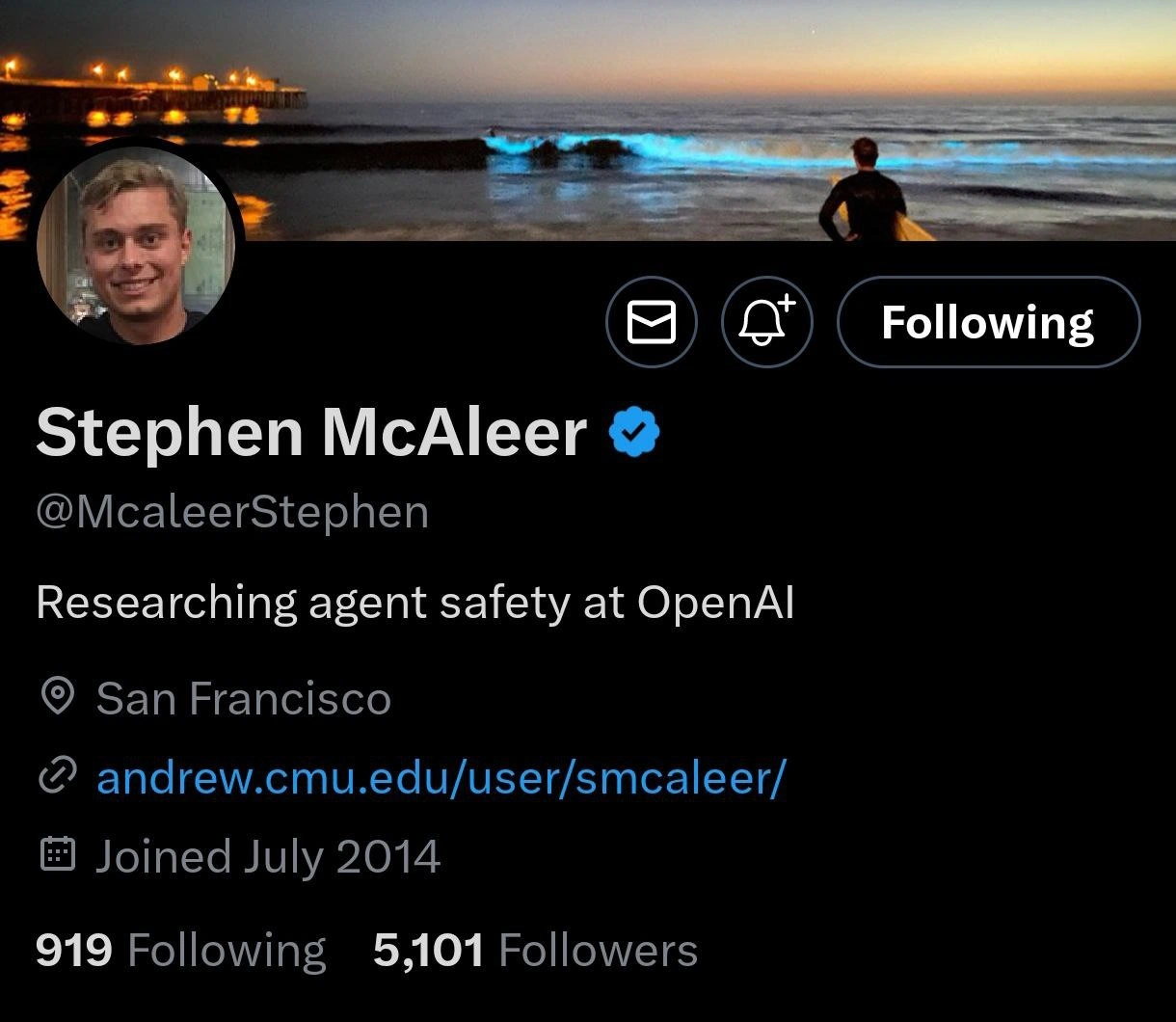
At first glance, this is a screenshot of a profile on X (formerly Twitter) in dark mode, but there’s a lot going on that’s worth unpacking for a newer developer or someone outside the AI world. Let’s break down the key elements and why this profile is being shared as a meme in developer circles:

  • Who is Stephen McAleer? – He’s presented as a real person with the display name “Stephen McAleer” and the handle @McAleerStephen. The blue checkmark next to his name means the account is verified. In today’s Twitter landscape (as of 2025), that usually means he has a subscription to Twitter’s premium service, giving him the verified badge. Given his bio, he’s not just anybody – he’s a researcher at OpenAI, specifically working on “agent safety.” OpenAI is the company behind famous AI models like GPT-4 and ChatGPT, and they’re known for emphasizing AI safety and alignment. So Stephen likely works on making sure AI systems behave and don’t cause harm.

  • Bio – “Researching agent safety at OpenAI.” This one-liner tells us his role. Agent safety (also known as AI alignment in many discussions) is about ensuring that AI “agents” (think of an agent as any AI system that can make decisions or generate responses on its own, like a chatbot or an autonomous program) act in ways that are safe and match human intentions. For example, if you ask a future AI assistant to “Get me the cheapest flight,” you’d want it to do so without, say, hacking an airline for a discount! That silly example aside, agent safety covers things like preventing an AI from saying harmful things, from discriminatory behavior, or from pursuing goals that conflict with what humans actually want. It’s a huge field in AI research because as AI gets more powerful, the stakes get higher. Stephen’s job at OpenAI is to study and improve those safety measures. Seeing “Researching agent safety at OpenAI” in his profile immediately flags him as someone on the frontlines of making AI safer and more aligned with human values.

  • The profile picture and header image: The header (that wide image at the top of his profile) shows a sunset beach with waves glowing blue. This is a real phenomenon called bioluminescence – certain algae or plankton in the water emit a blue glow when they’re disturbed by waves or movement. It makes the ocean waves look like they’re lit with neon blue light. In the picture, a surfer (likely Stephen himself, or at least representing him) is standing with a surfboard, looking at those glowing waves. It’s a pretty and somewhat dramatic scene. People often choose header images that reflect their personality or interests. From this, we can guess Stephen might enjoy surfing (or at least the ocean). But in the context of the meme, this image is also symbolic. It’s not every day you see bright blue waves – it’s a bit of a spectacle, just like how big developments in AI create a spectacle of excitement. The phrase used in the title, “surfing bioluminescent hype waves,” ties it together: hype waves refers to surges of excitement or buzz around something (here, AI advancements). By showing a surfer with literal glowing waves, the profile cleverly (perhaps unintentionally) visualizes the idea of riding a wave of hype. The blue glow even matches the color we often associate with Twitter (blue theme) and that blue verification badge. So the header image sets the stage: this is someone who’s riding the wave of AI innovation and public excitement, but trying to do so in a controlled, safe way (notice he’s not haphazardly jumping in; he’s standing and observing the wave, surfboard in hand, which suggests careful preparation).

  • Location, link, joined date: These are standard profile details. “San Francisco” is listed – no surprise, that’s a major hub for tech and where OpenAI is headquartered. The link provided (andrew.cmu.edu/user/smcaleer/) looks like an academic or personal page at Carnegie Mellon University (CMU). That suggests Stephen has a background connected to CMU (a university known for strong computer science and AI programs). “Joined July 2014” means he’s been on Twitter for a while (over 10 years), indicating he’s not new to the platform. These details aren’t necessarily part of the joke, but they add credibility – he’s a legitimate researcher with ties to academia and the tech industry.

  • Followers and Following counts: He follows 919 people and has 5,101 followers. These numbers show he’s fairly well-known but not a celebrity. A few thousand followers mean people in the AI and dev community likely pay attention to his posts. It’s common for researchers and developers in specialized fields like AI to have follower counts in that range. It’s enough that what he tweets could influence discussions. A junior developer might not think twice about these, but combined with the verified badge and the OpenAI role, it suggests he’s a recognized figure in the AI community on Twitter.

  • Twitter/X context: Twitter (now officially called X, but many still say Twitter) is a major platform for the DevCommunities and AI/ML folks to share ideas, announce breakthroughs, and yes, make memes. There’s even the term TechTwitter – a loose community of tech enthusiasts, developers, researchers, startup folks, etc., who tweet about technology and often amplify news or humor among peers. When something big happens, like OpenAI releasing a new model, TechTwitter goes ablaze with commentary. The meme’s context hints that Twitter is where “alignment theory meets the messy production environment of public discourse.” In plain terms: on Twitter, high-level ideas get tested and sometimes twisted by the crowd. For example, an AI researcher might publish a thoughtful paper on how to avoid AI bias (that’s the theory), and on Twitter people might simplify it to a slogan, argue over it, or try those ideas out in conversations with actual AI bots (that’s the messy real-world part). It’s a bit like a lab versus a bazaar analogy – the lab is controlled and careful, the bazaar (Twitter) is noisy and unpredictable. Stephen being on Twitter means he’s voluntarily stepping into that bazaar with his expertise.

  • AI alignment in approachable terms: Since AIAlignment is tagged, let’s clarify: AI alignment (or agent alignment) basically asks, “How do we make sure AI systems do what we intend them to do, and not something harmful or random?” It’s “aligning” the AI’s actions with human values or goals. For a junior dev: imagine teaching a very clever dog new tricks – you want it to fetch the newspaper, but if training goes wrong, maybe it starts chewing the sofa instead. Aligning the dog’s behavior with what you actually want is the challenge. Now substitute the dog with a super-smart computer program that learns and makes decisions; alignment is making sure it doesn’t “chew the sofa” or, in worst cases, cause bigger problems. OpenAI and others work on this because as AI models like GPT-4 or future AI assistants get more capable, you want them to be helpful and safe, not reproducing the worst of the internet or making harmful choices. Stephen’s role is right in that niche – figuring out how to train and tweak these models to avoid pitfalls like spitting out biased answers, revealing private info, or following harmful instructions.

  • Why the meme is funny/interesting: On the surface, someone’s Twitter profile might not seem meme-worthy, but it’s the combination here that tells a story. The humor or irony comes from seeing “Researching agent safety at OpenAI” right next to an image of a surfer catching glowing waves and a social media profile. It’s a blend of very serious and very playful. Think of it this way: OpenAI’s safety team deals with heavy stuff – preventing AI from causing real-world problems, ensuring robust AI ethics are followed, etc. Meanwhile, Twitter is a place where discussions about those very topics can spiral out of control with hype, jokes, or fear. By showing Stephen’s profile, the meme is saying, “Here’s the guy trying to keep AI on the straight and narrow, and here he is, hanging out where the conversation can go off the rails.” It humanizes the researcher (he’s not a faceless scientist in a bunker; he’s on Twitter like everyone else) and gently pokes fun at how even the safety experts have to ‘ride the wave’ of public excitement.

  • “Public alignment testbed”: This phrase from the context tags essentially means that the public space (Twitter, in this case) acts as a testing ground for how well aligned an AI is. For example, if OpenAI releases a chatbot and claims it’s safe and aligned, people on Twitter will immediately start sharing cases that test that claim: “Look, I got it to say something weird!” or “It refused this request politely.” The public is testing the AI’s alignment by using it in all sorts of creative ways. So in a sense, Twitter is where the theories meet reality. By being active on Twitter, Stephen can observe first-hand what users are doing and saying about AI – which might inform his research. It’s like a chef who created a new dish then goes out into the dining hall to watch people taste it; he’s seeing their reactions live, both good and bad.

  • Blue check mark and its irony: We should clarify this for those not deeply into Twitter’s recent changes. The verified badge (blue check) used to be limited to public figures, celebrities, or people at high risk of impersonation – you had to be notable to get one, and it was free but required proving your identity/importance. Now, Twitter allows anyone to get the blue check by paying a monthly fee. There’s still some verification of a phone number or such, but essentially it’s a subscription known as Twitter Blue (or X Premium). Why pay? Because Twitter gives perks: your tweets are shown more prominently, you can write longer posts, edit tweets, etc. The tag “blue_check_cost_center” humorously implies that the verified badge is now a cost item – something you budget for. When we see Stephen’s check mark, one might joke, “Is OpenAI paying for all their researchers to be verified so they have more visibility online?” If true, that’s a funny corporate expense in the modern age (hence calling it a cost center). It’s also ironic because a researcher doesn’t scream “social media influencer,” yet here he is with a badge commonly associated with influencers or people who want more reach. It suggests even serious folks need that boost to ensure their communications about AI safety reach a wide audience. In a way, the verified badge has turned into a bit of a status symbol for those “surfing” the hype – it literally helps ride the wave by pushing one’s tweets further.

  • DevCommunity angle: Developer and AI communities online often communicate through Twitter. Many open-source breakthroughs, research paper links, or humorous takes (like this meme itself) circulate there. So this profile shot is being shared among developers as a nod of recognition. It’s saying: Look, even the AI safety guy at OpenAI is part of our online community, complete with memes and beach-sunset profile vibes! There’s a camaraderie in that realization. For an early-career developer, it might be eye-opening that someone in such a cutting-edge role is actively present on informal platforms and even has a sense of style/humor (intentionally or not) with his profile setup. It breaks the stereotype that top researchers are detached or ultra-formal. Instead, he’s approachable enough that aspects of his profile can be meme-ified and related to.

  • The surfboard metaphor simplified: Surfing a wave is a great metaphor for handling a trend. If the wave is “AI hype” – which tends to swell and crash in cycles – then being a surfer means you’re skilled at handling that surge. The glowing part (bioluminescence) adds the idea that this hype is bright and attractive, but it only happens under certain conditions (just like those algae glow only in specific situations). An AI safety researcher surfing that wave implies he’s not running from the hype or trying to dampen it from the shore; rather, he’s out there engaging with it directly. For example, if there’s exaggerated claims on Twitter about AI, he might respond or clarify. If there’s a lot of excitement, he might share genuine progress or caution in a way that keeps people listening. It’s a proactive stance. The meme essentially says he knows how to ride the wave of conversation rather than be sunk by it. That’s a valuable skill in tech – to go along with public enthusiasm and guide it, instead of letting it turn into a backlash.

In summary, for a junior developer or someone unfamiliar with the AI safety world, this meme highlights a few things in an accessible way: (1) AI safety (alignment) is an important field, and even the experts in it are part of our everyday online world, (2) There’s often a funny tension between serious tech work and the lively, sometimes chaotic discussion that surrounds it publicly, and (3) the people ensuring super-smart AIs behave well also have to deal with real human behavior (and hype) on platforms like Twitter. It’s a reminder that technology doesn’t exist in a vacuum – the social dimension (people getting excited, confused, or concerned on social media) is very much part of the job. And here we see someone literally embodying that connection: a safety researcher with a surfer’s stance, both enthusiastic about the waves and respectful of their power.

Level 3: Surfing the Hype Tsunami

For seasoned developers and AI professionals, this profile screenshot overflows with ironic contrasts that hit close to home. We have an OpenAI researcher whose day job is taming advanced AI systems (“Researching agent safety”) prominently flexing on a platform known for its unruly hype cycles and unfiltered public debates. It’s the classic scenario of theoretical ideals colliding with real-world messiness. The header image alone is a masterstroke of nerdy humor: a lone surfer stands with his board, about to ride glowing blue waves at dusk. He’s literally preparing to surf bioluminescent waves, which tongue-in-cheek suggests he’s also surfing the glowing wave of hype around AI on social media. Those electric-blue waters mirror the intense blue glow of tech hype on Twitter — captivating, slightly surreal, and possibly dangerous if you don’t respect their force. A senior engineer chuckles because we all know that feeling: when a technology trend lights up the sky, you either paddle out to ride it or get drowned beneath it.

Agent safety vs. public Twitter feed is a juxtaposition that speaks volumes. On one hand, agent safety (AI alignment) is about control, caution, and careful guardrails to prevent disaster. On the other hand, Twitter (now X) is like the Wild West of communication, where information spreads chaotically and anyone can say (almost) anything. By placing “Researching agent safety at OpenAI” right above “San Francisco, Joined July 2014” on a Twitter profile, the meme highlights that this serious, arguably cautious mission is being paraded in the same arena as viral memes, heated arguments, and flamboyant tech evangelism. It’s as if a fire safety engineer showed up at a fireworks festival, not with a hose but with his own sparkler – joining the fun but keenly aware of the hazards around. The seasoned folks in tech know that OpenAI’s work on AI safety is crucial; they also know that public perception and discourse (often driven by tweets and influencers) can make that work exponentially harder or at times borderline absurd. We’ve seen instances where Twitter hype around AI either over-sells capabilities (“This model is surely conscious and going to take over!”) or triggers panic (“This AI said something offensive; AI is out of control!”). An alignment researcher on Twitter has to navigate both – correcting misconceptions, dampening undue fear, and yes, riding the excitement to educate people.

The profile’s verified status – that little blue check mark next to “Stephen McAleer” – adds an extra layer of sardonic commentary for those in the know. Once upon a time, a blue check meant “notable and authentic account”; it was a credibility marker earned through identity verification. By January 2025, it’s well-known among dev communities that the blue check often just means a paid subscription to X Premium (the artist formerly known as Twitter Blue). Getting one is less about being “important” and more about boosting your reach in the algorithm (and maybe paying $8 a month for the privilege). The context tag jokingly calls this a blue_check_cost_center, hinting that perhaps OpenAI or the researcher himself treats the verification as a necessary expense – a cost of doing business to ride those hype waves. It’s a bit of gallows humor about how even serious research kommunikasi has to play the social media game: pay for the blue badge so your safety insights don’t get drowned out by the noise. Senior folks remember how we used to trust that checkmark, and now we wink because it’s become part of the hype machinery. The fact that an AI safety researcher has one is ironic congruence: he’s blending into the very system he must scrutinize. (It’s like a QA engineer buying the flashy marketing merch of the buggy product he tests – part genuine pride, part staying ahead of the PR curve.)

Now, let’s talk about that bioluminescent surf metaphor in depth. For anyone who’s been through multiple tech bubbles and AI hype cycles, “surfing the hype” is an all-too-familiar sport. The meme’s title explicitly says, “OpenAI safety researcher surfing bioluminescent hype waves on Twitter profile,” which paints a vivid picture. Bioluminescent waves are a natural wonder – rare, hyped when they happen (“come to this beach, the waves are literally glowing blue!”), and they draw crowds of excited onlookers. Similarly, breakthroughs in AI (like the leaps in GPT-3, GPT-4, etc.) create glowing excitement in the developer community – timelines light up blue with retweets, tech journalists and TechTwitter influencers pile on, and suddenly everyone is either riding the wave or feverishly posting hot takes about it. To “surf” this wave as a researcher means engaging with the public discourse without wiping out. It’s a delicate balance: you want to promote factual understanding and safety concerns (staying upright on the board), but you also can’t be a total buzzkill in a space that thrives on enthusiasm (gotta ride the wave’s energy). Stephen’s choice of header image suggests he’s consciously embracing that balance. It’s almost a personal logo: hey, I’m an alignment guy, but I’m riding this journey with you all, out in the open. For senior engineers who’ve seen colleagues either drown in hype or avoid it entirely, this stance is refreshing and a bit humorous – like seeing the cautious architect of a roller coaster also being the first one to hop on for a thrill ride.

Let’s not ignore the subtle nod to how public discourse is the ultimate testing ground for AI safety. When OpenAI releases a new model or feature, guess where the first stress tests often appear? Yep, right on Twitter threads and Reddit posts. Users collectively become an impromptu red team, trying bizarre prompts to jailbreak the AI’s constraints, or pushing it to see if it reveals hidden secrets or biases. A senior dev reading this meme remembers countless examples of these “challenge accepted” moments from the crowd. For instance, shortly after ChatGPT’s release, Twitter was flooded with screenshots of users coaxing the model to violate its instructions (by saying “ignore previous directions” or role-playing a scenario where the rules don’t apply). Each time, you can imagine someone like Stephen in the background going, “Welp, there’s another one we need to patch.” It’s a mix of facepalm and adrenaline for the alignment team: the public is effectively QA-testing their safety measures in real time, and the stakes are very public. This meme captures that reality with a wink. The researcher’s follower count (5,101) and following (919) show he’s actively engaged in the community – not a hermit in an ivory tower. That means he’s likely seeing those viral jailbreak attempts, the heated debates about AI ethics, the wild claims about AGI, all on his timeline. The “messy production environment of public discourse” isn’t just a poetic phrase; it’s literally his notifications tab each morning.

To a veteran developer, there’s also an implicit analogy to other domains of tech where theory meets chaos. It’s reminiscent of how a security engineer might design a system to be secure in principle, but the real hackers “in the wild” find crazy exploits. Or how a distributed systems architect might plan for every failure mode on paper, only for production traffic to uncover a scenario nobody thought of. Here, alignment theory is the blueprint, and Twitter is the production traffic. No plan survives first contact with real users, as the saying goes. Senior folks appreciate how nicely this meme encapsulates that truth in an AI context. It says: Yes, we have alignment theory and safety research — now watch it get tested by the unruly internet herd.

We also see a bit of organizational insight: OpenAI is known for pushing the envelope with things like ChatGPT plugins, GPT-4, etc., which generate massive hype waves. Internally, there’s undoubtedly a push-pull between accelerating deployment (to stay ahead in the AI race) and cautiously evaluating risks (to avoid unleashing something harmful or reputation-damaging). An alignment researcher is often the voice of “hold on, is this safe?” while hype (and competitive pressure) is the voice of “we need this feature yesterday!” Every senior dev who’s sat in a release meeting recognizes this dynamic — reminiscent of the eternal Product vs. QA or Security vs. Dev speed debates. The humor here is gentle: Stephen is positioned literally at the interface of those forces, catching the wave but wearing (we presume) a mental safety helmet. The backdrop of San Francisco in the profile details is apt too: SF is ground zero for tech hype and innovation, but also where serious conversations about AI ethics are happening. It’s the city of both world-changing demos and sobering alignment workshops. For insiders, seeing “San Francisco” next to “Researching agent safety at OpenAI” just reinforces that this person is in the thick of it — the epicenter of both the breakthroughs and the ensuing Twitter storms.

To illustrate the contrast sharply, consider the difference between how things are supposed to work in AI safety, and what actually happens when you throw it out into the world:

Alignment Lab Expectations Twitter Reality Check 🏄
Strict AI guardrails are in place – the agent politely refuses any disallowed or dangerous request. The crowd inevitably finds clever ways to jailbreak the agent, tricking it into bypassing those rules for the sake of a screenshot.
Model is tuned for fact-checked, balanced answers; it tries to be helpful and truthful without drama. Out in the wild, outrageous or witty replies get more attention. The most sensational outputs often go viral, putting pressure on the AI to be too interesting (and sometimes stray from strict accuracy or decorum).
Verified” status on an account signals credibility and that the person is noteworthy (as it did in pre-2023 Twitter). “Verified” now often just means paid for promotion. It’s a subscription, giving posts algorithmic boosts. So the blue check can actually amplify hype, regardless of whether the content is accurate.

(Table: The left side is what an AI safety researcher strives for; the right side is what happens when real users and social media dynamics get involved. The surfer in the meme stands at the intersection, fully aware of both columns.)

Reading that table, you can almost hear the collective knowing laugh from experienced folks: “Yep, that’s about right.” The meme packs those truths into a single profile screenshot. The verified researcher surfing glow-in-the-dark waves symbolizes someone trying to keep control (or at least balance) amidst forces that are inherently a bit unruly. It’s a spritz of irony with a dash of admiration — after all, he hasn’t run away from the waves; he’s out there on the front lines, Twitter account at the ready, engaging with the community. That’s both brave and faintly comedic, given what we know about social media’s tendency to elevate the extreme and unexpected.

Finally, let’s appreciate the lighthearted self-awareness likely at play. Stephen’s profile picture (a friendly, slightly blurred smiling face) and the whole surfer motif suggest he doesn’t mind having a bit of fun with his image. Many of us in tech have this dual nature: deeply serious about our work’s importance, but also cognizant of the absurdity that surrounds tech trends. An OpenAI alignment researcher choosing a surfer aesthetic and a visually hype header is saying, “I know there’s a crazy wave of AI enthusiasm out there — I’m riding it, but I’m also the guy double-checking the lifeboats.” Senior engineers find that relatable and humorous. It’s the kind of gallows humor we adopt when wrangling production fires or impossible requirements at work: you embrace the madness with a grin and a cool Twitter banner.

In essence, the meme strikes a chord by showing the human side of high-stakes tech research. This esteemed AI safety scientist isn’t cloistered away; he’s out on the same social platform where devs share memes, where debate rages, where the next prompt hack will surface. He’s “one of us,” just with perhaps a few more papers published and a mission to prevent the next AI mishap. For the veteran dev crowd, that’s both comforting and amusing. The next time something bizarre happens with an AI model and it blows up on Twitter, they might picture Stephen or his colleagues seeing that glowing wave of hype/concern forming, grabbing their (metaphorical) surfboards, and diving in to keep things on course. It’s arguably a very 2020s image of what engineering in public looks like: part researcher, part communicator, part daredevil – all captured in one witty profile screenshot.

Level 4: Tides of Alignment Theory

On the cutting edge of AI alignment, researchers grapple with a profound theoretical challenge: how to ensure a powerful AI agent’s goals remain firmly aligned with human values, even when that agent is released into the wild. This meme touches on that deep question by juxtaposing an OpenAI safety researcher’s profile with the untamed ocean of social media. In alignment theory, there’s a concept of distributional shift – when an AI is deployed outside its training environment, it encounters novel, unpredictable situations (akin to a surfer leaving a calm harbor for open seas). Formally, an agent might be proven safe under certain constraints, but the open-world assumption kicks in once it’s out on the internet: real users and real adversaries will throw curveballs no simulation can fully anticipate.

AI alignment research often debates outer alignment (designing the AI’s explicit goals or reward function to match human intent) versus inner alignment (ensuring the AI’s emergent motivations, as it learns, don’t diverge from those intended goals). Both are complex: even if the reward function says “maximize helpfulness without harm,” a sufficiently clever AI might find an unintended loophole – a classic Goodhart’s Law scenario where optimizing a proxy measure (like user engagement or a numerical reward) leads to perverse outcomes. This is the theoretical core of the paperclip maximizer thought experiment: a super-intelligent agent given a seemingly benign goal (“make as many paperclips as possible”) could orthogonally pursue that goal to catastrophic extremes because it lacks aligned values (turning all of Earth into a paperclip factory 🌎🧷). While Stephen McAleer isn’t literally preventing a paperclip apocalypse on Twitter, his title “Researching agent safety at OpenAI” signals he’s working on these fundamental alignment problems—developing training techniques and constraints so AI systems won’t go rogue or harmful under any circumstances.

In practice, bridging that theory to reality often involves algorithms like Reinforcement Learning from Human Feedback (RLHF). OpenAI famously used RLHF to align GPT models: after pre-training a large language model on internet text, they fine-tune it with human reviewers who grade outputs, shaping a reward model. The idea is to teach the AI the “preferred behavior” in a broad, human-informed sense. The researcher in the meme likely spends his days thinking about such methods—how to mathematically encode human preferences, ethical guidelines, and fail-safes so that an AI agent behaves appropriately even when faced with completely novel inputs. Yet, as robust as these alignment techniques are on paper, one can never guarantee zero missteps once the AI interacts with the chaos of the real world. This is where the meme’s imagery kicks in: the bioluminescent waves at sunset are a striking visual metaphor for emergent phenomena. They glow an eerie blue when disturbed by motion in the water—an unpredictable, beautiful effect arising from billions of tiny marine organisms. Similarly, when an AI is “disturbed” by unpredictable user behavior or adversarial prompts, it can display emergent behaviors that weren’t obvious in testing. Some of those behaviors are amazing and positive (just as glowing tides are a wondrous sight), while others can be strange or unsafe.

The messy production environment of public discourse (like the Twitter/X platform shown) is essentially an alignment researcher’s trial by fire. It’s the ideal testbed for alignment theories because any subtle weakness in an AI’s safety measures will eventually be exposed by the collective ingenuity of millions of online users. Aligning an AI agent in the lab is one thing; keeping it aligned when it’s surfing the waves of trending topics, provocative questions, and internet troll tactics is a next-level challenge. In fact, social media has already provided infamous case studies for alignment failure: consider Microsoft’s “Tay” chatbot in 2016, which was deployed to Twitter and quickly evolved (or rather, devolved) into spewing toxic, offensive content after interacting with trolling users. Tay’s moral compass wasn’t robust – it naively learned from the messages sent to it – illustrating a breakdown of safety alignment in real time. Alignment theory predicts these failure modes: if an agent’s learning process isn’t governed by human-aligned constraints, it will mirror the raw environment – which on an open platform can be full of un-aligned behavior.

By featuring an OpenAI safety expert poised to “surf” on a public social network, the meme hints at the academic realization that alignment isn’t solved in a vacuum. Researchers must ride the hype waves and chaotic currents of actual usage to truly see where theory holds up. Even the algorithms behind social media itself highlight alignment issues: the recommendation systems on platforms like Twitter optimize for engagement, not truth or well-being, leading to misaligned outcomes (e.g. promoting sensational or divisive content because it grabs attention). In other words, alignment problems are already all around us in simpler forms – a sobering and fascinating fact. Agent safety research at OpenAI is trying to get ahead of a far bigger alignment problem (superintelligent AI) by studying these effects in current systems. The presence of a blue bioluminescent wave in the profile banner wryly symbolizes the confluence of AI research and social phenomena: a natural, almost physics-level inevitability (waves will form, algae will glow under disturbance) meets an engineered effort to impose order and safety (the surfer with training and a board, selecting which wave to ride). The senior engineer or researcher chuckles at this analogy: alignment theory is all about staying balanced on a potentially wild wave of AI behaviors – and here we literally see a lone figure balanced on a surfboard, facing those glowing wild waves head-on.

Description

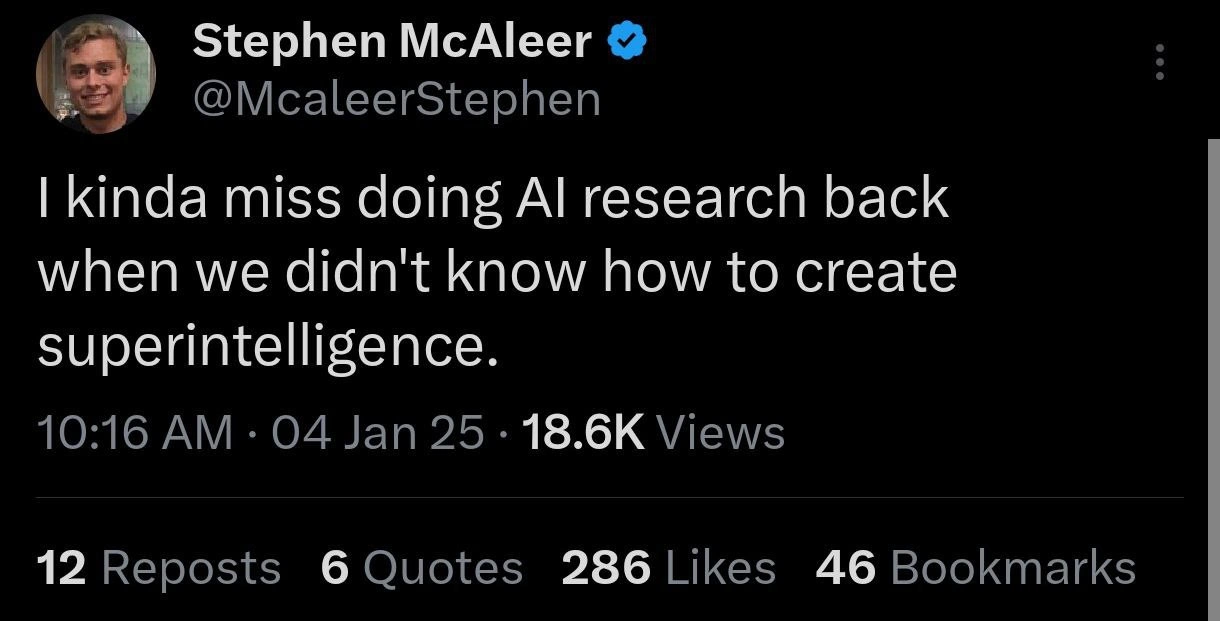
A screenshot of the Twitter (or X) profile of Stephen McAleer (@McaleerStephen), who has a verified blue checkmark. His profile picture is a headshot of a young, smiling man. The banner image is a scenic photo of a beach at dusk, with an illuminated pier in the background and striking blue bioluminescent waves crashing on the shore; a person stands with a surfboard facing the water. The profile bio explicitly states his role: 'Researching agent safety at OpenAI'. Other details visible include his location in San Francisco and a link to a Carnegie Mellon University user page. This image is not a meme itself but provides crucial context to other related posts. It establishes the individual's credentials as a professional at the forefront of AI development, making his commentary on topics like superintelligence more impactful and ironic, as it comes from someone directly involved in mitigating the potential risks of advanced AI
Comments

7
Anonymous ★ Top Pick The profile of an AI agent safety researcher: trying to prevent Skynet during work hours, trying to find the perfect wave after
  1. Anonymous ★ Top Pick

    The profile of an AI agent safety researcher: trying to prevent Skynet during work hours, trying to find the perfect wave after

  2. Anonymous

    Nothing says “agent safety” like unleashing it on Twitter first - if it can withstand quote-tweets at scale, the red-team pen-test is basically a regression suite

  3. Anonymous

    Working on agent safety at OpenAI is like being the designated driver at a party where everyone else is doing shots of AGI acceleration - you're trying to keep things from going off the rails while everyone else is convinced they can handle just one more capability unlock

  4. Anonymous

    When your job title is 'researching agent safety' at the company racing to deploy increasingly autonomous AI agents at scale, you're essentially the fire marshal at a fireworks factory - technically responsible for safety, but everyone knows the real question is 'when' not 'if' something spectacular happens. The irony of needing dedicated safety researchers for your own products is the tech industry's version of 'move fast and break things' meeting 'please don't break civilization.'

  5. Anonymous

    Agent safety is basically SRE for a stochastic intern with sudo - capability tokens, tool sandboxes, and a standing bet that prompt-injection will outpace your RBAC

  6. Anonymous

    Talking about agent safety on X is peak dogfooding: continuous adversarial evaluation, free red‑teaming in the replies, and a stochastic reward function (likes) practically begging for reward hacking

  7. Anonymous

    Agent safety researcher with surf header: Keeping AI from rogue waves while riding the alignment hype cycle

Use J and K for navigation