Community Reacts to a Tech CEO's Casual Existential Tweet
Why is this AI ML meme funny?
Level 1: Big Scary Hint, Everyone Panics
Imagine you’re at school and over the loudspeaker the principal suddenly announces: “I might cancel summer vacation… maybe not.” Then he doesn’t explain anything else and just leaves everyone hanging.
How would people react? Everyone would freak out! Kids would start whispering, “Did he really mean it? Can he do that? What’s going on?” Teachers would look worried and try to get more information. Parents might hear the rumor and begin calling the school. The whole place would be on edge because that’s a huge, scary thing to say without any details. Is it a serious warning? Is it a joke? Nobody knows, and that makes it even scarier.
That feeling is exactly what’s happening in this meme. A very important tech leader said something super vague and possibly huge (like canceling summer break or pressing a big red disaster button), and all the developers on Twitter immediately panicked. Just like students hearing that mysterious announcement, the tech folks didn’t have enough information and their imaginations went wild with worry.
In simple terms: someone in charge gave a tiny hint that they might do something really drastic, then went silent about it. Everyone who heard it started preparing for the worst just in case. It’s funny in the meme because we’re not actually in danger, but it shows how even a few little words from the right (or wrong) person can cause a lot of commotion!
Level 2: Don’t Tweet the Big Red Button
This meme highlights how communication can cause panic in the tech world if done wrong. Let’s break down what’s happening in simpler terms:
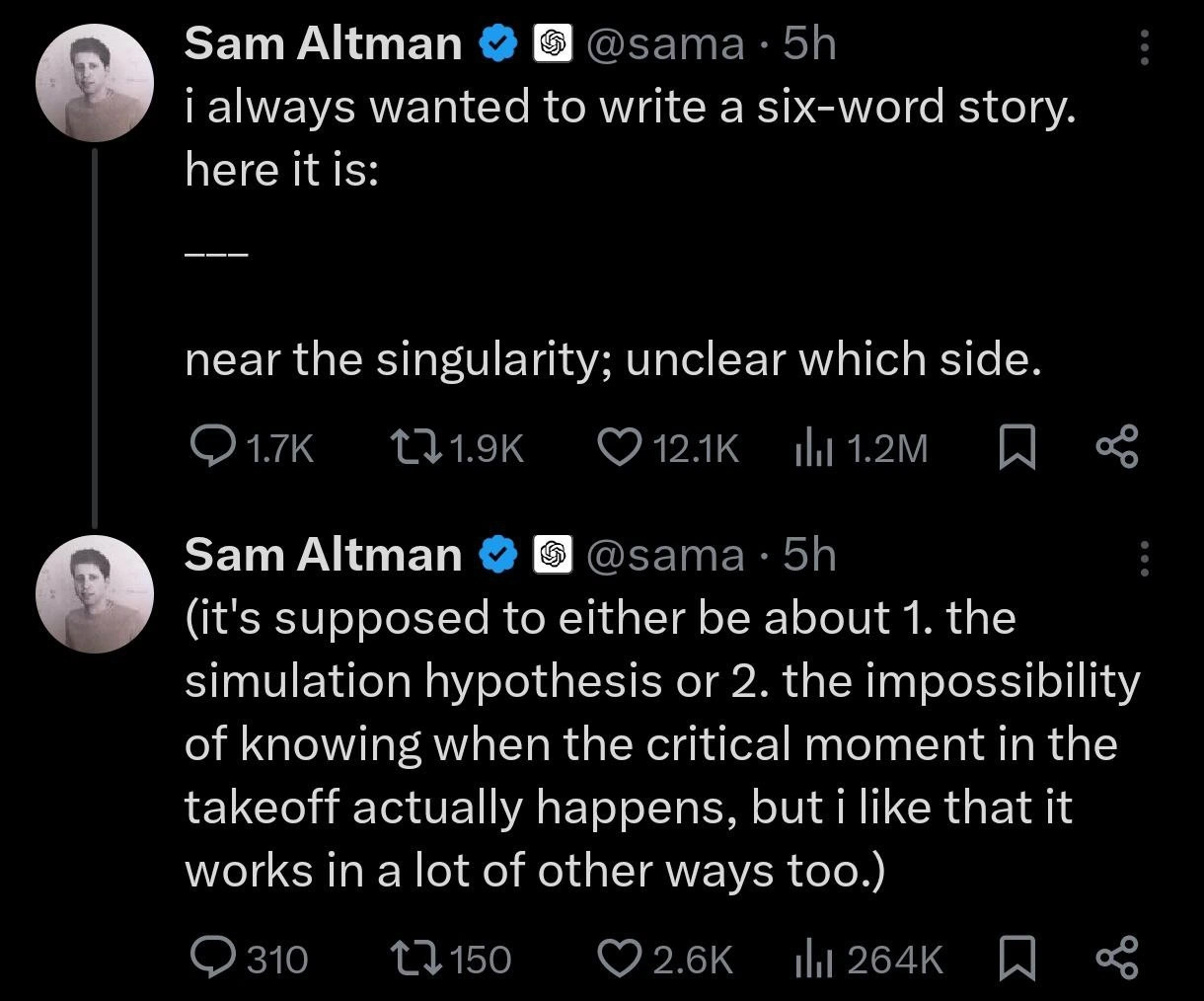
Sam Altman (mentioned as “@sama”) is the CEO of OpenAI, the company behind ChatGPT and other advanced AI. When he tweets something mysterious or alarming, people pay attention. In this case Sam apparently tweeted something so vague and ominous that it put everyone on edge.
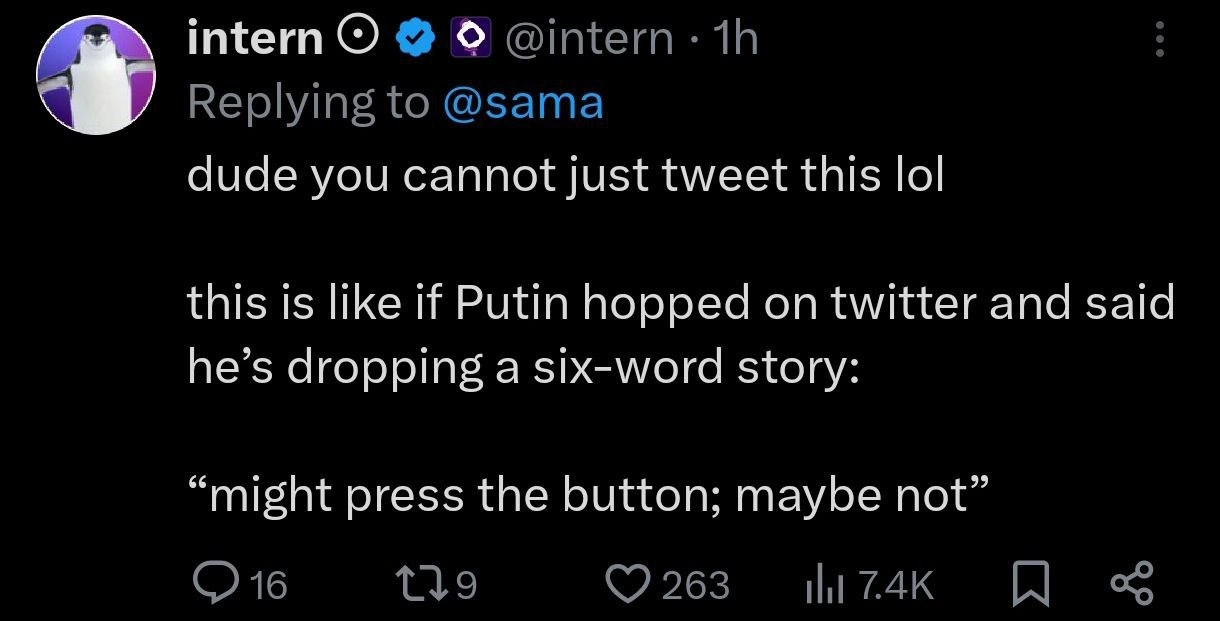
The reply in the image is from someone named “intern” (with a penguin avatar and a verified checkmark). The intern account basically says: “Dude, you can’t just tweet this lol.” That casual “dude” shows even an intern (a very junior position) knows this tweet is a bad idea. It’s like a newbie telling the CEO, “Hey, that message is freaking everyone out.” The intern compares Sam’s tweet to a scenario where Vladimir Putin (the Russian president) tweets “might press the button; maybe not.” Here “the button” is a common shorthand for launching nuclear missiles – a metaphor for an extremely high-stakes action.
The “six-word story” reference is a nod to a famous writing challenge: telling a whole story in just six words (for example, “For sale: baby shoes, never worn.”). In the meme, the “six-word story” is: “might press the button; maybe not.” Those six words sketch out a very scary story (global destruction?) in a tiny space. The intern is saying Sam’s vague tweet felt as dramatic as a world leader casually talking about nuclear war in six words. In short, too much implied danger in too few words.
In tech terms, the situation is likened to a principal architect (a very senior engineer/technical lead) posting on Slack (a workplace chat app) something like “may delete prod database; unsure.” The production database (“prod DB”) is the live, critical database that runs a company’s main product or website. Deleting it would be catastrophic – like erasing all user data or bringing everything down. If an important tech leader even jokes about maybe doing that, everyone from junior devs to the CTO would instantly panic. It’s considered an extreme communication breakdown or anti-pattern to be so unclear (and flippant) about something so serious. Proper communication in a company (especially about potentially disastrous actions) needs to be clear and specific, not “maybe I’ll blow everything up, maybe I won’t 😉.”
“Dev Twitter reaches for the incident pager”: Dev Twitter means the community of developers on Twitter. An incident pager refers to systems like PagerDuty that alert on-call engineers when something is wrong in production (traditionally via a loud pager or phone notification). The meme is joking that Sam’s tweet was so alarming that it made the whole developer community feel like an urgent alarm went off. It’s like everyone collectively thought, “Is this a DEFCON 1 situation?” (In U.S. military terms, DEFCON 1 is the highest alert level, meaning nuclear war is imminent.) People were ready to respond as if an emergency had been declared.
The categories and tags clue us in to the themes here:
- AI_ML & AIHumor: It’s humor about the AI industry. Sam Altman’s work is in AI, and any hint from him sparks big reactions. The community often jokes about how dramatic AI news can be (AI hype).
- Communication & CommunicationBreakdown: The meme is about a failure of good communication. It shows how a badly phrased or too-brief message from a leader can cause confusion and panic.
- IndustryTrends_Hype & AIHypeVsReality: This points to the cycle of excitement vs. reality in tech. There’s a lot of buzz (hype) around AI, and sometimes leaders tease big news to create buzz. But this can backfire if reality doesn’t match or the tease is too ambiguous. The meme mocks how a tiny teaser can blow up into a huge deal.
- TwitterHumor & TechIndustrySatire: It’s making fun of how tech folks communicate on Twitter and how the industry reacts. It’s exaggerated satire of both leadership behavior and the reactive “dev Twitter” culture.
- existential_ai_threats & nuclear_button_metaphor: Some people worry AI could pose an existential threat (a threat to humanity’s existence) if it goes wrong. Sam Altman, who works on advanced AI, tweeting cryptically might make folks wonder if he’s hinting at something big on that front. The meme uses a nuclear war metaphor (“press the button”) to highlight how over-the-top the concern feels — as if an ambiguous AI announcement is being treated like the end of the world.
In plain terms, this meme is a cautionary tale: if you’re a leader in tech, don’t be vague on social media about potentially serious things. A short, unclear tweet from the wrong person can send hundreds of people into panic mode. Clarity and context are key. Without them, you might accidentally trigger an “incident response” mentality in your followers — all over a message that was meant to be a tease or a joke.
Level 3: The Tweet Heard ’Round DevOps
intern (replying to @sama):
“dude you cannot just tweet this lolthis is like if Putin hopped on twitter and said he’s dropping a six-word story:
‘might press the button; maybe not’”
Even an intern (literally, the Twitter user named “intern” with a penguin avatar) knows that Sam Altman’s vague tweet is a huge problem. The reply above basically says: “Mate, this is not okay. That tweet is as dangerously unclear as a world leader casually hinting at nuclear war in a six-word story.” In other words, you can’t just drop a cryptic bombshell and leave everyone hanging.
For seasoned engineers, this situation is painfully relatable. It’s like a principal architect strolling into Slack and posting: “thinking about wiping the production database… not sure yet 🤔”. In the tech world, that’s how you start a five-alarm fire. A communication anti-pattern of the highest order. Why? Because if someone with the “keys to the kingdom” even hints at doing something catastrophic, everyone down the chain goes into panic mode.
Sam Altman is the CEO of OpenAI (of ChatGPT fame), so when he tweets something freaky and ambiguous, people treat it seriously. The meme compares it to Vladimir Putin tweeting “might press the button; maybe not.” “The button” here means the nuclear launch button – the ultimate doomsday switch. So Sam’s tweet (whatever it was) felt that weighty to folks in AI and tech. It’s a tongue-in-cheek exaggeration, but it captures the vibe: an ambiguous message from a powerful figure that could signal world-altering consequences.
Here’s how the tech crowd reacts when that happens:
- On-call engineers instinctively reach for their pagers (or smartphones). They’re jokingly ready to handle an emergency because it feels like a production system just yelled for help. “Did a server melt down? Did an AI escape its sandbox? Do I need to drop everything?!”
- Team leads and CTOs scramble to interpret the message. “Is Sam hinting at a major AI release? Or a policy change? Is something wrong at OpenAI? Do we need an emergency meeting?”
- Infosec and SRE folks start double-checking everything: “Was there a breach? A data leak? Why else would he say something so foreboding without details?”
- Everyone on Twitter begins mental gymnastics, trying to read the tea leaves of Sam’s six words. Rumors and conspiracy theories fly within minutes.
All this chaos from a one-liner! It’s funny because it’s true: tech history is full of incidents where a single vague message caused outsized drama. Senior devs have seen it time and again:
- The famous “we have an announcement, stand by...” email that ruined weekends because nobody knew if it was good or bad.
- A CEO’s “surprise coming 😁” tweet that made all the engineers work overnight preparing for traffic spikes just in case.
- The lead dev who joked in Jira, “maybe we should rewrite the whole app next week 😂” and accidentally sent the company stock tumbling when someone took it seriously.
In this meme, the intern account is the voice of reason (ironically!). They’re basically saying what every sensible comms handbook would: please don’t be so reckless with your messaging. It highlights a key insight: in high-stakes fields like AI, words can cause real-world reactions. There’s already a ton of AI hype and fear out there. A poorly phrased teaser from someone like Sam Altman can spike anxiety levels across the industry. Think of it as yelling “maybe fire?” in a crowded theater – even the “maybe” is enough to send people running for the exits or grabbing fire extinguishers.
This scenario also touches on the idea of incident response culture. In well-run tech organizations, if there’s even a hint of a major problem (“the site might be down”, “data might be corrupted”), everyone has specific roles and jumps into action. It’s like a fire drill. But here the trigger wasn’t a monitoring alert or an error log – it was a tweet. A vague tweet became the pseudo-pager alerting the whole community. That’s both hilarious and terrifying. Hilarious because, come on, Twitter drama shouldn’t activate our on-call instincts... Terrifying because, well, it clearly does now.
So, at this senior perspective: the meme is poking fun at leaders who communicate important stuff the wrong way, and the collective PTSD of developers who have learned to expect the worst from one cryptic message. It’s a mix of dark humor and reality. We laugh, but we also nod knowingly, recalling our own war stories of late-night scares from a single Slack line or tweet. The big takeaway: if you’re holding the metaphorical “red button”, don’t joke about maybe pressing it on public channels. You’ll send the whole world into a tailspin.
Level 4: Mutually Assured Miscommunication
At a theoretical level, this meme touches on the game theory of communication under uncertainty. When someone like Sam Altman broadcasts an ambiguous high-stakes signal, it creates a coordination problem for everyone else. Think of it as a mini version of Cold War brinkmanship: one superpower leader sends a cryptic message (“I might launch... maybe not”), and the other side has to decide whether to scramble the jets or stay calm. If you assume it’s a joke and you’re wrong, the consequences are dire; if you treat it as a real threat and it was nothing, you’ve cried wolf and expended resources for no reason.
During the Cold War, this dilemma was encapsulated in the doctrine of Mutually Assured Destruction (MAD). Both sides knew a miscommunication or false alarm could literally end the world. This led to the creation of careful hotlines and agreed-upon signals to avoid accidental nuclear war. In the tech world, we obviously aren’t dealing with nuclear weapons on Twitter (most days, at least), but the metaphor in the meme leans on exactly that imagery. It’s highlighting how an information misfire from an AI leader can feel (emotionally, to observers) like a step toward an “AI doomsday” scenario.
There’s also a concept in risk management called information hazards – situations where sharing certain information can cause harm. Announcing something like “we’ve developed a powerful AI that might be dangerous... or maybe it’s fine” in a vague way could be considered an info hazard. Why? Because people might overreact or underreact in harmful ways. For example:
- Investors might panic-sell or irrationally buy stocks, causing market volatility (we’ve seen single tweets wipe out billions in market cap – an unintended economic “explosion”).
- Other AI labs or even nation-states might race to respond or double-down, thinking a major breakthrough or threat is imminent (potentially leading to rash decisions or a tech arms race).
- The public could either be alarmed unnecessarily (leading to fear-mongering and bad policy) or desensitized to warnings (the boy-who-cried-wolf effect, which is dangerous if a real warning comes later).
From an information theory perspective, a six-word message from a key figure carries an enormous amount of implicit information. In theory, information content is measured in bits, but here those bits are entangled with context. Sam Altman’s position gives those words high entropy in terms of possible outcomes: they could mean anything from “AGI is here” to “just kidding, nothing to see.” The lack of clarity forces every receiver (the readers) to fill in the blanks, essentially decoding a very noisy signal. Each decoder (person) will use their own biases and fears, often assuming the worst-case scenario (a well-known bias called worst-case thinking under uncertainty).
This dynamic can be modeled like a distributed system of nodes (the people on Twitter) trying to reach consensus about an event with incomplete data. It’s almost like a faulty consensus algorithm in a distributed database: one leader node (Sam) sends an unreliable message, and all the follower nodes (devs, media, etc.) start an unpredictable consensus process (rumors, discussions) to decide on the “state of the world”. Just as in distributed computing, ambiguity or asynchronous communication can lead to inconsistencies and split-brain scenarios (in human terms: mass confusion and contradictory narratives). Eventually, additional information (maybe a clarifying follow-up from Sam, analogous to a new commit in a database) is needed to resolve the state. Until then, the system (the community) is in a kind of limbo state.
Historically, we’ve learned that clear protocols and channels are crucial for high-stakes announcements. The famous “Doomsday Clock” maintained by scientists is essentially a very carefully crafted message about existential risk levels (nuclear war, climate change, and now AI). They don’t update that clock with cryptic tweets; they do it with detailed explanations precisely to avoid misunderstanding. In the corporate tech realm, companies have PR teams and internal policies for how to communicate big news or potential issues (sometimes even SEC regulations demand it for public companies). Bypassing those channels with an offhand remark is like circumventing an error-checking mechanism in a safety-critical system. It introduces the possibility of misinterpretation faults.
In summary, on a deep level this meme reflects the perennial challenge of signal vs. noise in communication. A powerful figure’s six-word signal, without context, generates a ton of noise and chaotic downstream effects. It underscores why robust communication protocols—whether between nuclear superpowers, between distributed servers, or between AI CEOs and the public—are so important. In complex systems (technical or social), a tiny message can have outsized effects if not properly framed, much like a single bit flip in a critical algorithm or a single line in a config file causing a cascading failure. In other words, it’s all fun and games until someone loses an eye — or in this case, until a cryptic six-word tweet wipes out a few billion in stock value and sends an entire engineering team scrambling on a Saturday.
Description
This is a screenshot of a tweet from the user 'intern' (@intern), shown with a penguin avatar, replying to Sam Altman (@sama). The tweet humorously criticizes the casual yet alarming nature of a previous tweet from the OpenAI CEO. The text reads: 'dude you cannot just tweet this lol', followed by an analogy: 'this is like if Putin hopped on twitter and said he's dropping a six-word story: “might press the button; maybe not”'. The tweet's engagement metrics are visible at the bottom: 16 comments, 9 retweets, 263 likes, and 7.4K views. The meme's humor stems from the stark comparison, equating a tech leader's cryptic message about the AI singularity - a world-altering event - to a world leader casually threatening nuclear war. It's a commentary on the immense power and responsibility wielded by figures in the AI space and the public's anxiety about the technologies they are developing
Comments
7Comment deleted
Dev 1: 'Did you see Sama's tweet? Is it a product launch or an eschatological event?' Dev 2: 'Doesn't matter. Just another ticket for the 'Potential Existential Threats' epic in Jira.'
Nothing says ‘robust governance’ like the CEO’s six-word changelog: “might unleash AGI; maybe not.”
When your CEO treats production deployments like Schrödinger's cat - simultaneously breaking and not breaking everything until someone checks PagerDuty
Every senior engineer knows that moment of existential terror hovering over the deploy button at 4:59 PM on Friday - the Schrödinger's deployment where the production environment is simultaneously fine and catastrophically broken until you actually push. The real six-word story is: 'Deployed to prod. Slack went silent.'
Sam's teasers: more undefined than a race condition without atomic ops
Tweeting “might press the button; maybe not” is CAP theorem for comms - availability of chaos over consistency of governance; the CAB just got replaced by a blue check
Leadership shipping strategy via tweet, 'might press the button; maybe not,' is just ad hoc change management: a 100% blast radius canary with no SLOs, no runbook, and you on call