Sabotaging Your AI Pair Programmer Is Peak Villainy
Why is this AI ML meme funny?
Level 1: A Silly Prank
Imagine you have a helpful robot friend who tries to finish your sentences or help you solve puzzles. Normally, you say things that make sense so the robot can guess the next step and be useful. Now picture this: you decide to speak in complete gibberish or make your puzzle a tangled mess on purpose, just to see your poor robot friend go, "Huh? What now?" Doing that is a bit mean and very silly – you’re basically tricking your helper for a laugh. That’s exactly what’s going on in this meme. The coder is playing a prank on their AI helper (Copilot) by writing code so messily that the helper gets confused and doesn’t know how to help. It’s like drawing a really crazy, scribbly map for someone who’s good at giving directions – the helper can’t figure it out. The cartoon villains in the picture are jokingly saying, “Wow, that’s the most evil thing I can think of!” – which is an exaggeration to make it funny. In simple terms, the meme is funny because the programmer is being naughty on purpose: instead of doing a good job, they make a mess just to confuse their assistant. It’s a playful joke about being mischievous and testing the limits of a helper tool. The idea of making something harder for your own helper is so backward and goofy that it makes people who understand the situation giggle.
Level 2: Pranking GitHub Copilot
Let’s break down what’s happening in simpler terms. GitHub Copilot is an AI programming assistant – basically a tool that uses machine learning to help you write code by predicting what you might want next. Think of it like a super smart autocomplete for coding. It’s trained on tons of public code, which means it usually suggests reasonable, clean code because it has learned from how real projects are typically written. Now, in this meme, a developer comes up with a devious idea: “What if I write really bad, confusing code on purpose, just to see Copilot struggle?” Writing “ugly” code or intentionally bad code means doing everything we’re taught not to do: using meaningless variable names (like foo, data1, data2 everywhere), zero comments or explanations, deeply nested loops and conditions that twist and turn, inconsistent formatting (maybe mixing tabs and spaces, random indents) – basically creating a big ball of confusion in code form. This kind of messy code is often dubbed spaghetti code, because, like a pile of spaghetti noodles, it’s all tangled up and hard to make sense of. It’s also an example of a code smell – a term developers use to describe hints that code might have underlying problems (another example code smell is a super long function that tries to do everything at once). Good CodeQuality practices tell us to avoid these smells: keep code tidy, well-structured, and readable.
So why would someone do the opposite on purpose? For a prank! The idea is to confuse the AI assistant. Copilot expects code to follow patterns it has seen, so if you throw something really bizarre at it, it might give odd suggestions or basically say “Uh… I’m not sure what to do here.” It’s a bit like throwing a curveball at a predictor. For example, if Copilot usually sees code that calculates a sum with clear variable names and straightforward logic, it will happily complete that. But if your code is all over the place (maybe you start calculating a sum, then suddenly open a file, then use a variable named x that comes from nowhere), Copilot’s next suggestion might be nonsense because it’s lost. The developer in the meme finds this funny in a cheeky way – they’re basically playing a trick on the AI. This falls into AIHumor or developer humor because it’s treating the very tool that’s supposed to help as the target of a joke. It’s a bit of a malicious developer prank, but “malicious” here is in a comedic sense; no one is actually harmed except the poor AI’s effectiveness.
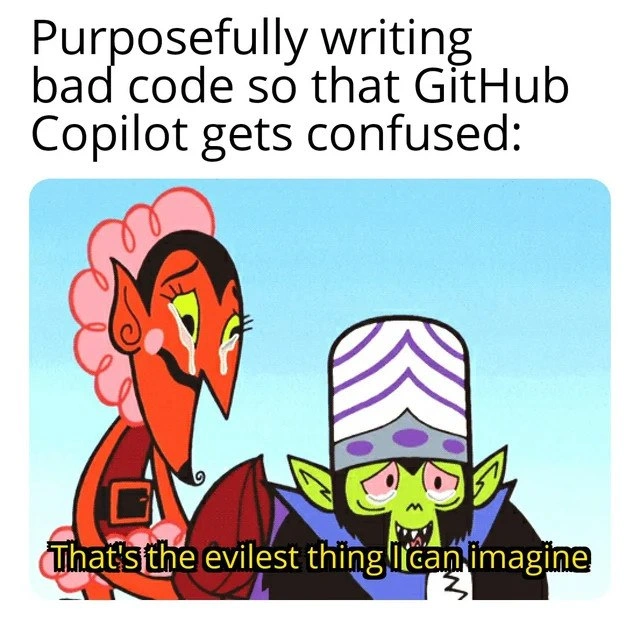
Now, look at the image itself: it shows two cartoon villains from The Powerpuff Girls (that’s a famous cartoon). The text at the top says, “Purposefully writing bad code so that GitHub Copilot gets confused:” and the cartoon villains are grinning. The bottom caption on the image says, “That’s the evilest thing I can imagine.” This is a popular meme format where a small evil plan is exaggerated as a great act of evil. Here, the powerpuff_girls_reference works perfectly: those characters (Him, the red devilish character, and Mojo Jojo, the monkey with the big brain helmet) are known for being melodramatically evil. They’re basically saying, “Wow, what an incredibly evil idea!” The joke is that normally “evil” in coding would be something truly harmful, but instead it’s just this silly idea of writing bad code to make an AI assistant’s life harder. It highlights the contrast: AI assistants are meant to help with good code, and here a developer is turning that on its head, intentionally creating chaos. For a newcomer, it’s helpful to know that developers often joke about AI tools like this – we’re excited by them, but we also love to test their limits for fun. It’s the same energy as a kid trying to trick Siri or Alexa with a weird question. And importantly, it underscores why code quality matters: bad code doesn’t just confuse Copilot, it confuses people too! The meme just uses Copilot as a funny victim because it’s a trendy new tool. In reality, writing clean code is encouraged so that both humans and machines can understand it. This meme gets laughs by pretending a programmer has gone “rogue” against that idea just to play a joke on an AI.
Level 3: Spaghetti Code Scheme
From a senior developer’s perspective, this scenario is hilariously backwards. We spend our careers preaching code quality and avoiding code smells — those telltale signs of problematic code, like overly complex methods or nonsensical variable names. Yet here we have a developer deliberately writing atrocious, spaghetti code on purpose! Spaghetti code is a nickname for code that’s tangled and twisted like a bowl of pasta – no clear structure, everything referencing everything else, making it nearly impossible to follow. It’s the kind of code that gives maintainers nightmares. Normally, encountering such a mess in a codebase prompts senior engineers to ask, “Who wrote this and why?!” because it often leads to bugs and endless refactoring. But in this meme, it’s an “evil scheme” – the developer knows it’s bad and is smirking while doing it, purely to throw off GitHub Copilot’s AI suggestions.
Why is this funny to experienced devs? For one, it’s poking fun at the idea of sabotaging an AI tool out of mischief. Copilot is meant to improve Developer Experience (DX) by suggesting helpful code snippets, saving time on routine coding. It thrives on common patterns – think of how many times you’ve written a loop or a handler function; Copilot has likely seen thousands of similar ones. Intentionally breaking those patterns is like playing a prank on your otherwise straight-laced pair-programming partner. A senior dev knows that in reality, writing bad code hurts you and your team more than any AI. After all, the AI doesn’t truly suffer – it’s not conscious, and it won’t have to fix the bugs later. The poor human developers (possibly future you) would be the ones untangling that ugly code. In that sense, the meme is a tongue-in-cheek caution: doing this is so counterproductive that it’s “evil” – you’re effectively cursing your own project with chaos just to get a laugh out of confusing the machine. It’s like cutting off your nose to spite your face, technically speaking.
There’s also an undercurrent of DeveloperHumor about our relationship with AI assistants. Ever since Copilot (and similar AI pair programming tools) appeared, engineers have been curious and a bit mischievous: “What if I give it really weird code, can I break it? Will it suggest something crazy?” The meme plays on that temptation. It also reflects a lighthearted fear that some devs joke about: “If Copilot learns from our code, maybe I should write in a way no AI can follow – job security through obscurity!” Of course, that strategy is sarcastically portrayed as villain-level evil because while you might confuse the AI, you’re also undermining your own productivity and your team’s sanity. In real teams, if someone pulled a “bad code prank” intentionally, code reviews or linters would catch it. Senior engineers have workflows with code reviews, style guides, and static analysis to maintain quality – all tools that would scream in agony if they saw deliberately horrible code being committed. The image of Powerpuff Girls villains gleefully conspiring underscores the absurdity: it frames the dev’s minor act of trolling an AI as if it’s a diabolical plan to take over the world. Seasoned devs chuckle because it dramatizes what is essentially a silly, self-defeating idea. We’ve all seen code so bad it felt malicious, but rarely is it literal villainy. Here, though, we jokingly attribute that level of malice to someone intentionally injecting code smells (like global variables everywhere, functions hundreds of lines long, etc.) just to mess with an algorithm. In summary, the humor from the senior viewpoint comes from the contrast between our earnest pursuit of clean code and this scenario of maliciously dirty code – it’s an inside joke about both code quality and the quirky ways developers might “rebel” against new AI tools.
Level 4: Adversarial Code Antics
At the deepest technical layer, this meme hints at an unexpected AI/ML twist: it’s essentially describing an adversarial example for a code-generating neural network. GitHub Copilot is powered by a large language model (OpenAI’s Codex, a descendant of GPT-3) that has been trained on millions of lines of public GitHub code. It works by statistically predicting the next chunk of code based on patterns it has seen. When you feed it normal, well-structured code, it confidently suggests likely continuations (like a super-charged autocomplete). But if you start feeding it bizarre, spaghetti code (i.e. code with tangled logic and no clear structure), you’re essentially giving the model an input that lies outside the distribution of what it learned as “good code.” This is akin to showing a computer vision AI a noise-distorted image to make it misrecognize a stop sign – an adversarial input. The model’s confidence plummets because the sequence of tokens (keywords, symbols, indents) doesn’t match any familiar pattern. In machine learning terms, you’re maximizing the model’s perplexity (a measure of how “confused” the model is by the input). High perplexity means the AI has no strongly probable guess for what comes next, leading to either nonsensical suggestions or a very generic fallback.
From a theoretical perspective, language models like Copilot excel when your code follows conventions and logical flow. They’ve essentially learned the grammar and idioms of multiple programming languages from lots of clean code examples. Deliberately writing ugly, unidiomatic code is like speaking in riddles to confuse a translator. The AI tries to pattern-match your chaotic code against its giant internal knowledge base. If your code is full of weird tricks, poor naming (x1, x2, xxx3 everywhere), and deeply nested or unpredictable flows, the model’s internal neural network weights struggle to find a sensible completion. You might get wild, off-the-mark suggestions as the AI grasps at straws, or it might even mirror the nonsense – producing equally convoluted code since it assumes that’s your “style.” In essence, you’ve performed a “malicious” prompt engineering: crafting your input to break the AI’s usual helpful behavior.
It’s a devilish delight for an engineer with an ML mindset: this prank showcases how even advanced AI assistants have failure modes when encountering inputs that violate assumptions. Real research in AI safety and robustness looks at exactly this kind of scenario (though usually to prevent bad inputs from causing chaos!). Here, our villainous developer is intentionally creating a miniature AI confusion event. And because Copilot is non-sentient, it won’t get “upset” like a human – but its outputs might start to resemble a confused student who was handed a terribly written textbook. The meme’s joke exaggerates this effect as an “evil mastermind” move, underlining a truth in AI pair programming: garbage in, garbage out. If you feed the assistant garbage code, don’t be surprised when it produces garbage suggestions. This deep cut of humor plays on knowledge of how AI models rely on learned patterns – and how breaking those patterns is like tossing a wrench into the probabilistic gears of the software. It’s simultaneously a poke at AI’s limitations and a geeky nod to the idea of outsmarting a smart system by going “off-script.”
Description
A meme featuring a screenshot from the animated series 'The Powerpuff Girls'. The top text reads, 'Purposefully writing bad code so that GitHub Copilot gets confused:'. The image below shows two famous villains from the show, the demonic 'HIM' and the super-intelligent ape 'Mojo Jojo,' both crying with expressions of awe and horror. The caption at the bottom, from the show's dialogue, says, 'That's the evilest thing I can imagine'. This meme humorously elevates the petty act of intentionally confusing an AI coding assistant to the level of ultimate evil. For experienced developers, it's a funny take on the human-AI interaction in programming, touching upon the temptation to 'test the limits' or even playfully sabotage the tools that are supposed to help them. It's a nod to the chaotic-neutral tendencies of programmers and the inside joke of polluting the AI's learning model with nonsensical or deliberately flawed code
Comments
11Comment deleted
Some devs write bad code to confuse Copilot. I write legacy-style enterprise Java. Copilot isn't confused, it's just depressed
Sure, poison Copilot with 2-letter Hungarian variables and 1,000-line God classes - just remember: gradient descent forgets in minutes, but git blame keeps receipts forever
The real evil isn't writing bad code accidentally - it's realizing that every poorly written snippet you commit today becomes tomorrow's training data, creating a recursive loop of technical debt that even GPT-5 won't be able to refactor its way out of
The ultimate form of technical debt: code so deliberately convoluted that even your AI pair programmer throws up its hands and suggests 'TODO: refactor this entire module.' It's like writing Perl that would make Larry Wall weep, but with the specific intent of gaslighting a transformer model trained on millions of lines of clean code. Bonus points if your variable names are just Unicode homoglyphs and your control flow looks like a bowl of spaghetti that achieved sentience and chose chaos
Veteran move: Embed goto in async Rust to watch Copilot hallucinate a kernel panic mid-suggestion
Adversarial programming: crank cyclomatic complexity to 50, shadow two imports, sprinkle a mutable singleton - and watch Copilot autocomplete an apology
We do Copilot chaos engineering: hide a mutable singleton in the “functional core,” wire CQRS through ActiveRecord, and name the async function Sync - its autocomplete quietly devolves to // good luck
Is Copilot released? Comment deleted
Not yet Comment deleted
Purposefully writing your code so GitHub Copilot gets confused Comment deleted
Future employers won't offer you a job Comment deleted