The Eternal Struggle: Proprietary Demands vs. Open Source Freedom
Why is this OpenSource meme funny?
Level 1: Sharing Is Caring
Imagine a kid who loves to share his toys with all his friends. He thinks everyone should get a turn to play and have fun together. Now picture a very strict parent who suddenly yells at this kid, “Stop sharing your toys! Keep them to yourself!” How do you think the kid would react? He’d probably throw a tantrum, right? He might scream and cry because sharing is what he believes in and it feels so wrong to just keep everything secret.
In this meme, Linux is like that kid who wants to share. Linux is a type of computer program (an operating system) that is open-source, which basically means it’s made to be shared and collaborated on by everyone. The parent in the meme is shouting, “Why can’t you just be proprietary!” — which means “Why can’t you just keep all your code secret and not share it?” That’s like telling our sharing-loving kid to suddenly become selfish. And Linux (the kid in this scenario) responds by screaming in protest. In other words, the idea of not sharing its code makes Linux so upset that it just yells wildly. The humor here is a lot like a parent-child drama on a playground: the parent wants the child to act “normal” (in the parent’s eyes, normal means not sharing secrets), but the child can only be himself. Linux’s true self is all about sharing knowledge and software with everyone (because sharing is caring! 😊). So the meme is funny because it’s basically saying: you can’t force someone (or something) who lives to share and play nice to suddenly play keep-away — they’re going to scream and resist with everything they’ve got. Linux will always share its toys (code), no matter who tells it to stop. And that rebellious, noisy refusal is what makes people laugh and cheer in this picture.
Level 2: Tux Tantrum
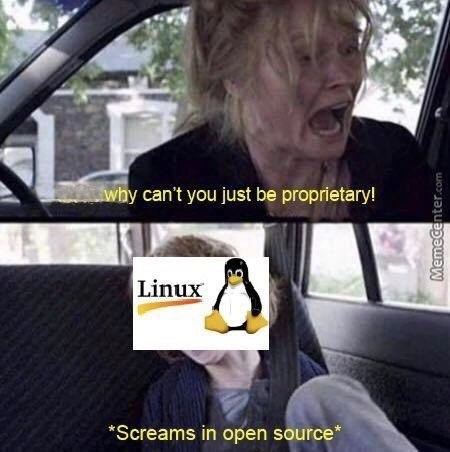
Let’s break down what’s happening here in simpler terms. The meme uses a popular two-panel “car tantrum” format (often captioned as “Why can’t you be normal? – Screams”*). In this version, the text has been changed to “why can’t you just be proprietary!” in the first panel, and “Screams in open source” in the second. The image shows a mother figure yelling in frustration in the front seat, and a child in the back seat having a full-blown tantrum. Only here, the child’s head is covered by the Linux logo (the penguin named Tux). So effectively, the mother is shouting at Linux, telling it to behave like proprietary software, and Linux (as the child) responds by screaming gibberish in “open-source language” – basically refusing loudly.
To understand the joke, you need to know what Linux is and what we mean by open source versus proprietary. Linux is a famous open-source operating system (technically, it’s a kernel, the core part of an OS). “Open-source” means the source code (the human-readable instructions of the software) is publicly available. Anyone can look at it, use it, modify it, and share it, usually under certain license rules. In Linux’s case, it’s licensed under the GPL, which is a type of open-source license that says: “Sure, you can use and modify this code, but if you release a product with it, you have to make your modifications open as well.” In contrast, proprietary software is the opposite: its source code is kept secret by the company or person who made it. You can’t legally copy, modify, or distribute that code without permission. Think of Windows or macOS – these are proprietary operating systems. You get the software as a user, but you never see the actual source code behind them; only Microsoft or Apple’s authorized developers can change those.
Now, the mother in the meme shouting “why can’t you just be proprietary!” is like someone (maybe a business exec or a closed-source enthusiast) who doesn’t like that Linux is so open. She’s basically saying, “Why can’t you just keep your code secret and charge money for it like a normal product?” And the child – representing Linux – is not having it. The child just screams even louder in open-source mode. The caption “Screams in open source” is a humorous way to say that Linux is expressing itself entirely as an open-source thing. It’s like it only knows how to communicate by being open. The wording is playing on a meme trend where people say “screams in [X]” (for example, “screams in Spanish” as a joke in other memes) to mean someone is screaming in a way characteristic of X. So “screams in open source” means Linux is metaphorically screaming with open-source fervor. Maybe imagine the child yelling something like, “I WILL ALWAYS BE FREE AND OPEN!” at the top of their lungs. 😄 It’s a dramatized refusal.
For a junior developer or someone new to this context, it helps to connect it to real-life scenarios in tech. Many companies use Linux because it’s free and powerful, but they sometimes get frustrated with the obligations that come with that freedom (like having to reveal their own changes to the Linux code). The meme is funny to developers because we often see this mismatch in attitudes: developers and open-source communities love sharing code and collaborating (that’s how Linux is built by thousands of people worldwide!), but business folks sometimes wish they could take that code and lock it up to make money or keep control. Here’s a quick comparison to clarify:
| Open Source (Linux) 🚀 | Proprietary Software 🔒 |
|---|---|
| Code Availability: Code is public and anyone can view or download it. | Code Availability: Code is closed-off; only the owner/company can see or access it. |
| Modification: Developers worldwide can modify/improve the software (and often share those improvements back). | Modification: Only the original creators or licensed partners can modify the software. |
| Licensing: Often uses licenses like GPL that require sharing any changes (copyleft). The emphasis is on collaboration and user rights. | Licensing: Uses restrictive licenses or EULAs. The emphasis is on control, profit, and protecting intellectual property. |
| Examples: Linux kernel, Firefox browser, Apache web server (you can get their source code for free). | Examples: Microsoft Windows, Adobe Photoshop, Apple’s iOS (code is not released to the public). |
In the meme, Linux is basically portrayed as a child firmly on the left side of this table (open source) being yelled at to become like the right side (proprietary). The reason developers find this hilarious is because Linux never budges on being open — that’s what it is. Trying to make Linux proprietary is absurd, akin to yelling at a penguin to start flying like an eagle. It’s just not going to happen, and the penguin will squawk indignantly. The “tantrum” we see is Linux sticking to its open-source guns.
Also, note the clever use of the meme template: the original meme (from a movie scene) had the mother shout, “Why can’t you just be normal?!” and the kid screams wildly. It’s used online whenever someone or something refuses to be “normal” or conventional. Here, “normal” for the mom character means “proprietary, closed-source software” because maybe that’s what she’s used to. But Linux is the weird kid that insists on being open-source no matter what. So the text became “why can’t you just be proprietary!” to fit the software theme, and the kid’s scream is explicitly labeled as an open-source scream. It’s a fun way of saying Linux will always choose freedom and openness even if someone literally screams at it to change. In fact, the louder you demand it to be closed, the louder it will scream in open source. Developers chuckle at this because it personifies the almost stubborn purity of Linux’s open-source nature. If you’ve ever tried to explain to a non-tech friend why you contribute to open source or why some tools are free, you might have gotten confused looks — in a sense those folks are like the parent asking “why can’t it just be proprietary (normal)?”. And the only answer, as the meme jokes, is an incoherent open-source scream — because to us, the openness is the norm and the only way for Linux.
Level 3: Kernel of Resistance
This meme highlights a licensing philosophy conflict at the heart of tech culture: open source vs proprietary. In the top panel, a frustrated figure (think of a boss or a company executive) yells, “why can’t you just be proprietary!” at the child in the back seat. The child’s face is covered by the Linux logo (the penguin Tux), and in the bottom panel the child is shrieking with the caption “Screams in open source”. To an experienced developer, this scene immediately evokes the drama of trying to force Linux – the poster child of OpenSource – into a closed-source mold. It’s like watching someone try to put a leash on a wild penguin 🐧: amusing and doomed to fail.
At a deep technical and community level, Linux simply cannot “be proprietary.” The Linux kernel is released under the GPL (GNU General Public License), a famous copyleft license that legally and philosophically prohibits turning the code proprietary. Under the GPL, any derivative work of Linux must remain open source and distributed under the same license terms. If a company tried to take the Linux source code, modify it, and not release the modifications, they’d be violating this license (essentially breaking the rules of the open-source playground). In other words, the GPL ensures Linux will always scream in open source. This strong licensing is by design: it protects user freedoms and prevents exactly what the yelling parent in the meme is demanding. Linus Torvalds (Linux’s creator) chose the GPL to make sure no one could grab his code and turn off the freedom faucet. It’s baked into Linux’s DNA that it stays free (as in freedom, not just free of charge). Telling Linux to stop being open source is like telling water not to be wet – a fundamental non-starter.
The humor hits home for developers because it exaggerates a real-world tension. OpenSourceSoftware projects like Linux are built on a culture of transparency and collaboration, whereas ProprietarySoftware is all about control and secrecy. Seasoned engineers have seen this clash play out in companies and the industry at large. Imagine a corporate meeting where a non-technical manager says, “Can’t we just keep this code internal and proprietary? Why share it?” and the dev team collectively gasps because they know the project is under GPL or benefits from community contributions. The meme channels that collective gasp as a full-on tantrum. 😀 Many of us have experienced a scenario where we champion an open-source tool or library, only to run into management paranoia about “giving away our secret sauce.” This image personifies Linux as the child who only knows how to be open, being yelled at by a parent figure representing the corporate “closed-source” mindset. The result? Linux (the child) responds with an ear-splitting open source scream, essentially saying, “No way, I won’t keep my code secret!”. It’s a rebellious streak that veteran devs recognize and cheer for.
There’s also a sly nod to tech history here. In the early days, big companies viewed Linux and the GPL as a threat — a famous CEO once dubbed GPL-licensed code a “cancer” because it forces anything it touches to also be open source. That’s exactly the attitude of the yelling parent: an older proprietary worldview baffled (and angered) by the viral openness of Linux. Over the decades, though, Linux and open source won huge victories (Linux runs everything from servers to Android phones), and even former adversaries had to adapt. Nowadays even Microsoft proclaims love for Linux, a far cry from the past. This meme plays off that history by depicting a ProprietarySoftware advocate essentially losing it when faced with Linux’s unyielding openness. If you’re a senior dev, you likely remember the “Open Source vs Proprietary” debates, the licensing_philosophy_conflict in boardrooms, and maybe fought a few battles to open-source a project or comply with GPL requirements. Seeing Linux personified as a screaming child is darkly funny because it’s so true — Linux would rather throw a fit than ever surrender its OpenSource principles. The phrase “Screams in open source” itself parodies the meme format of “screams in [language],” implying that Linux’s very language and instinct is open source. In practice, that scream could be imagined as a torrent of passionate community emails, legal cease-and-desist letters for license violations, or maybe Tux flapping and squawking about freedom at the top of its lungs. It’s the OperatingSystems world’s version of a teenager yelling “You’re not the boss of me!” to a parent. And in this case, the parent’s demand truly is impossible — a senior developer knows that no amount of corporate pressure can magically convert Linux’s licensing; you’d either have to rewrite the entire kernel from scratch under a new license or face the wrath of the open-source community. So the kernel (pun intended) of the joke is that Linux’s core identity is freedom, and any attempt to strip that away will be met with an indignant, unignorable scream.
Description
This is a two-panel meme using the format from the movie 'The Babadook,' where a distressed mother is yelling at her child in the car. In the top panel, the mother is screaming, with the caption reading, 'why can't you just be proprietary!'. In the bottom panel, the child in the back seat has their face replaced with the Linux logo, featuring Tux the penguin. The caption below reads, '*Screams in open source*'. The meme humorously personifies the long-standing cultural and philosophical clash between the worlds of proprietary, closed-source software and the free and open-source software (FOSS) movement. It captures the frustration that corporate environments sometimes have with the licensing, support models, or perceived lack of polish of open-source solutions, while simultaneously celebrating the defiant, community-driven identity of Linux and the FOSS world
Comments
13Comment deleted
The reverse is a developer forced to use Windows, whispering to their Linux VM: 'Why can't you just have a stable GUI and not break my audio drivers after every update?' *Screams in kernel panic*
“Sure, we can ship a proprietary Linux build - just strip every EXPORT_SYMBOL_GPL and let me know if the kernel still boots.”
The real horror story isn't the Babadook - it's explaining to your CTO why the critical production system you just migrated to Alpine Linux doesn't have bash installed by default, right after you spent three meetings evangelizing about the superiority of open source solutions
The eternal struggle: management wants proprietary control and vendor lock-in for 'enterprise support,' while the engineering team is ready to fork the entire codebase and maintain it themselves rather than compromise on GPL principles. Bonus points if this argument happens right after someone suggests migrating from a perfectly functional open-source solution to a SaaS product that costs 10x more and does half as much
PM: "Why can’t you just be proprietary?" Linux: "Happy to - once Legal re-licenses every commit since ’91."
Ask to “make it proprietary on Linux” and you’ll find the only thing you can statically link is the compliance team - copyleft’s transitive closure beats your microservice graph
Proprietary: one vendor's controlled chaos. Open source: infinite forks, zero consensus - pure sysadmin therapy
Lol Comment deleted
How im tired of linux fans, who's life so miserable, what the only thing they can be proud of is a linux in their pc. "How cares you have a wife, kids and a regular sex? I have gentoo installed!!!!" Comment deleted
if you had arch you could be more proud Comment deleted
like that ever happened Comment deleted
Installing Gentoo/Arch automatically puts 3 dicks and fist into your ass, so... Comment deleted
Ok ... Comment deleted