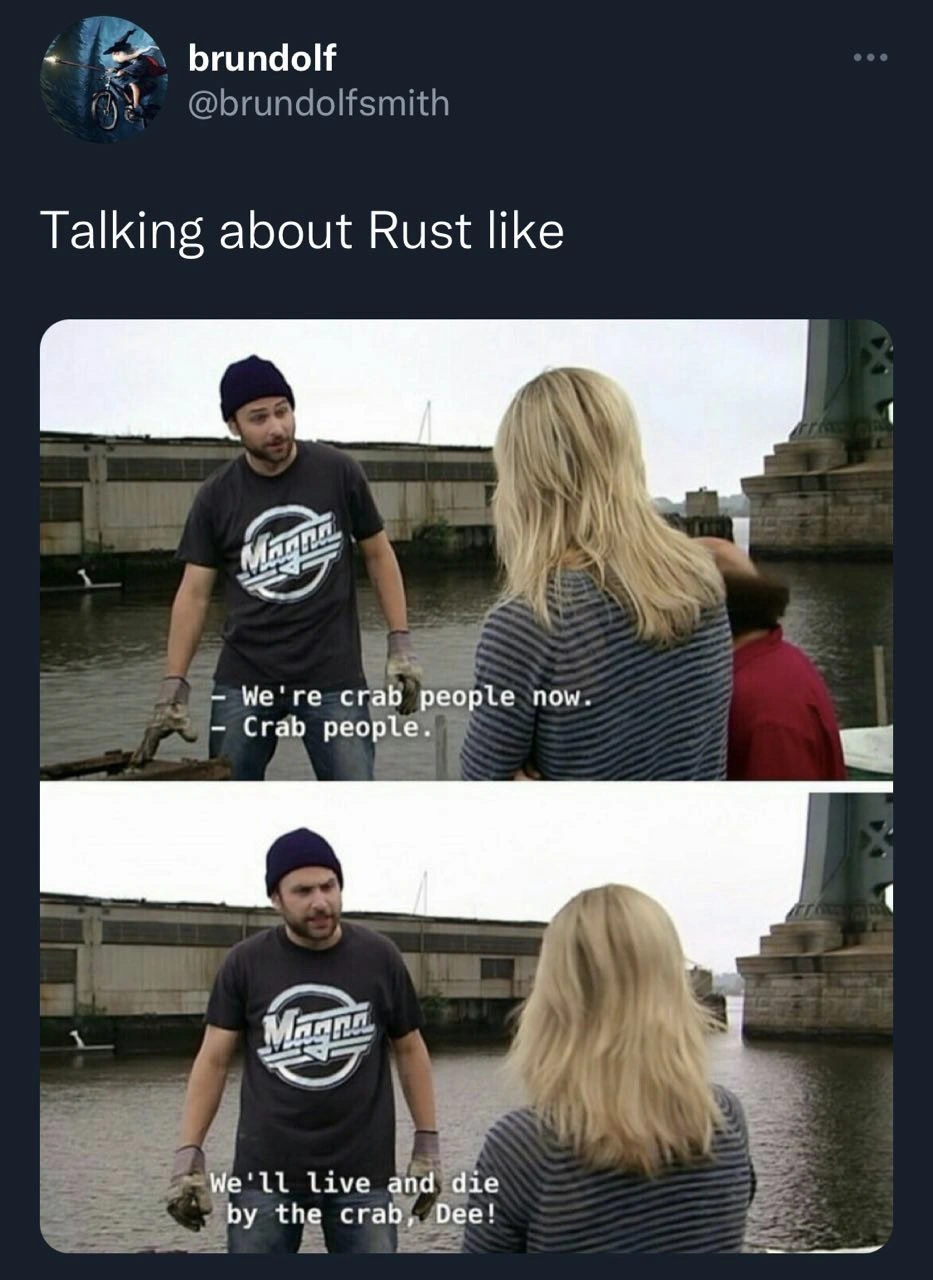
Rust developers proclaim crab allegiance in meme highlighting community identity and enthusiasm
Why is this Languages meme funny?
Level 1: Crab People Forever
Imagine you have a group of friends who all love the same thing – let’s say a cool toy or cartoon character that happens to be a crab. You guys form a fun little club around it. You call yourselves “the Crab People” and even make a cute crab your team mascot. You’re all so excited that you start saying silly, over-the-top stuff like, “We’re crab people now! We’ll live and die by the crab!” 😄 Obviously, you’re not actually going to live or die because of a crab – you’re just showing huge love and loyalty to your favorite thing in a dramatic, playful way.
This meme is doing exactly that, but with computer programmers and their favorite programming language. Rust is the thing they love, and a crab named Ferris is its mascot (kind of like a team logo). The joke is that these programmers are acting like they joined a crab fan club for life. It’s funny because normally people don’t get that pumped up about a tool or language – it’s like if someone said they’d “live and die” by their favorite pencil or their gaming console. It’s an exaggerated way to show how excited and proud Rust programmers are. Even if you don’t know anything about Rust, you can laugh at the idea of grown-ups essentially saying, “We’re officially crab people now, and we’re never giving that up!” It’s just like friends who are super fans of a sports team or a hero, proudly wearing the same colors and shouting the same slogans together. The meme makes us smile because it shows a bunch of tech folks sharing a goofy, passionate team spirit – all rallying around a happy little crab.
Level 2: Rustaceans Unite
Let’s break down the joke in simpler terms. Rust is a modern programming language that developers are very excited about. It was created (with support from Mozilla) to give the speed and power of low-level languages like C or C++, but without those languages’ notorious pitfalls. In Rust, a lot of bugs that could crash your program (such as trying to use memory that was freed, or concurrent threads messing up shared data) are caught at compile time, before the program even runs. This is achieved through Rust’s strict rules about ownership and borrowing – basically the language’s way of tracking who can use which data, and when. If you break the rules, the Rust compiler refuses to build your program until you fix it. While that can be tough for beginners at first (facing the strict borrow checker feels like a stern teacher marking up your homework), it leads to very reliable code. Rust folks like to say it provides “memory safety without a garbage collector”: unlike Java or Python, Rust doesn’t have a runtime engine periodically cleaning up memory. Instead, memory is managed through those ownership rules, so you get the efficiency of manual memory control but the safety of automatic memory management. This combination is a big part of why Rust fans love the language – it’s both fast and safe, which is a holy grail in systems programming.
Now, who are the “Rustaceans” mentioned in the meme? That’s what Rust developers affectionately call themselves as a community. It’s a pun: Rust + crustacean = Rustacean, reflecting that their unofficial mascot is a crab (a crustacean). The little red/orange crab you often see in Rust materials is named Ferris. Ferris isn’t in the core documentation as a technical element, but you’ll find him in a lot of Rust’s community content, blogs, conference slides, and even the Rust books. He’s a cute, bubbly crab cartoon that embodies the friendly, quirky spirit of Rust’s community. Rust developers embraced Ferris from early on as a symbol of the language – much like how Go programmers have the Go gopher or Linux users have the penguin Tux. This means Rust enthusiasts have a fun shared identity: they joke that they are “crab people” or “Ferris’s followers”. Calling themselves Rustaceans is a light-hearted way to say “We are proud users of Rust, and we have our own little culture.” Think of it as a team name for people on Team Rust.
The meme image itself highlights this community_enthusiasm in a humorous way. It shows characters from a TV show (the show is It’s Always Sunny in Philadelphia, a comedy known for characters getting into absurd situations) with subtitles that have been memefied. In the scene, one character (Charlie) dramatically says “We’re crab people now.” and later “We’ll live and die by the crab, Dee!” (Dee is the name of the woman he’s talking to). These lines weren’t actually about programming in the show – they’ve been repurposed here as a joke. The idea is: this is what it sounds like when die-hard Rust fans talk about their language. They basically identify so strongly with Rust (and Ferris the crab) that it’s as if they’ve all joined a devoted crab-centric club. “We’re crab people now” = we have converted to Rust and there’s no going back. “We’ll live and die by the crab!” = we’re going to stick with Rust through thick and thin, letting the Ferris crab guide our development life. It’s exaggerated for comedic effect — real Rust developers don’t literally chant about crabs (at least, not outside of joking), but they do often show a lot of pride and unity about being Rustaceans.
To someone new, this meme might look completely bizarre (“Why on earth are developers talking about crabs?”). Here’s the context: Rust’s mascot being a crab has led to a lot of in-jokes. For example, Rust conferences hand out crab stickers, and documentation might include Ferris icons to highlight examples. The community even refers to newcomers learning Rust as “rustlings” (a playful term, also the name of an official Rust learning exercise project). All of this builds a sense of camaraderie. The meme is funny because it exaggerates that camaraderie to the level of a ridiculous pledge. It’s taking a normal scenario (developers happily discussing their favorite programming language) and dialing it up to a TV comedy scenario (characters acting like they joined a crab cult). If you’re familiar with how developers can sometimes argue over which language is best – often called language wars – you’ll recognize this as poking fun at the almost fanatical side of those debates. Rust has actually been voted the “most loved programming language” in developer surveys several years in a row around 2022, so its users do tend to be very enthusiastic in praising it. This meme playfully ribs Rust fans about that: “You guys love Rust so much, you basically worship a crab!”
Let’s clarify some terms from the tags in the context of this meme:
- Ferris the crab mascot: Ferris is the smiling crab drawing representing Rust. He’s not an official logo (Rust’s official logo is a gear/cog with an ‘R’), but Ferris has become a beloved symbol at meetups and in online discussions. The Rust community enjoys having a cute mascot—it makes the community feel more fun and approachable.
- Rustacean identity: This refers to the identity of being a Rust developer. Rustaceans often bond over the challenges of learning Rust (like mastering the borrow checker) and celebrate the language’s successes together. It’s an identity that people wear with pride, sometimes even literally (with T-shirts or forum titles calling themselves Rustacean). When the meme says “We’re crab people now,” it’s directly referencing this adopted identity.
- Always Sunny reference (always_sunny_reference): The format of the meme (using that specific scene with characters Charlie and Dee on a dock) is a reference to It’s Always Sunny in Philadelphia, a sitcom. In one episode, characters joke about bizarre concepts (though “crab people” is also a phrase that appeared as a joke in South Park, another show, which adds an extra pop-culture layer). By using this scene, the meme taps into the absurd humor style of Always Sunny to amplify how overzealous Rust talk can sound. Even if you don’t know the show, you can tell from the subtitles and the characters’ expressions that it’s a comedic, exaggerated moment.
- Talking_about_rust: This tag just highlights that the meme is about how people speak of Rust. In many tech communities, people poke fun at Rust users for how often they bring up Rust’s advantages (“Ooh, this would be so much safer/faster in Rust!”). The meme is basically saying “when Rust developers talk about Rust, they act like this.” It’s lovingly mocking the way Rust fans can sometimes be one-note, always circling back to how great Rust is.
Finally, let’s appreciate why this is light-hearted developer humor. Developers often give each other a hard time over the tools and languages they love. It’s similar to how sports fans might jokingly tease someone for being a die-hard supporter of a team. Here, Rust is depicted as a team with a crab mascot, and Rust fans are the die-hards painting their faces (or rather, their keyboards) orange in support. The phrase “live and die by the crab” isn’t something you’d normally hear in a discussion about software engineering! By putting that dramatic line in a developer context, the meme format makes it clear it’s a joke. It’s saying: Rust developers are so enthusiastic, it’s as if they’d stake their life on this crabby language. Of course, in reality, it’s all in good fun — they just really enjoy Rust and its community. The humor works because it’s an inside joke: if you know about Rust’s Ferris mascot and the reputation of Rustaceans, you immediately chuckle at the idea of developers pledging allegiance to “the Crab”. If you don’t know these things yet, now you do – and the meme’s wacky imagery starts to make sense!
Level 3: Ferris Fervor
Rust developers’ fervent loyalty to their language has become legendary in programming circles. This meme captures that passion by portraying Rustacesans as if they’ve joined an almost cult-like tribe of crab-worshippers. In the screenshotted tweet, a scene from It’s Always Sunny in Philadelphia is repurposed so the characters triumphantly declare:
Charlie: “We’re crab people now.”
Dee: “Crab people.”
Charlie: “We’ll live and die by the crab, Dee!”
This over-the-top oath mirrors how enthusiastically Rust aficionados champion their language. It’s as if joining the Rust community means swearing fealty to Ferris the Crab, the unofficial Rust mascot. The phrase “live and die by the crab” is obviously hyperbole – it humorously exaggerates the rustacean_identity devs feel, where Ferris (the friendly cartoon crab) is their banner. The joke lands because it’s just plausible: Rust’s community is known for being zealously proud, so much that to outsiders they might sound like “crab people” forming a quirky cult around a programming language. 🦀
So, why are Rust developers so intense about their language? The humor draws on real technical triumphs that Rustaceans often boast about. Rust is a systems programming language that offers performance on par with C/C++ without the usual horrors of manual memory management. Seasoned engineers know the pain of elusive memory bugs – null pointer dereferences, data races, buffer overflows – the stuff that causes segmentation faults at 3 AM. Rust’s compiler enforces strict memory safety through its ownership and borrowing rules (a.k.a. the borrow checker), virtually eliminating those bugs at compile time. This is a huge deal! After years battling memory corruption or heisenbugs in other languages, discovering Rust can feel like finding religion. You suddenly trust that whole classes of runtime errors simply cannot happen in safe Rust code. No wonder folks proudly say things like “In Rust We Trust” and joke about rewriting every project in Rust. The language delivers a rare combination of performance and reliability, and that success has inspired almost fanatical devotion – a key reason this meme’s absurd pledge of allegiance resonates with truth.
The Rust community’s enthusiasm isn’t just about avoiding bugs, though. Rust introduced concepts like fearless concurrency – allowing developers to write multithreaded code that the compiler guarantees is free of data races. Concurrency bugs are notoriously hard to debug, so Rust’s approach feels like a superpower. A veteran developer who has been bitten by race conditions or thread-safety issues might feel immense relief and excitement using Rust’s tools. It’s the kind of excitement that makes them want to tell everyone, “Look, no segfaults! No deadlocks! This crab means business!” They’ve seen the dark side of undefined behavior and come out the other side as true believers in Rust’s stricter discipline. The meme’s comedic cry “We’re crab people now” playfully hyperbolizes that conversion experience — one day you’re debugging a gnarly C++ core dump, the next day you’ve tried Rust and are gleefully telling all your colleagues to bow to the Ferris crab for salvation.
Beyond the tech itself, Rust’s developer experience (DX) and community culture fuel this fervor. The language was designed with a keen eye on ergonomics: Cargo, Rust’s build and package manager, makes dependency management and building crates remarkably smooth. Rust’s compiler error messages are famously friendly and informative, often teaching you how to fix the problem in your code with a bit of humor or encouragement. (Seasoned devs will tell you how refreshing it is to have a compiler that talks to you politely instead of spitting cryptic hex codes.) This supportive tooling and onboarding experience gives newcomers warm fuzzy feelings – you don’t just write Rust, you feel like Rust has your back. Over time, that positive experience translates into community_enthusiasm. Rustaceans love to point out how thoughtful design in documentation (the official book, Rust By Example), tooling, and forums (the users forum, Discord chats) make learning Rust rewarding. When a language takes care of its developers, the developers happily take up its banner. In Rust’s case, that banner has a smiling crab on it, so of course they’re waving it proudly and shouting its praises.
The DevCommunities aspect is key: Rust’s community from the beginning set out to be welcoming and inclusive. They embraced the Ferris the 🦀 as a fun, quirky symbol that everyone could rally around. At RustConf and other meetups, you’ll find stickers and plushies of Ferris, people wearing “Rustacean” T-shirts, and plenty of inside jokes about claws and crustaceans. This shared humor (like referring to themselves unironically as crab people) builds camaraderie. For experienced developers, it’s reminiscent of other strong tech subcultures — think of Linux folks with Tux the penguin, or Go programmers with the gopher mascot. Each community has its rallying symbols, but Rust’s might be one of the most whimsical in recent memory. The meme pokes fun at this by implying Rust fans have basically formed a Crab People Club and signed an oath in saltwater. It’s a bit of self-aware ribbing: the Rustaceans in on the joke are effectively saying “Haha yeah, we do act like a crab-worshipping cult sometimes — but only because Rust is that awesome!”
There’s also an undercurrent of LanguageWars humor here. In tech circles, debates over programming languages can get heated, almost like sports rivalries. Rust enthusiasts have a reputation (earned or not) for being especially vocal about the superiority of their language’s features. The tweet caption “Talking about Rust like” implies that whenever Rust developers speak, it’s always about how great Rust is — as if they can’t have a conversation without recruiting someone to the Rust side. The meme exaggerates this by giving them a comical battle cry: “We’ll live and die by the crab!” It’s satire of the way devs sometimes dramatically proclaim “$MyFavoriteLanguage or bust!” Whether it’s Python vs. Ruby, or JavaScript vs. everyone, such fervor is familiar to any senior engineer. Here Rust is the new champion, and its fans’ zealous (and sometimes quirky) advocacy is being playfully lampooned. The choice to use an Always Sunny TV screencap is clever: that show is known for parodying extreme, absurd behavior. By mapping Rust evangelism onto a scene of characters acting way over-the-top (joining some ridiculous “crab people” scheme), the meme says: Yes, we know we Rustaceans can sound a little crazy — isn’t it great? The humor works on two levels: it good-naturedly teases Rust fans for their one-track enthusiasm, and it gives a knowing wink to insiders through the always_sunny_reference (“Crab people” being such a random, funny thing to declare).
In short, this meme is a celebration of Rust community culture wrapped in a joke. It highlights how talking_about_rust often carries a fervor beyond normal tech chatter. By proudly chanting the crab_people_quote, developers are basically saying Rust isn’t just a tool they use; it’s a badge they wear. The technical merits of Rust (memory safety, fearless concurrency, great tooling) have forged an identity so strong that calling themselves “crab people” in jest actually makes sense. For a seasoned dev, the meme elicits a chuckle of recognition: been there, seen that – new language arrives, saves us from some pain, loyal followers ensue. Rust just happens to have made its followers particularly enthusiastic educators and evangelists (and given them an adorable crustacean to rally around). The Ferris fervor is real, and this meme captures its essence: a mix of serious technical admiration and tongue-in-cheek tribal camaraderie, all symbolized by one cute little crab.
Description
Screenshot of a tweet from user “brundolf @brundolfsmith” with the tweet text “Talking about Rust like”. Below are two stacked frames from a TV scene: in both, a man in a dark beanie and “Magna” T-shirt faces a blonde woman by a riverside dock. Subtitles in the first frame read “- We’re crab people now. - Crab people.”; the second frame reads “We’ll live and die by the crab, Dee!”. The meme equates Rust programmers (nicknamed Rustaceans after Ferris the crab mascot) with zealously calling themselves “crab people”, poking fun at how Rust enthusiasts adopt a shared identity around the language’s safety guarantees and modern features. The humor relies on inside-developer culture and the crab metaphor widely used in Rust documentation and conferences
Comments
6Comment deleted
I suggested rewriting one CLI tool in Rust; now every design doc ends with “because borrow checker” and the infra lead signs emails “🦀 regards.” Turns out you don’t adopt Rust - the crab adopts you
After twenty years of watching memory-safe languages promise to save us from ourselves, I've finally accepted that Rust developers are just C++ programmers who went through therapy and came out with really strong opinions about borrowing
The Rust community has achieved what no other language could: making developers voluntarily embrace a compiler that argues with them. Most engineers spend their careers trying to avoid strict type systems and borrow checkers, but Rustaceans have somehow turned 'fighting the compiler for three hours' into a badge of honor. It's the Stockholm Syndrome of programming languages - you suffer through the learning curve, and then you can't imagine why anyone would willingly use a language that lets you shoot yourself in the foot with null pointers and data races. The real genius is that they made memory safety so appealing that developers now hold crabs and declare tribal allegiance, as if Ferris were leading them to the promised land of zero-cost abstractions and fearless concurrency
Every design review now ends with “rewrite in Rust” and an Arc<Mutex<T>> - crustacean-driven development, where appeasing the borrow checker doubles as the migration plan
Rust devs: 'Embrace the crab or segfault trying' - living and dying by the borrow checker's pinch after decades of pointer roulette
We adopted Rust and became crab people: live by the borrow checker, die on the FFI boundary - compile times pinch, but UB finally stays underwater