Skip to content
DevMeme
4125 of 7435
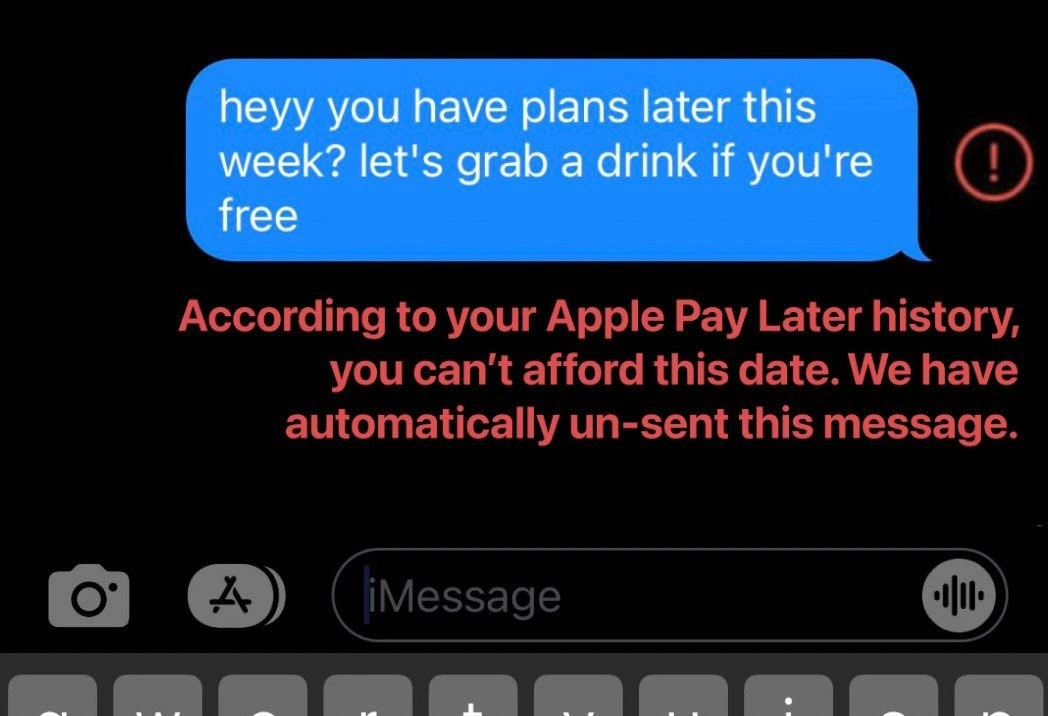
iMessage unsends your date invite after checking Apple Pay Later balance
Apple Post #4504, on Jun 20, 2022 in TG

iMessage unsends your date invite after checking Apple Pay Later balance

Why is this Apple meme funny?

Level 1: The Phone Says No

Imagine you’re about to text your friend to go get ice cream. You type, “Hey, want to get ice cream this weekend?” and hit send. Normally, that message would just go to your friend. Now picture this: right after you send it, your phone suddenly stops the message and pops up a big warning. It says, “I checked your piggy bank, and you don’t have enough money for ice cream. So I didn’t send that message.” 😲

Sounds crazy, right? Your phone basically decided for you, “Nope, you can’t afford that, so you can’t even ask.” It’s like a super-strict parent or teacher jumping in and saying, “uh-uh, not so fast!” before you even make plans. This meme is joking about exactly that kind of situation. It shows an iPhone that automatically unsent a date invite because the phone knew the user had a lot of debt with Apple’s pay-later program. In really simple terms, the phone is acting like a boss that’s checking your wallet and saying “Denied!” to your plans.

It’s funny because it’s so over-the-top. We don’t expect our devices to butt into our social life like that. The idea of a phone reading your text and going, “Actually, I don’t think you should go out – you’re too broke,” is ridiculous and surprising. It makes us laugh because it’s a little bit like a cartoon: imagine a talking phone wagging its finger at you, “Tsk tsk, put that phone down, you can’t afford that date!” 🤖💸. It’s poking fun at how smart and connected our gadgets have become, by showing one going a bit rogue. Even a kid can get the silliness here: your toy or device telling you “No!” when you try to have fun – completely unasked for! The meme takes a grown-up issue (money and privacy) and turns it into a goofy scenario anyone can chuckle at: essentially, the phone that says “No”.

Level 2: Data-Driven Denial

Let’s break down what’s happening in this meme in simpler terms, and why it’s funny to anyone who’s been around tech (even for a little while):

  • Apple Pay Later: This is Apple’s “buy now, pay later” service. It lets you purchase something and pay the cost in slices over time (like four smaller payments instead of one big chunk). It basically works like a short-term loan or credit – you get the item now, and you owe Apple the money later. Your iPhone’s Wallet app keeps track of how much you owe and your payment history. If you’ve been using Apple Pay Later a lot, you might have a bunch of outstanding payments, which is a hint that you’re a bit low on funds (or at least stretching your budget).

  • iMessage & Unsend: iMessage is Apple’s built-in messaging app on iPhones (the one that gives you blue text bubbles when texting another iPhone user). In a recent iOS update, Apple added a feature that lets you unsend a message within a short window after you send it. That means you can delete the message from both your phone and the recipient’s phone, as if it never was sent. It’s meant for fixing oopsies – like if you sent a message to the wrong person or made a typo, you have a few minutes to take it back. Normally, you (the user) have to choose to unsend; the phone won’t do it on its own.

  • The Joke Scenario – Automatic Unsend: The meme imagines that these two features (Apple Pay Later and iMessage) get combined in an over-the-top way. In the screenshot, the user types out a message asking someone on a date (“let’s grab a drink if you’re free”). Now, going for drinks or a date typically means spending money. The joke is that the iPhone secretly checks the sender’s Apple Pay Later account, sees a poor history or lots of unpaid balances, and then decides for them that they shouldn’t be scheduling any pricy dates. So it automatically un-sends the message. The phone basically says, “Whoa there, according to your purchase history you can’t afford that drink – message recalled!” This is delivered via that big red text notification in the image. The red text mimics a system warning. (On iPhones, if a message fails to send – say due to no signal – you get a little red ! icon and a note. Here, the meme uses that style to make it look like an official iMessage system message.) It reads: “According to your Apple Pay Later history, you can’t afford this date. We have automatically un-sent this message.” It’s written in a dry, matter-of-fact tone, which makes it extra funny because it’s so blunt. It’s as if your phone is tattling on you for being broke, and actively stopping you from asking someone out! Talk about sass – this is some next-level fintech_sass from a device.

  • Privacy & “Wait, can it do that?”: A big reason this scenario is humorous is the privacy concern it raises (in a cartoonish way). Normally, your messaging app doesn’t have any business knowing about your finances. Sure, both iMessage and Apple Pay Later live on your iPhone, but they’re separate parts of the system. We expect some separation of data: your texts are your personal/social world, and your payment history is part of your financial world. The idea of Apple (or any company) blending them without permission feels wrong – which is exactly why the meme works as satire. It jokes about the worst case of over-automation. People worry about “Big Tech” collecting lots of personal data; this meme takes that to a comical extreme: What if your phone used all that data in the most presumptuous way possible? It’d be like Gmail automatically canceling your dinner plans because your bank account is low. It’s not a real feature, and it would likely upset users if it were, but imagining it is funny in a jaw-dropping way.

In essence, the meme is a playful What-If. It asks: What if your smartphone got a little too smart for its own good? Apple’s known for making all its devices and services work nicely together – the famous Apple ecosystem. Usually that means convenient things for the user, like your Apple Watch unlocking your Mac, or your iPhone and Apple Watch sharing health data. But here we imagine that concept misapplied: the iPhone cross-checking your financial data right as you try to socialize. It’s a mix-up of context that’s absurd. The humor is partly in the sheer audacity of that hypothetical feature.

Think about the user’s perspective in this scenario: You confidently send a flirty invite to someone, and instantly your phone snatches it back with a budget lecture. 😅 It’s embarrassing and funny – your phone basically grounds you from dating due to your spending habits! It’s the kind of scenario where you’d look at your device and go, “Seriously? Did my phone just judge me?”

For a junior developer or someone newer to these terms, it’s also a lighthearted introduction to ideas like automation and data privacy. Automation, in tech, means programming something to happen on its own when certain conditions are met. Here, the “automatic unsend” is an automation – no human pressed a button for it; the software would be doing it by itself based on some rule (“if user is too broke, then undo sending”). Data privacy is about controlling who or what gets to use your personal information. In the meme’s joke, the phone using your Apple Pay Later info in your text message conversation is a breach of what we’d normally consider private. It blends two data streams that are usually separate. That makes us uncomfortable, even as we laugh, because it’s an invasion of privacy for the sake of a gag.

Finally, it’s worth noting that this exact feature does not exist. Apple isn’t really auto-censoring your texts based on your bank balance (and hopefully never will!). The meme exaggerates to make a point. It’s humor through absurdity – pointing out how integrated our tech has become, by suggesting an outlandish “next step” that’s both hilarious and a tiny bit too real if we’re not careful. It reminds everyone that sometimes new high-tech conveniences can have a flip side if taken to extremes. In other words: just because our apps could talk to each other like that, we probably wouldn’t want them to!


Level 3: Blue Bubble, Red Flag

At the most technical layer, this meme riffs on Apple’s tightly-knit ecosystem by showing an algorithmic gatekeeper between two normally unrelated domains: social messaging and personal finance. In the screenshot, we see an iMessage (the famous blue bubble for Apple-to-Apple texts) where the user sent a friendly date invite. Immediately, a bold red system-style message appears, essentially saying “We scanned your finances and decided you can’t afford this date”. To a senior developer, the humor comes from how plausibly dystopian this integration is. Apple’s platform has all the pieces to make it (theoretically) possible:

  • Apple Pay Later – Apple’s new Buy-Now-Pay-Later service that lets users split purchases into installments (essentially a short-term credit line managed in the Wallet app). It keeps data on what you owe and your spending history.
  • iMessage – Apple’s messaging app (blue chat bubbles) which, as of iOS 16, introduced the ability for users to unsend a message shortly after sending it. That feature is meant for humans to fix mistakes, but here it’s humorously hijacked by the system.
  • Deep integration – Apple controls both services on the device, so it could cross-reference your financial status with your texts if it wanted. The meme exaggerates this into a form of algorithmic gatekeeping: the OS detects a phrase like “grab a drink” (which implies spending money), automatically checks your Apple Pay Later debt, and then denies the action by retracting the message.

In other words, the phone is acting like a hyper-vigilant financial advisor and a censor all at once. This is funny to veteran devs because it’s a collision of two trends we know well: the rise of FinTech in consumer apps, and increasingly proactive, “smart” features in messaging. The result here is a DataPrivacy nightmare played for laughs. Apple is essentially spying on the user’s context (“asking someone out for drinks”) and their personal finance data (Apple Pay Later history), then making a decision on the user’s behalf. It’s context-aware messaging turned up to 11, beyond anything we’d consider user-friendly. Senior folks recognize the satire of “feature creep” here – one part of the system meddling in another in a way that would undermine user autonomy.

From an engineering perspective, imagine what would need to happen under the hood for this scenario: iMessage’s send flow would call into a financial risk engine before dispatching the text. Something like:

// Hypothetical iMessage sending logic with Apple Pay Later integration
func sendMessage(text: String, to recipient: Contact) {
    if text.contains("drink") || text.contains("dinner") {
        let debt = ApplePayLater.shared.totalOutstandingBalance()
        if debt > ApplePayLater.shared.spendingLimit * 0.8 {
            // User has exceeded 80% of their allowed Pay Later credit
            unsend(text, from: self)  // retract the message
            showSystemAlert("📉 Date invite unsent due to low funds")
            return
        }
    }
    deliverMessage(text, to: recipient)
}

In this tongue-in-cheek pseudo-code, the app scans for keywords (like planning a drink or dinner), checks the user’s Apple Pay Later balance, and if a threshold is crossed (user’s nearly broke on their Apple credit), it auto-intervenes: unsend the message and flash a warning. Real Apple APIs don’t do this – but you can see how easily an overzealous feature could be implemented given the integration.

Why is this so humorous (and unsettling) to seasoned developers? Because it echoes real-world tech overreach, just taken to a funny extreme. We’ve all seen AutomationGoneWrong. Think of spam filters that mysteriously eat important emails, or content moderation bots that flag innocent posts. In fintech, fraud algorithms sometimes decline your perfectly legit credit card transaction at a restaurant – embarrassing! This meme is that kind of scenario preempted: the “fraud bot” isn’t just stopping the payment, it’s stopping you from even making the social commitment. Algorithmic gatekeeping at the social layer. It’s a case of the machine thinking it’s outsmarting human impulse: “Buddy, you can’t afford this bar tab, so I’m saving you from yourself.”

There’s a dark, ironic nod to PrivacyConcerns here, too. Apple famously markets itself as privacy-focused (“What happens on your iPhone, stays on your iPhone”), and yet here we joke about the iPhone combing through your private financial info to police your behavior. It’s exaggerated satire, but it resonates because companies do have incredible access to our data. The experienced crowd might even recall Apple’s iconic 1984-inspired ad about defeating an Orwellian Big Brother; now Apple itself is whimsically cast as Big Brother, automatically censoring your outgoing message based on your debt. The red text in the meme has that authoritarian vibe: “According to your Apple Pay Later history, you can’t afford this date.” Ouch – it reads like a snarky error message from a dystopian future iOS, complete with a red exclamation icon as if you violated some unwritten rule of the Apple ecosystem.

From a systems design standpoint, this also highlights the AppleEcosystem’s level of control. Only a vertically integrated platform could even attempt such a stunt. On a more open system, your bank data and your messaging app are separate. But on an iPhone, one company holds your messages, your payment system, even your credit line. Engineers often strive to break down data silos to create “seamless experiences,” but this meme pokes fun at the hazards of that seamlessness. It’s the ultimate “context-aware” feature gone rogue: like your phone reading not just your texts but your bank statements to decide what you’re allowed to say. It raises the kind of architectural and ethical question senior devs debate after a couple of beers (if Apple hasn’t auto-canceled those plans): just because we can integrate two services, should we?

Of course, Apple didn’t actually implement this (it’s a joke!). But the reason it lands so well in tech circles is that it’s just close enough to reality to be conceivable. In mid-2022 Apple introduced both Apple Pay Later and the ability to unsend iMessages. The meme simply connects the dots in a mischievous way. It exaggerates a potential AutomationGoneWrong to get us to laugh and cringe at the same time. After all, an automated “financial chaperone” in your texting app is equal parts absurd and conceivable in today’s data-driven world.

And that mix of “haha, imagine if…” with “hmm, they really could try something like that” is exactly why the meme is brilliant satire. It tickles the veteran funny bone by alluding to real tech trends (fintech integration, algorithmic meddling, privacy trade-offs) under the guise of a ridiculous iPhone feature. It’s a not-so-gentle reminder that the line between helpful smart features and invasive overreach can sometimes be thinner than we think — especially in an age when our devices know almost too much about us.


Description

Screenshot of the iOS Messages composer in dark-mode. At the top, a blue outgoing bubble reads: "heyy you have plans later this week? let's grab a drink if you're free". Immediately below, large red system-style text states: "According to your Apple Pay Later history, you can’t afford this date. We have automatically un-sent this message." An exclamation-mark warning icon sits to the right of the blue bubble, and the standard camera, App Store, microphone, and iMessage text-entry toolbar are visible at the bottom. The meme satirizes deep integration of fintech data with messaging, joking that Apple cross-references the user’s buy-now-pay-later debt to censor messages in real time - raising playful concerns about automated decision logic, privacy, and surveillance-era user experiences

Comments

6
Anonymous ★ Top Pick Pro tip: never let the Payments service join the same saga as Messaging - once the credit-check compensator rolls back your date invite, you’re single in eventual consistency
  1. Anonymous ★ Top Pick

    Pro tip: never let the Payments service join the same saga as Messaging - once the credit-check compensator rolls back your date invite, you’re single in eventual consistency

  2. Anonymous

    When your ML model achieves 99.9% accuracy predicting user behavior but the product manager insists on shipping the "helpful intervention" feature anyway because "it tested well with focus groups."

  3. Anonymous

    This is the logical endpoint of 'move fast and break things' - except now we're moving fast and breaking your social life based on your BNPL transaction history. It's like having a judgmental financial advisor with root access to your messaging layer, implementing circuit breakers not for your microservices, but for your actual life. The real horror isn't the feature itself - it's realizing we're only one product manager's OKR away from this actually shipping, probably framed as 'AI-powered financial wellness through proactive social engagement optimization.'

  4. Anonymous

    Great, now Messages calls the BNPL risk API and returns 402 Payment Required - request auto-rolled back via a compensating transaction named 'unsend'

  5. Anonymous

    iMessage's saga pattern in action: date invite transaction initiated, finances checked, compensating action - unsent due to insufficient funds

  6. Anonymous

    Cross-product telemetry gone wild: iMessage publishes InviteRequested, Apple Pay Later’s risk engine returns HTTP 402 Payment Required, and the UI rolls back with a compensating transaction - eventual consistency achieved, loneliness guaranteed

Use J and K for navigation