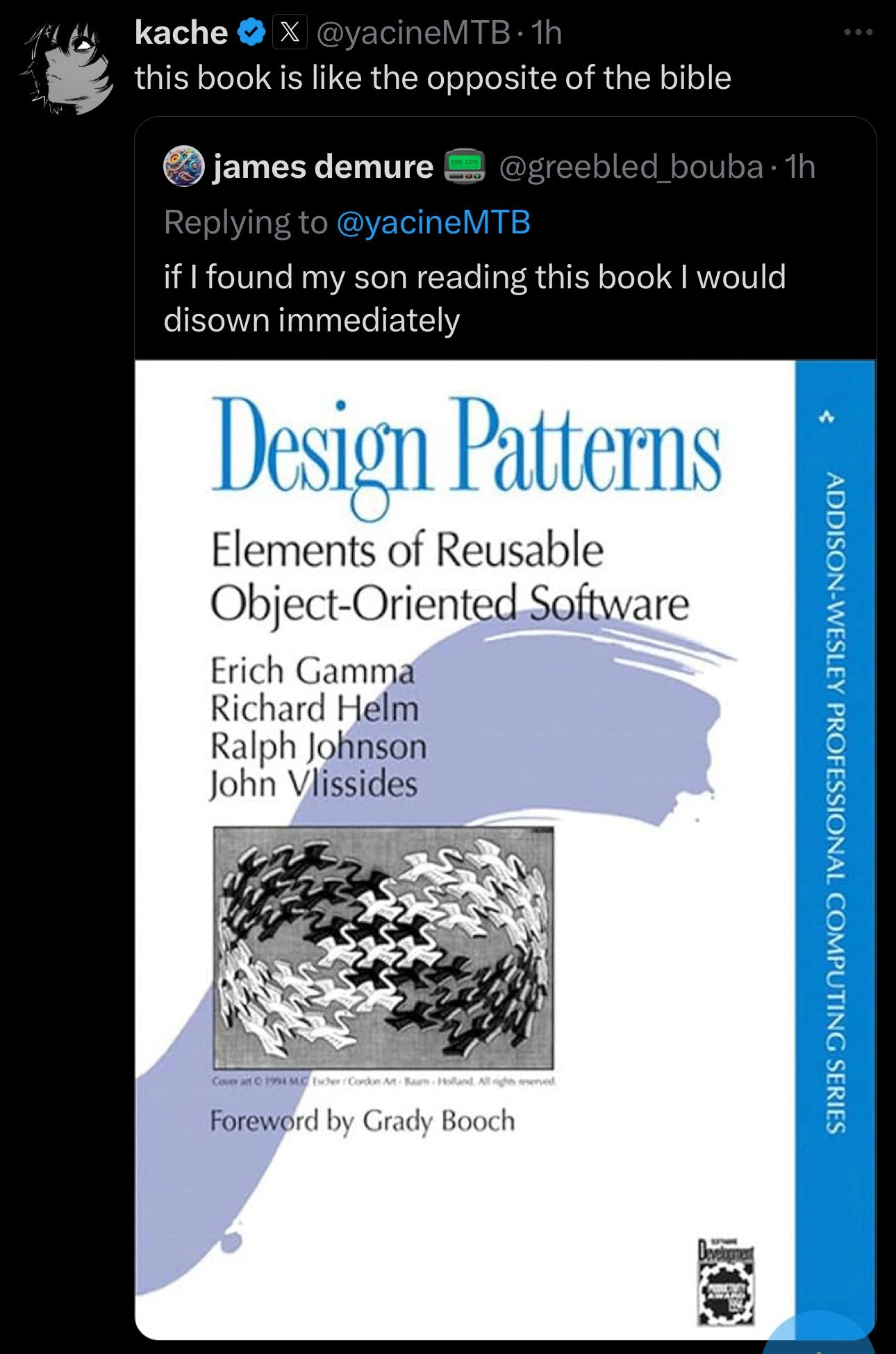
Controversial 'Gang of Four' Design Patterns Book Mocked on Social Media
Why is this DesignPatterns Architecture meme funny?
Level 1: Big Book, Small Problem
Imagine you have a giant, fancy rulebook that tells you very complicated ways to do things. It has all sorts of big ideas – like a huge cookbook with super complex recipes. Now, suppose you want to make a simple sandwich. Instead of just peanut butter and jelly, the book’s recipe says: “First, build a 3-layer kitchen machine, then craft an artisan bread from scratch, then engineer a special knife that spreads exactly 2.5 millimeters of peanut butter…” – absurd, right? If a kid followed such an over-the-top guide for a tiny task, their parent might laugh and say, “Oh no, if you’re really doing all that, I might disown you!” (They don’t mean it seriously; it’s a joking way to say “That’s so ridiculously over-complicated, please don’t do that!”) In the same way, this meme is joking about a famous programming book that can make people over-complicate things. It’s funny because everyone knows a sandwich shouldn’t need a factory or a blueprint to make – and in coding, sometimes people forget the simple way and follow a super fancy book for no good reason. The joke is basically: “Don’t use a huge complex guide for a tiny simple job – that’s just silly!”
Level 2: Meet the Gang-of-Four
Let’s break down what this meme is talking about. The image shows the famous book “Design Patterns: Elements of Reusable Object-Oriented Software.” It’s a textbook from 1994 authored by four software engineers – Erich Gamma, Richard Helm, Ralph Johnson, and John Vlissides. Because four authors wrote it, people often call them the Gang of Four (GoF). This book is a big deal in programming history; it collected and described design patterns for software. A design pattern in programming is like a general, reusable solution to a common problem in software design. It’s not code you copy and paste, but rather a template for how to structure your solution. For example, one well-known pattern is Singleton, which says “hey, if you only ever need one instance of a class (like one single logging object shared everywhere), here’s how to ensure only one is created.” Another pattern, Observer, describes a way for one object to automatically notify many other objects about changes (like how a button click event notifies multiple parts of a GUI). The GoF book covers 23 of these patterns, giving them names and explanations. Because of this, many developers in the late 90s and 2000s treated the book as essential reading – almost like a “must-read” Bible of software architecture. It was part of learning SoftwareArchitecturePatterns: how to make code more flexible, modular, and reusable using tried-and-true formulas.
However, the meme jokes that this book is “the opposite of the Bible.” Why would someone say that? Well, the Bible is often seen as a source of ultimate truth or goodness. Calling the design patterns book the opposite of that suggests they think the book’s influence might be… not so great. The second tweet even says, “If I found my son reading this book I would disown him immediately.” That’s a pretty extreme (and comically exaggerated) negative reaction! This humor comes from a real sentiment among some programmers that pushing these design patterns too much can lead to overcomplicated, unnecessary designs – what we call overengineering. Overengineering means designing a solution that's far more complex than it needs to be for the problem at hand. It’s like building a Rube Goldberg machine (those overly complex contraptions) to pour a glass of water – sure, it works, but wow, it’s overkill.
Over the years, a backlash developed against the overuse of patterns. In practice, some developers would read the GoF book and then try to stuff every pattern somewhere in their code, even when it wasn’t needed. This can result in code that’s harder to read and maintain. For instance, you might see something simple like reading a file turned into an elaborate dance of classes: a FileReaderFactory class to create file readers, an AbstractFileReader interface, multiple ConcreteFileReader subclasses for each file type, and so on – when maybe just one function could have done the job. When someone does this just because “that’s what the design pattern says to do,” it’s often referred to as cargo cult programming (or here cargo_cult_architecture). That term “cargo cult” refers to a phenomenon where people copy behaviors without understanding their purpose, hoping to get the same results. In coding, it means using fancy patterns or code you saw somewhere without truly understanding if it’s necessary, just because you think it’s the “proper” way. The meme is pointing out that treating the GoF book like a strict rulebook can be as misguided as following ritual without reason.
Another phrase in the tags is oop_fetish. This jokingly refers to an almost obsessive love of Object-Oriented Programming (OOP) and its patterns. OOP was the dominant style when the GoF book was written – everything was about classes and objects. An OOP fetishist (in playful terms) might insist on using OOP patterns everywhere, even when a simpler or more modern approach would work better. For example, in some languages today, you might solve a problem with a few lines of functional code (like using a lambda or built-in library function), but an OOP purist might prefer to create several classes because “that’s the OO way.” This sometimes leads to frustratingly complex solutions for simple tasks.
Now, the context is a Twitter thread (dark themed screenshot indicates it’s likely on Twitter’s app or site). Developer Twitter is known for humor and “hot takes.” A hot take is a strongly worded, often controversial opinion, sometimes exaggerated for effect. Here the hot take is that the GoF design patterns book is so bad (in the tweeter’s opinion) that it’s anti-Bible and a disownable offense to read. They’re roasting (making fun of) the book and, indirectly, those who treat it as gospel. This doesn’t mean the book is literally evil or that reading it is bad – many of these Twitter jokes are tongue-in-cheek. It’s more about poking fun at the culture around the book.
To understand the humor, you should know that for a long time, being familiar with design patterns was seen as a hallmark of being a “real” software engineer or architect. People put it on their resumes, interviewers asked about it, and tech talks glorified pattern-heavy designs. After some time, folks realized this sometimes went too far. Not every problem needs a design pattern from the book; sometimes a simple solution with less code is better. There’s a saying, “Keep It Simple, Stupid” (KISS) – a reminder that simplicity is often wiser than clever complexity. If a newbie reads the patterns book and then thinks “I must apply Adapter, Factory, and Singleton in my tiny project,” they might turn a straightforward task into a convoluted mess. Seasoned devs have seen that happen, which is why some of them react dramatically (for comedic effect) to the idea of a young programmer devouring the GoF book as if it’s the only truth.
In summary, this meme is a humorous take on the DevCommunity debate about the value of the GoF design patterns today. On one side, the book is a piece of TechHistory and a source of knowledge – the collective wisdom of the “Gang of Four” that still informs software design. On the other side, if someone treats it like unbreakable doctrine, they might end up with overengineered code. The Twitter comments exaggerate this second viewpoint for laughs. So the top tweet mocks the book’s revered status by calling it the opposite of holy writ, and the reply doubles down by joking about a parental disowning – implying “I so strongly disagree with worshipping that book, I’d consider it a familial betrayal!” It’s all in jest, but it highlights a real sentiment: Don’t just blindly follow old design dogma; use your judgment. After all, times change, and so do best practices.
Level 3: From Gospel to Heresy
Fast forward to today’s developer culture, and the Gang-of-Four book holds a paradoxical status. Older engineers still speak of it in reverent tones – “Have you read the GoF book? It’s the Bible of design.” Many of us became fluent in terms like Decorator, Adapter, or Mediator thanks to this text. Knowing these patterns is still useful: they give names to common structures, making it easier to discuss architecture. Yet, among modern developers (especially on Twitter and other DevCommunities), there’s a backlash against treating these patterns as unquestionable scripture. The tweet in the meme captures this backlash with biting humor:
kache ❌ (@yacineMTB): “this book is like the opposite of the bible”
james demure 🪩 (@greebled_bouba): “if I found my son reading this book I would disown immediately”
Here, dev humor turns reverence on its head. Calling the GoF book “the opposite of the Bible” implies it’s unholy or blasphemous to cling to it now. It’s a playful Twitter hot take (twitter_hot_take): exaggerating to make a point. And the reply about disowning a son reading it is hyperbole that satirizes just how strongly some feel against blind pattern worship. Of course, no one would literally disown their child for reading a programming book – this is IndustrySatire and dark humor. But technically, it’s poking fun at a real tension in software development: pattern catechism vs. pragmatic architecture.
In many real-world codebases, especially those influenced by early Java or enterprise C++, you’ll find instances where developers went pattern-happy. Everything gets an AbstractFactory, every group of classes needs a Manager or Mediator, and a simple task sprawls into a maze of interfaces and indirections. Seasoned devs have seen this and groaned – it’s the classic overengineering scenario. Imagine a simple data record that could be a plain struct or JSON, but instead, someone implements it with a full Builder pattern, a Factory to create it, and maybe a Singleton registry to track instances. The result? Twenty files of code to accomplish what one simple class could do. This is what we call cargo-cult architecture: adopting design elements ritualistically, without a clear need, just because “that’s what the book says” or “that’s what ‘good’ architecture looks like.” The meme’s humor strikes a chord because many developers have battled such over-complicated systems and thought, “Who on earth designed this?! Were they just trying to use every pattern from the book?”
The Gang-of-Four patterns themselves are not bad – in fact, they can be elegant solutions when used in the right context. The key phrase is context and trade-offs. The GoF book painstakingly lists each pattern’s Applicability and Consequences, i.e., when to use it and what downsides it brings. But in the hands of enthusiasts or less experienced devs, patterns sometimes became buzzwords to check off. In the late ’90s and 2000s, job interviews would quiz candidates on “What is the Visitor pattern?” or “Explain Model-View-Controller,” as if reciting these from memory proved one’s competence. This led to a culture where knowing patterns was seen as the mark of an architect, and not knowing them could label you a newbie. Consequently, some developers started using patterns just to prove they could – even when a simpler solution would do. The result: pattern fever – every problem looked like a nail for some hammer in the book. This could yield absurd outcomes, like the notorious Java class name AbstractSingletonProxyFactoryBean (an actual class in Spring framework) which crams three patterns (“Abstract,” “Singleton,” “Factory”) plus “Proxy” and “Bean” into one concept. It’s both comical and painful – an embodiment of OOP_fetish naming. No wonder folks on Twitter joke about burning the “pattern Bible”; they’ve been scarred by encountering this Pattern Pyramid of Babel.
There’s also a generational shift in play. The GoF book is 30 years old – many young devs today weren’t even born when it was written. They come into a world with different tools and philosophies. Functional programming rose in popularity, bringing concepts that often solve problems without OO patterns. Dynamic languages like Python or JavaScript handle many scenarios that once required patterns by using built-in constructs (e.g., functions as first-class citizens eliminate the need for a Strategy class hierarchy). Design patterns also aren’t as hyped in curricula today; instead, there’s more emphasis on composition over inheritance, simple code, and using frameworks that encapsulate patterns so you don’t reinvent them each time. To a generation comfortable with, say, React hooks or microservices, the idea of memorizing the Visitor pattern feels archaic. Thus, the meme is a bit of rebellion – younger devs or just modern-thinking devs thumbing their nose at what they see as over-engineered “Java grandfather” architecture. It’s relatable because who hasn’t opened an old project and felt like they needed a Rosetta Stone to decipher layers of pattern indirection?
At the same time, experienced engineers see the nuance: the Design Patterns book is full of wisdom when applied judiciously. But the humor here arises from relatability to the worst-case scenario of pattern abuse. It’s essentially saying: “This book, if worshipped dogmatically, leads to madness.” The Bible reference is especially apt in mocking tone – the GoF book had been treated like gospel; now devs jest that it’s actually the devil’s scripture because of how badly its teachings can be misused. This is classic IndustrySatire: exaggerating a real concern (overengineering) to get laughs and nods of agreement. The subtext behind “I’d disown my son for reading it” is that we don’t want the next generation to repeat the mistakes. Seasoned developers who lived through the J2EE design pattern craze joke darkly to warn others away from that path. There’s a bit of catharsis in it too – publicly roasting the sacred cows of tech (like the GoF book) can be liberating, a way of saying “we’ve moved on, we’ve learned from this.”
To sum up the senior perspective: the meme is funny because it rings true. The Design Patterns book, once a treasured holy text of architecture, has in some circles become a cautionary tale. The humor lands because it’s over the top yet rooted in genuine experience: treat any book like infallible dogma and you’ll end up with absurd results. In real engineering, pragmatism beats catechism – understanding when to use a pattern (and when not to) is more important than blindly following it. Or in meme-speak: don’t turn every coding problem into an excuse to build a cathedral of abstract factories. Sometimes a simple hut will do, and that doesn’t make you a heathen — it makes you practical.
Level 4: Genesis of Patterns
In the beginning (of the 1990s), there was a quest for reusable software architecture. The legendary Gang of Four (GoF) – Erich Gamma, Richard Helm, Ralph Johnson, and John Vlissides – published Design Patterns: Elements of Reusable Object-Oriented Software in 1994, a time when Object-Oriented programming (OOP) was ascendant. This book cataloged 23 classic SoftwareArchitecturePatterns – proven design solutions to common problems in OOP design. The GoF didn’t invent these patterns from thin air; they observed recurring solutions in successful systems (mostly in C++ and Smalltalk) and gave them names like Singleton, Factory, Observer, and Visitor. By documenting a “pattern language” for software, they created a shared vocabulary for architects to discuss program design at a higher level than raw code. It was a landmark in TechHistory: engineers finally had a catalog of best practices, a bit like an architectural canon for coding.
The idea of a “pattern” itself was inspired by architect Christopher Alexander, who wrote about design patterns in buildings and towns. Software’s DesignPatterns movement adopted that philosophy: each pattern has a name, a problem description, a solution template, and consequences (trade-offs). It was an effort to turn craft knowledge into teachable science. Patterns were meant to capture architectural trade-offs (as hinted by the tag ArchitecturalTradeoffs) – they weren’t one-size-fits-all rules, but if you had, say, many kinds of objects needing different creation logic, a Factory Method pattern could abstract that. If you needed a single global instance coordinating things, the Singleton pattern was a known solution (with known downsides). The GoF book became an instant classic, revered and colloquially called “the Bible of Object-Oriented Design.” Its white-and-blue cover, with Escher’s tessellated lizards artwork, became iconic on office shelves. A foreword by Grady Booch (an OOP pioneer) anointed it further – this was the holy scripture of software design for a generation of developers.
However, the seeds of pattern dogma were also planted. Academically inclined programmers like Peter Norvig pointed out that some GoF patterns are workarounds for limitations in languages. For example, the Strategy pattern (choosing an algorithm at runtime) is trivial in languages with first-class functions (just pass a function!), and the Iterator pattern is built into modern languages as for...of loops or generators. In fact, Norvig showed that many of the 23 patterns become either moot or simpler in dynamic or functional languages. This highlights a deep truth: design patterns are very context-dependent. The GoF patterns assumed languages without features like lambdas, multimethods, or powerful metaprogramming. As languages evolved (introducing generics, lambdas, modules), some patterns became less essential or turned into language features. Thus, what was canon in 1994 could turn into cliché by 2010. This evolution illustrates how SoftwareArchitecture ideas aren’t eternal truths carved in stone but live in a context of tools and languages. The Gang of Four book was a product of its time – deeply influential, yet also destined to be re-evaluated as technology progressed.
Crucially, the GoF never intended their patterns to be blindly worshipped. A pattern is a double-edged sword: use it when it fits, but beware the costs. For instance, the Observer pattern beautifully decouples subjects and observers for event notification (the basis of modern event emitters), but if misused it can create confusing webs of updates. The Singleton gives a single global point of access – but overuse it and you basically have global variables (hard to test, order-dependent, a potential anti-pattern today). The book itself warns that overusing patterns can lead to complexity. Yet, despite these caveats, the community elevation of this book to “Bible” status led to a kind of pattern orthodoxy: some practitioners began treating the 23 patterns as articles of faith to apply everywhere. This is where things took a turn from science to scripture. The meme’s joke about the book being “the opposite of the Bible” is riffing on exactly this journey – how a text once seen as gospel can become viewed as heretical in modern practice. In a sense, the Design Patterns book underwent a canonization and subsequent reformation: from celebrated wisdom to, decades later, a subject of playful dev community scorn.
Description
A screenshot of a Twitter/X thread discussing the seminal software engineering book, 'Design Patterns: Elements of Reusable Object-Oriented Software' by the 'Gang of Four' (Gamma, Helm, Johnson, Vlissides). One user, James Demure, comments, 'if I found my son reading this book I would disown immediately.' Another user, Kache, adds, 'this book is like the opposite of the bible.' The image centers on the book's cover, which features its full title and authors, a Foreword by Grady Booch, and an M.C. Escher-style artwork of interlocking bird-like creatures. The technical context is the contentious legacy of the GoF book; while foundational for object-oriented design, its patterns are often criticized in modern software development for leading to over-engineering or being overly prescriptive. The hyperbolic reactions in the tweets satirize the dogmatic application or rejection of these classic patterns, a debate well-known to experienced engineers

Comments
14Comment deleted
The Gang of Four book taught us all the patterns for writing reusable software, but the most-used pattern it inspired was 'Copy-Paste Singleton' into a god object
Parents worry about bad influences; architects worry their kids will re-implement a Singleton-Factory-Facade pipeline after reading this
Twenty years later, you're still maintaining the AbstractSingletonProxyFactoryBean your son wrote after reading this, wondering if disowning him would've been less painful than debugging his enterprise-grade FizzBuzz implementation
The irony here cuts deep: the Gang of Four's Design Patterns book is simultaneously the most recommended and most misapplied text in software engineering. Every senior architect has witnessed the carnage of junior developers discovering AbstractFactoryBuilderSingletonObserverStrategyProxyDecoratorAdapterFacade patterns and applying them with religious fervor to a simple CRUD app. The 'disown immediately' reaction perfectly captures that moment when you realize someone has weaponized the GoF book without understanding that patterns are descriptive, not prescriptive - and that sometimes, a simple function is not a code smell requiring seventeen layers of abstraction. It's the software equivalent of giving someone a hammer and watching them conclude that everything, including their career, is a nail
The book isn’t the problem; it’s the phase where someone reads Chapter 1 and your PR shows up with AbstractFactoryFactory, a Singleton registry, and a Visitor where an if would do - true Elements of Reusable Postmortems
Gift a junior the GoF book and you’ll wake up to an AbstractFactoryFactory, three Singletons, and a 300‑line interface “for extensibility” - great vocabulary, catastrophic coupling
GoF: Where singletons were born, ensuring your app's state outlives the universe - disownment for preventing that legacy
I do have this book in reading list... Is there anyone who actually finished it? How does it feel? Comment deleted
It feels like being a goose farmer is a better career choice. Comment deleted
I have read it, but believe it or not, it makes you look like a script kiddie.😂 Comment deleted
this kills the javascript kiddie Comment deleted
"One who believes all of a book would be better off without books" ~ Mencius Comment deleted
В чем прикол этой книги? Comment deleted
Elbib Comment deleted